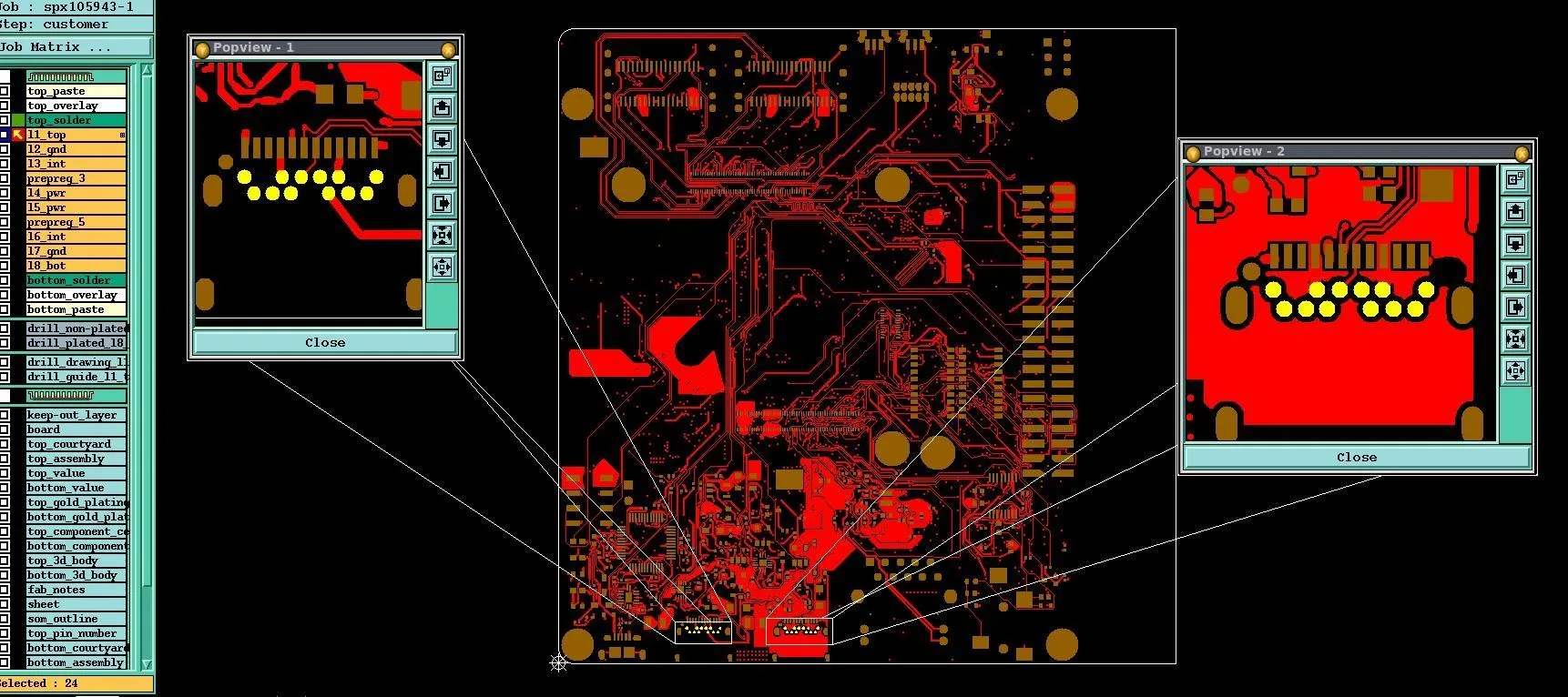





Via-in-Pad
What Is Via-in-Pad?
Via-in-pad is a PCB design technique where vias are placed directly inside surface mount component pads rather than being routed to a separate via location nearby. This approach eliminates the need for a trace (dog-bone) between the pad and the via, saving valuable routing space and reducing trace stub lengths that can degrade signal integrity at high frequencies. Via-in-pad is commonly used under fine-pitch BGA packages, for thermal pad connections on exposed-pad components, and in any design where minimizing trace length between a component pin and an inner-layer connection is critical.
Via-in-pad requires that the via be filled with conductive or non-conductive epoxy and then planarized (capped and flattened) to create a smooth, solderable surface. Without proper filling and planarization, solder can wick down into the via barrel during reflow, causing solder voids, insufficient solder joints, or solder balls on the opposite side of the board. This additional manufacturing step increases fabrication cost, but the routing density and signal integrity benefits often justify the expense for high-performance designs.
Via-in-Pad Strategy in Automated Layout
The decision to use via-in-pad involves tradeoffs between signal performance, routing density, and manufacturing cost that must be evaluated on a per-component and per-net basis. Physics-driven AI layout engines can selectively apply via-in-pad where it provides meaningful signal integrity or density benefits — such as under fine-pitch BGAs or for high-speed differential pairs — while using conventional dog-bone patterns elsewhere to minimize unnecessary manufacturing cost. This context-aware via strategy optimization is difficult to achieve consistently in manual layout, where designers often apply a blanket approach to via style across the entire board.