



Hardware Rich Development

Published

Written by

Workbench

Learning as a Discipline, Engineering as a Craft | Quilter’s Osman Romero

Published

February 17, 2026

A Humans in the Loop profile

When Osman Romero talks about his career, the through-line is not prestige or titles. It is learning. Learning as persistence. Learning as humility. Learning as something you do with your hands, your curiosity, and sometimes with your kids at the kitchen table. That posture, more than any résumé bullet, is what makes Osman feel at home at Quilter.

Osman is a software engineer with roughly eighteen years of experience, originally from the north of Chile. He moved to the United States in 2015 after years of traveling to the Bay Area for consulting work. What was meant to be a two-year stint quietly became a decade. “The plan was to come to the states for only two years,” he says, “and 10 years later, here I am.” That openness to unexpected paths shows up everywhere in his story, from how he found programming to why he chose Quilter.

The Humans in the Loop series exists to surface exactly these stories. Quilter’s technology is ambitious, but the company is built by people who approach hard problems with patience, rigor, and a willingness to keep learning long after expertise sets in. Osman’s journey is a clear example of that ethos in practice.
Origins: Art, Curiosity, and a Very Expensive Computer

Osman did not begin with a straight line into engineering. In high school, he describes himself as “completely lost.” He attended an art school, spent time drawing and painting, and thought seriously about becoming an architect. That path ultimately did not materialize, but the sensibility stuck. Creativity was never something he shed. It simply changed form.

A pivotal moment came in 1995, when his mother bought him a computer that, by his own description, was “super expensive.” He used it for nearly eight years. With it came video games, and soon after, programming. “The moment I learned how to program, that was the first thing I did,” he recalls. He started with Pascal and assembly, building simple ASCII-based games. “It was the best time of my life.”

Those early experiments mattered because they framed software not as abstraction, but as something tactile and playful. Programming was not homework. It was making something move, respond, and behave. That orientation toward building, rather than merely studying, would follow him throughout his career.

Becoming an Engineer by Doing the Work

Osman’s transition into formal computer science was catalyzed by a professor who noticed his side projects. That professor connected him with a more advanced student who pushed him to get serious. “He told me, like, hey, no joking around. You have to learn C.” Osman did. They worked on a project called Merc, hosted on SourceForge before Git was commonplace. It was an early taste of real collaboration and real constraints.

Over time, passion projects gave way to professional demands. After joining SpaceX, free time evaporated. “After I joined SpaceX, you barely have any time for passion projects,” he says plainly. But even then, curiosity did not disappear. It shifted.

One of the most revealing moments in the interview comes when Osman describes working on the Swarm satellite program. Swarm deployed around 160 CubeSats, and Osman was part of that effort. Years later, his son designed and built a stand for one of those satellites. “He put most of the parts together and, yeah, it runs,” Osman says, clearly proud. “That’s like my passion project.”

Teaching his son Python through small tools like CodeCombat, building Arduino cars together, and watching his child develop an instinct for solving problems became an extension of Osman’s engineering life. Learning was no longer solitary. It was shared.

Perspective Shaped by Migration

Osman’s view of engineering culture is deeply shaped by his experience moving from Chile to the United States. He speaks candidly about how difficult it can be to pivot careers in more rigid systems. “In Chile, if you pursue one career, you’re basically stuck on that,” he explains. Hiring managers rarely take risks on unconventional backgrounds.

By contrast, what struck him in the U.S. was the permeability between disciplines. He has worked with people who moved from psychology to UX, and even with a lawyer who became a coder. “To me that’s the beauty,” he says. “Meritocracy is like for real in the sense of like, okay, you say you can do this, show it to me, and they’ll give you that shot.”

That belief shows up later in how he evaluates companies. Osman is not interested in environments that posture expertise without curiosity. He values places where learning is ongoing and visible.

Why Quilter: Substance Over Hype

Osman joined Quilter only shortly before this interview, but his reasons for choosing the company are already sharply articulated. He describes his first weeks working on the application layer, touching both frontend and backend, and orienting himself inside the codebase. Beyond that, what excites him is the opportunity to improve how teams work. “There’s definitely always things that you can do that can make our life easier and make us move faster,” he says, pointing to deployment automation and release workflows.

But the deeper pull is Quilter’s technical stance. Osman is explicit about what differentiated the company for him. “They’re not on the AI hype because everyone is writing an LLM wrapper to provide another SaaS service,” he explains. “In this case, old school reinforcement learning to solve a very hard problem.”

That distinction matters. Quilter’s use of reinforcement learning, grounded in physics and real constraints, signals seriousness. For Osman, it was “one of the main drivers” behind joining. The problem itself, not its marketability, was the attraction.

He also notes the culture around the AI team. Many members come from academic backgrounds and are comfortable teaching. That matters to someone who approaches learning as an ongoing practice rather than a checkbox.

Beyond the Workbench

Outside of work, Osman is refreshingly specific. He plays soccer every Tuesday with a group intentionally skewed older to avoid injuries. “I’m a defender,” he says with a laugh. “I’m the guy who kicks the forwards. And I’m very nasty too.”

He also skateboards, though more carefully now. Skateboarding, in fact, played an unexpected role in his life. Through it, he learned English by spending time with American, Canadian, and Australian kids in Chile during the late 1990s. “I learned English thanks to skateboarding,” he says. “Through that I met my wife and everything. So yeah, I owe a lot to skateboarding.”

Food matters too. Asked what meal he could eat forever, Osman does not hesitate. “Ceviche. The Peruvian style ceviche.” He speaks with reverence about the ingredients, the corn varieties, the spices, and the difficulty of recreating it properly outside Peru. “This is coming from a Chilean,” he adds, acknowledging the rivalry. “Their food kicks ass.”

A Line to Remember

Near the end of the conversation, Osman is asked for a motto. He pauses, then answers simply: “Anything can be learned.” He qualifies it carefully. Learning may be harder for some than others, and unlearning is rare. “You can only improve on top of them,” he says. “But you cannot unlearn.”

That statement encapsulates both his humility and his confidence. It explains why he is drawn to complex systems, why he values teaching, and why Quilter feels like the right place at this moment in his career.

Closing Reflection

What stands out about Osman Romero is not just his experience, but his posture. He does not position himself as finished. He positions himself as engaged. In a company tackling one of the hardest problems in hardware design, that mindset matters. Quilter’s ambition requires engineers who are comfortable saying, I don’t know yet, but I can learn. Osman lives that principle every day.

Try Quilter for Yourself

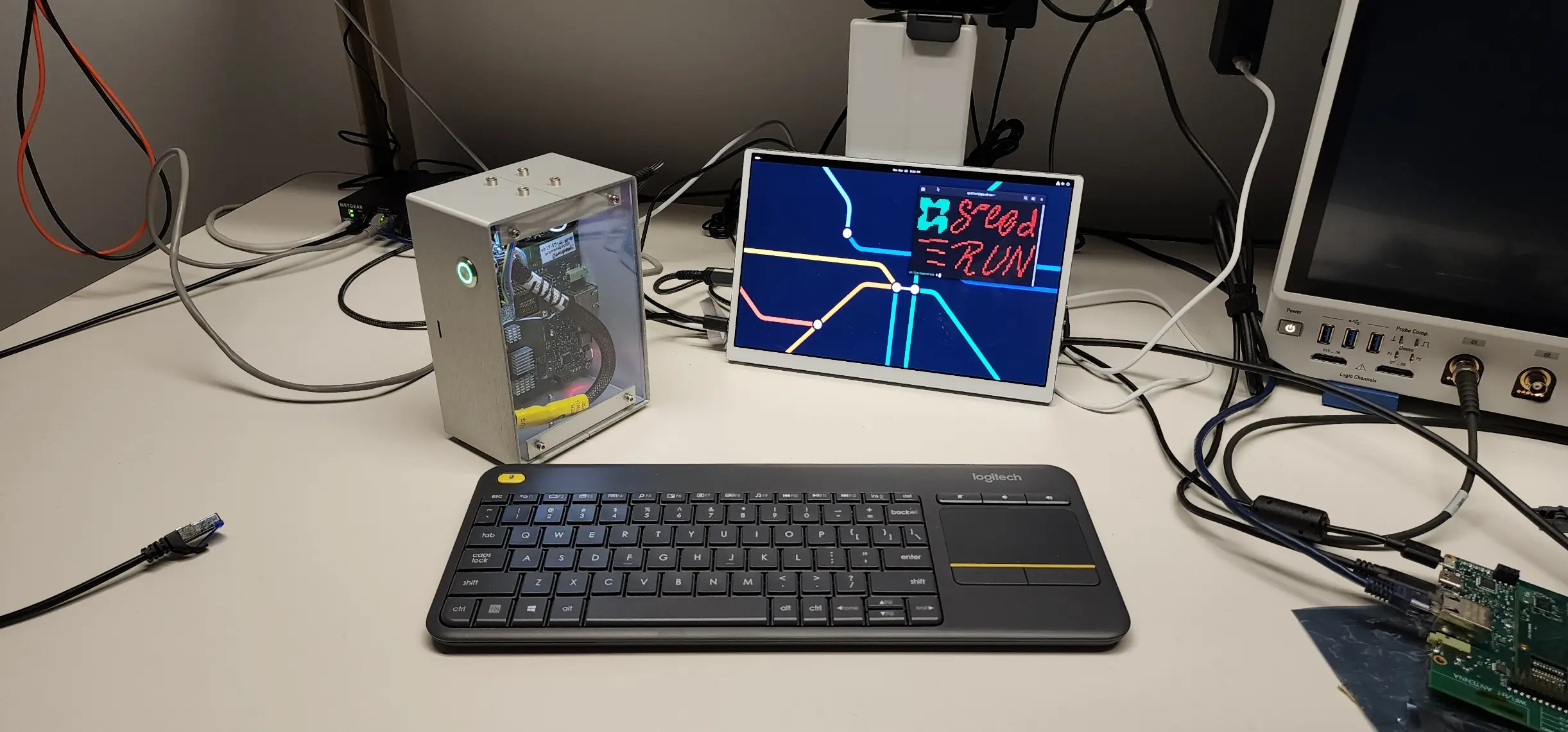
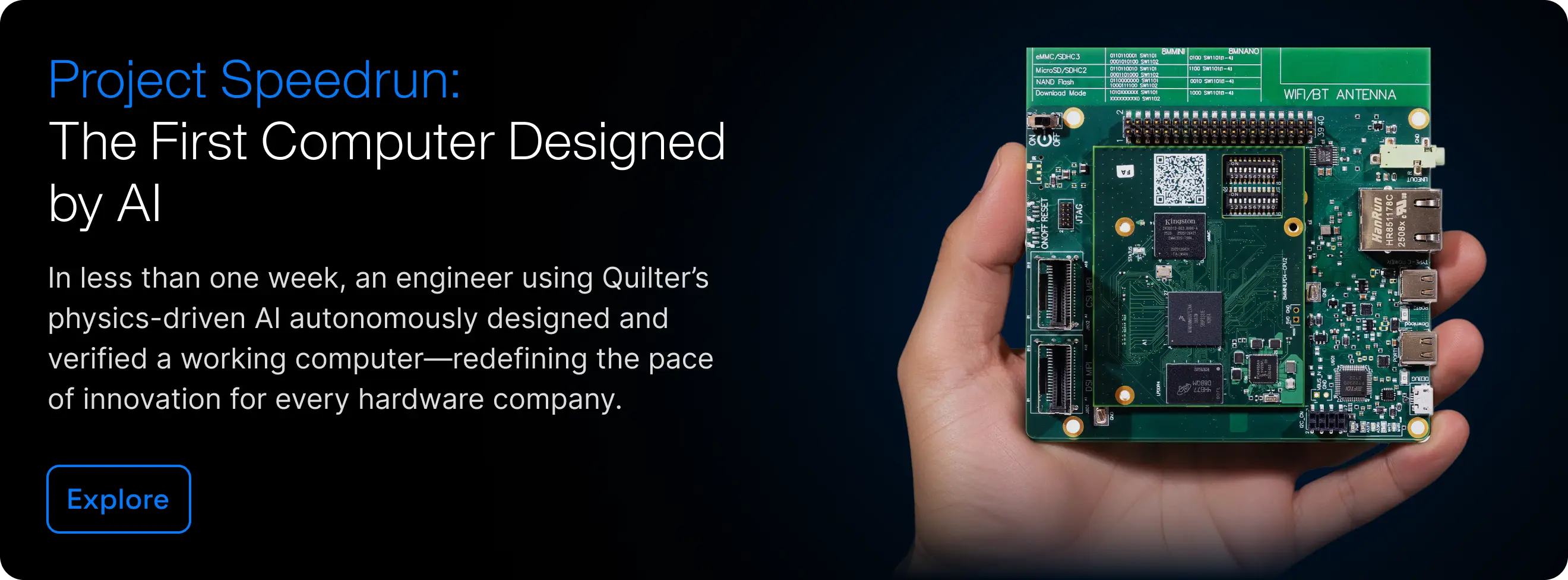
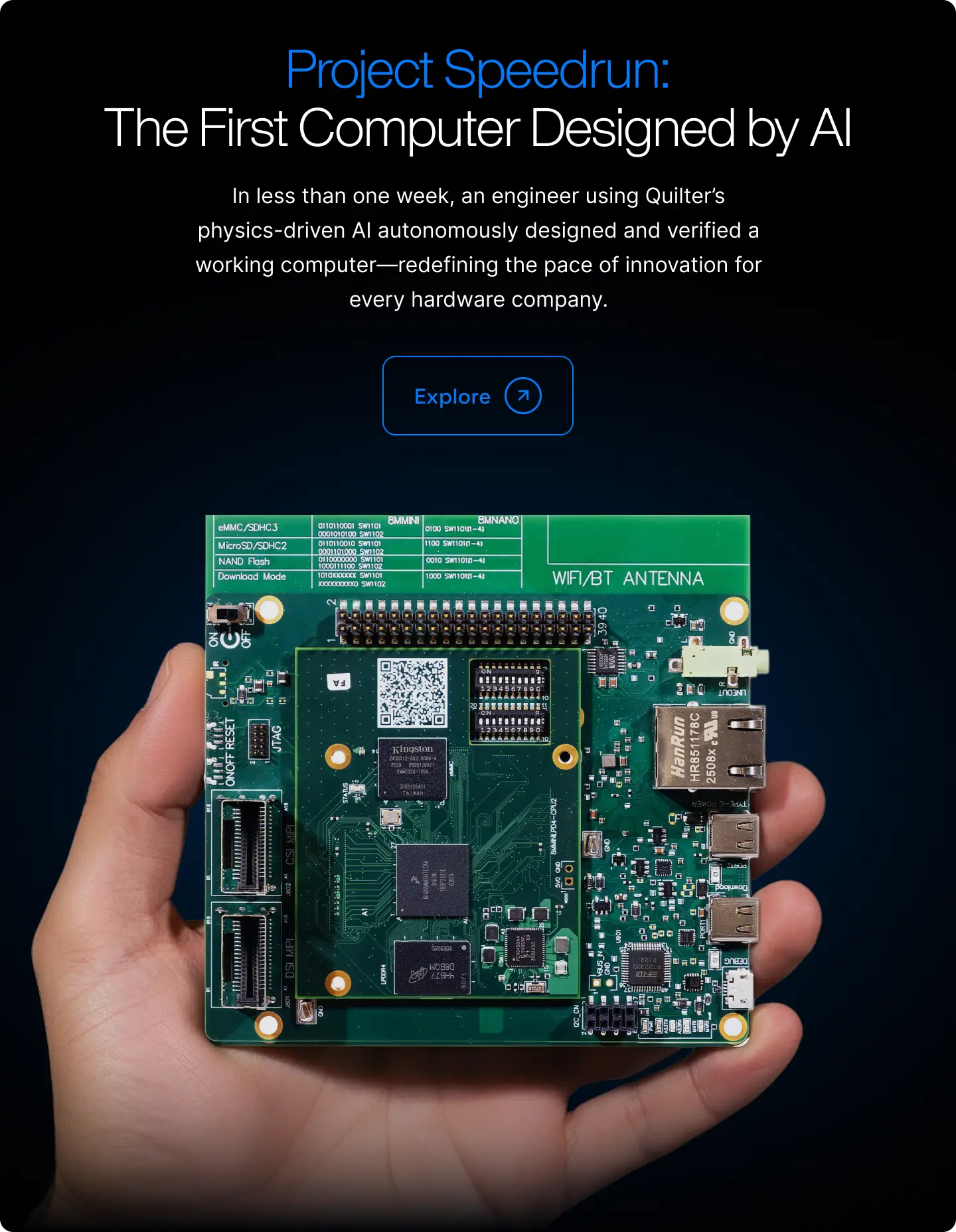
Project Speedrun demonstrated what autonomous layout looks like in practice and the time compression Quilter enables. Now, see it on your own hardware.

Get Started

Validating the Design

With cleanup complete, the final question is whether the hardware works. Power-on is where most electrical mistakes reveal themselves, and it’s the moment engineers are both nervous and excited about.

Continue to Part 4

Cleaning Up the Design

Autonomous layout produces a complete, DRC'd design; cleanup is a brief precision pass to finalize it for fabrication.

Continue to Part 3

Compiling the Design

Once the design is prepared, the next step is handing it off to Quilter. In traditional workflows, this is where an engineer meets with a layout specialist to clarify intent. Quilter replaces that meeting with circuit comprehension: you upload the project, review how constraints are interpreted, and submit the job.

Continue to Part 2

Learning as a Discipline, Engineering as a Craft | Quilter’s Osman Romero

February 17, 2026
by
Cody Stetzel
and

A Humans in the Loop profile

When Osman Romero talks about his career, the through-line is not prestige or titles. It is learning. Learning as persistence. Learning as humility. Learning as something you do with your hands, your curiosity, and sometimes with your kids at the kitchen table. That posture, more than any résumé bullet, is what makes Osman feel at home at Quilter.

Osman is a software engineer with roughly eighteen years of experience, originally from the north of Chile. He moved to the United States in 2015 after years of traveling to the Bay Area for consulting work. What was meant to be a two-year stint quietly became a decade. “The plan was to come to the states for only two years,” he says, “and 10 years later, here I am.” That openness to unexpected paths shows up everywhere in his story, from how he found programming to why he chose Quilter.

The Humans in the Loop series exists to surface exactly these stories. Quilter’s technology is ambitious, but the company is built by people who approach hard problems with patience, rigor, and a willingness to keep learning long after expertise sets in. Osman’s journey is a clear example of that ethos in practice.

Origins: Art, Curiosity, and a Very Expensive Computer

Osman did not begin with a straight line into engineering. In high school, he describes himself as “completely lost.” He attended an art school, spent time drawing and painting, and thought seriously about becoming an architect. That path ultimately did not materialize, but the sensibility stuck. Creativity was never something he shed. It simply changed form.

A pivotal moment came in 1995, when his mother bought him a computer that, by his own description, was “super expensive.” He used it for nearly eight years. With it came video games, and soon after, programming. “The moment I learned how to program, that was the first thing I did,” he recalls. He started with Pascal and assembly, building simple ASCII-based games. “It was the best time of my life.”

Those early experiments mattered because they framed software not as abstraction, but as something tactile and playful. Programming was not homework. It was making something move, respond, and behave. That orientation toward building, rather than merely studying, would follow him throughout his career.

Becoming an Engineer by Doing the Work

Osman’s transition into formal computer science was catalyzed by a professor who noticed his side projects. That professor connected him with a more advanced student who pushed him to get serious. “He told me, like, hey, no joking around. You have to learn C.” Osman did. They worked on a project called Merc, hosted on SourceForge before Git was commonplace. It was an early taste of real collaboration and real constraints.

Over time, passion projects gave way to professional demands. After joining SpaceX, free time evaporated. “After I joined SpaceX, you barely have any time for passion projects,” he says plainly. But even then, curiosity did not disappear. It shifted.

One of the most revealing moments in the interview comes when Osman describes working on the Swarm satellite program. Swarm deployed around 160 CubeSats, and Osman was part of that effort. Years later, his son designed and built a stand for one of those satellites. “He put most of the parts together and, yeah, it runs,” Osman says, clearly proud. “That’s like my passion project.”

Teaching his son Python through small tools like CodeCombat, building Arduino cars together, and watching his child develop an instinct for solving problems became an extension of Osman’s engineering life. Learning was no longer solitary. It was shared.

Perspective Shaped by Migration

Osman’s view of engineering culture is deeply shaped by his experience moving from Chile to the United States. He speaks candidly about how difficult it can be to pivot careers in more rigid systems. “In Chile, if you pursue one career, you’re basically stuck on that,” he explains. Hiring managers rarely take risks on unconventional backgrounds.

By contrast, what struck him in the U.S. was the permeability between disciplines. He has worked with people who moved from psychology to UX, and even with a lawyer who became a coder. “To me that’s the beauty,” he says. “Meritocracy is like for real in the sense of like, okay, you say you can do this, show it to me, and they’ll give you that shot.”

That belief shows up later in how he evaluates companies. Osman is not interested in environments that posture expertise without curiosity. He values places where learning is ongoing and visible.

Why Quilter: Substance Over Hype

Osman joined Quilter only shortly before this interview, but his reasons for choosing the company are already sharply articulated. He describes his first weeks working on the application layer, touching both frontend and backend, and orienting himself inside the codebase. Beyond that, what excites him is the opportunity to improve how teams work. “There’s definitely always things that you can do that can make our life easier and make us move faster,” he says, pointing to deployment automation and release workflows.

But the deeper pull is Quilter’s technical stance. Osman is explicit about what differentiated the company for him. “They’re not on the AI hype because everyone is writing an LLM wrapper to provide another SaaS service,” he explains. “In this case, old school reinforcement learning to solve a very hard problem.”

That distinction matters. Quilter’s use of reinforcement learning, grounded in physics and real constraints, signals seriousness. For Osman, it was “one of the main drivers” behind joining. The problem itself, not its marketability, was the attraction.

He also notes the culture around the AI team. Many members come from academic backgrounds and are comfortable teaching. That matters to someone who approaches learning as an ongoing practice rather than a checkbox.

Beyond the Workbench

Outside of work, Osman is refreshingly specific. He plays soccer every Tuesday with a group intentionally skewed older to avoid injuries. “I’m a defender,” he says with a laugh. “I’m the guy who kicks the forwards. And I’m very nasty too.”

He also skateboards, though more carefully now. Skateboarding, in fact, played an unexpected role in his life. Through it, he learned English by spending time with American, Canadian, and Australian kids in Chile during the late 1990s. “I learned English thanks to skateboarding,” he says. “Through that I met my wife and everything. So yeah, I owe a lot to skateboarding.”

Food matters too. Asked what meal he could eat forever, Osman does not hesitate. “Ceviche. The Peruvian style ceviche.” He speaks with reverence about the ingredients, the corn varieties, the spices, and the difficulty of recreating it properly outside Peru. “This is coming from a Chilean,” he adds, acknowledging the rivalry. “Their food kicks ass.”

A Line to Remember

Near the end of the conversation, Osman is asked for a motto. He pauses, then answers simply: “Anything can be learned.” He qualifies it carefully. Learning may be harder for some than others, and unlearning is rare. “You can only improve on top of them,” he says. “But you cannot unlearn.”

That statement encapsulates both his humility and his confidence. It explains why he is drawn to complex systems, why he values teaching, and why Quilter feels like the right place at this moment in his career.

Closing Reflection

What stands out about Osman Romero is not just his experience, but his posture. He does not position himself as finished. He positions himself as engaged. In a company tackling one of the hardest problems in hardware design, that mindset matters. Quilter’s ambition requires engineers who are comfortable saying, I don’t know yet, but I can learn. Osman lives that principle every day.