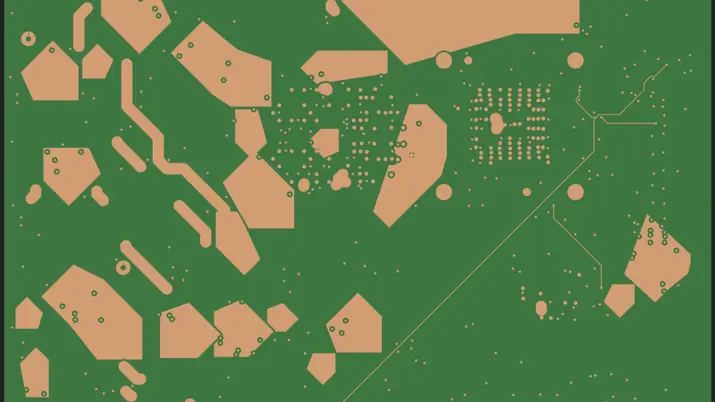





Routing Density
What Is Routing Density?
Routing density is a measure of how much of a PCB's available routing space is occupied by copper traces, expressed as a percentage or as trace length per unit area. High routing density indicates that the board is approaching the limits of its routing capacity, with most available channels occupied by traces. Understanding routing density is essential for making early-stage decisions about board size, layer count, and component placement — a design that exceeds 100% routing density on the available layers simply cannot be completed without adding layers, increasing board size, or changing the via strategy.
Several factors determine the achievable routing density for a given design: the number of signal layers in the stackup, minimum trace width and spacing allowed by the fabrication process, via size and drill-to-copper clearances, component placement density, and the complexity of the netlist (total number of connections and their topological relationships). Designs with dense BGA packages, numerous differential pairs, and strict impedance requirements consume routing resources faster than designs with simpler connectivity patterns. Estimating routing density accurately before committing to a board size and stackup is one of the most valuable skills in PCB design.
AI-Driven Routing Density Optimization
One of the most powerful capabilities of physics-driven AI layout tools is the ability to generate complete routing across multiple stackup configurations, providing actual routing density data rather than estimates. Engineers can compare how routing density varies across different layer counts, board sizes, and via strategies — making board size and stackup decisions based on real routed designs rather than rules of thumb. This data-driven approach to density management eliminates the uncertainty that traditionally surrounds the question of whether a design will fit on a given board, reducing the risk of mid-project stackup changes that waste time and money.