







Read the Full Series
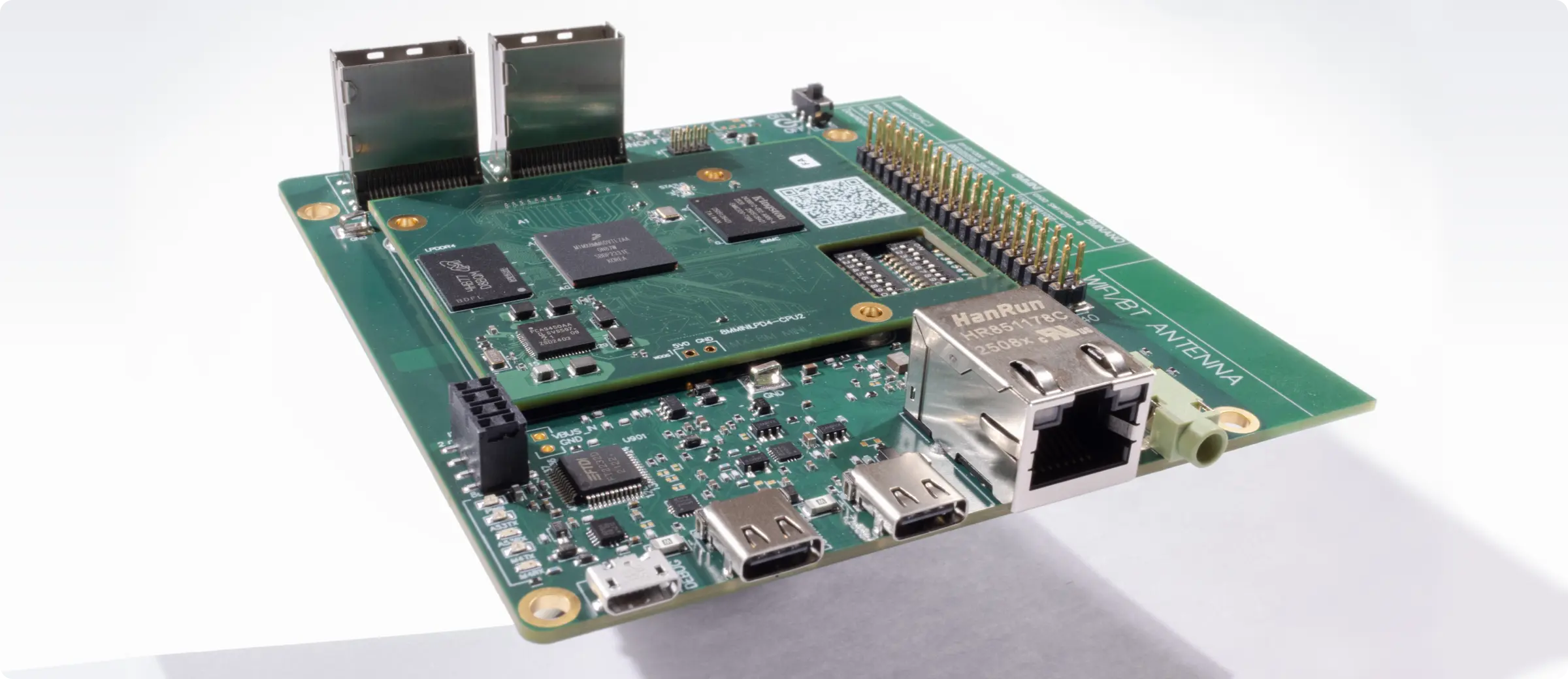
This article is one part of a walkthrough detailing how we recreated an NXP i.MX 8M Mini–based computer using Quilter’s physics-driven layout automation.
Modern PCB applications are becoming too dense, too fast, and too physically constrained for layout to remain a purely manual exercise. Complex boards now carry high-speed signals, compact power systems, RF behavior, embedded compute, mechanical keepouts, thermal limits, and manufacturing rules inside the same physical object. Engineers still make the decisive judgments, but the search space around those judgments has become enormous. Automated PCB layout matters because it can help hardware teams explore more possible designs without pretending that engineering judgment has become optional. This argument belongs naturally inside Quilter’s Hardware Rich Development series because it treats automation as an extension of engineering craft, not a replacement for it.
Across conversations with Quilter engineers Ben, Fayaz, and Dan, a sharper argument emerges about the future of pcb layout. Useful automation does not replace the engineer. Serious automation makes constraints visible, searchable, and testable. PCB design and layout has always been a negotiation between intent and physics, and better tools should help engineers make that negotiation faster, more explicit, and more repeatable. For teams evaluating PCB applications in advanced products, the real question is not whether a tool can draw traces; the real question is whether it can reason through the constraints that make traces matter.
Why PCB Applications Begin in the Physical World
Ben’s origin story starts with a bench-level moment: “The first time I saw an LED light up, I was hooked.” Small physical feedback like that explains why PCB designing feels different from purely digital work. A board either powers up or refuses to. A signal either behaves on the scope or exposes a hidden flaw in impedance, return path, grounding, or component placement. Copper, dielectric, vias, connectors, and planes turn design intent into physical evidence.
Dan’s path reinforces the same physical foundation from a different angle. Extra coursework in microwave electromagnetics pulled him toward the world where fields, parasitics, radiation, and coupling dominate design behavior. High-frequency work makes the board feel less like a drawing and more like a physical instrument. Trace geometry, layer transitions, reference planes, spacing, and discontinuities all shape what the circuit becomes. Quilter’s broader discussion of signal integrity discipline makes the same point from another expert angle: advanced PCB applications require layout tools that understand more than connectivity.
Why PCB Is Not Silicon
Ben names one of the clearest reasons PCB automation cannot simply borrow from semiconductor routing: “No one was really able to successfully apply those [semiconductor routing] algorithms to PCB design… in a PCB a via is almost always larger than the trace going into it.” Board-level geometry changes the problem from the start. A via on a PCB is not a tiny abstract transition between layers. It consumes meaningful space, changes routing options, affects signal behavior, and can create discontinuities or manufacturing concerns. Algorithmic assumptions that work at chip scale often break once copper, holes, planes, and assembly constraints enter the board.
PCB design constraints multiply because boards sit at the intersection of electronics and physical product design. Connector locations, mounting holes, enclosure limits, keepouts, stackups, impedance targets, differential-pair requirements, power pours, thermal zones, and assembly tolerances all compete for the same space. A route that solves one net can block another. A via that saves one escape path can damage a return path. Automated PCB layout becomes valuable only when it reasons across these interactions rather than treating routing as a simple pathfinding exercise. This is also where design for reliability and manufacturability becomes part of layout, not a separate downstream concern.
Physics in the Loop Is the Core Requirement
Ben’s phrase “We’re actually using reinforcement learning and putting physics in the loop” should sit near the center of Quilter’s point of view. Many AI design conversations focus on generation: can a system produce a layout, draw traces, or create something that resembles a finished board? Hardware teams need a harder question answered first. Can the system evaluate whether the board is physically credible? Without grounded evaluation, generation becomes visual pattern-making rather than engineering.
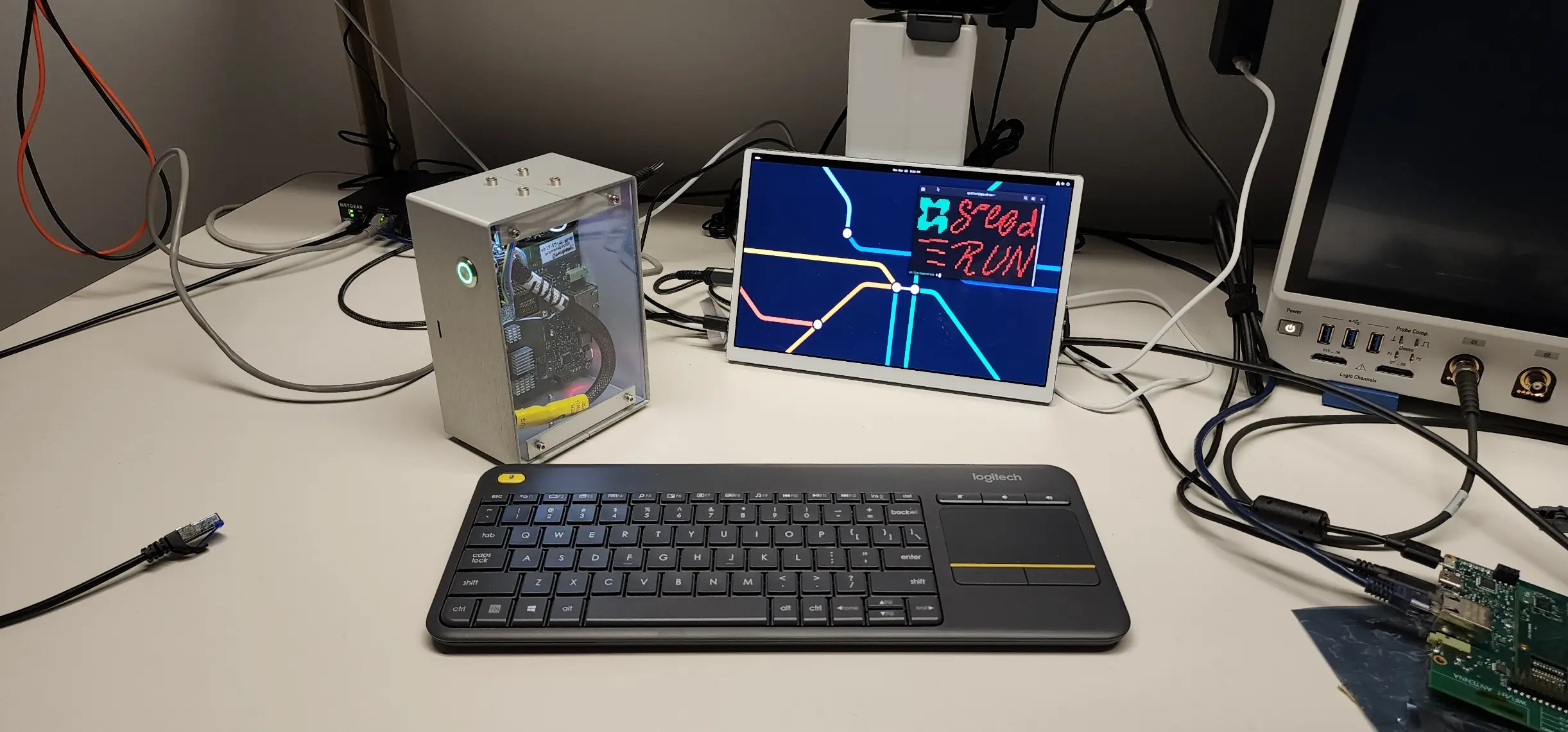
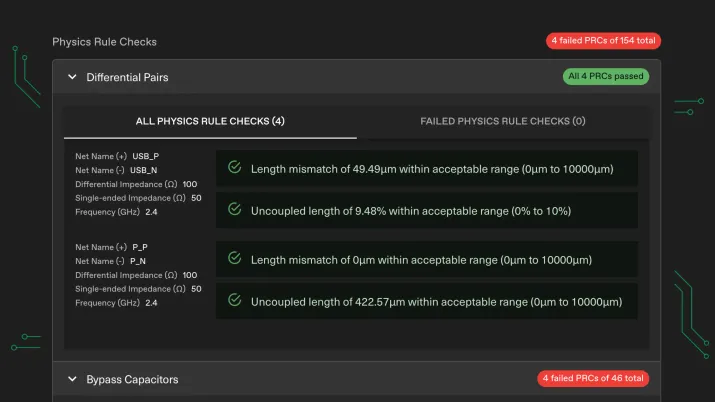
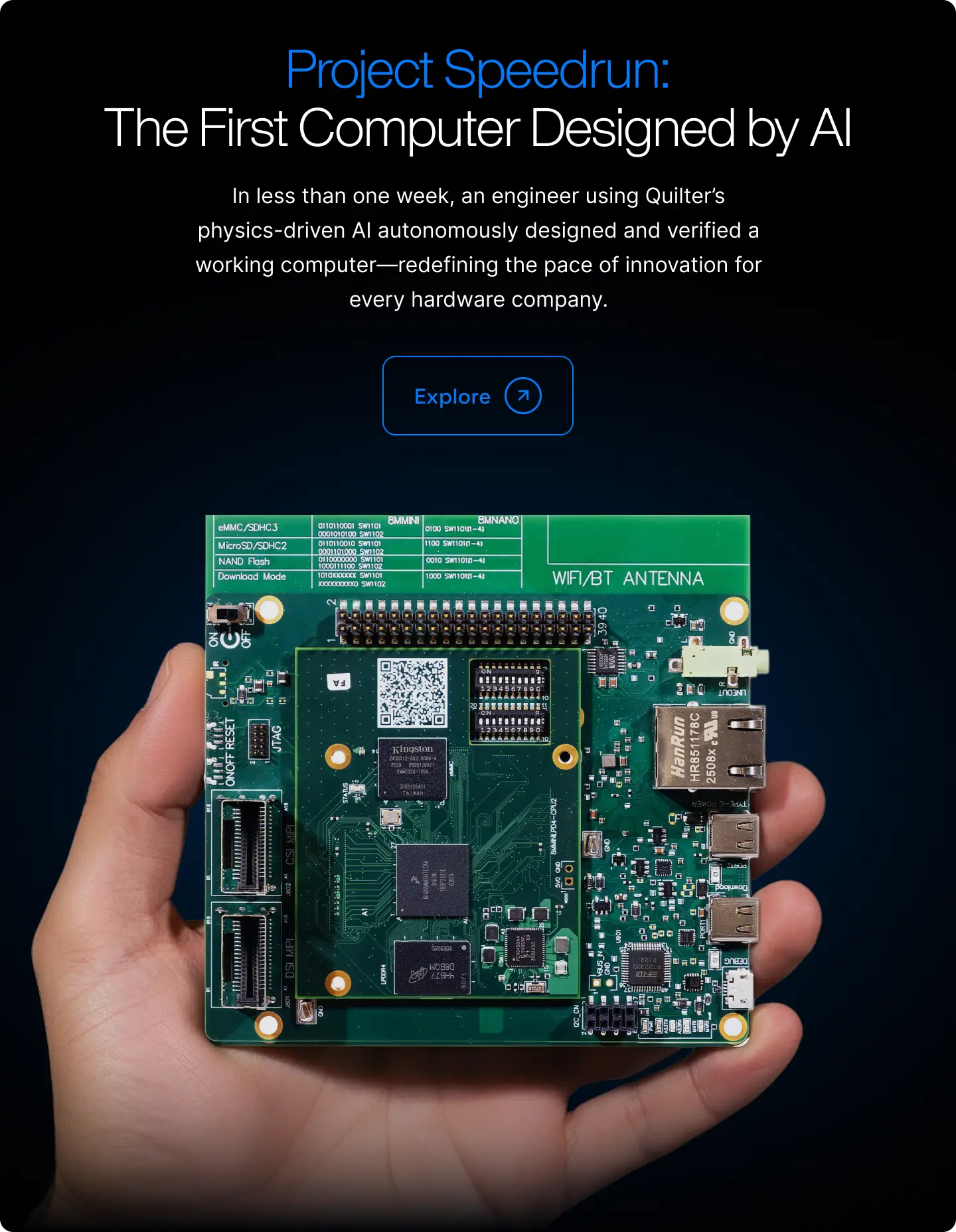
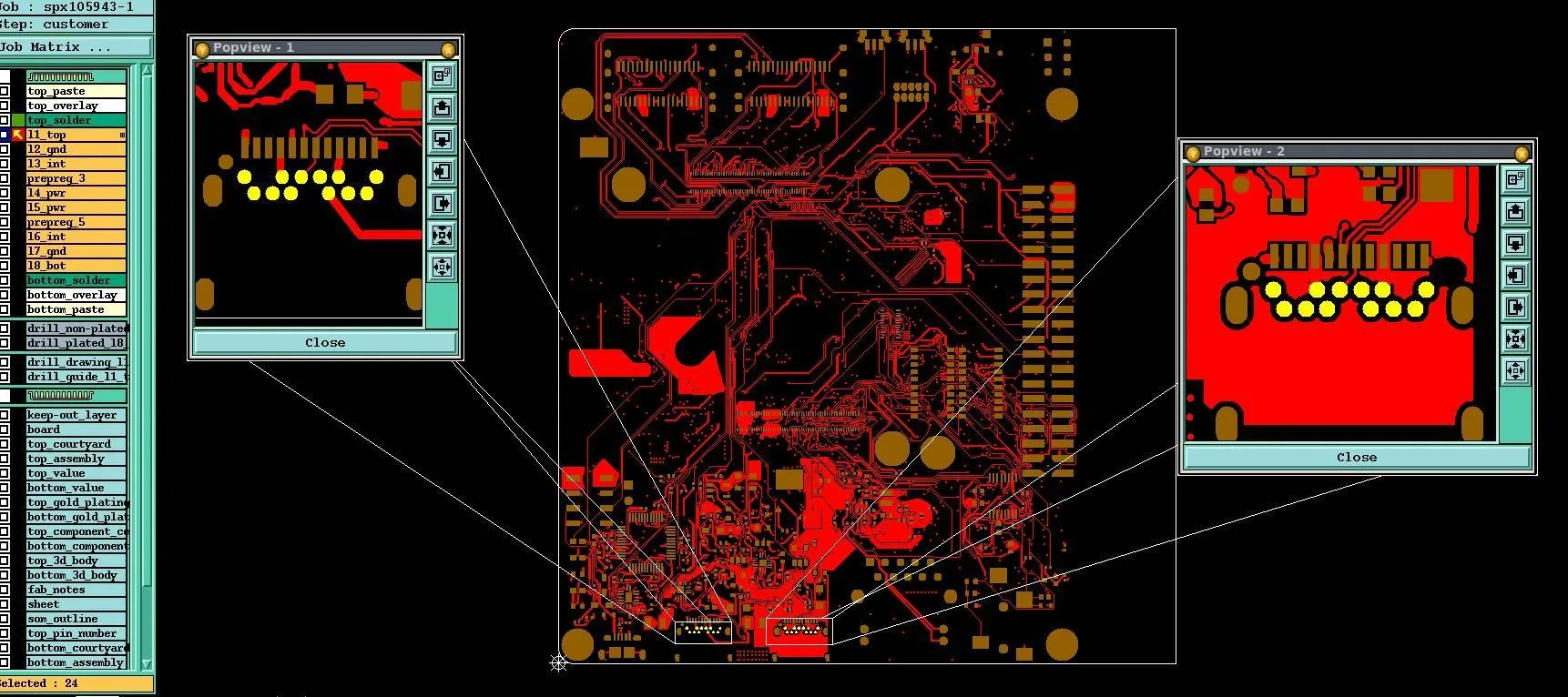
Physics-aware automated PCB layout requires feedback from real constraints. Clearance, impedance, return paths, route completion, current density, component placement, manufacturability, and power behavior all need to influence the search. Ben also notes the practical limit: “3D field solvers take a long time to run… we don’t always have the time or luxury to use those.” Serious PCB routing automation must therefore balance speed and fidelity. Fast approximations, learned evaluation, rules, simulations, and engineer guidance all need to work together inside the design loop. Quilter’s Project Speedrun is useful proof context here because it shows physics-driven automation being tested against a real board rather than discussed only as a concept.
Power Integrity Shows Why Best Practice Is Not Enough
Power integrity often sounds simple until the board becomes dense. Place bypass capacitors near the pins, keep loops short, use solid reference planes, and follow the reference design. Ben’s comment cuts through that simplicity: “It sounds very trivial, but no one was able to do it.” Bypass capacitor placement is a perfect example of how obvious rules become difficult inside real PCB applications. “Close” depends on pin location, via structure, loop inductance, plane access, current demand, routing congestion, and competing placement priorities.
Power delivery also changes with software behavior. Firmware can alter current draw, transient response, and operating modes long after the schematic looks stable. Evaluation kits and reference designs help, but they rarely capture every use case of a new product. Designing only for worst-case demand can waste copper, cost, and space. Designing too close to typical behavior can expose instability during bring-up. Automated PCB layout needs to help engineers reason through this gray area rather than flatten systems thinking in power integrity into a checklist.
PCB Routing Automation Is a Sequencing Problem
Fayaz’s perspective brings the discussion inside the router: “Router is very sequential… we can’t do some sort of backtracking.” That observation explains why PCB routing automation is harder than connecting nets one by one. Early decisions reshape the available design space for everything that follows. A power pour can improve current delivery while blocking later escape routes. A wide trace can satisfy current capacity while starving neighboring signals of room. A via choice can solve a local problem and create a global bottleneck.
Fayaz sharpens the issue when discussing power pours and variable trace widths: “If you allocate a lot of space for a pour, then there might not be enough space for the other pins… the order and the constraints is probably the most difficult thing.” PCB design constraints interact like gears inside a dense machine. Moving one changes the pressure on another. Human layout engineers learn to anticipate those pressures through experience. Automated systems need a comparable ability to preserve future routing options while satisfying immediate electrical and physical constraints.
Better PCB Design and Layout Means Faster Learning
Dan describes the practical value of automation with a simple line: “The only problem is it’s a huge time suck… after a while it becomes repetitive.” Layout can be satisfying, but not every layout task deserves the same level of human attention. Repetitive routing, cleanup, iteration, and constraint juggling can consume hours that engineers would rather spend on architecture, validation, signal behavior, power strategy, and system integration. Automated PCB layout becomes compelling when it gives engineers more time for the decisions only experienced humans can make.
Speed matters because hardware development is a learning process. Every PCB project contains uncertainty about placement, routing density, power behavior, signal integrity, thermal performance, and manufacturability. Faster layout exploration gives teams more chances to discover constraint conflicts before the design hardens around bad assumptions. Better automation can surface congestion earlier, compare candidate designs more quickly, and help teams understand which tradeoffs are actually available. Readers who want to inspect Quilter’s strongest public proof point can inspect the Speedrun design files after reading the essay.
Curiosity Still Matters in Automated PCB Layout
Dan’s advice, “Always stay curious. Stay curious… kind of stay like a kid,” sounds simple, but it belongs in a serious engineering argument. Curiosity matters because hardware constraints keep changing. New components arrive, interfaces get faster, enclosures shrink, thermal budgets tighten, firmware behavior shifts, and manufacturing partners introduce new limits. Each board teaches something the previous board could not. Engineers who stay curious keep updating their model of what the physical system is really doing.
Automation increases the value of curiosity rather than reducing it. When a tool can generate more layout candidates than a human could manually draw, the engineer’s role shifts toward interpretation. Which candidate protects margin? Which tradeoff is acceptable? Which constraint was expressed poorly? Which surprising result deserves investigation? Better PCB design and layout tools should give engineers a larger design space to question, not a black box to trust blindly. That is why engineering as a craft remains a useful frame for AI-assisted hardware development.
Why PCB Applications Need Constraint-Literate Automation
Advanced PCB applications now appear across embedded compute, robotics, aerospace, medical devices, industrial controls, RF systems, energy hardware, edge AI, and high-speed consumer electronics. Each category introduces a different mix of signal, power, mechanical, thermal, regulatory, and manufacturing constraints. Generic automation cannot serve these systems well if it treats layout as a cosmetic final step after schematic design. Board layout is where many of the system’s real engineering commitments become physical. Quilter’s autonomous PCB design guide can serve as a related next read for evaluators comparing automated approaches.
Constraint-literate automation starts from a different premise. PCB designing is not merely drawing copper between pads. Real layout means reasoning about fields, vias, planes, pours, clearances, routing order, current paths, fabrication limits, and validation cost. Automated PCB layout becomes useful when it helps engineers search through those physical possibilities with discipline. Quilter’s strongest argument is therefore not that AI makes PCB design easy. A better claim is that physics-aware automation can help engineers explore harder boards with more speed, clarity, and control.
Conclusion: Automated PCB Layout Cannot Repeal Physics
Constraint literacy is the through-line across Ben, Fayaz, and Dan’s perspectives. Vias have physical size. Planes create discontinuities. Fields radiate. Current demand changes. Routing order matters. Power guidance can be ambiguous. Simulation has a cost. Manufacturing has limits, and engineering time remains scarce.
Modern PCB applications do not need shallow automation that imitates finished boards. Hardware teams need systems that can search through board possibilities while respecting physics, design intent, and real PCB design constraints. Automated PCB layout succeeds when it gives engineers more leverage over the physical design space. PCB routing automation succeeds when it preserves judgment rather than hiding it. Quilter’s opportunity is to make complex pcb design and layout more explorable, more measurable, and more aligned with how expert engineers already think.


.webp)