





Published

Written by

Workbench

Digital Marketing for Engineering Companies: Darin Ten Bruggencate’s Ambitious Integrity

Published

December 16, 2025

Darin Ten Bruggencate has built his career at the intersection of electronics and communication. Now in marketing at Quilter, he draws on years in the EDA space, from Altium Japan to Cadence, Synopsys, and beyond. “I’ve always been interested in technology, so the opportunity to work in electronics was appealing to me,” he explains. Though not an engineer by training, his fascination with electronics and commitment to honest storytelling anchor his work. Humans in the Loop captures voices like Darin’s, showing how Quilter builds not just cutting-edge AI for hardware design, but a culture rooted in integrity, curiosity, and respect for craft.

Origins

From an early age, Darin was drawn to technology. “For Christmas you always put your Christmas list together. I never got anything that I wanted on my Christmas list because I only ever had one thing and it was really expensive. It was something computer related. And I always got sweaters and things like that instead of a computer.” That spark never faded. Even without an engineering degree, he found his way into electronics through marketing: “I don’t have any engineering education at all whatsoever, but… electronics are cool, they’re fun to play with, and this is kind of electronics adjacent. I can geek out and nerd out with people.”

Journeys in Engineering

Darin’s career path spans some of the most recognizable names in the EDA industry. “I’ve been in the EDA space for a while, starting first after college in Japan. I worked at Altium Japan for a few years… then went back to Altium, this time in a marketing role, not a sales role.” Later he joined Cadence: “I worked in product marketing for Cadence for just under five years… Obviously a much different customer base and a much wider portfolio of solutions before joining Synopsys and working on go to market for their EDA cloud solution.”

That journey sharpened his conviction that marketing must serve truth, not gimmicks. “I think as marketing we’re not trying to convince anyone of anything. We’re purely just making information available. It’s on the product to succeed.” Engineers, he knows, are allergic to clever ploys: “The audience for our tools is pretty adverse to clever campaigns… Engineering is serious business. A funny tagline isn’t going to make them motivated to buy.” Instead, his focus is on clarity and value, a perspective that resonates with Quilter’s rigor and fact-based ethos.

Marketing Without Illusions

One of the most destabilizing ideas in Darin’s transcript is also one of the simplest. He rejects the premise that marketing exists to convince anyone of anything.

“I think as marketing we’re not selling anything. We’re purely just making information available.”

This is not rhetorical modesty. It is an operating constraint.

For AI startups, particularly those serving engineers, marketing cannot compensate for gaps in capability. The role of marketing is not to push demand forward, but to reduce friction for the people who already need awareness.

“It’s on the product to succeed.”

This reframes digital marketing as a systems problem rather than a persuasion problem. The job is not to amplify desire but to improve signal fidelity: to help the right people recognize whether a tool fits their constraints, workflows, and risk profile.

That distinction matters because AI startups are often tempted to market future potential rather than present reality. Engineers, however, do not buy futures. They buy tools that survive contact with their backlog.

Why Clever Campaigns Fail in Technical Markets

In consumer tech, novelty is currency. In engineering markets, novelty is a liability.

“I think the audience for our tools is pretty adverse to clever campaigns.”

Darin’s skepticism is informed by experience. He recounts a past campaign that leaned into provocation rather than empathy:

“There’s 100 million engineers in China who will do your job cheaper than you can. What makes you so special? That was their campaign, and it did not go over well.”

The failure was not merely about tone. It violated a deeper rule: engineers do not want marketing to editorialize their anxieties back at them.

“Engineering is serious business. And yeah, they like to have fun, don’t get me wrong. But a funny tagline isn’t going to make them motivated to buy.”

For AI startups, this is especially important. AI already introduces uncertainty around labor, expertise, and displacement. Marketing that adds theatricality on top of that uncertainty erodes trust rather than building it.

Digital Marketing as Research, Not Broadcast

Darin consistently describes marketing as a two-way system rather than a megaphone.

“When we do campaigns in this space… we are being systematic in how we approach understanding an engineer and our target audience and what struggles they encounter, motivates them and where they get their information.”

This is not market research bolted onto marketing. It is marketing as research.

Crucially, that research does not only flow outward.

“Sometimes we find that the value we thought we provided is not something anybody else is interested in. And we can give that feedback back to the product team.”

For AI startups, this feedback loop is existential. AI systems are probabilistic. Their value emerges unevenly across use cases. Marketing becomes one of the earliest sensors for mismatch between internal assumptions and external reality.

This reframes content, campaigns, and positioning not as artifacts to be optimized, but as probes that test whether the product narrative survives exposure to real constraints.

The Product Placement Fallacy in B2B AI

Much of modern digital marketing borrows from entertainment logic: embed the product in stories, let aspiration do the work. Darin is blunt about where that analogy breaks down.

“I think the analogy or the closest thing that we have to product placement is success stories and case studies.”

But even there, he draws a sharp distinction between authentic signal and contrived narrative.

“The success stories that are on your own brand’s website… are probably not very interesting to anybody other than someone who is actively considering buying.”

Instead, the most credible signal is indirect.

“Somebody on their own accord just telling their own story on a podcast or whatever and saying, here’s how I was successful… and I use these tools to do it.”

For AI startups, this is uncomfortable because it removes control. You cannot script third-party validation. You can only earn it by delivering value that survives unsupervised use.

“The only way to actually do that is have a valuable tool.”

Why Quilter?

Darin joined Quilter for both the mission and the honesty in its approach. “I think what’s easy for us is the AI that we’re developing is not taking anyone’s job. It’s making everyone’s job easier. It’s actually making everyone’s job better.” He contrasts this with broader AI hype: “There’s a lot of snake oil and flash and pizzazz about AI. And I think when it comes to selling B2B, it’s not flashy. It looks professional, but it’s not flashy. It’s reliable, not boisterous. It’s fact based, not emotional based.”

This no-nonsense attitude makes Quilter a natural fit. “Really, really bad marketing can make it really, really hard for a product to succeed, but if it’s a good product, it will still succeed. And really, really good marketing can create the environment for a product to succeed, but if it’s not good enough, it still won’t succeed.” For Darin, Quilter represents a place where product and message align, and where engineers’ time and attention are respected.

Why Marketing Cannot Save a Weak AI Product

In venture culture, marketing is often treated as an accelerant. Darin treats it as a constraint.

“Really, really bad marketing can make it really, really hard for a product to succeed, but if it’s a good product, it will still succeed.”

The inverse is more damning.

“Really, really good marketing can create the environment for a product to succeed, but if it’s not good enough, it still won’t succeed.”

This is particularly unforgiving for AI startups because early traction can be misleading. Demos can outperform reality. Benchmarks can be cherry-picked. Narratives can run ahead of reliability.

Marketing that amplifies those gaps does not merely mislead buyers. It creates internal pressure that distorts product decisions.

For engineers evaluating AI tools, credibility compounds slowly and collapses instantly.

AI, Jobs, and the Unusual Position of Hardware

Darin’s perspective on AI marketing becomes especially sharp when he contrasts software and hardware labor markets.

“When it comes to PCB design, there is nobody on planet Earth who has PCB design skills that is want for work. We do not have enough.”

This matters because AI is often framed as a labor-reducing force. In hardware design, the constraint is capacity, not demand.

“What’s easy for us is the AI that we’re developing is not taking anyone’s job. It’s making everyone’s job easier.”

That positioning is not rhetorical. It is structural. AI tools that expand throughput in undersupplied domains are received differently than AI tools that threaten saturation.

For AI startups, honest positioning around labor impact is not optional. Engineers will interrogate it regardless.

“There is no way you can slice us as bad. The worst you can say about us is it doesn’t do what I need it to do.”

That is the kind of criticism engineers respect.

Reliability Beats Flash

Darin repeatedly returns to a simple axis that many AI startups ignore.

“When it comes to selling B2B, it’s not flashy. It looks professional, but it’s not flashy. It’s reliable, not boisterous. It’s fact based, not emotional based.”

This is not an argument against aesthetics. It is an argument against spectacle as a substitute for trust.

AI marketing often leans into visual metaphors because the underlying systems are opaque. But opacity makes engineers more suspicious, not more receptive.

Engineers do not want inspiration. They want constraints, failure modes, and clarity around what breaks first.

That reality makes AI marketing harder.

And cleaner.

The Milkmaid, Not the Emperor

One of Darin’s most revealing analogies comes from art history.

“B2B marketing is harder because we’re painting the picture of the milkmaid, not the emperor, the king.”

Consumer tech sells aspiration. Enterprise AI sells diligence.

“If I’m selling an iPhone, that’s the emperor… We’re talking about nerdy engineering stuff.”

This metaphor matters because it reframes dignity. The work AI startups support is often invisible, infrastructural, and unglamorous. Marketing that tries to elevate it through spectacle misses the point.

The dignity is in the craft itself.

A Marketing Discipline AI Startups Actually Need

Taken together, Darin’s perspective describes a form of digital marketing that feels almost anachronistic in startup culture. It is restrained. It is skeptical of growth theatrics. It refuses to promise what the product cannot already deliver.

But for AI startups selling into technical domains, this discipline is not optional.

“It makes the job uncontentious. It makes marketing very fact based.”

That may not produce viral moments. It will, however, produce durable trust.

And in AI, durability is the only real moat.

Beyond the Workbench

Outside of marketing, Darin finds inspiration in art, philosophy, and culture. Reflecting on the power of reframing the ordinary, he recalls: “At that time, the Royal Society of Arts… had established a hierarchy of art… And the Dutch said, you know what, screw you guys. We’re going to focus on glamorizing and elevating the peasants and show the beauty in that.” For him, this mirrors B2B storytelling: “B2B marketing is harder because we’re painting the picture of the milkmaid, not the emperor, the king. If I’m selling an iPhone, that’s the emperor… We’re talking about nerdy engineering stuff.”

His imagined dinner companions reveal his intellectual range: “It would be Albert Camus, William Morris, and Alan Watts.” And, with a laugh, he places himself in “1920s Paris. Drinks with Hemingway. Fitzgerald too. Everybody from Midnight in Paris.”

Try Quilter for Yourself

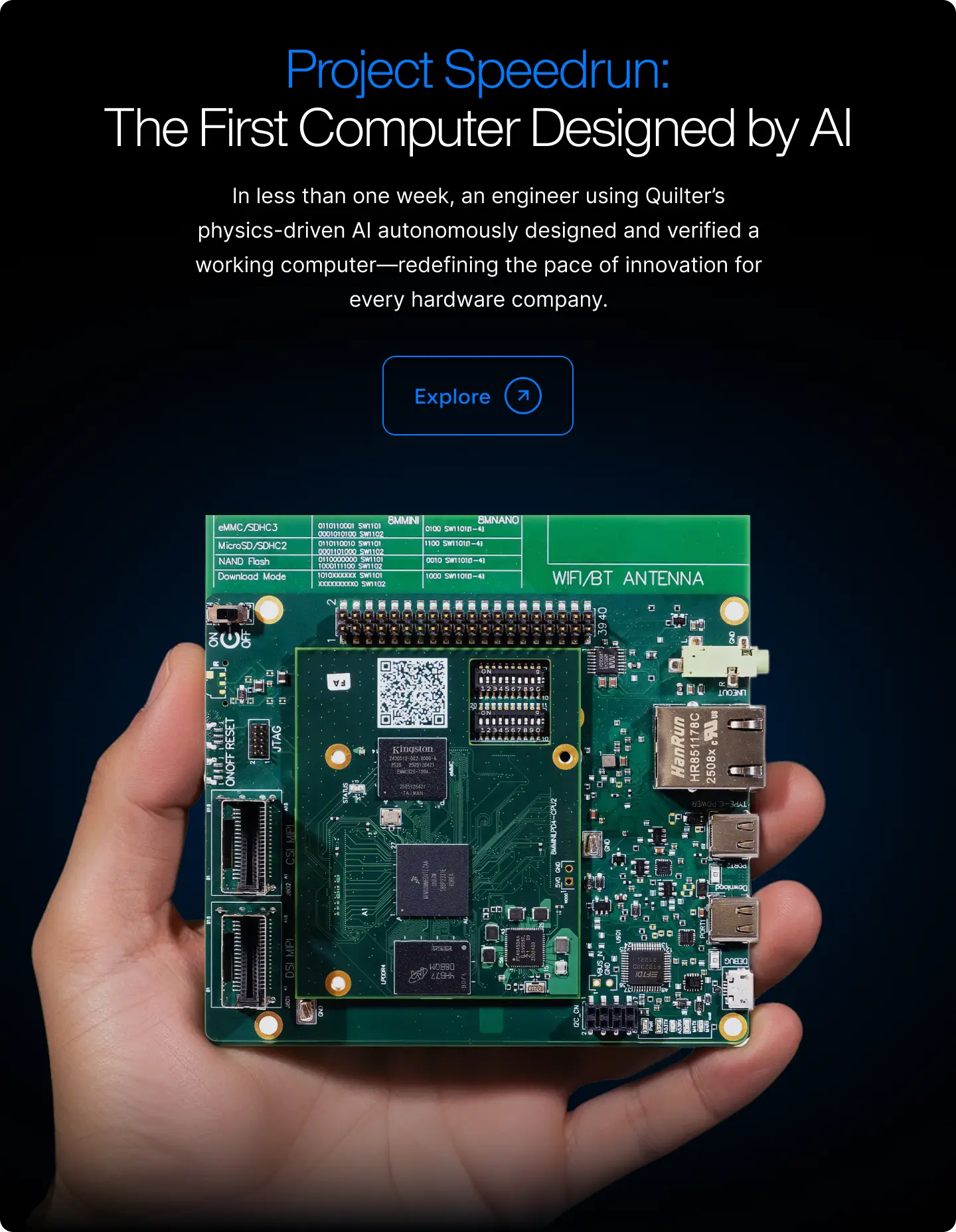
Project Speedrun demonstrated what autonomous layout looks like in practice and the time compression Quilter enables. Now, see it on your own hardware.

Get Started

Validating the Design

With cleanup complete, the final question is whether the hardware works. Power-on is where most electrical mistakes reveal themselves, and it’s the moment engineers are both nervous and excited about.

Continue to Part 4

Cleaning Up the Design

Autonomous layout produces a complete, DRC'd design; cleanup is a brief precision pass to finalize it for fabrication.

Continue to Part 3

Compiling the Design

Once the design is prepared, the next step is handing it off to Quilter. In traditional workflows, this is where an engineer meets with a layout specialist to clarify intent. Quilter replaces that meeting with circuit comprehension: you upload the project, review how constraints are interpreted, and submit the job.

Continue to Part 2

Digital Marketing for Engineering Companies: Darin Ten Bruggencate’s Ambitious Integrity

December 16, 2025
by
Cody Stetzel
and
Darin ten Bruggencate

Darin Ten Bruggencate has built his career at the intersection of electronics and communication. Now in marketing at Quilter, he draws on years in the EDA space, from Altium Japan to Cadence, Synopsys, and beyond. “I’ve always been interested in technology, so the opportunity to work in electronics was appealing to me,” he explains. Though not an engineer by training, his fascination with electronics and commitment to honest storytelling anchor his work. Humans in the Loop captures voices like Darin’s, showing how Quilter builds not just cutting-edge AI for hardware design, but a culture rooted in integrity, curiosity, and respect for craft.

Origins

From an early age, Darin was drawn to technology. “For Christmas you always put your Christmas list together. I never got anything that I wanted on my Christmas list because I only ever had one thing and it was really expensive. It was something computer related. And I always got sweaters and things like that instead of a computer.” That spark never faded. Even without an engineering degree, he found his way into electronics through marketing: “I don’t have any engineering education at all whatsoever, but… electronics are cool, they’re fun to play with, and this is kind of electronics adjacent. I can geek out and nerd out with people.”

Journeys in Engineering

Darin’s career path spans some of the most recognizable names in the EDA industry. “I’ve been in the EDA space for a while, starting first after college in Japan. I worked at Altium Japan for a few years… then went back to Altium, this time in a marketing role, not a sales role.” Later he joined Cadence: “I worked in product marketing for Cadence for just under five years… Obviously a much different customer base and a much wider portfolio of solutions before joining Synopsys and working on go to market for their EDA cloud solution.”

That journey sharpened his conviction that marketing must serve truth, not gimmicks. “I think as marketing we’re not trying to convince anyone of anything. We’re purely just making information available. It’s on the product to succeed.” Engineers, he knows, are allergic to clever ploys: “The audience for our tools is pretty adverse to clever campaigns… Engineering is serious business. A funny tagline isn’t going to make them motivated to buy.” Instead, his focus is on clarity and value, a perspective that resonates with Quilter’s rigor and fact-based ethos.

Marketing Without Illusions

One of the most destabilizing ideas in Darin’s transcript is also one of the simplest. He rejects the premise that marketing exists to convince anyone of anything.

“I think as marketing we’re not selling anything. We’re purely just making information available.”

This is not rhetorical modesty. It is an operating constraint.

For AI startups, particularly those serving engineers, marketing cannot compensate for gaps in capability. The role of marketing is not to push demand forward, but to reduce friction for the people who already need awareness.

“It’s on the product to succeed.”

This reframes digital marketing as a systems problem rather than a persuasion problem. The job is not to amplify desire but to improve signal fidelity: to help the right people recognize whether a tool fits their constraints, workflows, and risk profile.

That distinction matters because AI startups are often tempted to market future potential rather than present reality. Engineers, however, do not buy futures. They buy tools that survive contact with their backlog.

Why Clever Campaigns Fail in Technical Markets

In consumer tech, novelty is currency. In engineering markets, novelty is a liability.

“I think the audience for our tools is pretty adverse to clever campaigns.”

Darin’s skepticism is informed by experience. He recounts a past campaign that leaned into provocation rather than empathy:

“There’s 100 million engineers in China who will do your job cheaper than you can. What makes you so special? That was their campaign, and it did not go over well.”

The failure was not merely about tone. It violated a deeper rule: engineers do not want marketing to editorialize their anxieties back at them.

“Engineering is serious business. And yeah, they like to have fun, don’t get me wrong. But a funny tagline isn’t going to make them motivated to buy.”

For AI startups, this is especially important. AI already introduces uncertainty around labor, expertise, and displacement. Marketing that adds theatricality on top of that uncertainty erodes trust rather than building it.

Digital Marketing as Research, Not Broadcast

Darin consistently describes marketing as a two-way system rather than a megaphone.

“When we do campaigns in this space… we are being systematic in how we approach understanding an engineer and our target audience and what struggles they encounter, motivates them and where they get their information.”

This is not market research bolted onto marketing. It is marketing as research.

Crucially, that research does not only flow outward.

“Sometimes we find that the value we thought we provided is not something anybody else is interested in. And we can give that feedback back to the product team.”

For AI startups, this feedback loop is existential. AI systems are probabilistic. Their value emerges unevenly across use cases. Marketing becomes one of the earliest sensors for mismatch between internal assumptions and external reality.

This reframes content, campaigns, and positioning not as artifacts to be optimized, but as probes that test whether the product narrative survives exposure to real constraints.

The Product Placement Fallacy in B2B AI

Much of modern digital marketing borrows from entertainment logic: embed the product in stories, let aspiration do the work. Darin is blunt about where that analogy breaks down.

“I think the analogy or the closest thing that we have to product placement is success stories and case studies.”

But even there, he draws a sharp distinction between authentic signal and contrived narrative.

“The success stories that are on your own brand’s website… are probably not very interesting to anybody other than someone who is actively considering buying.”

Instead, the most credible signal is indirect.

“Somebody on their own accord just telling their own story on a podcast or whatever and saying, here’s how I was successful… and I use these tools to do it.”

For AI startups, this is uncomfortable because it removes control. You cannot script third-party validation. You can only earn it by delivering value that survives unsupervised use.

“The only way to actually do that is have a valuable tool.”

Why Quilter?

Darin joined Quilter for both the mission and the honesty in its approach. “I think what’s easy for us is the AI that we’re developing is not taking anyone’s job. It’s making everyone’s job easier. It’s actually making everyone’s job better.” He contrasts this with broader AI hype: “There’s a lot of snake oil and flash and pizzazz about AI. And I think when it comes to selling B2B, it’s not flashy. It looks professional, but it’s not flashy. It’s reliable, not boisterous. It’s fact based, not emotional based.”

This no-nonsense attitude makes Quilter a natural fit. “Really, really bad marketing can make it really, really hard for a product to succeed, but if it’s a good product, it will still succeed. And really, really good marketing can create the environment for a product to succeed, but if it’s not good enough, it still won’t succeed.” For Darin, Quilter represents a place where product and message align, and where engineers’ time and attention are respected.

Why Marketing Cannot Save a Weak AI Product

In venture culture, marketing is often treated as an accelerant. Darin treats it as a constraint.

“Really, really bad marketing can make it really, really hard for a product to succeed, but if it’s a good product, it will still succeed.”

The inverse is more damning.

“Really, really good marketing can create the environment for a product to succeed, but if it’s not good enough, it still won’t succeed.”

This is particularly unforgiving for AI startups because early traction can be misleading. Demos can outperform reality. Benchmarks can be cherry-picked. Narratives can run ahead of reliability.

Marketing that amplifies those gaps does not merely mislead buyers. It creates internal pressure that distorts product decisions.

For engineers evaluating AI tools, credibility compounds slowly and collapses instantly.

AI, Jobs, and the Unusual Position of Hardware

Darin’s perspective on AI marketing becomes especially sharp when he contrasts software and hardware labor markets.

“When it comes to PCB design, there is nobody on planet Earth who has PCB design skills that is want for work. We do not have enough.”

This matters because AI is often framed as a labor-reducing force. In hardware design, the constraint is capacity, not demand.

“What’s easy for us is the AI that we’re developing is not taking anyone’s job. It’s making everyone’s job easier.”

That positioning is not rhetorical. It is structural. AI tools that expand throughput in undersupplied domains are received differently than AI tools that threaten saturation.

For AI startups, honest positioning around labor impact is not optional. Engineers will interrogate it regardless.

“There is no way you can slice us as bad. The worst you can say about us is it doesn’t do what I need it to do.”

That is the kind of criticism engineers respect.

Reliability Beats Flash

Darin repeatedly returns to a simple axis that many AI startups ignore.

“When it comes to selling B2B, it’s not flashy. It looks professional, but it’s not flashy. It’s reliable, not boisterous. It’s fact based, not emotional based.”

This is not an argument against aesthetics. It is an argument against spectacle as a substitute for trust.

AI marketing often leans into visual metaphors because the underlying systems are opaque. But opacity makes engineers more suspicious, not more receptive.

Engineers do not want inspiration. They want constraints, failure modes, and clarity around what breaks first.

That reality makes AI marketing harder.

And cleaner.

The Milkmaid, Not the Emperor

One of Darin’s most revealing analogies comes from art history.

“B2B marketing is harder because we’re painting the picture of the milkmaid, not the emperor, the king.”

Consumer tech sells aspiration. Enterprise AI sells diligence.

“If I’m selling an iPhone, that’s the emperor… We’re talking about nerdy engineering stuff.”

This metaphor matters because it reframes dignity. The work AI startups support is often invisible, infrastructural, and unglamorous. Marketing that tries to elevate it through spectacle misses the point.

The dignity is in the craft itself.

A Marketing Discipline AI Startups Actually Need

Taken together, Darin’s perspective describes a form of digital marketing that feels almost anachronistic in startup culture. It is restrained. It is skeptical of growth theatrics. It refuses to promise what the product cannot already deliver.

But for AI startups selling into technical domains, this discipline is not optional.

“It makes the job uncontentious. It makes marketing very fact based.”

That may not produce viral moments. It will, however, produce durable trust.

And in AI, durability is the only real moat.

Beyond the Workbench

Outside of marketing, Darin finds inspiration in art, philosophy, and culture. Reflecting on the power of reframing the ordinary, he recalls: “At that time, the Royal Society of Arts… had established a hierarchy of art… And the Dutch said, you know what, screw you guys. We’re going to focus on glamorizing and elevating the peasants and show the beauty in that.” For him, this mirrors B2B storytelling: “B2B marketing is harder because we’re painting the picture of the milkmaid, not the emperor, the king. If I’m selling an iPhone, that’s the emperor… We’re talking about nerdy engineering stuff.”

His imagined dinner companions reveal his intellectual range: “It would be Albert Camus, William Morris, and Alan Watts.” And, with a laugh, he places himself in “1920s Paris. Drinks with Hemingway. Fitzgerald too. Everybody from Midnight in Paris.”