







Read the Full Series
This article is one part of a walkthrough detailing how we recreated an NXP i.MX 8M Mini–based computer using Quilter’s physics-driven layout automation.
Yes, electrical engineers are in demand, and many hardware teams report a shortage of engineers with years of board-level experience. Recent electrical engineering graduates have relatively low unemployment. In 46% of our analyzed customer conversations in 2026, companies described not having enough layout capacity.
We speak with hardware teams across all industries and company sizes, and we integrate with all the major electronic computer-aided design (ECAD) tools. It gives us a good view of what is happening across the industry. We are developing physics-driven AI for PCB layout, so our sample may be biased toward innovative, forward-thinking teams that want to adopt AI for hardware development. Even so, we've spoken with enough companies to trust the overall signal. One issue we hear about again and again is an engineering talent shortage, specifically a lack of electrical engineers and PCB designers. Many of our customers tell us they don't have enough capacity to design as many boards as their organizations need.
We published The Electrical Engineer Shortage Is Structural earlier this year. Our argument was that hardware teams can't hire their way out of the shortage of electrical engineers and PCB designers. It became one of our most commented and shared posts at the time. Many engineers and hiring managers told us it reflected what they see on the job market. Others disagreed and pointed to wages and expectations. It also reached beyond our readers: Forbes cited it in its coverage of Colare, a San Francisco startup that raised $2.5 million to help companies screen hardware engineering candidates with simulations of real job problems. In October, we teamed up with Hardware FYI to put the question to four engineering and manufacturing leaders, and we've published their experiences and advice in a separate recap. Several webinar attendees asked how AI is changing the job market and college enrollment. This post looks at the latest evidence on both, alongside what hardware teams tell us.
Key Findings
- Electrical engineering job postings on Indeed were at 155% of their February 2020 level on October 30, 2026, while software development postings were at 82%.
- Recent electrical engineering graduates had relatively low unemployment in 2024: 3.2%, compared with 4.2% for recent graduates overall.
- The three of our webinar panelists who hire hardware engineers, along with many customers on our calls, described difficulty hiring engineers with years of board experience. Two of the panelists said recent graduates were easier to find.
- In 46% of our analyzed customer conversations, companies described not having enough layout capacity.
- Experienced PCB designers are retiring and are hard to replace. Customers on our calls described designers who retired and openings they couldn't fill, and 29% of respondents to a 2025 Printed Circuit Engineering Association salary survey of mostly PCB designers had more than 30 years of experience.
- Electrical engineering enrollment grew 14% in fall 2025. New students will need years of school and work before they can fill senior roles.
Where Our Evidence Comes From
We drew on three sources: our October webinar panel with Hardware FYI, our recorded customer calls, and public labor-market, survey, and enrollment data. The panel was Akshay Budhiraja of Agility Technologies (imaging systems for search and rescue, Vancouver area), Chris Denney of Worthington Assembly (contract manufacturing, Massachusetts), Frank Monaco of Simulator Product Solutions (flight simulation hardware, Southern California), and Milton Santos of Allient (motor drive electronics, Portugal). We asked them whether the shortage is real, why it's happening, and what they're doing about it. You can watch the full recording on YouTube.
Quilter talks with hardware teams across the industry every week: solo engineers and startups, mid-sized product companies, contract design firms, Fortune 500 manufacturers and defense primes. They work in aerospace and defense, semiconductors, power electronics and energy, automotive, medical devices, industrial automation, consumer electronics, and test and measurement, in North America, Europe, Asia, and the Middle East. That gives us a view across company sizes and industries that no single employer's hiring experience provides, and many of those conversations touch on hiring and layout capacity. So we went back through our calls from this year to see how often they come up. We report shares rather than call counts because our call volumes are commercially sensitive data. We record and transcribe most, but not all, of our customer conversations, and all quotes are anonymized and obfuscated.
Are Electrical Engineers in Demand?
Yes. The federal job outlook for electrical engineers shows continued growth. The Bureau of Labor Statistics (BLS) projects employment of electrical and electronics engineers to grow 8% from 2025 to 2035, with about 16,300 openings a year. Openings include replacements for people who retire or change occupations, so they aren't a count of unfilled jobs.
Electrification and the data center buildout add to that demand. The International Energy Agency projects U.S. electricity demand to grow nearly 2% a year through 2030, with about half of the increase coming from data centers. It remains to be seen how regulation and a growing skepticism toward data center build-out will impact these projections. BLS breaks its projection down further: 10% growth for electrical engineers and 4% for electronics engineers, and BLS names solar arrays, semiconductors, consumer electronics, and communications technologies among the work driving that growth.
Recruiters describe the same pull. "Double-E's with power systems backgrounds are super high in demand," George Santos of the recruiting firm 180 Engineering told Design News. In the International Energy Agency's World Energy Employment 2025 report, more than half of the 700-plus energy companies, unions, and training institutions it surveyed reported critical hiring bottlenecks. The IEA also estimates that in grid roles, 1.4 workers are nearing retirement for every young worker entering.
Factories returning to the U.S. are another source of demand, and electronics accounts for a large share of the jobs. Of the manufacturing jobs companies announced in 2025 through reshoring and foreign investment, about 81,000 were in computer and electronic products or electrical equipment, according to the Reshoring Initiative, which tracks those announcements. Those figures cover every kind of manufacturing role, not just engineering, and the group lists the availability of skilled workers among the biggest long-term limits on how far U.S. manufacturing can expand.
Recent electrical engineering graduates were finding work in 2024. In the New York Fed's estimates for 2024, published in February 2026, unemployment among college graduates aged 22 to 27 who majored in electrical engineering was 3.2%, compared with 7.0% for computer science, 7.8% for computer engineering, and 4.2% for recent graduates overall. Aerospace and civil engineering graduates were lower still. These figures describe outcomes by college major for recent graduates only, so they don't show how hiring conditions vary by experience level or whether those graduates work in electrical engineering. They also predate this year's job market.

Note: Graduates aged 22 to 27, excluding those enrolled in school. Data: Federal Reserve Bank of New York, from the 2024 American Community Survey.
Electrical engineering postings are above their 2020 level, and software postings are below theirs. On Indeed's job postings indexes, which are seasonally adjusted and set each field's February 1, 2020 level to 100, electrical engineering stood at 155 on October 30, 2026, up 34% from a year earlier on the same series. Software development stood at 82. Each index compares a field with its own 2020 baseline, so the gap doesn't mean electrical engineering has more openings than software.
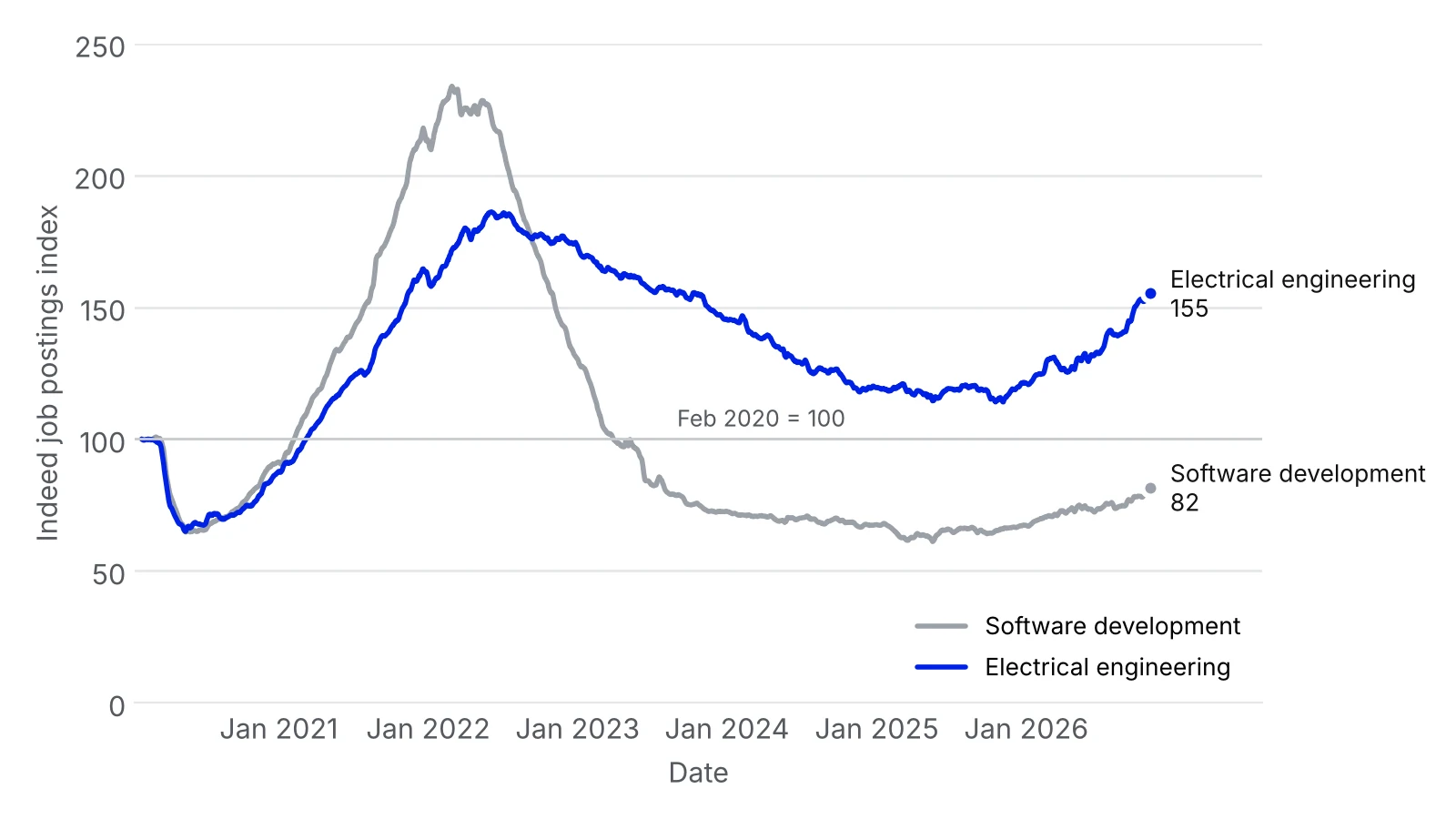
Note: Seasonally adjusted; each series indexed to its own February 1, 2020 level = 100. Data: Indeed Hiring Lab, CC BY 4.0.
Employer surveys show broader hiring conditions improving while engineering recruitment stays difficult.
- In the Aerospace Industries Association (AIA) and McKinsey study, 36% of aerospace and defense companies said it was easier to attract new employees in 2024, up from 31% in 2023, and 28% said it was harder, down from 38%. Engineering was still the function with the highest hiring demand and the biggest sourcing challenge, at 76% of 25 companies for each.
- In Germany, unemployment in engineering and IT occupations reached its highest level since the series began in 2011, yet energy and electrical engineering occupations still had 238 openings for every 100 unemployed people in the third quarter of 2026, according to the VDI and IW Ingenieurmonitor.
The Shortage Is in Experienced Engineers
The New York Fed numbers describe entry-level hiring, and our panel's harder problem was experience. Frank and Milton described the same pattern: recent graduates were available, and engineers with years of hands-on experience were hard to find. Milton set out to hire experienced engineers this year, ended up hiring recent graduates and training them, and meanwhile heard from about ten experienced consultants. Akshay's small team had to take longer than planned to hire a hardware engineer, because they needed one person with experience across circuit design, signal integrity, and layout, which usually means a senior engineer. Chris, whose company builds boards for customers, sees the consequences in boards that were clearly designed by engineers without enough design for manufacturing (DFM) experience. Our webinar recap covers the full discussion.
Customers on our calls described the same difficulty when it comes to layout. An engineer at a defense startup said, "PCB layout designers are really hard to come by." A hardware lead at a German power electronics company said, "We cannot find enough engineers here in Germany for making layouts," and later, "the market is empty."
Frank said that in Southern California, pay is competitive and "not the limiting factor." The broader evidence is mixed. In the AIA and McKinsey 2025 aerospace and defense workforce study, 88% of 32 surveyed companies had raised base compensation in the prior year. In a separate question, 79% of 28 companies said salary was a reason leading candidates chose other employers. Better pay, flexible location, narrower role requirements, or a consulting arrangement may help a particular company attract experienced engineers, and Milton's experience with consultants suggests some of that experience is available on different terms.
Electrical Engineers Increasingly Do Their Own PCB Layout
Electrical engineering and PCB layout are two different jobs: electrical engineers design the circuit, and PCB designers lay out the board. Companies used to hire dedicated layout designers. Now more and more of them, especially smaller teams, expect one engineer to own the whole board, from the circuit through layout and sometimes firmware. That engineer is usually an electrical engineer by training, and in some cases a mechanical engineer designs the board. Larger companies with complex boards still keep dedicated layout teams.
Judy Warner, a longtime PCB industry veteran, writer, and host of The EEcosystem Podcast, told us that electrical engineers laying out their own boards was “the number one thing that changed” in the industry, and that electrical engineers now do their own layout across every industry vertical. Chris Denney of Worthington Assembly, a contract manufacturer, sees it in the boards his company builds for customers: "We work with a ton of mechanical engineers trying to do circuit board design."
Our panel described the same expectation. Milton said "this hardware engineer that people are looking for" needs to understand the components, the board materials, and the electromagnetic fields, and "besides all of that, we have the firmware." Akshay said his team could find people who had laid out boards from a circuit someone else designed, but needed one engineer with experience across all of those areas. Frank advised engineers looking for work to be "a little bit more rounded," with "a little bit of firmware" and "a little bit of a flavor of everything."
Our calls show how common this setup is among the teams we talk to. In 18% of them, the team had no dedicated PCB designer at all, so electrical engineers or other engineers did their own layout. A hardware lead at a power electronics company said that at a previous employer, "for the full control board, we'd usually send it out to the layout team. Now that I'm in this much younger company that doesn't have quite the same resources... I've gone back to fully laying out full PCBs myself."
Federal data shows the same trend. BLS doesn't count PCB designers as a separate occupation, but it projects employment of electrical and electronics drafters, a broad category that includes PCB designer roles, to decline 3% from 2025 to 2035. For drafters overall, BLS expects CAD software to let engineers and architects take on more of the work drafters used to do.
PCB Layout Is Where Teams Run Out of Capacity
When one engineer owns the circuit, the layout, and the firmware, layout is often where the time runs out. Teams told us they have more boards to lay out than people or time to do it. A three-person electrical engineering team at a consumer electronics company described its problem as "we just don't have the bodies." An engineer at a satellite company said, "I am essentially a one person show. I have a lot of PCBAs to build and get through. And there is but one of me." A robotics hardware lead said, "I'm not going to go hire 100 people just because of these burst modes we go through."
Key finding: In Quilter's analysis of recorded calls with hardware teams evaluating AI for PCB layout, from January 1 to November 4, 2026, customers described or implied not having enough layout capacity in 46% of calls. The most common reasons were overloaded designers or a queue of boards (19% of calls), no dedicated PCB designer, so engineers do their own layout (18%), and sending layout out because the team couldn't do it in-house (16%). Many teams listed several reasons at once. In 25% of calls, layout was one of the biggest bottlenecks holding up the schedule.
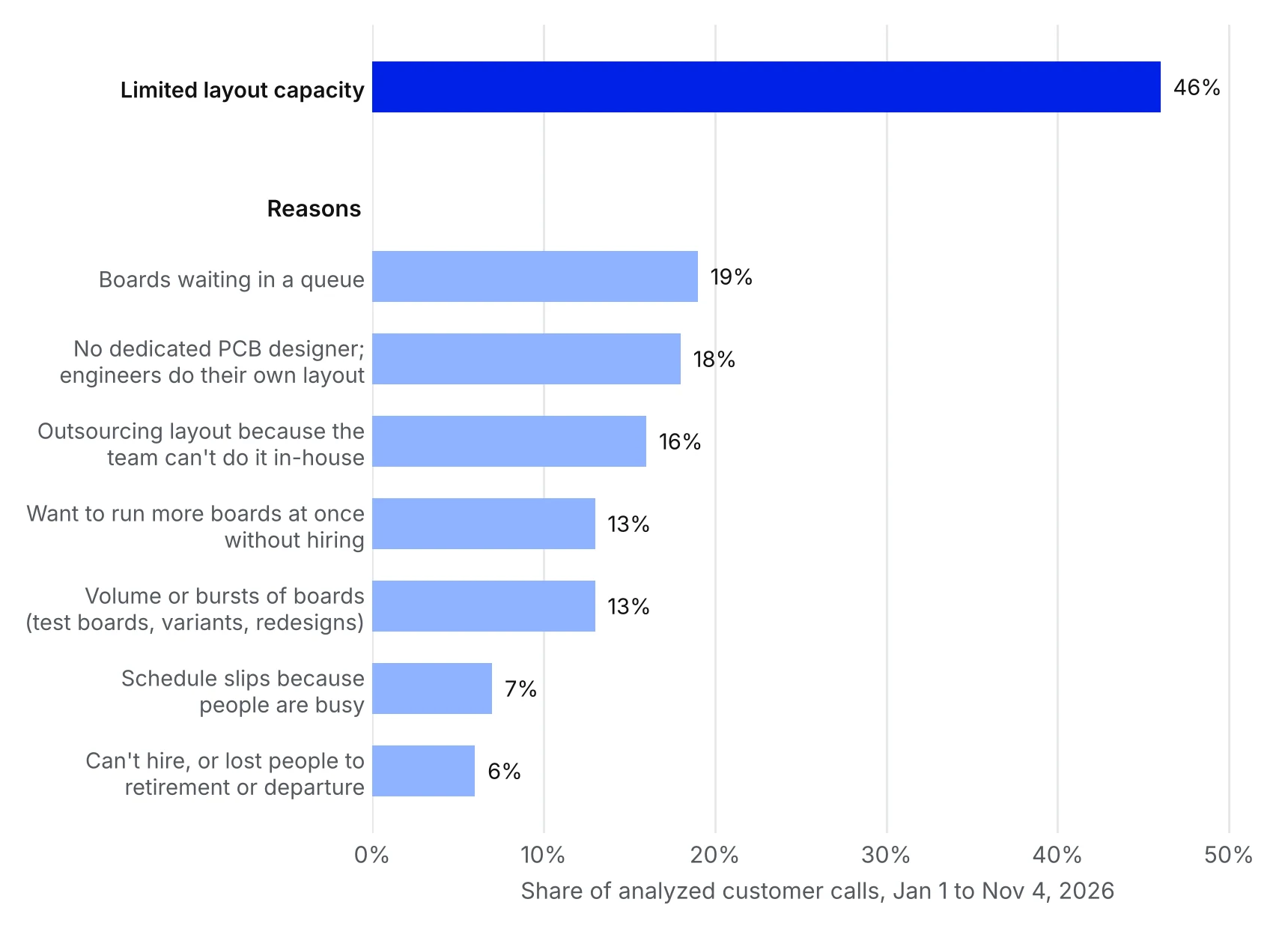
Note: Share of analyzed conversations. Reasons are shown below the overall share; a call can have more than one. Data: Quilter analysis of recorded customer calls.
We counted a call when the customer said directly, or made clear through what they described, that their team lacked the people or time for its layout work, whoever does that layout. The reasons were recorded only for calls that met that test, so having no dedicated PCB designer or outsourcing layout didn't count on its own. We didn't ask about layout capacity on every single call, so some teams with the problem may not have mentioned it.
| Theme | Share of analyzed calls |
|---|---|
| Limited layout capacity | 46% |
| Reasons | |
| Boards waiting in a queue | 19% |
| No dedicated PCB designer; engineers do their own layout | 18% |
| Outsourcing layout because the team can't do it in-house | 16% |
| Want to run more boards at once without hiring | 13% |
| Volume or bursts of boards (test boards, variants, redesigns) | 13% |
| Schedule slips because people are busy | 7% |
| Can't hire, or lost people to retirement or departure | 6% |
PCB designers report the same pressure. In the Printed Circuit Engineering Association's 2025 salary survey, 48% of respondents named workload as their top challenge for the year.
The PCB Designer Shortage: Experienced Designers Are Retiring
Some teams lost experienced layout people and struggled to replace them. One hardware team's two dedicated PCB designers "both retired," leaving the rest of the engineers to do their own layouts. A PCB design manager responsible for half of a 17-designer PCB team was "struggling to backfill a guy that just retired." Some teams backfill a retiring designer with another layout specialist, and others hand the layout to the engineers who remain.
Among respondents to the Printed Circuit Engineering Association's 2025 salary survey, most of whom work mainly in PCB design, 29% had more than 30 years of experience, and 47% expected to stay in their current role for only one to five more years. The survey doesn't say whether they plan to retire, change employers, move into other roles, or consult, but it points to a succession and knowledge-transfer concern on layout teams.
Electrical Engineering Enrollment Is Rising, but the Pipeline Is Slow
Our April report, The Electrical Engineer Shortage Is Structural, was built on a long-running trend: since the 1980s, US enrollment in electrical engineering has shrunk to about a tenth of its former level relative to computer science (Figure 4). Federal degree data show the same shift in the mix of graduates: US colleges awarded about 1.2 electrical engineering bachelor's degrees for every computer and information science degree in 1980, and about 0.15 in 2022, because computing degrees grew about tenfold while electrical engineering degrees grew far less.
In fall 2025, electrical engineering enrollment at four-year colleges rose 14% while computer and information science fell 8.1%, and preliminary data for fall 2026 shows computer and information science down another 12.4%.
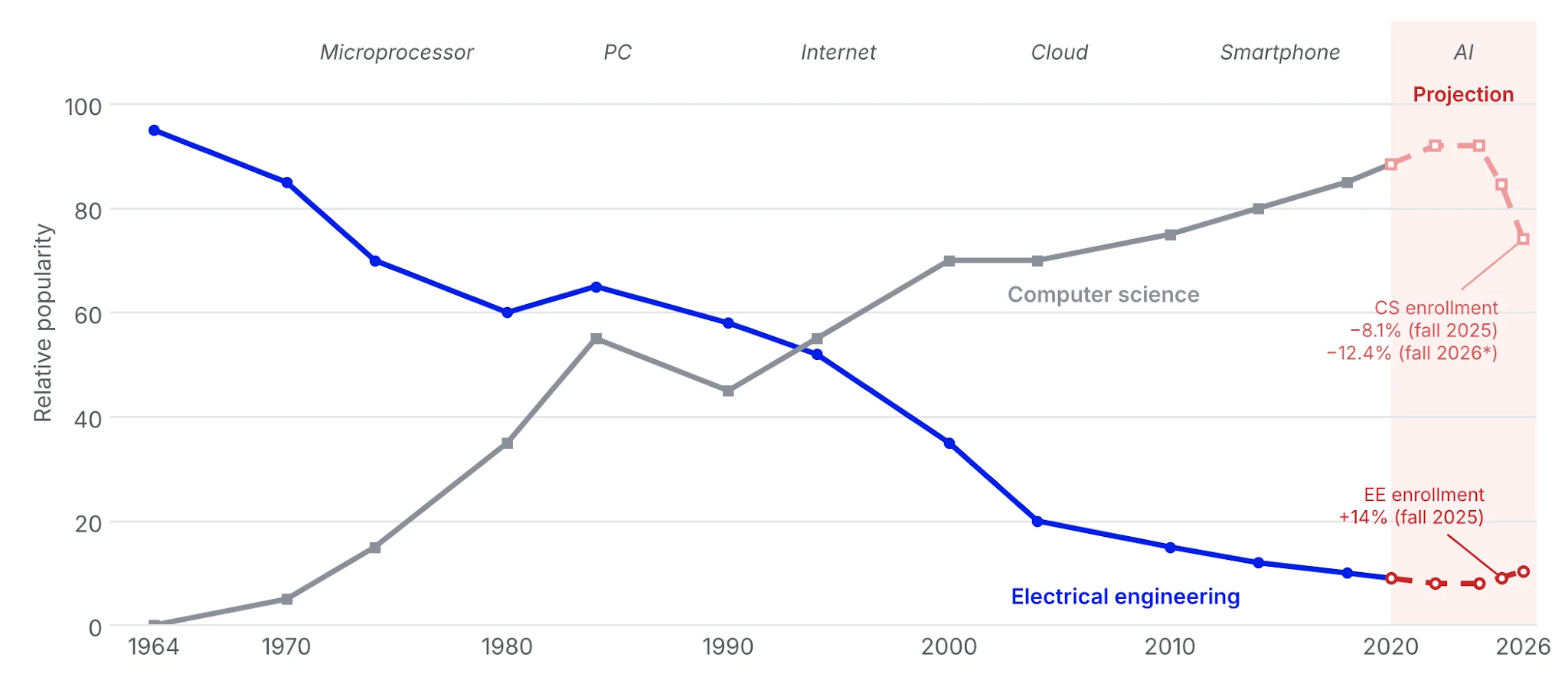
Note: Solid lines: relative popularity of the two majors, 1964 to 2020, as presented by Raja Koduri (Intel) at the 2022 IEEE VLSI Symposium from U.S. Department of Education data and shown in our April post, with the technology eras labeled there. Dashed lines: our projection for 2020 to 2026. It follows Koduri's values through 2022, then applies the change in declared-major enrollment at four-year colleges from the prior fall. The fall 2026 figure is preliminary, and that release doesn't report electrical engineering, so the 2026 electrical engineering point assumes the fall 2025 change repeated. The projection is illustrative, because enrollment change and Koduri's popularity index are different measures. Data: Koduri (2022); National Student Clearinghouse, via The Washington Post (fall 2025) and NSC preliminary data (fall 2026).
Several webinar attendees asked us for the newest enrollment numbers. Figure 5 shows the fall 2025 changes by field, from a Washington Post analysis of National Student Clearinghouse data. Data science and data analytics, which the Clearinghouse counts separately, topped 35,000 enrollments that fall, and the Post's analysis suggests some students who might once have chosen computer science picked those majors instead.
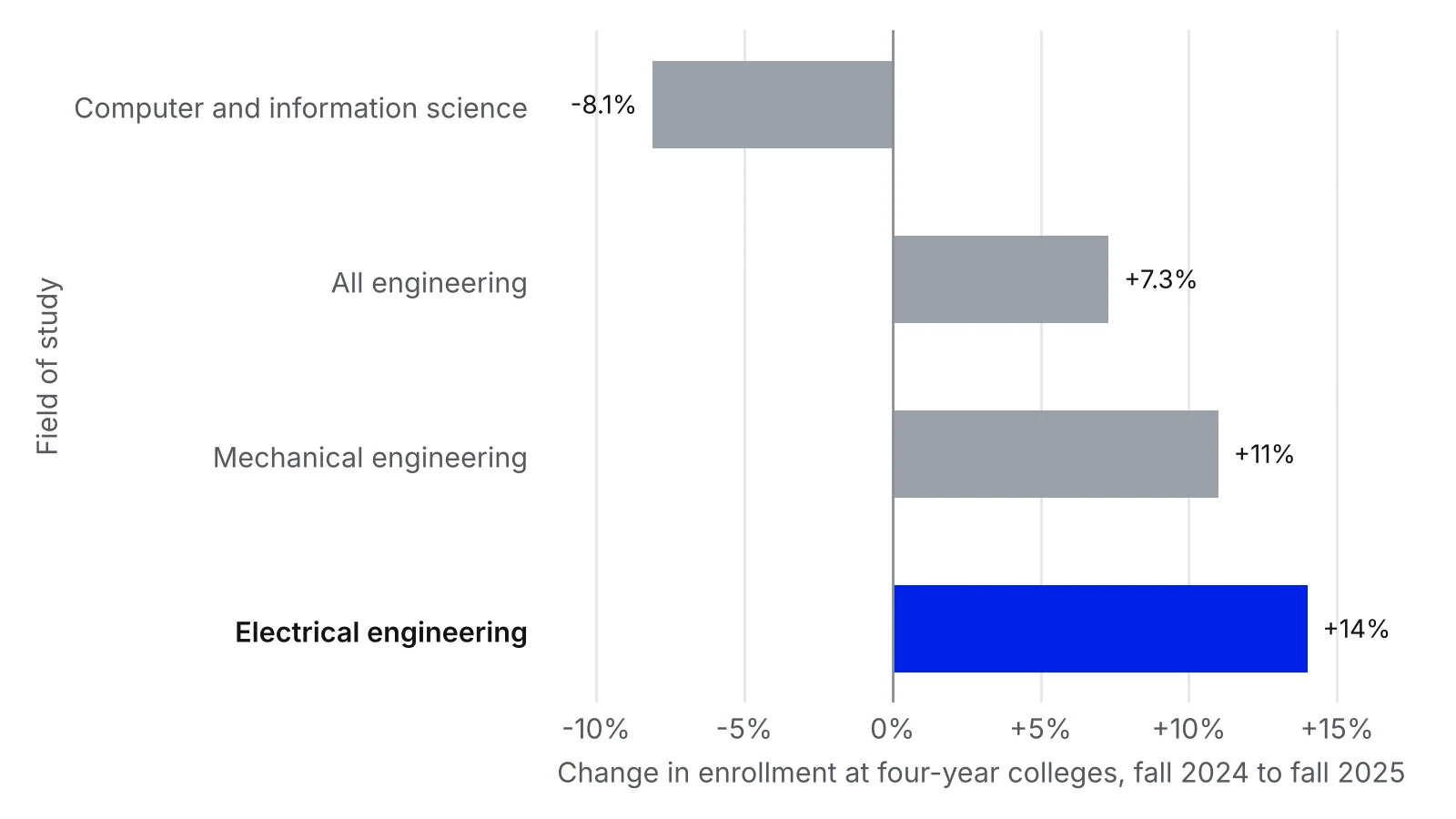
Note: Percent change by field. Computer and information science is the Clearinghouse's category. Data: National Student Clearinghouse, via The Washington Post.
Dr. Eric Bogatin, a professor at the University of Colorado Boulder who teaches high-speed digital design, signal integrity, and the senior design capstone, and who advises Quilter, described what he has seen at CU over the last two years. "Enrollment in our computer science department is way down," he said. In his account, computer science students have moved into electrical, mechanical, and aerospace engineering, with electrical engineering taking a large share. "Hardware engineering students have more job offers than there are students," he said, adding that, in his experience, every student in CU's PCB design class finds a job.
Enrollment figures at other universities show similar shifts, though totals alone don't show why students chose their majors. At Arizona State, electrical engineering enrollment rose from 2,825 students in fall 2024 to 3,252 in fall 2025, while enrollment in the computer science BS program fell from 5,844 to 5,008, according to the Fulton Schools of Engineering as reported by The State Press.
Students in those classes are still years away from the senior roles teams struggle to fill, and the teams that hire them need senior time to train them. Several customers described limited capacity to do that training. One medium-size company told us, "We have just one layout person. And so if you hire somebody out of college, you don't have that dedicated layout resource to do the training."
What Hardware Teams Can Do Now
The right response depends on which problem a team has.
| Team's constraint | Responses to consider |
|---|---|
| An experienced position stays unfilled | Reassess compensation, role breadth, location requirements, and whether a consulting or contract arrangement would work |
| Engineers or PCB designers have more layout work than they can handle | Add capacity through hiring, contractors, or layout automation |
| Junior engineers need more support than seniors can give | Reserve time for mentoring and review, and give juniors supervised responsibility on real projects |
| Critical knowledge rests with one person | Plan documentation, pairing, and knowledge transfer before that person leaves |
Our panelists described how they handle these in practice, from pairing new graduates with senior engineers to choosing contract manufacturers that flag design problems. See how the panel trains and supports junior engineers in the webinar recap.
Automation raises a training question. If tools take over work that junior engineers used to learn from, teams have to make sure juniors still build judgment. In a Semiconductor Engineering roundtable on college graduates and AI, Dave Kelf, CEO of Breker Verification Systems, said, "If you hire a new grad, you've got to spend a year to get them up to speed on real designs. That seems to be getting worse," and added that "AI is somewhat replacing the need for interns." Simon Davidmann, an AI and EDA researcher at the University of Southampton, said, "If you don't have graduates coming in and apprenticeships, you will have a problem because they never become the experts." One practical answer is to spend some of the time automation saves on mentoring, design review, and working through real failures with junior engineers.
Where AI Layout Tools Fit
Quilter builds physics-driven AI for PCB layout, so we benefit if teams take this route. Our April post, The Electrical Engineer Shortage Is Structural, made the case that recruiting can't solve this by itself, and this follow-up article still supports that argument. More students are choosing electrical engineering, but they are years away from the senior roles our customers are trying to fill, and the PCB designers retiring now are hard to replace. In the meantime, the boards still have to be designed by the engineers teams already employ, and automating layout lets each of them finish more. The gap is too large for any one company's product to fix, and we'd like Quilter to be among the tools hardware teams rely on while the pipeline rebuilds.
Quilter works from your native Altium, Cadence Allegro, Siemens Xpedition, or KiCad files and your constraints, and returns fully routed, physics-validated layout candidates that your team reviews and signs off. That helps with the problems teams described in different ways. A hardware engineer who owns the whole board gets back time that layout takes from circuit design and firmware. A team with more boards than layout capacity can get through a busy stretch without hiring for the peak. Senior PCB designers can put more of their hours into setting constraints and reviewing boards, the parts of the job that depend on their experience, and fewer into straightforward routing.
Automation won't create experienced engineers or train new ones, and the engineers our panel is trying to hire still decide whether a layout is right. It can increase how many boards each of them gets through and leave more time to mentor the engineers who will follow them. If your team has more boards than layout capacity, book a demo.
Keep the Conversation Going
We'd like to keep this conversation going. If you hire hardware engineers, or you're looking for a hardware job, tell us what you're seeing in the comments on our LinkedIn and X posts about this article. For the panel's advice on hiring and training engineers, and their answers to attendee questions, read our webinar recap.
Related Reading
- The Electrical Engineer Shortage Is Structural: Why Hiring Can't Fix It (2026 Data)
- How to Hire and Train Hardware Engineers: Lessons From Four Leaders
- How Engineering Intuition Is Built Through Repair
Frequently Asked Questions
Is There a Shortage of Electrical Engineers in 2026?
Yes, especially for engineers with years of board experience. All three of our webinar panelists who hire hardware engineers said those engineers were hard to find, and customers on our calls described the same problem with PCB layout specialists. The AIA and McKinsey survey reported broader difficulty recruiting engineering talent in aerospace and defense, and Indeed's job postings index for electrical engineering is above its pre-pandemic level.
Why Is It Hard to Hire Experienced PCB Designers?
Many experienced PCB designers are late in their careers, and fewer teams keep dedicated layout designers. In the Printed Circuit Engineering Association's 2025 salary survey of mostly PCB designers, 29% had more than 30 years of experience, and 47% expected to stay in their current role for only one to five more years. BLS projects employment of electrical and electronics drafters, a category that includes some PCB designer roles, to decline 3% from 2025 to 2035.
Is AI Pushing Students From Computer Science Into Electrical Engineering?
AI concerns may be influencing some students' choices, but the enrollment data doesn't show how large that effect is. Computer and information science enrollment at four-year colleges fell 8.1% in fall 2025 while electrical engineering grew 14%, according to National Student Clearinghouse data analyzed by The Washington Post. The totals don't show how many students switched fields.
How Soon Will Rising Enrollment Ease Hiring?
For senior roles, it will take years. Students who enroll now need to finish their degrees, and they then need years of hands-on board work before they can fill the experienced roles that are hardest to hire for.
Will Higher Salaries Fix the Electrical Engineer Shortage?
Better pay may help a company attract experienced engineers, but the evidence doesn't show how much of the shortage it would solve, and pay can't substitute for board experience. Frank Monaco said pay in his Southern California market is competitive and not the limiting factor. In separate questions in the AIA and McKinsey 2025 study, 88% of 32 aerospace and defense companies had raised base compensation, and 79% of 28 said salary was a reason leading candidates chose other employers.
Will AI Replace Electrical Engineers or PCB Designers?
Electrical engineering employment is still projected to grow: BLS expects 8% growth for electrical and electronics engineers from 2025 to 2035. BLS projects employment of electrical and electronics drafters, a category that includes some PCB designer roles, to decline 3% from 2025 to 2035, but that projection doesn't isolate the effect of AI. AI layout tools, including Quilter's, automate parts of placement and routing, while engineers and designers remain responsible for requirements, tradeoffs, review, and sign-off.
Should a Small Hardware Company Hire a PCB Designer or Outsource Layout?
It depends on how steady the layout work is. A dedicated PCB designer makes sense when there's enough work to keep one busy. Outsourcing, used by teams in 16% of our analyzed customer calls, covers bursts of work but adds turnaround in weeks, a handoff for every design change, and design files leaving the company. Layout automation is a third option: Quilter works from your native ECAD files and returns layout candidates your team reviews and signs off.
Sources
Aerospace Industries Association and McKinsey & Company. Accelerating Progress: Maximizing the Return on Talent in A&D. Arlington, VA: AIA, 2025. https://www.aia-aerospace.org/wp-content/uploads/AIA-McKinsey-Annual-Workforce-Study-2025.pdf.
Bailey, Brian. "College Grads and AI." Semiconductor Engineering, November 5, 2026. https://semiengineering.com/college-grads-and-ai/.
Data USA. "Electrical Engineering." IPEDS completions data, 2012 to 2024. Accessed November 5, 2026. https://datausa.io/profile/cip/electrical-engineering.
Federal Reserve Bank of New York. "The Labor Market for Recent College Graduates." Outcomes by major, 2024 estimates. Accessed November 5, 2026. https://www.newyorkfed.org/research/college-labor-market.
Federal Reserve Bank of St. Louis. "Indeed Job Postings Index: Electrical Engineering in the United States (IHLIDXUSTPELECENGI)." FRED. Accessed November 5, 2026. https://fred.stlouisfed.org/series/IHLIDXUSTPELECENGI.
Howard, Ryann. "Among PCB Design, Raises Are Up, Benefits Are Down and Deadlines Don't Budge." PCD&F/Circuits Assembly, October 2025. https://digital.pcea.net/issues/october-2025/salary-survey/.
Indeed Hiring Lab. "Job Postings Tracker." Data through October 30, 2026. https://github.com/hiring-lab/job_postings_tracker.
International Energy Agency. Electricity 2026. Paris: IEA, 2026. https://www.iea.org/reports/electricity-2026/executive-summary.
International Energy Agency. World Energy Employment 2025. Paris: IEA, 2025. https://www.iea.org/reports/world-energy-employment-2025/executive-summary.
Ira A. Fulton Schools of Engineering, Arizona State University. "Enrollment." Accessed November 5, 2026. https://engineering.asu.edu/enrollment/.
Koduri, Raja. Keynote presentation, IEEE Symposium on VLSI Technology and Circuits, June 2022. Chart reproduced in Atwell, Cabe. "Electronics and Electrical Engineering Jobs on the Decline: Can They Be Saved?" Electronic Design, November 29, 2022. https://www.electronicdesign.com/technologies/embedded/article/21255051/electronic-design-electronics-and-electrical-engineering-jobs-on-the-declinecan-they-be-saved.
Martinez, MJ. "Is a Computer Science Degree Still Relevant? ASU Enrollment Trends Suggest a Shift." The State Press, March 26, 2026. https://www.statepress.com/article/2026/03/asu-cs-enrollment-declines.
National Center for Education Statistics. Digest of Education Statistics. Table 325.35, degrees in computer and information sciences (2023), and Table 325.47, degrees in engineering by field (2018). https://nces.ed.gov/programs/digest/d23/tables/dt23_325.35.asp and https://nces.ed.gov/programs/digest/d18/tables/dt18_325.47.asp.
National Student Clearinghouse Research Center. "Preliminary Fall Enrollment Trends." October 29, 2026. https://nscresearchcenter.org/prelim-fall-enrollment-trends/.
Ovide, Shira, and Andrew Van Dam. "The Hottest College Major Hit a Wall. What Happened?" Washington Post, April 13, 2026. https://www.washingtonpost.com/technology/2026/04/13/computer-science-major-ai/.
Prosser, David. "Hiring a New Generation of Hardware Engineers with Colare." Forbes, October 26, 2026. https://www.forbes.com/sites/davidprosser/2026/10/26/hiring-a-new-generation-of-hardware-engineers-with-colare/.
Quilter. "How to Hire and Train Hardware Engineers: Lessons From Four Leaders." Quilter, November 2026. https://www.quilter.ai/blog/hiring-training-hardware-engineers.
Quilter and Hardware FYI. "Is There Really a Shortage of Electrical Engineers?" Webinar, October 8, 2026. YouTube video. https://youtu.be/Yv7kyuwIag4.
Reshoring Initiative. Reshoring Initiative 2025 Annual Report, Including 2026 1H Data. Reshoring Initiative, 2026. https://reshorenow.org/content/pdf/2025_Reshoring_Initiative_Annual_Report.pdf.
Spiegel, Rob. "Here's Where Engineering Talent Shortages Are Hitting Hardest." Design News, November 10, 2026. https://www.designnews.com/industry/here-s-where-engineering-talent-shortages-are-hitting-hardest.
U.S. Bureau of Labor Statistics. "Drafters." Occupational Outlook Handbook. Accessed November 5, 2026. https://www.bls.gov/ooh/architecture-and-engineering/drafters.htm.
U.S. Bureau of Labor Statistics. "Electrical and Electronics Engineers." Occupational Outlook Handbook. Accessed November 5, 2026. https://www.bls.gov/ooh/architecture-and-engineering/electrical-and-electronics-engineers.htm.
VDI and Institut der deutschen Wirtschaft. "Ingenieurmangel trotz Rekordarbeitslosigkeit." Ingenieurmonitor Q3 2026, October 26, 2026. https://www.vdi.de/news/detail/ingenieurmangel-trotz-rekordarbeitslosigkeit-der-arbeitsmarkt-ist-im-umbruch.
Zhuravel, Iryna. "The Electrical Engineer Shortage Is Structural: Why Hiring Can't Fix It (2026 Data)." Quilter, April 27, 2026. https://www.quilter.ai/blog/hardware-engineers-shortage-2026.