







Read the Full Series
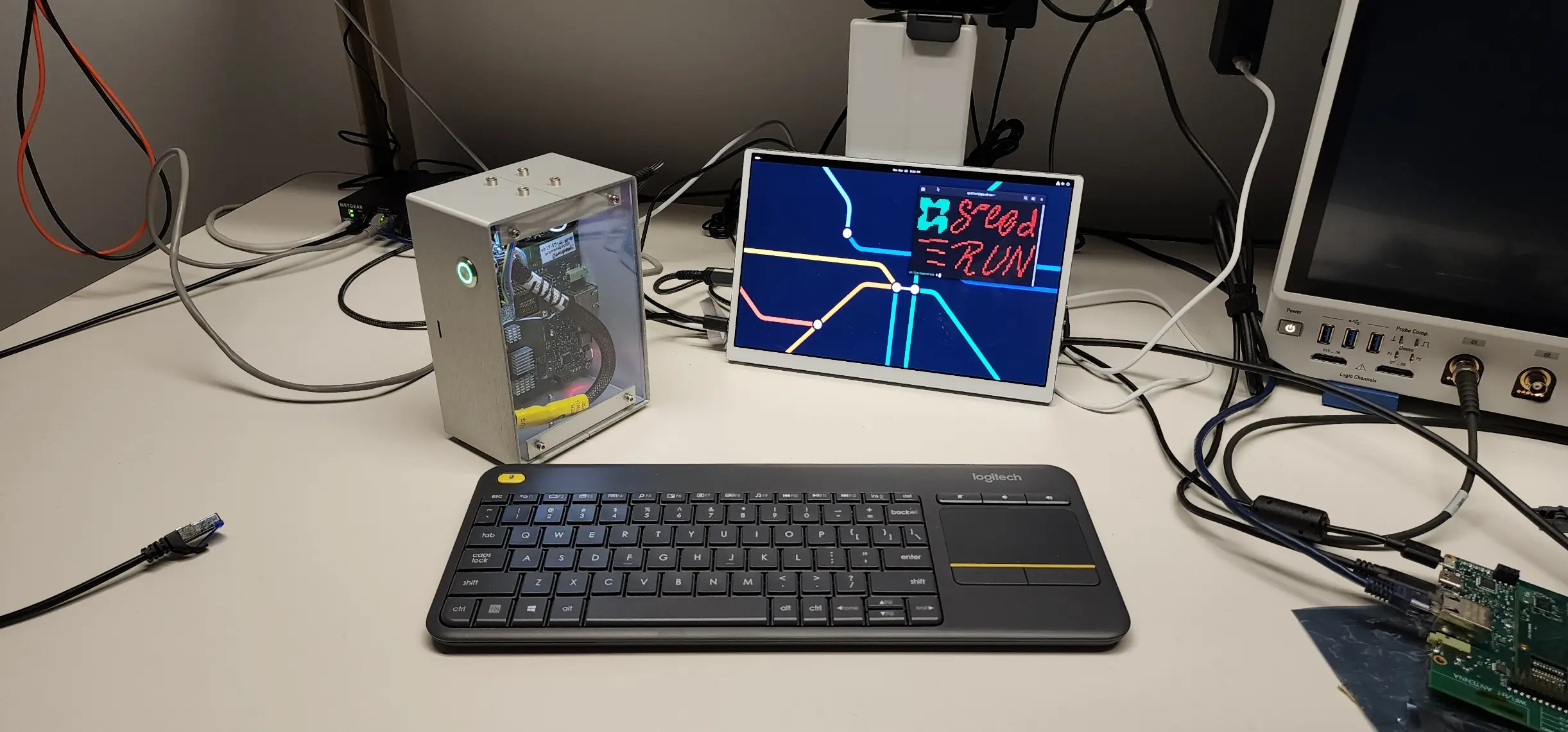
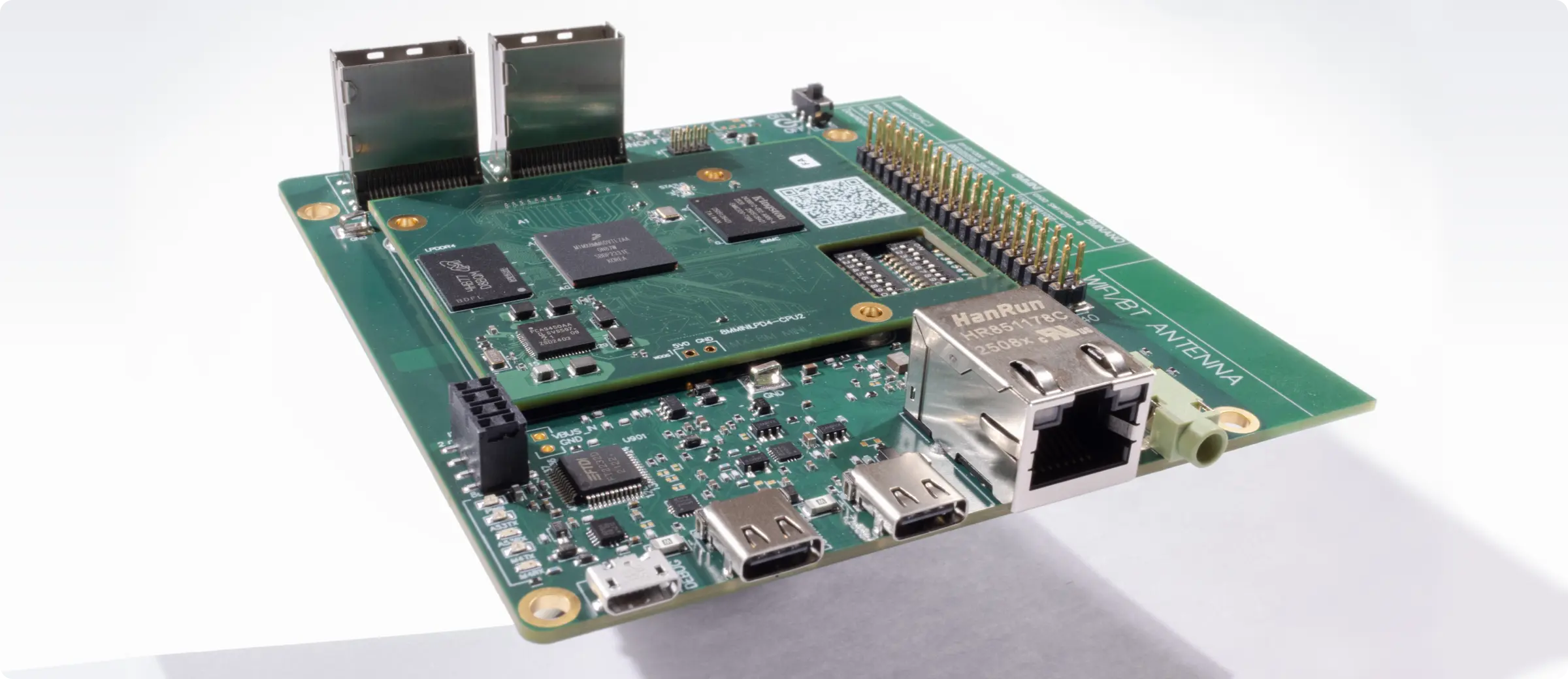
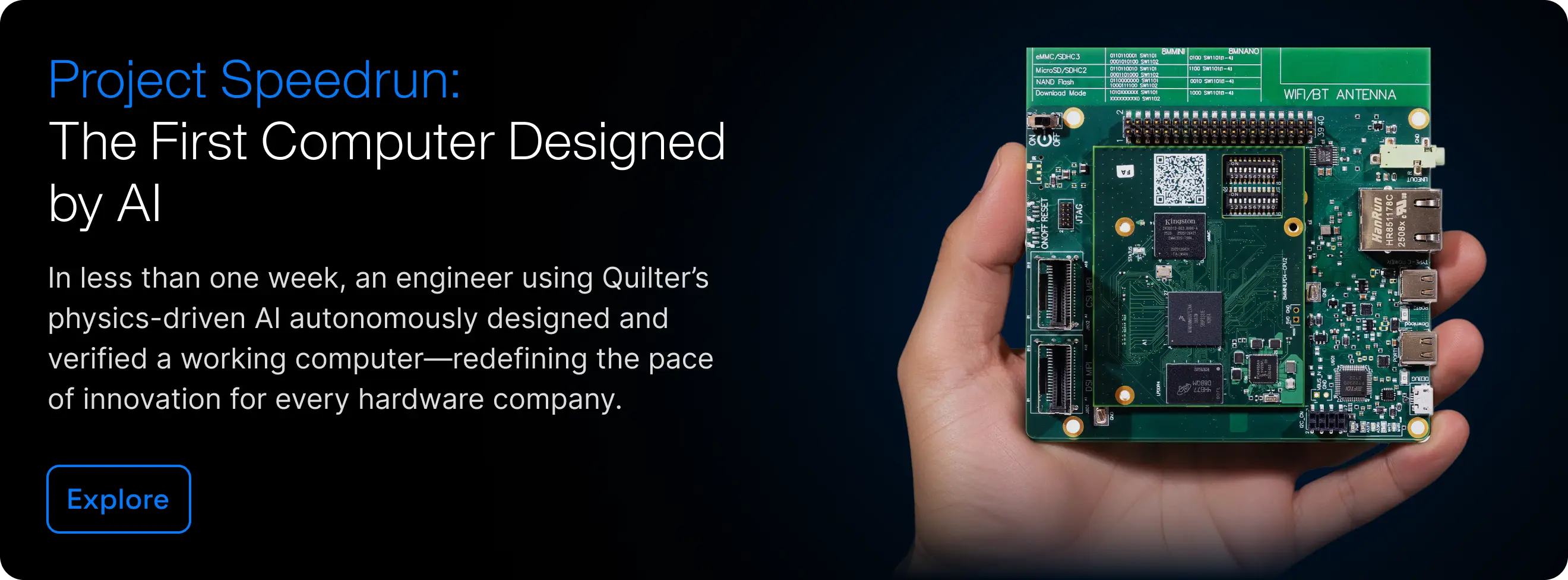
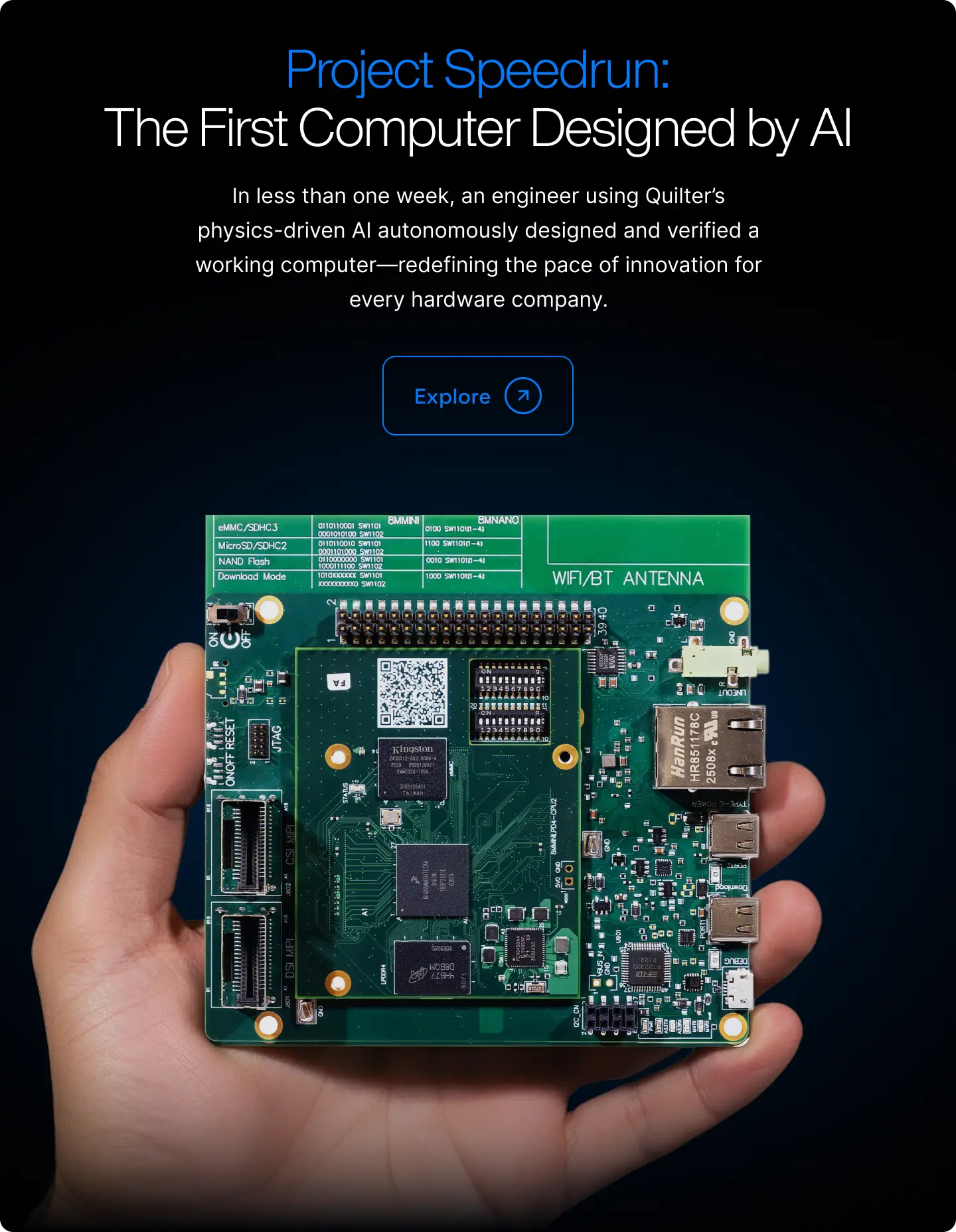
This article is one part of a walkthrough detailing how we recreated an NXP i.MX 8M Mini–based computer using Quilter’s physics-driven layout automation.
If you’ve ever kicked off Altium’s autorouter on a dense, high-speed board, you already know the pattern: low completion, broken diff pairs, and hours of tedious cleanup. In 2026, you finally have another option. This article pits Altium’s built-in autorouting against Quilter’s physics-driven AI, so you can see how each performs on the kinds of boards that actually block your schedule.
Let’s define what engineers really mean by “autorouter” today
When engineers say “autorouter,” they usually mean a built-in feature in a PCB CAD tool that automatically connects unrouted nets after the designer has already done the hard part: placement and constraint definition.
Historically, most autorouting falls into two broad buckets:
- Grid-based autorouting: the classic approach that discretizes space into a grid and searches for paths through that grid. It can be fast, but it tends to produce “machine-looking” routing with unnecessary jogs, extra vias, and awkward neck-downs.
- Shape-based autorouting: a more modern approach that works with real copper geometry and obstacles more naturally. This usually looks cleaner than grid routing, but it still struggles when the problem becomes globally constrained (timing, return paths, escape patterns, layer transitions, EMI risk).
In tools like Altium (and similarly in OrCAD, PADS, and other suites), the real-world flow looks like this:
- Manual placement and floorplanning
- Enter constraints and design rules
- Run an autoroute pass to get first-pass connectivity
- Spend significant time cleaning up topology, vias, diff pairs, and layer transitions
- Repeat as constraints tighten and ECOs arrive
The expectation is reasonable. Engineers want faster first-pass connectivity, acceptable topologies, and less grunt work. The catch is that many marketing descriptions of autorouting assume the board is lightly constrained, sparsely populated, and operating at low to mid speeds. The moment you introduce tight BGA breakouts, multiple impedance-controlled interfaces, mixed-signal isolation, and real power integrity needs, the “push button routing” story breaks down.
That gap is why “PCB autorouting alternatives” is now a real search category. Senior designers are not looking for magic. They are looking for a tool that delivers credible, high-speed results with less cleanup, fewer surprises in the lab, and fewer late-stage rescue cycles.
Here’s why classic autorouting struggles on real high-speed boards
Altium’s autorouter is not “bad.” It is doing what built-in autorouters have always done: optimize local geometry under a set of mostly geometric rules. The problem is that modern high-speed hardware fails for system-level reasons, not just local clearance violations.
Here are the failure modes designers repeatedly see on dense boards:
- Low completion rates once routing corridors tighten, keepouts stack up, and escape routing competes for the same channels
- Via farms and layer thrash where the router finds connectivity, but at the cost of excessive transitions, poor reference continuity, and routing that is painful to review
- Broken diff pair symmetry, where pairs are technically connected but not matched in geometry or coupling quality across the route
- Length-matching violations or “technically matched but practically risky” routes where the topology introduces discontinuities, stubs, or inconsistent reference behavior
On high-speed designs, these mechanical outcomes translate into physics problems:
- Impedance discontinuities from frequent neck-downs, abrupt bends, or inconsistent coupling in diff pairs
- Stubs and resonances are introduced by unnecessary vias or fan-out patterns that were not chosen with signal behavior in mind
- Reference plane transition issues where signals jump layers without clean return paths, creating noisy return currents and coupling into sensitive regions
- Noisy return paths that show up later as jitter, EMI headaches, or analog noise that is hard to root-cause
The core limitation is not “lack of settings.” It is that classic autorouting optimizes routing segments in isolation. It does not reliably reason about the end-to-end behavior of a net, a channel, or a bus in the way a senior SI-aware designer does. It also does not co-optimize placement with routing, where much of the high-speed success is determined.
And the knock-on effects are not subtle:
- Extra ECO loops because the first routed attempt forces placement changes anyway
- More re-spins or lab surprises because “DRC clean” is not the same as “high-speed clean.”
- Senior engineers pulled into late-stage routing rescue instead of architecture, bring-up, or validation work
If you are a manager, this looks like “layout is behind again.” If you are the designer, it looks like a familiar grind: you spend your best hours on cleanup that does not advance the product.
That is the opening for a different approach to high-speed PCB layout automation, one that treats physics and constraints as first-class and treats placement and routing as one combined problem.
How does Quilter’s physics-informed AI actually work?
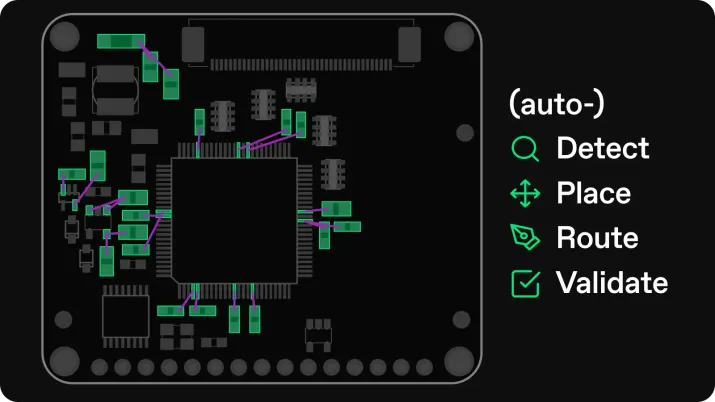
Quilter is not an “autorouter button.” Quilter is a placement-and-routing system that treats the board as a constrained optimization problem and iterates through candidates until it finds solutions that satisfy the physical constraints you care about.
The practical difference is this: classic autorouting usually starts after placement is already “locked.” Quilter co-optimizes placement and routing so that the router is not forced to solve an impossible maze.
Co-optimization instead of bolt-on routing
In Quilter, you can define the board outline, pre-place critical connectors, set no-go regions, and enforce keepouts. But the system is not limited to routing around a fixed floorplan. It can explore placements and routing together, which matters a lot for:
- BGA escape efficiency
- DDR and high-speed bus topology
- Sensitive analog isolation and return path quality
- Power distribution and decoupling adjacency
Physics-informed PCB design, not just geometry
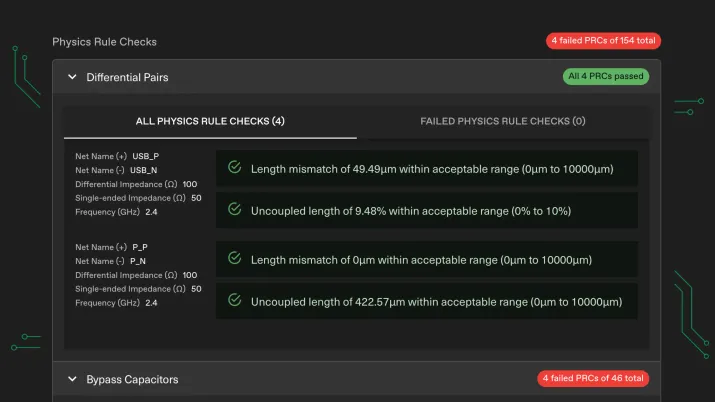
Quilter’s workflow is designed around “physics-aware design review” rather than “did it connect.” It identifies key considerations that high-speed teams care about, including:
- Bypass capacitors and decoupling intent
- Impedance-controlled nets and differential pairs
- Return path constraints and reference continuity assumptions
- High-speed routing patterns that are likely to reduce SI risk
This is where the term “physics-informed PCB design” matters. It is not claiming you can skip engineering judgment. It claims the system is explicitly designed to optimize toward high-speed survivability, not just DRC compliance.
Reinforcement learning plus validation loops
Quilter uses reinforcement learning to actively explore thousands of candidate boards. Conceptually, it looks like this:
- Generate candidate placements and routes
- Evaluate against the constraints you provided
- Score each candidate based on how well it satisfies those constraints
- Iterate and refine toward better candidates
- Return multiple viable options for engineering review
Instead of a single “best effort” autoroute, you get an iterative search that produces options. This is a significant mindset shift for teams that have operated under “one layout, one schedule.”
Deterministic handoff into your CAD tool
A practical concern with any AI layout tool is: “Will it break my workflow?” Quilter’s positioning is explicit: it works with existing workflows. You can upload projects from Altium, Cadence, Siemens, or KiCad, define constraints and must-place items, then get back files in the same format so you can run DRC, polish, and generate fab outputs in the CAD tools you already use.
For Altium-first teams specifically, this means Quilter can serve as an Altium competitor for routing capacity without replacing Altium as the system of record for documentation, output jobs, manufacturing packages, and revision control.
Quilter vs. Altium autorouter: what does the layout outcome really look like?
To make this comparison concrete, the only fair test is a controlled bake-off:
- Same schematic
- Same stack-up
- Same rules and constraints
- Same board outline and keepouts
- Same must-place connectors and mechanical constraints
Then you run:
- Left: Altium autorouter result
- Right: Quilter AI physics-informed routing result
What you typically see in the outcome
On boards that are genuinely high-speed and dense, the differences tend to show up in a few visible ways:
- Via count and via placement discipline: autorouters often “solve” congestion by adding transitions. Quilter’s candidate search can reduce unnecessary transitions because it is not stuck with a single placement.
- Path smoothness and readability: high-speed review is partly about inspection efficiency. A layout that is easier to read is easier to sign off on. Cleaner routes are not just aesthetic; they reduce review time.
- Diff pair matching quality: not just length, but coupling consistency, symmetry through breakouts, and fewer odd discontinuities.
- Fan-out quality around BGAs: classic autorouting can generate patterns that are technically connected but awkward to validate and difficult to clean.
- Layer usage patterns: less “layer thrash” usually means better return path continuity and fewer late-stage surprises.
Cleanup effort is the real hidden metric
Teams often compare routers by “Did it route?” That is the wrong question. The real question is: How many engineering hours are required after the run to make the layout reliable?
A representative internal style test narrative looks like this:
A team takes a mixed-signal validation board with a DDR interface, an RF-adjacent analog section, and a dense power stage. They run Altium Autorouter to achieve connectivity, then spend the next two days cleaning up diff pairs, reworking BGA escape, reducing vias, and patching return-path issues caused by layer transitions. The result is usable, but the schedule did not really improve, and the senior SI engineer still has to review every risky segment.
They run the same project through Quilter, lock the must-place constraints, and generate multiple candidates. The outcome still requires engineering review, but the effort shifts from “manual rescue” to “review and polish.” Instead of days of cleanup, the team spends hours selecting the best candidate, doing targeted improvements, and producing manufacturing outputs in Altium.
The point is not that Quilter eliminates expertise. The point is that it keeps expertise focused on decisions that matter, not on repetitive cleanup.
Small comparison table
Here is a simple, scannable summary of what most teams care about when searching “competitors to Altium auto-route.”
Criteria
Altium autorouter
Quilter AI routing
Completion rate on dense, constrained boards
Often limited by congestion and fixed placement
Typically higher due to placement + routing co-optimization
Cleanup time after routing
Often hours to days on high-speed boards
Often review + light polish, not full reroute cleanup
SI awareness beyond geometric rules
Limited, mostly rule-driven geometry
Physics-informed constraint evaluation and review signals
Placement integration
Mostly separate from autorouting
Integrated co-optimization of placement and routing
Iteration approach
One primary outcome per run
Multiple candidates in hours for selection and comparison
Role in workflow
Built-in convenience feature
Capacity multiplier that returns native CAD projects
If you want your content to rank for “PCB autorouting alternatives,” tables like this help because they answer the question directly and quickly.
Run a low-risk bake-off
Try the simplest experiment that settles the debate in your team:
- Export one real Altium project that includes at least one high-speed interface
- Run Altium autorouter with your standard constraints
- Upload the same project to Quilter and generate candidates
- Compare completion rate, cleanup time, via count, and SI risk indicators
Go to Quilter and click Get Started, then upload an Altium project to generate your first physics-validated candidates in hours.
What results can you expect when you switch from an autorouter to Quilter?
Results vary by board class, but the pattern Quilter is optimized for is consistent: layout becomes fast and abundant, so engineering decisions happen earlier, and iteration becomes normal.
Typical timeline shifts
For many teams, the practical shift looks like this:
- Layout cycles that used to take weeks can be reduced to hours for first-pass candidates
- First candidates can appear quickly enough to change a decision mid-sprint, not after the sprint
- You can test multiple stack-ups, manufacturers, or form factors in parallel instead of serially
This matters because the shipping board is rarely your first choice. When the layout is scarce, you make architecture decisions without seeing the routing reality. When layout is abundant, routing reality informs architecture earlier.
Representative outcomes teams care about
When teams move from “autorouter plus cleanup” to Quilter AI routing, the gains often show up as:
- Higher completion rates on dense BGA designs because placement is not frozen into an impossible corner
- Fewer SI and PI surprises in the lab because routing topology and transitions are more constrained-aware
- Fewer late-stage ECO loops because early candidates expose real constraints sooner
Quilter’s solution positioning lines up with board types where routing bottlenecks dominate schedules:
- Test fixtures and harness-adjacent boards where speed matters and iteration is frequent
- IC evaluation boards where dense escape and clean buses drive bring-up success
- Design validation boards where you need fast iteration without losing credibility
- Backplanes and interconnect boards, where constraints and layer usage discipline are critical
For R&D managers, this is about schedule and throughput. For PCB designers, it is about reclaiming time for the hardest constraints and the most sensitive review decisions. For electrical engineers, it is about iterating architecture and proving ideas faster.
Here’s how Quilter fits into an Altium-first workflow
If your team is Altium-first, you do not want a new CAD religion. You want more throughput without breaking your existing toolchain. Quilter is designed to drop into that reality.
The round-trip flow
A typical Altium-first workflow looks like:
- Start in Altium as normal: schematic, constraints, classes, differential pairs, rules
- Export the project for a round-trip into Quilter
- Upload into Quilter, define board outline, and must-place items
- Run Quilter to generate candidates
- Re-import the returned Altium project files
- Run DRC, review, polish, then generate fab outputs inside Altium
What stays in Altium vs what Quilter uses
- Constraints that are already encoded in the Altium design rules and net classes can be preserved through the round-trip
- Quilter can also infer and surface high-speed considerations such as diff pairs, impedance-controlled nets, and bypass capacitor intent, so you can review what it will and will not account for up front
- You keep control by locking critical placements, enforcing keepouts, and specifying no-go regions
The goal is not to take control away. The goal is to remove the slowest part of the layout: the part that consumes weeks of calendar time and forces you to accept one layout outcome.
Export and import settings
Below are example settings you can include in your internal runbook so teams do not break constraints during a bake-off. Treat these as “sanity checklist” items. Adapt naming to your Altium version and team standards.
Altium export checklist for Quilter round-trip
- Ensure design rules are up to date:
- Differential pair rules (width, gap, coupling expectations)
- Impedance-controlled net classes (widths by layer)
- Length matching constraints (as applicable)
- Clearance rules and manufacturing constraints
- Confirm board outline and keepouts:
- Board shape defined
- Mechanical keepouts set
- Component keepouts set where required
- Lock must-place components before export:
- Connectors, mounting holes, shields, critical RF parts
- Any components with fixed mechanical alignment
- Save project and verify:
- Compile project, run ERC if applicable
- Run DRC pre-export to confirm baseline
Quilter setup checklist for fair comparison
- Upload the exported Altium project
- Confirm:
- Stack-up selection matches the Altium stack-up used for autoroute
- The same board outline and keepouts are present
- Define constraints and must-place items:
- Lock critical connector placement
- Mark no-go regions and keepouts
- Confirm diff pairs and impedance nets are recognized
- Generate multiple candidates:
- Run enough candidates to compare tradeoffs (via count, layer usage)
Altium re-import checklist after Quilter run
- Open the returned Altium project files
- Run DRC immediately:
- Confirm clearance, widths, diff pair rules, and net classes remain correct
- Validate high-speed nets:
- Review diff pairs for coupling and symmetry through breakouts
- Inspect layer transitions in critical paths
- Check length matching status where required
- Final polish:
- Minor reroutes, silkscreen cleanup, documentation, output jobs
When does a traditional autorouter still make sense?
It is worth saying out loud: there are times when Altium autorouter is the right tool.
If the board is simple, low-speed, and lightly constrained, an autoroute pass plus quick cleanup can be perfectly sufficient. The built-in tool is convenient, and the cost of switching context is not worth it.
Classic autorouting also remains useful for:
- Last-minute ECOs where you need to patch a small set of nets quickly
- Tiny utility boards where the layout is not schedule-critical and the review burden is low
A pragmatic hybrid strategy is common in mature teams:
- Use Quilter for high-value boards where timing, SI risk, and dense routing dominate the schedule
- Keep built-in autorouting for trivial work and quick patches where the cleanup is genuinely minimal
The key framing is this: Quilter is not a CAD replacement. It is high-speed PCB layout automation that multiplies design capacity across the existing tool stack.
How to run your first “Quilter vs. autorouter” bake-off on a live design
If you want a bake-off that your best designers will respect, it needs to be controlled, measurable, and based on a real project. Here is a checklist you can follow.
Step 1: Pick the right test design
Choose a real in-flight design that includes at least one of these:
- BGA escape with tight routing corridors
- DDR, SerDes, PCIe, USB, or other high-speed interface sections
- Sensitive analog area adjacent to switching power or digital buses
Avoid a toy board. The point is to test the failure modes that matter.
Step 2: Define controlled conditions
To keep the comparison honest:
- Use the same stack-up in both runs
- Use the same design rules and constraints
- Use the same board outline and keepouts
- Lock the same must-place components in both workflows
If your team debates “fairness,” you are doing it right.
Step 3: Run both flows and capture artifacts
Run Altium autorouter using your standard approach. Capture:
- Final completion percentage
- Total via count (overall and in critical areas)
- Time spent on cleanup to reach “reviewable quality.”
- Screenshots of key regions (BGA escape, diff pair routes, layer transitions)
Then run Quilter with the same constraints and capture:
- Best candidate and runner-up candidates
- Via count and layer usage patterns
- Time spent selecting and polishing a candidate
- The same screenshot set
Step 4: Evaluate using criteria that matter
Use a small scorecard that senior designers will accept:
- Completion rate: what percentage of nets are cleanly routed without hacks
- Cleanup time: how many engineer-hours to reach sign-off quality
- Via count and layer changes: a proxy for transitions and potential return path risk
- SI risk indicators: reference plane transitions, discontinuities, odd neck-downs, diff pair coupling consistency
- Readability and reviewability: how fast can a senior engineer approve the result
Step 5: Socialize the result internally
Document the outcomes in a short internal memo with screenshots, numbers, and what you learned. Bring it to:
- The PCB design lead who owns sign-off standards
- The EE lead who owns the SI risk and brings up accountability
- The R and D manager who owns the schedule and throughput
If Quilter wins on cleanup time and completion rate for your real design, the decision is clear.
What you need to know about pricing, access, and next steps
If you are evaluating PCB autorouting alternatives in 2026, pricing structure matters because it shapes who can iterate. Quilter’s model is positioned around scaling by pin count rather than per-seat constraints, which can make it easier for entire organizations to iterate without routing capacity becoming a bottleneck.
Access paths are designed to reduce friction for evaluation:
- A free tier for trying the workflow
- A startup program for teams racing toward product-market fit
- Enterprise options for mission-critical environments and support needs
For teams that care about data security and IP handling, treat evaluation as you would any tooling decision: review vendor documentation, confirm internal policies, and align with your security requirements.
Best next step: run the bake-off. Upload a real Altium project, lock your must-place constraints, generate candidates, and compare against your current Altium autorouter workflow using completion rate and cleanup time as the primary metrics.
FAQ
Is Quilter a replacement for Altium?
No. Quilter is designed to work with your existing workflow. Altium remains the system of record for schematic capture, documentation, DRC checks, output jobs, and manufacturing packages. Quilter functions as a capacity multiplier for placement and routing, then hands back native project files.
Can I still edit the layout in Altium after Quilter generates it?
Yes. The intent is for you to re-import the returned project into Altium, run the DRC, and then polish, document, and finalize fabrication outputs as you normally would.
Does Quilter specifically support high-speed constraints such as differential pairs and impedance-controlled nets?
Quilter is built around physics-informed PCB design and surfaces high-speed considerations, such as differential pairs and impedance-controlled nets, for review, with candidate evaluation aimed at producing more credible high-speed outcomes than traditional geometry-first autorouting.
What is the lowest-risk way to evaluate Quilter?
Pick one real design that has historically been painful to route, run a controlled bake-off with the same constraints and stack-up, and compare completion rate, via count, layer transitions, and cleanup time to reach sign-off quality.
Final note for teams searching “competitors to Altium auto-route”
If your board is truly high-speed, the bottleneck is rarely “finding any path.” The bottleneck is producing a layout you can trust without burning days in cleanup. That is the real head-to-head: not autoroute vs AI as a concept, but “connectivity with cleanup” vs “physics-aware candidates with faster review.”
If you want a low-risk proof, run the bake-off. It is the fastest way to see whether Quilter AI routing can replace weeks of routing grind with hours of candidate generation and focused engineering review.



.webp)