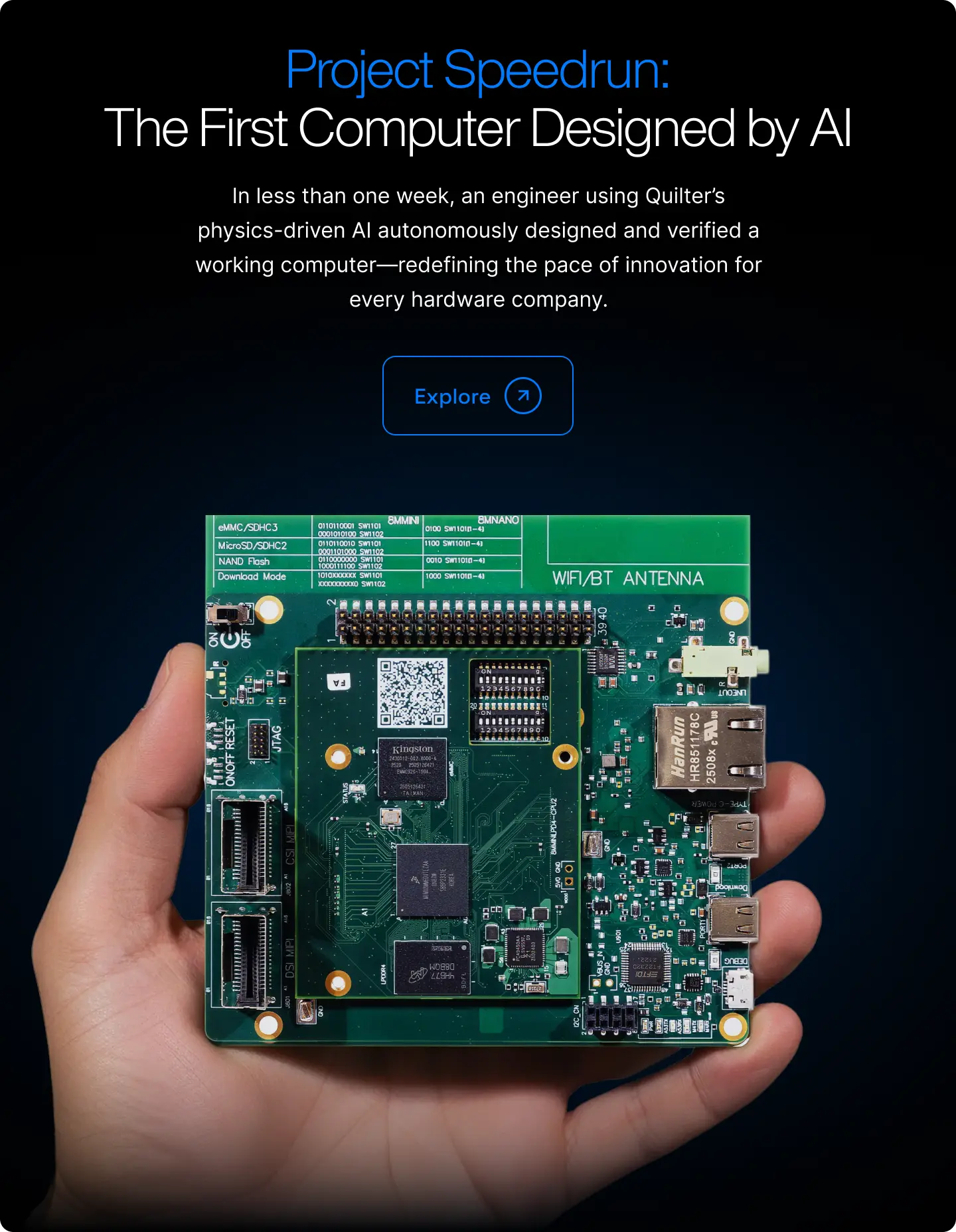
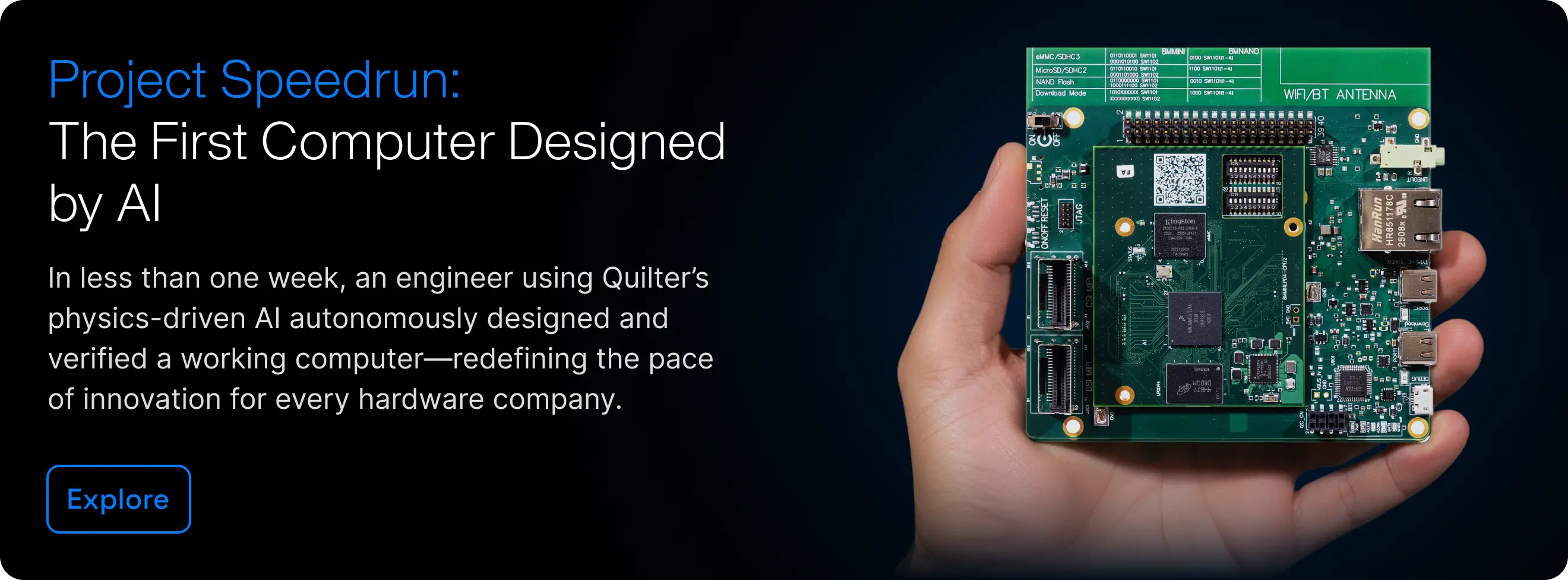
Project Speedrun: Der erste von KI entworfene Computer
Mehr erfahren
Quilter
Produkt und Technologie

Alle

Überblick

Mehrere Kandidaten in Stunden erzeugen. Physik validiert jede Leiterbahn.

Technologie

Quilter nutzt Reinforcement Learning, um Tausende erzeugte Platinenkandidaten aktiv zu untersuchen.

Workflow

PCB-Design bleibt eine wichtige Disziplin. Entwickler müssen ihre Zeit jedoch nicht für nebensächliche Layoutaufgaben aufwenden.

Lösungen

Nach Designtyp

Prüfvorrichtungen und Kabelbäume

Verkürzen Sie die Inbetriebnahme um 4–6 Wochen

IC-Evaluierungsplatinen

Verkürzt Layoutzyklen von Wochen auf Stunden und ermöglicht schnelle Designiterationen mit fertigungsreifen Ergebnissen

Platinen zur Designvalidierung

Verkürzt Validierungszyklen von Monaten auf Tage

Backplanes und Verbindungsplatinen

Von 30+ Tagen auf unter 24 Stunden

Nach Branche

Halbleiter

Innerhalb eines Arbeitstags bereit für die Inbetriebnahme; erste Kandidaten liegen oft schon in der ersten Stunde vor.

Robotik

Verkürzen Sie die Inbetriebnahme von 4 Wochen auf unter 1 Tag

Konsumelektronik

Platinen innerhalb eines Arbeitstags fertig; erste Kandidaten liegen oft schon in der ersten Stunde vor

Luft- und Raumfahrt sowie Verteidigung

Schnellere Platineninbetriebnahme für Validierung und TRR

Nach Rolle

R&D-Manager

Beschleunigen Sie die Platineninbetriebnahme

PCB-Designer

Vollständige, fertigungsreife Designs in unter 4 Stunden

Elektroingenieure

Vom Schaltplan zur Fertigungsreife in unter 4 Stunden

Ressourcen

Alle

Blog

Produktupdates, technische Einblicke und Unternehmensnachrichten vom Quilter-Team.

Workbench

Ein Mikroblog mit Einblicken hinter die Kulissen unserer Hardwareprojekte und der KI, die sie entwirft.

Hardware-Rich Development

Wie physikbasierte KI schnellere Hardwareprogramme mit mehr Iterationen ermöglicht.

Dokumentation

Ein Überblick über Quilters Funktionen, mit denen Sie fertigungsreife Leiterplatten in Stunden statt Wochen erzeugen, untersuchen und optimieren.

Änderungsprotokoll

Quilter verbessert sich mit jeder Veröffentlichung. Hier finden Sie Neuheiten, Änderungen und einen Ausblick auf die nächsten Entwicklungen.

Community

Stellen Sie Fragen, teilen Sie Projekte und erhalten Sie Hilfe bei realen Platinen – von anderen Nutzern und unserem Team.

Project Speedrun: Der erste von KI entworfene ComputerProject Speedrun: Der erste von KI entworfene ComputerProject Speedrun: Der erste von KI entworfene Computer
Preise
Unternehmen

Alle

Über uns

Karriere

Kontakt

Support

Presse

Quilter für Startups

Quilter kostenlos nutzen

Einblicke ins Team

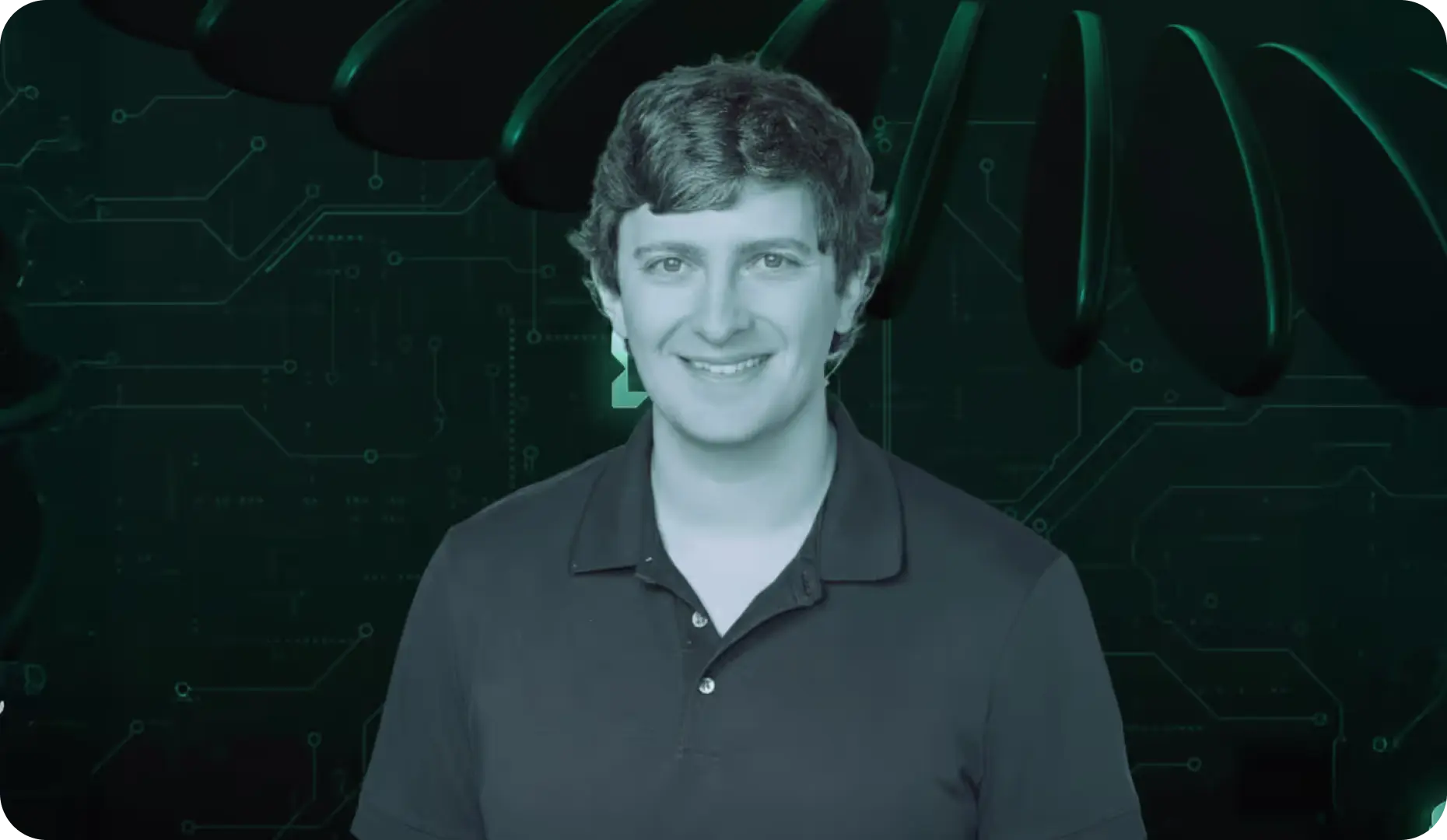
Titelbild für: Groß denken, Regeln brechen – ein Kamingespräch mit Sergiy Nesterenko

Groß denken, Regeln brechen – ein Kamingespräch mit Sergiy Nesterenko

Offene Stellen

Im Fokus

Senior/Staff Software Engineer (C++)
US Time zone
Full time
Remote
Engineering
Bewerben
Senior/Staff Backend Engineer - PCB CAD Integration
US Time zone
Full time
Remote
Engineering
Bewerben
Senior/Staff ML Systems Engineer
US Time zone
Full time
Remote
Engineering
Bewerben
English
日本語
German
Anmelden
Mit einem Entwickler sprechen
English
日本語
German

Legal

Service Level Agreement

Last Update | July 11, 2025

SERVICE LEVEL AGREEMENT

This “Service Level Agreement” is made a part of and incorporated by reference into the [Order Form and Agreement] between Quilter and Customer.

  1. Definitions. For purposes of this Service Level Agreement, the following terms have the meaning ascribed to each term below:

“Downtime” means if Customer is unable to access the Service by means of a web browser as a result of failure(s) in the Service or architecture, as confirmed by Quilter. 

“Monthly Uptime Percentage” means the total number of minutes in a calendar month minus the number of minutes of Downtime suffered in a calendar month, divided by the total number of minutes in a calendar month.

“Service Credit” means the number of days that Quilter will add to the end of the Term, at no charge to Customer.

  1. Service Level Warranty. During the Term, the Service will be operational and available to Customer at least 99.5% of the time in any calendar month (“Service Level Warranty”).  If the Monthly Uptime Percentage does not meet the Service Level Warranty in any calendar month, and if Customer meets its obligations under this Agreement, then Customer will be eligible to receive Service Credit as follows:  
Uptime Days Credited
< 99.5% – ≥ 98.0% 3
< 98.0% – ≥ 95.0% 7
< 95.0% 15
  1. Customer Must Request Service Credit.  In order to receive Service Credit, Customer must notify Quilter within 30 days from the time Customer becomes eligible to receive a Service Credit under the terms of this Agreement.  Failure to comply with this requirement will forfeit Customer’s right to receive Service Credit.
  2. Maximum Service Credit. The aggregate maximum amount of Service Credit to be issued by Quilter to Customer for all Downtime that occurs in a single calendar month will not exceed 15 days.  Service Credit may not be exchanged for, or converted into, monetary amounts.
  3. Exclusions. The Service Level Warranty does not apply to any performance issues that: (i) are caused by riots, insurrection, fires, flood, storm, explosions, acts of God, war, terrorism, earthquakes, or any other causes that are beyond Quilter’s reasonable control so long as Quilter uses commercially reasonable efforts to mitigate the effects of such force majeure; (ii) resulted from Customer’s equipment or third party equipment or service (e.g. Customer’s internet connection), or both; or (iii) resulted from Customer’s violation of the Agreement.
  4. Exclusive Remedy.  This Service Level Agreement sets forth Customer’s sole and exclusive remedy for any failure by Quilter to meet the Service Level Warranty.
  5. Chronic Failure & Termination Right. Customer shall have the right to terminate the Agreement upon notice to Quilter in the event Quilter fails to substantially comply with the Service Level Warranty as follows: (a) if the Service Level Warranty is not met on two (2) or more separate occasions in a 1 month period; or (b) if the Service Level Warranty is not met on three (3) or more separate occasions in a 6 month period.

SUPPORT SERVICES SCHEDULE

This Support Services Schedule to the ___ is made a part of and incorporated by reference into the Agreement between Quilter and Customer and sets forth the terms on which Quilter provides technical support (“Support”) to Customer (“Support Terms”) for the Software and/or Service.

  1. Definitions.

“Error” means a failure of the Software and/or Service to conform to the published specifications, resulting in the inability to use, or material restriction in the use of, the Software and/or Service.

“Escalation” means the process by which Quilter will work continuously, and at multiple levels of its organization, to resolve an Error if not resolved within the specified Resolution Time set forth in Section 4, below.

“Start Time” means the time at which Quilter first becomes aware of an Error during Quilter’s regular business hours, following initiation of a Support case by Customer in accordance with Sections 2 and 3, below.

  1. General. During a Subscription Term, Quilter will provide the Support described in these Support Terms. Quilter provides Support during normal business hours (9am – 5pm, Pacific time, Monday - Friday).
  2. Contacts. Customer may initiate a Support case by emailing support@quilter.ai or such other customized email alias provided by Quilter to Customer from time to time. Customer may initiate an unlimited number of Support cases.
  3. Priority Levels and Timeframes. Quilter will establish the Priority Level of an Error and the corresponding Support case in its sole discretion and will use its best efforts to adhere to the Response Times and Resolution Times set forth below. If an Error is not addressed within the Resolution Time set forth below, Quilter will commence an Escalation. Response Times and Resolution Times are calculated from the Start Time. 
    1. Response & Resolution Times for Cloud Deployment Types:
Priority Level Description Response Time Resolution Time
1 Major Impact: The Service is inoperable with a serious degradation in performance due to an Error in the Service where all Authorized Users cannot reasonably continue to use the Service because of the Error, the Error cannot be circumvented with a workaround, and it affects End User's ability to perform its business. up to 2 hours up to 8 hours
2 Moderate Impact: An Error in the Service for all Authorized Users causes performance to be significantly degraded such that use of the Service is materially impaired, but the Error can be circumvented with a workaround. up to 4 hours up to 24 hours
3 Minor Impact: An Authorized User experiences a performance, operational, or functional issue in its use of the Service, attributed to an Error in the Service, that can be circumvented with a workaround, and the Error causes only minimal impact to the User's ability to use the Service. up to 24 hours up to 3 days
  1. Response & Resolution Times for Self-Hosted Deployment Types:
Priority Level Description Response Time Resolution Time
1 Major Impact: The Software is inoperable with a serious degradation in performance due to an Error in the Software where all Authorized Users cannot reasonably continue to use the Software because of the Error, the Error cannot be circumvented with a workaround, and it affects Authorized User's ability to perform its business. up to 6 hours up to 24 hours
2 Moderate Impact: An Error in the Software for all Authorized Users causes performance to be significantly degraded such that use of the Software is materially impaired, but the Error can be circumvented with a workaround. up to 12 hours up to 3 days
3 Minor Impact: An Authorized User experiences a performance, operational, or functional issue in its use of the Software, attributed to an Error in the Software, that can be circumvented with a workaround, and the Error causes only minimal impact to the Authorized User's ability to use the Software. up to 3 days up to 15 days
  1. Conditions, Exclusions, and Termination.
    1. Conditions. Quilter’s obligation to provide Support is conditioned upon the following: (i) Customer makes reasonable efforts to solve the Error after consulting with Quilter; (ii) Customer provides Quilter with sufficient information and resources to correct the Error, as well as any and all assistance reasonably requested by Quilter; and (iii) Customer procures, installs, and maintains all equipment, telephone lines, communication interfaces and other hardware necessary to access and operate the Software and/or Service. 
    2. Exclusions. Quilter is not obligated to provide Support in the following situations: (i) the problem is attributable solely to Customer’s Input including where such Input does not conform to the Quilter specifications within the Documentation; (ii) the problem caused by Customer’s negligence, hardware malfunction, or other causes beyond the reasonable control of Quilter; (ii) the problem is with third party software not licensed through Quilter; or (iii) Customer fails to pay any amount that is payable to Quilter within the timeframe for payment specified in the Agreement. 
    3. Termination. Quilter reserves the right to conclude its performance of a Support case when, in its reasonable discretion, Quilter determines that it has provided a satisfactory resolution or workaround to the Error.
    4. Chronic Failure & Termination Right. Customer shall have the right to terminate the Agreement upon notice to Quilter in the event Quilter fails to substantially comply with these Support Terms as follows: (a) with respect to Priority 1 Errors, on two (2) or more separate occasions; or (b) with respect to Priority 2, 3, Errors, substantially comply on three (3) or more separate occasions where Customer reasonably determines that such failure to comply has materially impacted the Software and/or Service.

‍

Abonnieren Sie unseren Newsletter

Quilter
Produkt
Über uns
Preise
Blog
Karriere
Kostenlose Version
Startup-Programm
Ressourcen
Support-Übersicht
Dokumentation
Community
Hilfe-Center
Unternehmen
Nutzungsbedingungen
Datenschutzerklärung
Cookie-Einstellungen
Folgen Sie uns
Rechtliches
Nutzungsbedingungen
Datenschutzerklärung
Cookie-Einstellungen
Lösungen

Nach Designtyp

Prüfvorrichtungen und Kabelbäume

Verkürzen Sie die Inbetriebnahme um 4–6 Wochen

IC-Evaluierungsplatinen

Verkürzt Layoutzyklen von Wochen auf Stunden und ermöglicht schnelle Designiterationen mit fertigungsreifen Ergebnissen

Platinen zur Designvalidierung

Verkürzt Validierungszyklen von Monaten auf Tage

Backplanes und Verbindungsplatinen

Von 30+ Tagen auf unter 24 Stunden

Nach Branche

Halbleiter

Innerhalb eines Arbeitstags bereit für die Inbetriebnahme; erste Kandidaten liegen oft schon in der ersten Stunde vor.

Robotik

Verkürzen Sie die Inbetriebnahme von 4 Wochen auf unter 1 Tag

Konsumelektronik

Platinen innerhalb eines Arbeitstags fertig; erste Kandidaten liegen oft schon in der ersten Stunde vor

Luft- und Raumfahrt sowie Verteidigung

Schnellere Platineninbetriebnahme für Validierung und TRR

Nach Rolle

R&D-Manager

Beschleunigen Sie die Platineninbetriebnahme

PCB-Designer

Vollständige, fertigungsreife Designs in unter 4 Stunden

Elektroingenieure

Vom Schaltplan zur Fertigungsreife in unter 4 Stunden

Hardware-Rich Development

Wie technisches Verständnis durch Reparaturen entsteht

Collin Ruzvidzo und die Entstehung von technischer Intuition

Warum neue Routing-Probleme alte Werkzeuge immer wieder an ihre Grenzen bringen

Warum die besten Signalintegritäts-Ingenieure aufhören, in Silos zu denken

Kalyan Vaddagiri über Mathematik, Multiphysik und die Zukunft des Ingenieurwesens

Abstimmung in Hardware-Teams: Warum gute Ingenieure trotzdem aneinander vorbeiarbeiten

Optimierung in der realen Hardwareentwicklung: Jacob Freking über Tempo, Reserven und Systemdenken

Simulation ist keine Validierung: Wie übermäßiges Vertrauen in Modelle Hardware-Teams ausbremst

Leiterplattenanwendungen und Constraint-Kompetenz: Warum automatisiertes PCB-Layout zuerst Physik lernen muss

Optimierung unter Nebenbedingungen im PCB-Design: Geometrie, Reinforcement Learning und die Zukunft der EDA-Automatisierung

Multikriterielle Optimierung und KI-PCB-Layout: Warum es keine optimale Platine gibt

Belohnungsfunktionen im KI-PCB-Design

Technik ist einfach. Menschen sind schwierig. Pooya Tadayon.

Richard Whitney: Wie Quilters kommissarischer Head of Product über Komplexität denkt

Keine Magie, sondern Struktur: Katie Scholl über Logik, Verantwortung und das Bauen von Dingen, die zählen

Stephanie Ngo und die unsichtbare Architektur des Fortschritts

Stelios Stavroulakis: Lernen, was man nicht tun sollte, und das Nächste entwickeln

Lernen als Disziplin, Ingenieurarbeit als Handwerk | Quilters Osman Romero

Das Mögliche im Unmöglichen finden: James Krejcarek über Werkzeuge, Vertrauen und die Freude am Entdecken

Stephen Newberry und die Disziplin der Signalintegrität

Vom FPGA zur KI: Ben über Neugier, Integrität und bessere Platinen

Von Signalen zu intelligenteren Systemen: Harshat über Mathematik, KI-Lernen und die Weiterentwicklung von Hardware

Von der Luft- und Raumfahrt zur KI: Boris über Neugier und Handwerk

Vom Silicon Valley zu Startups: Dan Gudino über Neugier und Schaltungstechnik

Von Geometrie zu Schaltungen: Chi-Han Peng über die Muster hinter allem

Von Nanometern zu neuen Dimensionen: Fei über die wiederentdeckte Freude am Schritt von null auf eins

Von CAD-Automatisierung zum Schaltungsverständnis: Jarvis Autey darüber, was Maschinen noch lernen müssen

Von Raketen zu schneller Iteration: Sam über sinnvolle Entwicklungsarbeit

Unter der Dunbar-Zahl bleiben: Nick Faughey über Infrastruktur, Agilität und die Freude am Entwickeln

Von der Forschung zum Routing: Fayaz Rahman über schnelles Lernen und intelligentere Systeme

MLOps-Entwickler: Open-Source-Wurzeln, neue Hardwaregrenzen und Fariz Rahman

Über Gleichwertigkeit hinaus: Geometrie in der KI und übermenschliche Ingenieursleistungen

Lektionen zur Versorgungsintegrität von Scott Witcher

Neugier in der Leistungselektronik: Gedanken mit Jovana Plavšić

Von GaN zu magnetischen Bauelementen: Wie Jovana Plavšić Hardware mit Neugier und Präzision entwickelt

Scott Witcher über Versorgungsintegrität, Systemdenken und bescheidene Führung

Technische Führung und Reflexion: Was es heißt, wirklich etwas aufzubauen – mit Derrek Cooper

Laser, Elektronen und der Mut, das Unmögliche zu bauen

Systementwicklung für Flugzeuge über das Review hinaus: menschliche Chemie und die leise Kunst guter Entwicklung

Was macht eine technische Führungskraft aus? Derrek Coopers Antwort

Björn Manuel Hegelich über gefährliche Laser, die Kunst des Loslassens und den Bau des nächsten Colliders von Hand

Carol Erikson über Systemdenken, technische Führung und Teams, die wirklich funktionieren

Der stille Held der Hardware: Test Engineering und Paul McDonald

Zuverlässigkeits- und fertigungsgerechtes Design: bessere Testsysteme entwickeln

Mit den Händen gestalten, mit dem Blick führen – Nancy Smith und die praxisnahe Zukunft des PCB-Designs

T-förmige Ingenieure in der Hardwareentwicklung: Transparenz und der Weg zum Generalisten

Die Freude ist die Arbeit: Nancy Smith über schöne Hardware, Platine für Platine

Transparenz, T-förmige Ingenieure und FPGAs: Interview mit Jami Friedman

Einfach ausliefern: Lektionen über Ausdauer, Tests und Teams aus Paul Robinsons Hardware-Odyssee

Was Hardware über Führung und Loslassen lehrt – mit Paul Robinson

Groß denken, Regeln brechen – ein Kamingespräch mit Sergiy Nesterenko

Hardware neu denken: Agile Lektionen von Dr. Lucas Fraile

Ingenieursarbeit ist Kunst: Hardware-Interview mit Carolina Hubbard

Die Wahrheit über Ingenieursarbeit: Wir versuchen alle nur, nicht wieder alles neu zu entwerfen

Design für Qualität: Erkenntnisse von Dr. Lucas Fraile

© 2026 Quilter AI. Alle Rechte vorbehalten.