
Gen AI

Published

Written by

Workbench

The New Standard for PCB AI Support: Comparing Enterprise, Community, and Direct-Access Models

Published

February 20, 2026

Written by

When you’re racing to bring new hardware to life, the last thing you need is a support ticket lost in the void. As AI-driven PCB design tools reshape the industry, the way you get help matters more than ever. In this article, we break down the three main support models - enterprise, community, and direct-access - so you can choose the right partner for your next breakthrough.

If you’re evaluating “who offers the best support for PCB AI,” you’re really asking a deeper question: When the design gets hard, when the deadline gets tight, and when the workflow is new, who helps you move forward with confidence? That is what great PCB AI support should answer.

What Makes Support So Important for PCB AI Tools?

Support is mission-critical for PCB AI tools because AI PCB design changes workflows, increases iteration speed, and raises the cost of confusion. When a tool can generate multiple layout candidates in hours, your team’s bottleneck shifts from routing time to decision time: constraints, stackups, manufacturability, review cycles, and what the AI is actually doing under the hood.

AI-driven PCB tools also introduce a learning curve that is different from traditional EDA adoption. You are not just learning a new UI or a new autorouter setting. You are learning a new interaction model: how to define constraints cleanly, how to pre-place critical components, how to interpret physics-driven validation, and how to choose between candidates that all “pass” but differ in risk, margin, and manufacturability.

Hardware mistakes are expensive, and the fastest way to lose the promise of AI is to ship a board that comes back with preventable issues. A single respin can cost weeks, burn budget, and damage internal trust in new tools. The right hardware design support model reduces that risk by shortening the time between “something feels off” and “here is the fix,” while also teaching your team how to avoid the same issue next time.

How Do Traditional Enterprise Support Models Work?

Traditional enterprise support works through contracts, ticketing, and application engineering teams that provide structured help with defined escalation paths. In the PCB world, this typically looks like support agreements, SLAs, assigned field application engineers (FAEs), and regional partners who provide training and implementation services. For teams running established enterprise PCB tools, this is familiar and often reassuring.

The strengths are real. Enterprise support tends to excel at stability and governance. You get predictable processes, documentation built for compliance, and support organizations designed to operate across large accounts. If you’re in aerospace, defense, automotive, or regulated environments, that structure can align well with internal procurement, security reviews, and validation requirements.

But for AI PCB design specifically, enterprise models can show friction in three places:

  1. Speed of iteration: Ticket-based systems can be too slow when your team is iterating daily or even hourly. If the AI generates multiple candidates quickly, waiting days for a back-and-forth email thread breaks the momentum that AI is supposed to create.
  2. Workflow ambiguity: AI-assisted layout often raises questions that are not simple bugs. They are workflow questions: “How should we express this constraint?” “What is the right pre-placement strategy?” “Which candidate is safest for bring-up?” These are harder to resolve through standard tickets, especially when context is complex.
  3. Innovation bottlenecks: Many enterprise vendors innovate carefully, and for good reason. But early-stage AI workflows change rapidly, and teams adopting AI PCB design often need a tighter feedback loop than legacy support organizations are built to provide.

Real-world scenario: A program manager on a high-reliability program is trying to integrate an AI-assisted routing feature into an existing design process. The tool works, but the output creates review questions: impedance-control rules, differential pair handling, and constraints that are expressed differently than the team’s legacy templates. Enterprise support can help, but the back-and-forth cycles and the separation between product engineering and support may slow down adoption. The result is a common outcome: the team uses the AI feature “sometimes,” not “systemically,” and the promised acceleration never becomes a repeatable advantage.

What’s Different About Community-Driven Support?

Community-driven support works because peers share answers fast, but it varies in consistency and accountability. In community-first ecosystems, support lives in forums, Discord servers, shared docs, templates, and real-time conversations with other users. This model can be incredibly effective when the user base is active and the product is evolving quickly.

The biggest benefit is velocity. You can ask a question, get three different approaches in an hour, and learn what works in practice. For startups, hobbyists, students, and teams in rapid prototyping mode, community support can feel like an always-on swarm of helpful builders. It also surfaces creative solutions that formal support channels might not prioritize.

The trade-offs show up when stakes rise:

  • Inconsistent quality: Advice may be great, decent, or wrong. Without knowing the responder’s context, it can be hard to judge reliability.
  • Limited escalation: If you hit a true blocker, there may be no guaranteed path to resolution. “Someone will answer eventually” is not an SLA.
  • No ownership: Communities are powerful, but they are not accountable to your tape-out date, your regulatory constraints, or your internal risk review.

Real-world scenario: A small hardware team is building a proof-of-concept device and using an AI-enabled PCB workflow. They hit a constraint definition issue and ask the community. They get a workaround quickly and keep moving. This is a win. Now fast-forward six months. That same team is shipping, and a constraint ambiguity creates a borderline design that passes some checks but fails in fab yield. Community support may still help, but the cost of “almost correct” guidance is now high.

Community-driven support can be excellent, but it tends to be best when your risk tolerance is higher, your timelines are flexible, or your project is not mission-critical.

Here’s How Direct-Access to Experts Changes the Game

Direct-access support changes the game by giving you real-time help from the engineers who build and understand the system, not just the ticket queue. This model is built for AI workflows where speed, clarity, and context matter as much as the tool itself.

For AI PCB design, direct-access engineering support is valuable because the “support question” is often a “design question.” You are not just reporting an issue. You are aligning constraints, interpreting physics-aware outputs, and deciding how to integrate an autonomous system into your existing workflow.

Quilter’s approach is designed around that reality. Quilter is a physics-driven AI system for PCB layout that generates multiple fab-ready candidates in hours, with physics checks built into the generation and review process. The support model matches the product promise: rapid iteration, high confidence, and reduced layout bottlenecks.

What direct-access typically enables for teams adopting Quilter:

  • Immediate, expert guidance: When you hit an ambiguity around constraints, stackups, DDR length matching, impedance control, clearances, or candidate evaluation, you can talk to experts who understand both PCB fundamentals and the AI’s behavior.
  • Tailored onboarding: Instead of generic training, you align on your workflow: how you define the outline, pre-place connectors, set constraints, and review outputs in your existing CAD environment.
  • Design reviews that accelerate decisions: Multiple candidates are only useful if your team can confidently choose the right one. Direct-access support helps teams translate candidate differences into engineering decisions quickly.
  • Workflow co-development: Early AI adoption benefits from feedback loops. When support is close to product engineering, your questions can shape improvements faster, and your team benefits from the evolution.

Real-world scenario: An R and D team is iterating a test fixture and needs to try multiple form factors and stackups quickly. The AI can generate candidates fast, but the team has a question about how to express one manufacturing constraint so it is evaluated the way they expect. With direct-access support, the question is answered in context, the constraint definition is corrected, and the team keeps iterating the same day.

This is the core difference: direct-access is not just “faster replies.” It is a different operational model for hardware design support that treats support as part of the engineering loop.

Which Support Model Fits Your Team’s Needs?

The best support model depends on your risk profile, your speed requirements, and how new the AI workflow is to your team. If you want a quick way to self-identify the best fit, use the comparison table below, then follow the decision flowchart.

Support model comparison table

Support Model

Best Fit Teams

Strengths

Trade-offs

Typical Outcome

Enterprise support (contracts, FAEs, SLAs)

Large orgs, regulated industries, teams standardized on enterprise PCB tools

Stability, compliance alignment, structured escalation

Slower iteration, less flexible workflow help, separation from product engineering

Strong for steady-state operations, slower for new AI workflows

Community-driven support (forums, Discord, peer help)

Startups, makers, students, prototyping teams, flexible timelines

Fast peer feedback, creativity, low friction learning

Inconsistent quality, limited accountability, no guaranteed escalation

Great for exploration, weaker for mission-critical delivery

Direct-access engineering support (real-time experts)

R and D leaders, hardware teams pushing timelines, early AI adopters, high-stakes innovation

Context-rich answers, rapid onboarding, faster decisions, tight feedback loop

Requires a provider built to offer it consistently

Fast adoption, fewer workflow stalls, higher confidence in AI PCB design

Quick decision flowchart (choose your path)

  1. Is your project regulated or compliance-heavy?
  • Yes → Enterprise support can fit well, but confirm AI workflow responsiveness.
  • No → Go to step 2.
  1. Is speed to iteration a top priority (daily or weekly design cycles)?
  • Yes → Direct-access support is likely best.
  • No → Go to step 3.
  1. Is your team comfortable with peer support and higher ambiguity?
  • Yes → Community-driven support may be enough.
  • No → Direct-access support is likely best.
  1. Are you adopting AI PCB design for a mission-critical program?
  • Yes → Prioritize direct-access support or a hybrid where experts are reachable quickly.
  • No → Community support may be sufficient early on.

Practical examples:

  • Enterprise fit: Aerospace or automotive teams that need predictable governance and already run enterprise PCB tools across large programs.
  • Community fit: Early-stage prototyping, personal projects, open-source workflows, and teams optimizing for learning speed over guaranteed outcomes.
  • Direct-access fit: Semiconductor validation hardware, robotics teams compressing bring-up schedules, and consumer electronics teams chasing tight market windows where iteration speed is the advantage.

Why Does Direct-Access Matter Most for Early AI Adopters?

Direct-access matters most for early AI adopters because the workflow is evolving and delays compound quickly in hardware. When your team pioneers AI PCB design, many questions are not “how do I click the button?” They are “how do we adapt our process so the AI consistently produces outputs we can trust?” That is a systems question, and it benefits from expert guidance.

Early adopters also face an internal trust challenge. Stakeholders want to know: Will this tool reduce risk or introduce it? The fastest way to build confidence is to shorten the loop between output, review, and resolution. Direct-access engineering support helps teams turn unknowns into decisions without losing days.

Mini-case study (illustrative): semiconductor validation team racing a deadline

A semiconductor validation team needs test hardware ready for a narrow bring-up window. They are using AI PCB design to compress layout cycles, but the first iteration raises questions during review: a set of impedance-controlled nets, a differential pair constraint expression, and a manufacturability preference tied to a specific fab.

  • With ticket-based support: The team documents the issue, waits for response, clarifies context, then repeats. Even if the support is good, the calendar moves, and the advantage of rapid candidate generation is reduced.
  • With community-driven support: They may get quick advice, but it might not account for the specifics of their constraints, stackup, and validation requirements.
  • With direct-access engineering support: They review the constraints and candidate outputs with experts, adjust the definition, regenerate candidates, and select a best-fit layout quickly. The team preserves iteration speed and reduces the risk of misinterpretation.

The point is not that one model is “bad.” The point is that early AI adoption is a high-context activity. Direct-access support makes that context usable in real time.

If you are evaluating PCB AI support for early adoption, prioritize the provider that can do three things consistently:

  1. Explain what the system will and will not account for up front
  2. Help you express constraints and review criteria cleanly
  3. Stay available when iteration speed is the advantage

Quilter is built around those needs, with a physics-first AI approach and a support experience designed for high-velocity hardware teams that cannot afford slow loops.

Ready to Accelerate Your Hardware Design? Let’s Talk

If you want the new gold standard in PCB AI support, direct access to experts is the model that best matches the pace of modern hardware development. Quilter pairs physics-driven AI PCB design with direct-access engineering support so your team can iterate faster, reduce rework risk, and turn AI output into confident decisions. Explore Quilter’s Support Overview, browse case studies, or book a demo and talk directly with the engineers behind the product to see how direct-access support works in practice.


Try Quilter for Yourself

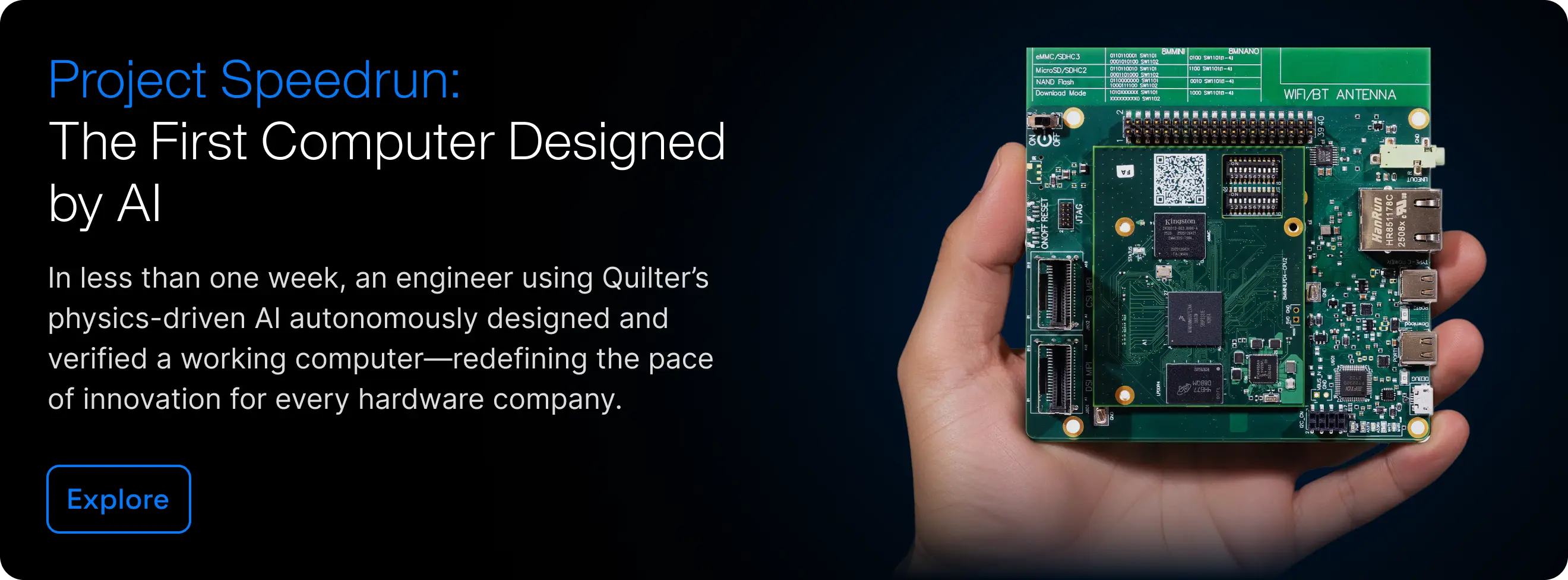
Project Speedrun demonstrated what autonomous layout looks like in practice and the time compression Quilter enables. Now, see it on your own hardware.

Get Started

Validating the Design

With cleanup complete, the final question is whether the hardware works. Power-on is where most electrical mistakes reveal themselves, and it’s the moment engineers are both nervous and excited about.

Continue to Part 4

Cleaning Up the Design

Autonomous layout produces a complete, DRC'd design; cleanup is a brief precision pass to finalize it for fabrication.

Continue to Part 3

Compiling the Design

Once the design is prepared, the next step is handing it off to Quilter. In traditional workflows, this is where an engineer meets with a layout specialist to clarify intent. Quilter replaces that meeting with circuit comprehension: you upload the project, review how constraints are interpreted, and submit the job.

Continue to Part 2

The New Standard for PCB AI Support: Comparing Enterprise, Community, and Direct-Access Models

February 20, 2026
by
Quilter AI
and

When you’re racing to bring new hardware to life, the last thing you need is a support ticket lost in the void. As AI-driven PCB design tools reshape the industry, the way you get help matters more than ever. In this article, we break down the three main support models - enterprise, community, and direct-access - so you can choose the right partner for your next breakthrough.

If you’re evaluating “who offers the best support for PCB AI,” you’re really asking a deeper question: When the design gets hard, when the deadline gets tight, and when the workflow is new, who helps you move forward with confidence? That is what great PCB AI support should answer.

What Makes Support So Important for PCB AI Tools?

Support is mission-critical for PCB AI tools because AI PCB design changes workflows, increases iteration speed, and raises the cost of confusion. When a tool can generate multiple layout candidates in hours, your team’s bottleneck shifts from routing time to decision time: constraints, stackups, manufacturability, review cycles, and what the AI is actually doing under the hood.

AI-driven PCB tools also introduce a learning curve that is different from traditional EDA adoption. You are not just learning a new UI or a new autorouter setting. You are learning a new interaction model: how to define constraints cleanly, how to pre-place critical components, how to interpret physics-driven validation, and how to choose between candidates that all “pass” but differ in risk, margin, and manufacturability.

Hardware mistakes are expensive, and the fastest way to lose the promise of AI is to ship a board that comes back with preventable issues. A single respin can cost weeks, burn budget, and damage internal trust in new tools. The right hardware design support model reduces that risk by shortening the time between “something feels off” and “here is the fix,” while also teaching your team how to avoid the same issue next time.

How Do Traditional Enterprise Support Models Work?

Traditional enterprise support works through contracts, ticketing, and application engineering teams that provide structured help with defined escalation paths. In the PCB world, this typically looks like support agreements, SLAs, assigned field application engineers (FAEs), and regional partners who provide training and implementation services. For teams running established enterprise PCB tools, this is familiar and often reassuring.

The strengths are real. Enterprise support tends to excel at stability and governance. You get predictable processes, documentation built for compliance, and support organizations designed to operate across large accounts. If you’re in aerospace, defense, automotive, or regulated environments, that structure can align well with internal procurement, security reviews, and validation requirements.

But for AI PCB design specifically, enterprise models can show friction in three places:

  1. Speed of iteration: Ticket-based systems can be too slow when your team is iterating daily or even hourly. If the AI generates multiple candidates quickly, waiting days for a back-and-forth email thread breaks the momentum that AI is supposed to create.
  2. Workflow ambiguity: AI-assisted layout often raises questions that are not simple bugs. They are workflow questions: “How should we express this constraint?” “What is the right pre-placement strategy?” “Which candidate is safest for bring-up?” These are harder to resolve through standard tickets, especially when context is complex.
  3. Innovation bottlenecks: Many enterprise vendors innovate carefully, and for good reason. But early-stage AI workflows change rapidly, and teams adopting AI PCB design often need a tighter feedback loop than legacy support organizations are built to provide.

Real-world scenario: A program manager on a high-reliability program is trying to integrate an AI-assisted routing feature into an existing design process. The tool works, but the output creates review questions: impedance-control rules, differential pair handling, and constraints that are expressed differently than the team’s legacy templates. Enterprise support can help, but the back-and-forth cycles and the separation between product engineering and support may slow down adoption. The result is a common outcome: the team uses the AI feature “sometimes,” not “systemically,” and the promised acceleration never becomes a repeatable advantage.

What’s Different About Community-Driven Support?

Community-driven support works because peers share answers fast, but it varies in consistency and accountability. In community-first ecosystems, support lives in forums, Discord servers, shared docs, templates, and real-time conversations with other users. This model can be incredibly effective when the user base is active and the product is evolving quickly.

The biggest benefit is velocity. You can ask a question, get three different approaches in an hour, and learn what works in practice. For startups, hobbyists, students, and teams in rapid prototyping mode, community support can feel like an always-on swarm of helpful builders. It also surfaces creative solutions that formal support channels might not prioritize.

The trade-offs show up when stakes rise:

  • Inconsistent quality: Advice may be great, decent, or wrong. Without knowing the responder’s context, it can be hard to judge reliability.
  • Limited escalation: If you hit a true blocker, there may be no guaranteed path to resolution. “Someone will answer eventually” is not an SLA.
  • No ownership: Communities are powerful, but they are not accountable to your tape-out date, your regulatory constraints, or your internal risk review.

Real-world scenario: A small hardware team is building a proof-of-concept device and using an AI-enabled PCB workflow. They hit a constraint definition issue and ask the community. They get a workaround quickly and keep moving. This is a win. Now fast-forward six months. That same team is shipping, and a constraint ambiguity creates a borderline design that passes some checks but fails in fab yield. Community support may still help, but the cost of “almost correct” guidance is now high.

Community-driven support can be excellent, but it tends to be best when your risk tolerance is higher, your timelines are flexible, or your project is not mission-critical.

Here’s How Direct-Access to Experts Changes the Game

Direct-access support changes the game by giving you real-time help from the engineers who build and understand the system, not just the ticket queue. This model is built for AI workflows where speed, clarity, and context matter as much as the tool itself.

For AI PCB design, direct-access engineering support is valuable because the “support question” is often a “design question.” You are not just reporting an issue. You are aligning constraints, interpreting physics-aware outputs, and deciding how to integrate an autonomous system into your existing workflow.

Quilter’s approach is designed around that reality. Quilter is a physics-driven AI system for PCB layout that generates multiple fab-ready candidates in hours, with physics checks built into the generation and review process. The support model matches the product promise: rapid iteration, high confidence, and reduced layout bottlenecks.

What direct-access typically enables for teams adopting Quilter:

  • Immediate, expert guidance: When you hit an ambiguity around constraints, stackups, DDR length matching, impedance control, clearances, or candidate evaluation, you can talk to experts who understand both PCB fundamentals and the AI’s behavior.
  • Tailored onboarding: Instead of generic training, you align on your workflow: how you define the outline, pre-place connectors, set constraints, and review outputs in your existing CAD environment.
  • Design reviews that accelerate decisions: Multiple candidates are only useful if your team can confidently choose the right one. Direct-access support helps teams translate candidate differences into engineering decisions quickly.
  • Workflow co-development: Early AI adoption benefits from feedback loops. When support is close to product engineering, your questions can shape improvements faster, and your team benefits from the evolution.

Real-world scenario: An R and D team is iterating a test fixture and needs to try multiple form factors and stackups quickly. The AI can generate candidates fast, but the team has a question about how to express one manufacturing constraint so it is evaluated the way they expect. With direct-access support, the question is answered in context, the constraint definition is corrected, and the team keeps iterating the same day.

This is the core difference: direct-access is not just “faster replies.” It is a different operational model for hardware design support that treats support as part of the engineering loop.

Which Support Model Fits Your Team’s Needs?

The best support model depends on your risk profile, your speed requirements, and how new the AI workflow is to your team. If you want a quick way to self-identify the best fit, use the comparison table below, then follow the decision flowchart.

Support model comparison table

Support Model

Best Fit Teams

Strengths

Trade-offs

Typical Outcome

Enterprise support (contracts, FAEs, SLAs)

Large orgs, regulated industries, teams standardized on enterprise PCB tools

Stability, compliance alignment, structured escalation

Slower iteration, less flexible workflow help, separation from product engineering

Strong for steady-state operations, slower for new AI workflows

Community-driven support (forums, Discord, peer help)

Startups, makers, students, prototyping teams, flexible timelines

Fast peer feedback, creativity, low friction learning

Inconsistent quality, limited accountability, no guaranteed escalation

Great for exploration, weaker for mission-critical delivery

Direct-access engineering support (real-time experts)

R and D leaders, hardware teams pushing timelines, early AI adopters, high-stakes innovation

Context-rich answers, rapid onboarding, faster decisions, tight feedback loop

Requires a provider built to offer it consistently

Fast adoption, fewer workflow stalls, higher confidence in AI PCB design

Quick decision flowchart (choose your path)

  1. Is your project regulated or compliance-heavy?
  • Yes → Enterprise support can fit well, but confirm AI workflow responsiveness.
  • No → Go to step 2.
  1. Is speed to iteration a top priority (daily or weekly design cycles)?
  • Yes → Direct-access support is likely best.
  • No → Go to step 3.
  1. Is your team comfortable with peer support and higher ambiguity?
  • Yes → Community-driven support may be enough.
  • No → Direct-access support is likely best.
  1. Are you adopting AI PCB design for a mission-critical program?
  • Yes → Prioritize direct-access support or a hybrid where experts are reachable quickly.
  • No → Community support may be sufficient early on.

Practical examples:

  • Enterprise fit: Aerospace or automotive teams that need predictable governance and already run enterprise PCB tools across large programs.
  • Community fit: Early-stage prototyping, personal projects, open-source workflows, and teams optimizing for learning speed over guaranteed outcomes.
  • Direct-access fit: Semiconductor validation hardware, robotics teams compressing bring-up schedules, and consumer electronics teams chasing tight market windows where iteration speed is the advantage.

Why Does Direct-Access Matter Most for Early AI Adopters?

Direct-access matters most for early AI adopters because the workflow is evolving and delays compound quickly in hardware. When your team pioneers AI PCB design, many questions are not “how do I click the button?” They are “how do we adapt our process so the AI consistently produces outputs we can trust?” That is a systems question, and it benefits from expert guidance.

Early adopters also face an internal trust challenge. Stakeholders want to know: Will this tool reduce risk or introduce it? The fastest way to build confidence is to shorten the loop between output, review, and resolution. Direct-access engineering support helps teams turn unknowns into decisions without losing days.

Mini-case study (illustrative): semiconductor validation team racing a deadline

A semiconductor validation team needs test hardware ready for a narrow bring-up window. They are using AI PCB design to compress layout cycles, but the first iteration raises questions during review: a set of impedance-controlled nets, a differential pair constraint expression, and a manufacturability preference tied to a specific fab.

  • With ticket-based support: The team documents the issue, waits for response, clarifies context, then repeats. Even if the support is good, the calendar moves, and the advantage of rapid candidate generation is reduced.
  • With community-driven support: They may get quick advice, but it might not account for the specifics of their constraints, stackup, and validation requirements.
  • With direct-access engineering support: They review the constraints and candidate outputs with experts, adjust the definition, regenerate candidates, and select a best-fit layout quickly. The team preserves iteration speed and reduces the risk of misinterpretation.

The point is not that one model is “bad.” The point is that early AI adoption is a high-context activity. Direct-access support makes that context usable in real time.

If you are evaluating PCB AI support for early adoption, prioritize the provider that can do three things consistently:

  1. Explain what the system will and will not account for up front
  2. Help you express constraints and review criteria cleanly
  3. Stay available when iteration speed is the advantage

Quilter is built around those needs, with a physics-first AI approach and a support experience designed for high-velocity hardware teams that cannot afford slow loops.

Ready to Accelerate Your Hardware Design? Let’s Talk

If you want the new gold standard in PCB AI support, direct access to experts is the model that best matches the pace of modern hardware development. Quilter pairs physics-driven AI PCB design with direct-access engineering support so your team can iterate faster, reduce rework risk, and turn AI output into confident decisions. Explore Quilter’s Support Overview, browse case studies, or book a demo and talk directly with the engineers behind the product to see how direct-access support works in practice.