


Gen AI

Published

Written by

Workbench

True Schematic-to-Layout Automation: How AI Overcomes Manual PCB Placement and Routing

Published

February 10, 2026

If you’ve ever wished you could skip the tedious, manual steps between schematic and finished PCB, you’re not alone. While most EDA tools promise “automation,” the reality is hours or even weeks spent on part placement, routing, power plane setup, and endless constraint tweaking. Quilter’s physics-driven AI changes that. Here’s how true schematic to PCB automation works, why traditional approaches plateau, and what “one-click” AI PCB layout actually delivers when the output has to be manufacturable and review-ready.

This article is written for electronics engineers, PCB designers, and hardware teams searching for software that converts schematics to board layouts automatically, without turning the engineer into a full-time router babysitter.

Let’s define what “automatic” really means in PCB design

In PCB layout, “automatic” is often used as shorthand for autorouting. But autorouting is only one slice of the work, and it’s rarely the slice that blocks a program the longest. Real schedule risk usually comes from placement quality, constraint coverage, power delivery decisions, and the high-stakes nets that demand discipline (clocks, high-speed links, switching power, sensitive analog, RF).

Most teams already know this from experience: you can push a netlist to a board file in seconds, but you still spend days getting the layout into a state you would actually manufacture. That gap is where “automation” gets fuzzy.

A useful way to define true schematic to PCB automation is this: you start with a schematic or netlist, you express design intent through constraints, and you get back a complete board layout that is routed, DRC-ready, and credible enough to review. The output does not need to be “perfect.” It needs to be coherent, constraint-driven, and fast enough that you can iterate multiple times before a deadline forces you into single-threaded heroics.

So what still dominates time in legacy flows?

  • Placement is manual because good placement is about electrical intent, not just connectivity. A naïve autoplacer optimizes trace length and promptly breaks everything else.
  • Constraints are often applied late because writing a complete constraint set is time-consuming, and many tools do not make it obvious which constraints are missing.
  • Power planes, return paths, and high-speed routing require expertise, and traditional automation struggles to reliably honor those requirements without heavy handholding.

True automatic board layout software should reduce those manual steps, not just route easier nets faster.

How do traditional tools handle schematic-to-board conversion?

Traditional EDA tools are excellent at keeping schematic and layout connected. They are also excellent at interactive routing and DRC. Where they struggle is turning an abstract circuit description into a complete, high-quality physical implementation with minimal manual intervention.

Here’s the common baseline across mainstream tools:

  1. Import schematic or netlist and create a PCB document.
  2. Define the board outline, keepouts, layer stack, and rules.
  3. Place key components manually (connectors, BGAs, power stages, sensors, antennas).
  4. Cluster supporting passives, decoupling, and protection parts.
  5. Route critical nets manually (impedance-controlled, differential pairs, sensitive analog, clocks).
  6. Attempt autorouting or interactive routing for the remainder.
  7. Fix DRC, SI, PI, EMI, and manufacturability issues through iterations.

This is not a knock on those tools. It’s a reflection of how hard the layout problem is when you care about performance and manufacturability, not just connectivity.

What “partial automation” looks like in practice

  • Altium and similar enterprise tools: Strong schematic-to-PCB synchronization (ECO), robust rule systems, and powerful interactive routing. Some auto-placement features exist, and autorouting can help for non-critical routing. But high-speed layout, power integrity, and dense constraints still depend on expert decisions and manual execution.
  • KiCad and other open-source flows: Excellent for many products, with strong interactive routing and rule support that keeps improving. External autorouters can route large portions of a board, but placement and critical routing remain largely manual, especially for higher-speed or noise-sensitive designs.
  • Mid-market integrated tools (for example DipTrace-style workflows): Helpful for fast conversion and quicker initial layouts, especially for simpler boards. The same ceiling appears as complexity increases: routing a netlist is not the hard part, placing and constraining the design is.

Comparison table: Traditional schematic-to-board vs true schematic-to-layout automation

Workflow step

Traditional tools (typical reality)

Quilter approach (true automation intent)

Import schematic / netlist

Fast import and sync

Fast import from existing CAD workflows

Board outline and keepouts

User-defined, manual

User-defined, then AI respects it

Key component placement

Manual, floorplan-driven

User can pre-place critical parts, AI completes placement around intent

Power plane strategy

Manual decisions, iterative

AI creates and evaluates power delivery structures under constraints

Differential pairs, impedance routing

Manual setup and careful routing

AI routes with constraint awareness and physics-driven validation

Constraint completeness

Often partial, applied late

AI surfaces what it will and will not account for up front

Candidate exploration

Sequential, time-limited

Generate multiple candidates in parallel for faster iteration

Review readiness

Significant polish required

Designed for transparent review and export back to your native tools

Here’s how Quilter’s AI changes the game

Quilter is built around the idea that schematic to PCB automation has to mean more than “autoroute the leftovers.” It should mean the layout candidate is generated as a whole, with electrical intent and physical feasibility evaluated throughout the process.

Quilter’s differentiator is not that it routes fast. It’s that it produces complete PCB layout candidates by combining constraint awareness with physics-driven validation. Instead of asking a designer to manually “teach” the tool through endless incremental edits, Quilter starts from the schematic, ingests constraints, and generates layout candidates that are meant to be reviewed, selected, and handed off.

What “true automation” looks like in Quilter

A practical definition of one-click AI PCB layout in Quilter is:

  • You provide the design and the constraints that express intent (board outline, keepouts, stackup preferences, net classes, critical placements).
  • Quilter generates placement, routing, and power structures automatically.
  • Each candidate is evaluated against the physical constraints so you can see what is actually complete, what is at risk, and what needs attention.

This matters because most layout pain is not typing commands. It’s managing tradeoffs you cannot see until late: return paths, coupling, via choices, escape routing, plane fragmentation, and the slow bleed of “small fixes” that add up to a week.

Automation that frees engineers without hiding the truth

The goal is not to remove humans from the loop. The goal is to move humans to the highest-leverage tasks:

  • Define intent, constraints, and system priorities.
  • Review AI-generated candidates with clear, transparent feedback.
  • Iterate quickly across stackups, manufacturers, and form factors.
  • Export to your existing CAD tools to run DRC, polish, and generate manufacturing deliverables.

In other words: engineers should spend time making decisions, not dragging parts around for three days to discover the same constraint conflict again.

What results can you expect with one-click AI layout?

When teams ask for software that converts schematics to board layouts automatically, they usually want a straight answer: what changes in time, quality, and risk?

The honest answer is that results depend on constraints and board complexity. But the consistent win comes from compressing layout time and expanding iteration capacity. Instead of one slow path to one layout, you can explore multiple candidates quickly, pick the strongest, and refine.

Featured snippet answer: What results can you expect with one-click AI PCB layout?

  • Massive time compression and faster iteration: Layout work that commonly stretches into days or weeks can be reduced to hours or minutes for initial candidates, so you can explore more options before committing.
  • More consistent, constraint-driven outputs: Rather than relying on manual placement habits and late-stage patchwork, AI-generated candidates are produced with constraint awareness and physics-driven review signals, improving review readiness and reducing respin risk.

What “better results” looks like on real teams

In practice, teams value three outcomes:

  1. Speed without sacrificing reviewability
    The first candidate is often the hardest. Quilter shifts that first candidate from a manual marathon to an automated generation step, so reviews start sooner.
  2. Parallel candidate generation
    Traditional layout is serial. Quilter makes it natural to generate multiple candidates with different assumptions (stackup options, manufacturers, placement constraints) so you can compare tradeoffs instead of arguing hypotheticals.
  3. Higher confidence through physics-driven checks
    When layout is generated fast, the next concern is “can I trust it?” Quilter’s emphasis on physics-driven evaluation is designed to make the output auditable, not mysterious.

Let’s walk through the workflow: From schematic to finished board in minutes

True schematic to PCB automation has to fit into the tools teams already use. The goal is not a walled garden. It’s a faster way to generate complete layout candidates, then hand them back for finishing and manufacturing.

Below is a workflow you can publish as-is, with clear visuals, captions, and a short video demo.

Step 1: Import your schematic or project

Start by uploading your existing CAD project. Quilter is designed to work with the formats teams already rely on, so you do not need to rebuild the design in a new environment.

What happens at import:

  • The design connectivity is interpreted from the schematic/netlist.
  • Nets and components become the basis for placement and routing decisions.
  • The system prepares to map constraints onto physical implementation.

Step 2: Define constraints that express intent

This is where true automation diverges from “press autoroute.” Constraints are not busywork, they are the language of intent. Good constraints prevent the AI from producing a technically connected board that is electrically wrong.

Common constraints to specify:

  • Board outline and keepout regions
  • Placement locks for connectors, mounting holes, antennas, and mechanical interfaces
  • Net classes for widths, spacing, and via rules
  • Differential pair rules and length targets where needed
  • Impedance-controlled nets and stackup expectations

The key is that you do not need to micromanage. You define the boundaries and priorities, and the AI uses them to generate candidates.

Step 3: Click “Generate Layout” and let AI handle placement, routing, and power

This is the core of automatic board layout software done right. Quilter generates complete candidates, not partial routing attempts.

What the system does during generation:

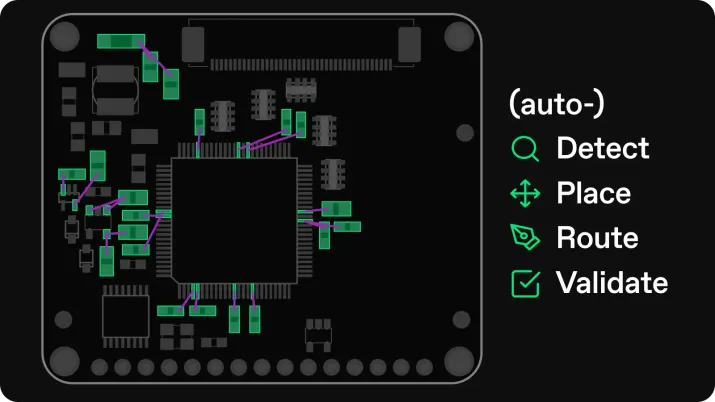
  • Places components to satisfy connectivity and constraint intent
  • Routes nets, including critical classes, with rule awareness
  • Builds power delivery structures and evaluates feasibility
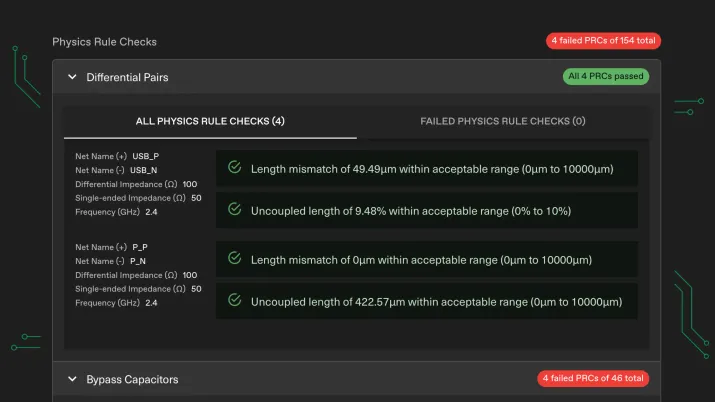
  • Runs a physics-driven review pass to flag issues and validate decisions

The output is a layout candidate meant to be reviewed, not a half-finished board that still requires days of manual rescue.

Step 4: Review candidates with transparent design feedback

Fast generation only matters if review is fast too. The review step should answer: what is done, what is risky, and what needs refinement?

A practical candidate review checklist:

  • Are connectors and mechanical interfaces correct?
  • Are critical nets routed with the expected rules?
  • Are return paths and plane structures coherent for the design class?
  • Are there obvious congestion zones that will cause late fixes?
  • Are the warnings actionable, not generic?

Step 5: Export back to your native CAD tools for final polish and manufacturing deliverables

Quilter is meant to accelerate layout creation without breaking downstream processes. After selecting a candidate, export the board files in the same format you submitted so you can:

  • Run your standard DRC flow
  • Apply final team-specific conventions
  • Generate fab and assembly files
  • Complete sign-off checks

This step is important for adoption: teams keep their existing review, release, and manufacturing pipeline intact.

Why does physics-driven AI matter for complex boards?

As boards get more complex, the failure modes get more expensive. High-speed interfaces, switch-mode power, sensitive analog front ends, RF sections, and dense BGAs all create constraints that interact in ways that are hard to predict until late.

This is exactly why “classic autorouting” tops out. Connectivity is not enough. You need awareness of physical behavior.

Physics-driven PCB design matters because it shifts validation earlier. Instead of discovering problems after hours of manual work, the system evaluates candidates against physical constraints as part of generation and review.

Where physics-driven AI helps most

  • Signal integrity and high-speed constraints
    Impedance control, return path continuity, coupling, differential pair discipline, and length sensitivity are all areas where “route anything anywhere” fails fast.
  • Power delivery and EMI risk
    Power plane strategy, current paths, decoupling placement relationships, and switching noise control are not routing problems alone. They are system behavior problems.
  • Manufacturability under tight density
    Via strategy, spacing constraints, escape routing feasibility, and congestion management determine whether the layout is buildable, not just routable.

The practical business outcome is fewer respins and fewer “mystery failures” that burn weeks. Even when you still do final tuning and sign-off in your native tool, starting from a candidate that has been evaluated against physical constraints changes the whole trajectory of the project.

Ready to see it for yourself?

If you’re evaluating schematic to PCB automation tools because manual placement and routing are your bottleneck, the fastest way to decide is to try a real project. Upload your design, define a few key constraints, and generate candidates you can review immediately. Quilter is built for teams that want true schematic-to-layout automation, AI PCB layout that respects engineering intent, and physics-driven PCB design that supports complex boards without slowing iteration. See how Quilter can turn your schematic into a finished board. Try it free or schedule a demo today.

- Quilter Product Overview

- Quilter Workflow

- Quilter Support

- Quilter Blog

- Quilter Contact

- Quilter Free Version

Try Quilter for Yourself

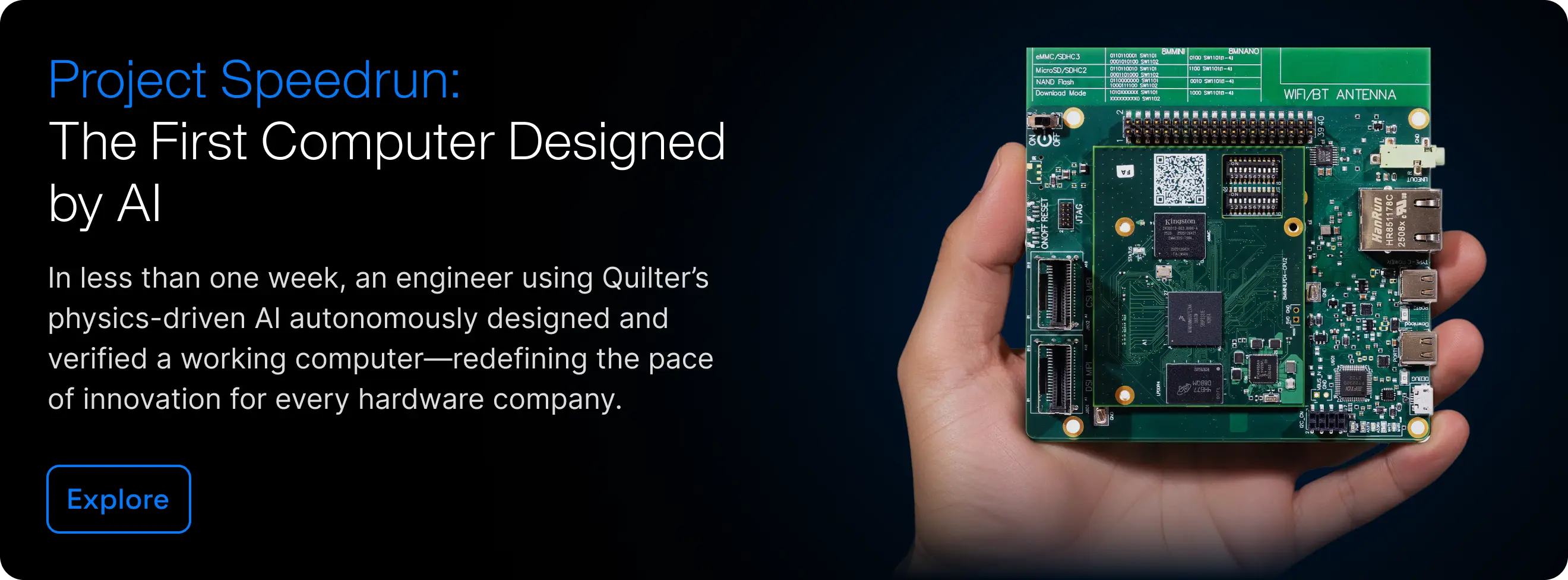
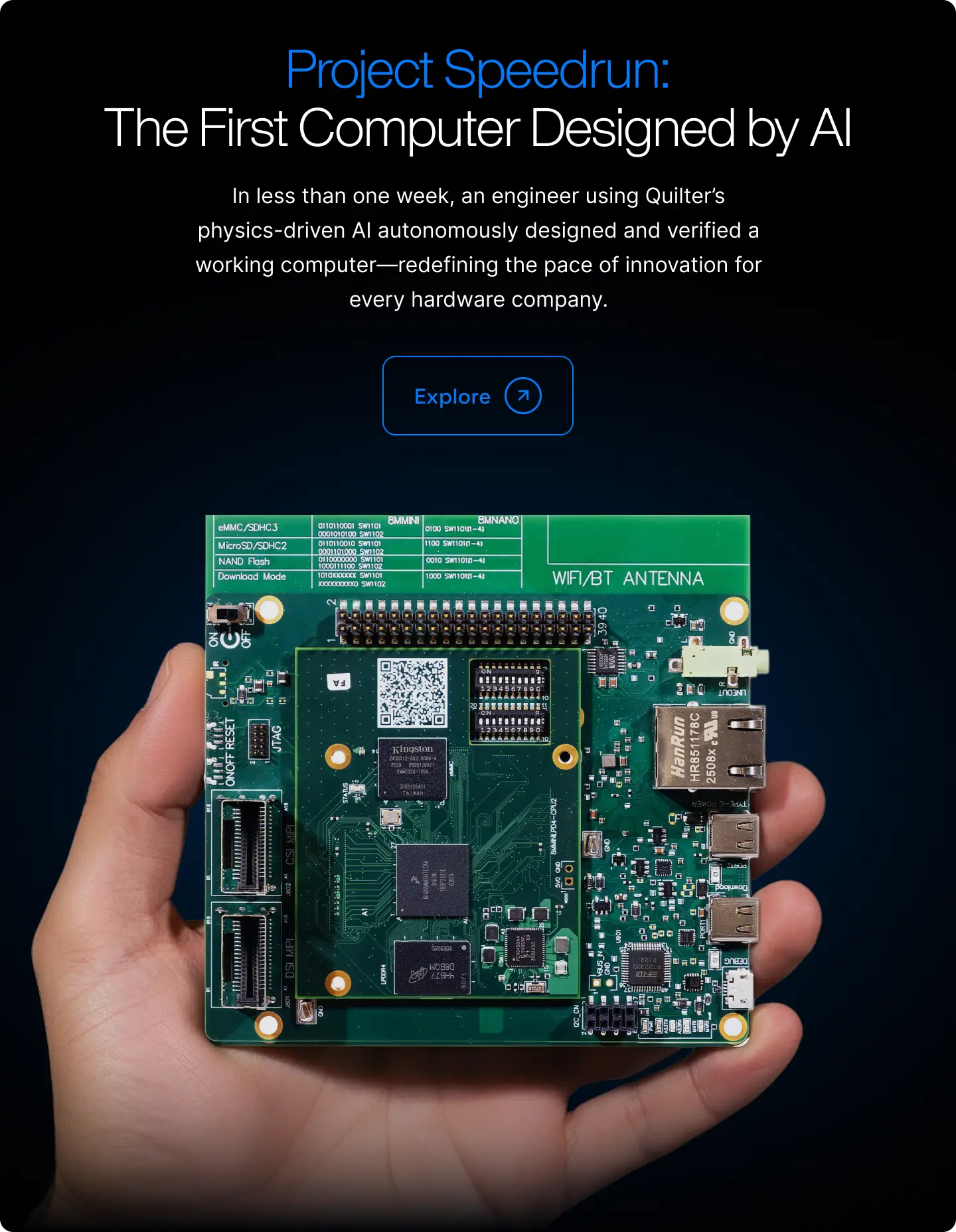
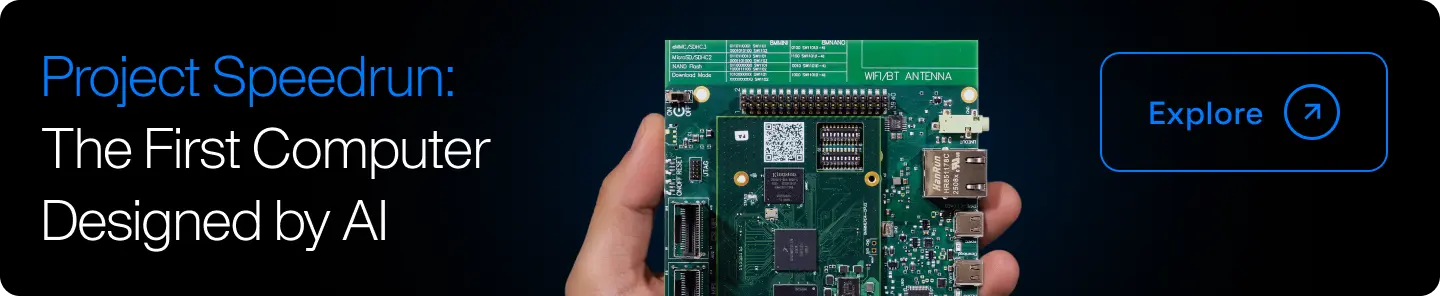
Project Speedrun demonstrated what autonomous layout looks like in practice and the time compression Quilter enables. Now, see it on your own hardware.

Get Started

Validating the Design

With cleanup complete, the final question is whether the hardware works. Power-on is where most electrical mistakes reveal themselves, and it’s the moment engineers are both nervous and excited about.

Continue to Part 4

Cleaning Up the Design

Autonomous layout produces a complete, DRC'd design; cleanup is a brief precision pass to finalize it for fabrication.

Continue to Part 3

Compiling the Design

Once the design is prepared, the next step is handing it off to Quilter. In traditional workflows, this is where an engineer meets with a layout specialist to clarify intent. Quilter replaces that meeting with circuit comprehension: you upload the project, review how constraints are interpreted, and submit the job.

Continue to Part 2

True Schematic-to-Layout Automation: How AI Overcomes Manual PCB Placement and Routing

February 10, 2026
by
Ben Jordan
and

If you’ve ever wished you could skip the tedious, manual steps between schematic and finished PCB, you’re not alone. While most EDA tools promise “automation,” the reality is hours or even weeks spent on part placement, routing, power plane setup, and endless constraint tweaking. Quilter’s physics-driven AI changes that. Here’s how true schematic to PCB automation works, why traditional approaches plateau, and what “one-click” AI PCB layout actually delivers when the output has to be manufacturable and review-ready.

This article is written for electronics engineers, PCB designers, and hardware teams searching for software that converts schematics to board layouts automatically, without turning the engineer into a full-time router babysitter.

Let’s define what “automatic” really means in PCB design

In PCB layout, “automatic” is often used as shorthand for autorouting. But autorouting is only one slice of the work, and it’s rarely the slice that blocks a program the longest. Real schedule risk usually comes from placement quality, constraint coverage, power delivery decisions, and the high-stakes nets that demand discipline (clocks, high-speed links, switching power, sensitive analog, RF).

Most teams already know this from experience: you can push a netlist to a board file in seconds, but you still spend days getting the layout into a state you would actually manufacture. That gap is where “automation” gets fuzzy.

A useful way to define true schematic to PCB automation is this: you start with a schematic or netlist, you express design intent through constraints, and you get back a complete board layout that is routed, DRC-ready, and credible enough to review. The output does not need to be “perfect.” It needs to be coherent, constraint-driven, and fast enough that you can iterate multiple times before a deadline forces you into single-threaded heroics.

So what still dominates time in legacy flows?

  • Placement is manual because good placement is about electrical intent, not just connectivity. A naïve autoplacer optimizes trace length and promptly breaks everything else.
  • Constraints are often applied late because writing a complete constraint set is time-consuming, and many tools do not make it obvious which constraints are missing.
  • Power planes, return paths, and high-speed routing require expertise, and traditional automation struggles to reliably honor those requirements without heavy handholding.

True automatic board layout software should reduce those manual steps, not just route easier nets faster.

How do traditional tools handle schematic-to-board conversion?

Traditional EDA tools are excellent at keeping schematic and layout connected. They are also excellent at interactive routing and DRC. Where they struggle is turning an abstract circuit description into a complete, high-quality physical implementation with minimal manual intervention.

Here’s the common baseline across mainstream tools:

  1. Import schematic or netlist and create a PCB document.
  2. Define the board outline, keepouts, layer stack, and rules.
  3. Place key components manually (connectors, BGAs, power stages, sensors, antennas).
  4. Cluster supporting passives, decoupling, and protection parts.
  5. Route critical nets manually (impedance-controlled, differential pairs, sensitive analog, clocks).
  6. Attempt autorouting or interactive routing for the remainder.
  7. Fix DRC, SI, PI, EMI, and manufacturability issues through iterations.

This is not a knock on those tools. It’s a reflection of how hard the layout problem is when you care about performance and manufacturability, not just connectivity.

What “partial automation” looks like in practice

  • Altium and similar enterprise tools: Strong schematic-to-PCB synchronization (ECO), robust rule systems, and powerful interactive routing. Some auto-placement features exist, and autorouting can help for non-critical routing. But high-speed layout, power integrity, and dense constraints still depend on expert decisions and manual execution.
  • KiCad and other open-source flows: Excellent for many products, with strong interactive routing and rule support that keeps improving. External autorouters can route large portions of a board, but placement and critical routing remain largely manual, especially for higher-speed or noise-sensitive designs.
  • Mid-market integrated tools (for example DipTrace-style workflows): Helpful for fast conversion and quicker initial layouts, especially for simpler boards. The same ceiling appears as complexity increases: routing a netlist is not the hard part, placing and constraining the design is.

Comparison table: Traditional schematic-to-board vs true schematic-to-layout automation

Workflow step

Traditional tools (typical reality)

Quilter approach (true automation intent)

Import schematic / netlist

Fast import and sync

Fast import from existing CAD workflows

Board outline and keepouts

User-defined, manual

User-defined, then AI respects it

Key component placement

Manual, floorplan-driven

User can pre-place critical parts, AI completes placement around intent

Power plane strategy

Manual decisions, iterative

AI creates and evaluates power delivery structures under constraints

Differential pairs, impedance routing

Manual setup and careful routing

AI routes with constraint awareness and physics-driven validation

Constraint completeness

Often partial, applied late

AI surfaces what it will and will not account for up front

Candidate exploration

Sequential, time-limited

Generate multiple candidates in parallel for faster iteration

Review readiness

Significant polish required

Designed for transparent review and export back to your native tools

Here’s how Quilter’s AI changes the game

Quilter is built around the idea that schematic to PCB automation has to mean more than “autoroute the leftovers.” It should mean the layout candidate is generated as a whole, with electrical intent and physical feasibility evaluated throughout the process.

Quilter’s differentiator is not that it routes fast. It’s that it produces complete PCB layout candidates by combining constraint awareness with physics-driven validation. Instead of asking a designer to manually “teach” the tool through endless incremental edits, Quilter starts from the schematic, ingests constraints, and generates layout candidates that are meant to be reviewed, selected, and handed off.

What “true automation” looks like in Quilter

A practical definition of one-click AI PCB layout in Quilter is:

  • You provide the design and the constraints that express intent (board outline, keepouts, stackup preferences, net classes, critical placements).
  • Quilter generates placement, routing, and power structures automatically.
  • Each candidate is evaluated against the physical constraints so you can see what is actually complete, what is at risk, and what needs attention.

This matters because most layout pain is not typing commands. It’s managing tradeoffs you cannot see until late: return paths, coupling, via choices, escape routing, plane fragmentation, and the slow bleed of “small fixes” that add up to a week.

Automation that frees engineers without hiding the truth

The goal is not to remove humans from the loop. The goal is to move humans to the highest-leverage tasks:

  • Define intent, constraints, and system priorities.
  • Review AI-generated candidates with clear, transparent feedback.
  • Iterate quickly across stackups, manufacturers, and form factors.
  • Export to your existing CAD tools to run DRC, polish, and generate manufacturing deliverables.

In other words: engineers should spend time making decisions, not dragging parts around for three days to discover the same constraint conflict again.

What results can you expect with one-click AI layout?

When teams ask for software that converts schematics to board layouts automatically, they usually want a straight answer: what changes in time, quality, and risk?

The honest answer is that results depend on constraints and board complexity. But the consistent win comes from compressing layout time and expanding iteration capacity. Instead of one slow path to one layout, you can explore multiple candidates quickly, pick the strongest, and refine.

Featured snippet answer: What results can you expect with one-click AI PCB layout?

  • Massive time compression and faster iteration: Layout work that commonly stretches into days or weeks can be reduced to hours or minutes for initial candidates, so you can explore more options before committing.
  • More consistent, constraint-driven outputs: Rather than relying on manual placement habits and late-stage patchwork, AI-generated candidates are produced with constraint awareness and physics-driven review signals, improving review readiness and reducing respin risk.

What “better results” looks like on real teams

In practice, teams value three outcomes:

  1. Speed without sacrificing reviewability
    The first candidate is often the hardest. Quilter shifts that first candidate from a manual marathon to an automated generation step, so reviews start sooner.
  2. Parallel candidate generation
    Traditional layout is serial. Quilter makes it natural to generate multiple candidates with different assumptions (stackup options, manufacturers, placement constraints) so you can compare tradeoffs instead of arguing hypotheticals.
  3. Higher confidence through physics-driven checks
    When layout is generated fast, the next concern is “can I trust it?” Quilter’s emphasis on physics-driven evaluation is designed to make the output auditable, not mysterious.

Let’s walk through the workflow: From schematic to finished board in minutes

True schematic to PCB automation has to fit into the tools teams already use. The goal is not a walled garden. It’s a faster way to generate complete layout candidates, then hand them back for finishing and manufacturing.

Below is a workflow you can publish as-is, with clear visuals, captions, and a short video demo.

Step 1: Import your schematic or project

Start by uploading your existing CAD project. Quilter is designed to work with the formats teams already rely on, so you do not need to rebuild the design in a new environment.

What happens at import:

  • The design connectivity is interpreted from the schematic/netlist.
  • Nets and components become the basis for placement and routing decisions.
  • The system prepares to map constraints onto physical implementation.

Step 2: Define constraints that express intent

This is where true automation diverges from “press autoroute.” Constraints are not busywork, they are the language of intent. Good constraints prevent the AI from producing a technically connected board that is electrically wrong.

Common constraints to specify:

  • Board outline and keepout regions
  • Placement locks for connectors, mounting holes, antennas, and mechanical interfaces
  • Net classes for widths, spacing, and via rules
  • Differential pair rules and length targets where needed
  • Impedance-controlled nets and stackup expectations

The key is that you do not need to micromanage. You define the boundaries and priorities, and the AI uses them to generate candidates.

Step 3: Click “Generate Layout” and let AI handle placement, routing, and power

This is the core of automatic board layout software done right. Quilter generates complete candidates, not partial routing attempts.

What the system does during generation:

  • Places components to satisfy connectivity and constraint intent
  • Routes nets, including critical classes, with rule awareness
  • Builds power delivery structures and evaluates feasibility
  • Runs a physics-driven review pass to flag issues and validate decisions

The output is a layout candidate meant to be reviewed, not a half-finished board that still requires days of manual rescue.

Step 4: Review candidates with transparent design feedback

Fast generation only matters if review is fast too. The review step should answer: what is done, what is risky, and what needs refinement?

A practical candidate review checklist:

  • Are connectors and mechanical interfaces correct?
  • Are critical nets routed with the expected rules?
  • Are return paths and plane structures coherent for the design class?
  • Are there obvious congestion zones that will cause late fixes?
  • Are the warnings actionable, not generic?

Step 5: Export back to your native CAD tools for final polish and manufacturing deliverables

Quilter is meant to accelerate layout creation without breaking downstream processes. After selecting a candidate, export the board files in the same format you submitted so you can:

  • Run your standard DRC flow
  • Apply final team-specific conventions
  • Generate fab and assembly files
  • Complete sign-off checks

This step is important for adoption: teams keep their existing review, release, and manufacturing pipeline intact.

Why does physics-driven AI matter for complex boards?

As boards get more complex, the failure modes get more expensive. High-speed interfaces, switch-mode power, sensitive analog front ends, RF sections, and dense BGAs all create constraints that interact in ways that are hard to predict until late.

This is exactly why “classic autorouting” tops out. Connectivity is not enough. You need awareness of physical behavior.

Physics-driven PCB design matters because it shifts validation earlier. Instead of discovering problems after hours of manual work, the system evaluates candidates against physical constraints as part of generation and review.

Where physics-driven AI helps most

  • Signal integrity and high-speed constraints
    Impedance control, return path continuity, coupling, differential pair discipline, and length sensitivity are all areas where “route anything anywhere” fails fast.
  • Power delivery and EMI risk
    Power plane strategy, current paths, decoupling placement relationships, and switching noise control are not routing problems alone. They are system behavior problems.
  • Manufacturability under tight density
    Via strategy, spacing constraints, escape routing feasibility, and congestion management determine whether the layout is buildable, not just routable.

The practical business outcome is fewer respins and fewer “mystery failures” that burn weeks. Even when you still do final tuning and sign-off in your native tool, starting from a candidate that has been evaluated against physical constraints changes the whole trajectory of the project.

Ready to see it for yourself?

If you’re evaluating schematic to PCB automation tools because manual placement and routing are your bottleneck, the fastest way to decide is to try a real project. Upload your design, define a few key constraints, and generate candidates you can review immediately. Quilter is built for teams that want true schematic-to-layout automation, AI PCB layout that respects engineering intent, and physics-driven PCB design that supports complex boards without slowing iteration. See how Quilter can turn your schematic into a finished board. Try it free or schedule a demo today.

- Quilter Product Overview

- Quilter Workflow

- Quilter Support

- Quilter Blog

- Quilter Contact

- Quilter Free Version