




Gen AI

Published

Written by

Workbench

The Three Eras of PCB Routing: From Autorouters to Auto-Interactive to Generative AI

Published

March 16, 2026

When engineers search for the most advanced pcb autorouters, they are rarely looking for yet another checkbox in their CAD tool. They want faster, more reliable layouts on real high-speed, high-density boards without getting bogged down in cleanup. In this article, we’ll walk through the three eras of routing technology and show where Quilter’s physics-driven AI sits relative to Cadence Allegro router, Siemens Xpedition routing, auto-interactive routing systems like ActiveRoute and Sketch Router, and the classic batch autorouters many teams still rely on.

If you’re doing a pcb autorouter comparison because schedules are tight, your designers are stretched, and every respin is expensive, the framing that matters is simple:

  • Era 1 focused on routing networks efficiently.
  • Era 2 tried to help experts route nets faster.
  • Era 3 aims to generate complete layouts under real constraints and validate them against physics before you spend a dollar on fabrication.

That third era is when generative AI PCB layout moves from “AI hype” to “design capacity”.

Let’s define how PCB routing got here in the first place

PCB routing started as a craft. Early boards were hand-placed and hand-routed because they had to be. Trace geometry was simple, net counts were manageable, and the limiting factor was time at the drafting table.

Then density arrived. Packages shrank, pin counts rose, and nets multiplied. As soon as boards became too complex to route manually within the schedule, batch autorouters emerged. Their promise was seductive: push a button, get connectivity.

For a while, it worked well enough. Early autorouters could achieve high completion on many digital boards, especially when “good enough” meant the board passed DRC and the product was tolerant of extra vias, long meanders, and less-than-ideal return paths.

But modern hardware changed the definition of “works.” High-speed interfaces, tighter EMI margins, and increasingly unforgiving SI and PI requirements meant that “connected” was no longer the goal. You needed controlled impedance, predictable delay, clean length matching, sensible layer transitions, and power delivery that did not become a science fair at bring-up.

That is the core reason “just throw an autorouter at it” stopped working for many teams. The routing task became inseparable from physics and system intent.

So routing automation evolved into three eras:

  • Batch autorouters: route the algorithm first; constraints serve as guardrails.
  • Auto-interactive routing: human strategy first, automation fills in the geometry.
  • Generative AI layout: explore many complete candidates, score them against constraints and physics, then hand the best back to engineers for final polish.

What do people really mean by “the most advanced PCB autorouter”?

When someone types “most advanced pcb autorouters on the market,” they are usually translating pain into a shopping query. They are not asking for a feature list. They are asking, “Which tool will stop stealing my schedule?”

In practice, the “advanced” label collapses into a few evaluation dimensions that matter to real programs:

1) Completion rate without creating a cleanup nightmare
A router that “finishes” by spraying vias everywhere is not finishing. Completion only counts if the result is close to production quality.

2) High-speed awareness that survives contact with reality
Does the router honor differential pair intent, impedance constraints, delay tuning, and topology, or does it require days of post-routing repair?

3) Manual cleanup required
How many hours of glossing, shove, reroute, neckdown fixes, and length-match rescue work do you pay after the automation runs?

4) Iteration speed under changing constraints
Boards rarely route once. Stack-ups change, connector locations shift, a regulator is replaced, and suddenly your “done” layout becomes a new problem. Advanced tools make iteration cheap, not just the first pass.

5) Integration with existing CAD and review workflows
Even the best router fails to gain adoption if it does not fit the team’s constraints, DRC flow, and manufacturing outputs.

The most common “advanced autorouter” pain points map directly to these dimensions:

  • Days of cleanup after a “successful” autoroute pass
  • Broken length matching when one placement changes
  • Via explosions that destroy density, cost, and signal quality
  • Routes that are legal per DRC but naive about return paths and power integrity

Those are exactly why teams evaluate Allegro, Xpedition, Altium, TopoR, and now AI-driven systems. The question is no longer “can it route.” The question is “can it route in a way that reduces engineering effort and risk?”

Here’s how first-generation batch autorouters actually work

Classic batch autorouters are optimization engines that try to connect nets while minimizing conflicts. Two common conceptual approaches show up across tools:

Grid-based routing
The board is discretized into a grid. Traces occupy grid edges or cells, and the router searches for paths. Grid systems can be fast and predictable, but they struggle with tight geometry, non-Manhattan routing freedom, and nuanced cost tradeoffs. They often need heavy parameter tuning to avoid pathological results.

Shape-based routing
Instead of treating the board like a coarse grid, shape-based routers work with actual obstacle geometry and clearance shapes. This typically improves quality and completion on denser boards because the router can “see” space more like a human. Many long-standing enterprise routers and integrated routers use variations of this approach.

Why these still matter: batch autorouters can be excellent for certain workloads.

  • They can achieve high completion on non-critical nets, especially on moderately complex boards.
  • They can reduce brute manual labor for connective tissue routing, leaving critical nets to experts.
  • They can be helpful when you need a quick baseline topology, even if you plan to refactor.

Where the plateau is also consistent.

They do not truly understand electrical intent.
They can obey constraints, but they do not reason about “why” those constraints exist. A constraint system is a proxy. SI and PI are the underlying reality.

They search once, then you fix.
Most batch workflows produce one answer. If it is messy, the human pays the difference. If a constraint changes, the human pays again.

They are brittle under modern density.
As soon as a design becomes both dense and high-speed, the router’s tradeoffs become expensive. It may route in a way that is formally legal but practically unreviewable or risky.

That is why “most advanced pcb autorouters” often look like a paradox. The more complex the board, the less any single batch pass feels like progress.

Here’s why auto-interactive routing became the new default

Auto-interactive routing emerged because experienced designers wanted leverage, not lottery tickets.

Instead of “push button and hope,” the workflow became “set intent, guide the router, then let automation do the boring geometry.” That intent can look like:

  • Corridors and route guides for bundles and buses
  • Differential pair helpers that maintain pair rules while you steer
  • Push-and-shove routing with interactive DRC that keeps you honest
  • Auto-tuning operations that add or remove length while respecting constraints

Tools in this category are often the day-to-day workhorses for advanced teams. You see it in:

  • Altium’s auto-interactive routing style features (often used as an Altium autorouter alternative to fully automatic routing on complex nets)
  • Siemens Xpedition routing capabilities, such as sketch-style guidance for bundles
  • Enterprise suites like Allegr,o where interactive routing and constraint enforcement are central to the workflow

Auto-interactive routing improved outcomes because it preserved what humans are good at:

  • Floorplanning and strategy
  • Knowing which nets are fragile
  • Making tradeoffs that reflect the system, not just the board

But it still leaves a stubborn gap.

The human is still the routing engine for the hard parts.
Auto-interactive tools are multipliers, not replacements. The designer still owns topology choices, layer strategy, return path sanity, escape complexity, and the edge cases that make boards real.

And that is where the modern constraint hits: even if a senior PCB designer can route anything, you cannot scale senior time. Programs choke not because experts forgot how to route, but because there are not enough expert hours to route everything fast, iterate multiple options, and still do a clean review.

Auto-interactive routing became the new default because it made experts faster. It did not make the layout abundant.

What changed in the generative AI era for PCB layout?

The generative AI era changes the unit of work.

Classic routing thinks in nets. Auto-interactive routing thinks in guided segments. Generative AI layout considers full-board candidates.

That sounds like a semantic shift, but it is operationally massive.

Generative search means the system explores thousands of possible full-board solutions rather than just one. Instead of routing once and tuning forever, it produces multiple plausible layouts that satisfy the same constraints in different ways. That gives teams something they almost never had at scale: design options.

Reinforcement learning changes how the system improves. Traditional algorithms optimize within predefined heuristics and cost functions. RL systems can learn routing strategies by iteratively receiving feedback and updating policies to improve outcomes across many designs. In a PCB context, the relevant feedback is not just “did it connect,” but “did it meet constraints and physical behavior expectations.”

Physics-anchored scoring is the point. If the scoring function is only geometric, you are back to “pretty routes that might fail.” When the candidate evaluation is tied to real constraints and physics checks, the system starts to behave less like an autorouter and more like a layout generator that respects engineering reality.

This is why “generative AI PCB layout” is not just a faster autorouter. It is a different workflow:

  • Humans define constraints and intent.
  • The system generates and evaluates multiple complete layouts.
  • Humans review candidates, choose a direction, and finalize in familiar CAD.

The payoff is iteration speed. When iteration becomes cheap, you get better boards and fewer surprises because you can explore, compare, and validate before fabrication.

Let’s talk about how Quilter’s physics-driven AI fits into this new era

Quilter is built around a simple premise: PCB design remains a critical discipline, but engineers should not spend their best hours on non-core layout tasks.

In practical terms, Quilter is designed to fit how teams already work.

Import and workflow compatibility
Quilter works with existing projects from major CAD ecosystems. The workflow begins where your design already lives: you upload the project, define the board outline, pre-place connectors, and determine the floor plan. You control the constraints. Quilter then returns files in the same format so you can run DRC, polish, and generate fab outputs in the tools you already use.

Internal link placeholders for publishing:

  • Cadence Allegro compatibility: /workflow/cadence
  • Siemens Xpedition compatibility: /workflow/siemens
  • Altium compatibility: /workflow/altium
  • KiCad compatibility: /workflow/kicad

Physics-aware understanding, up front
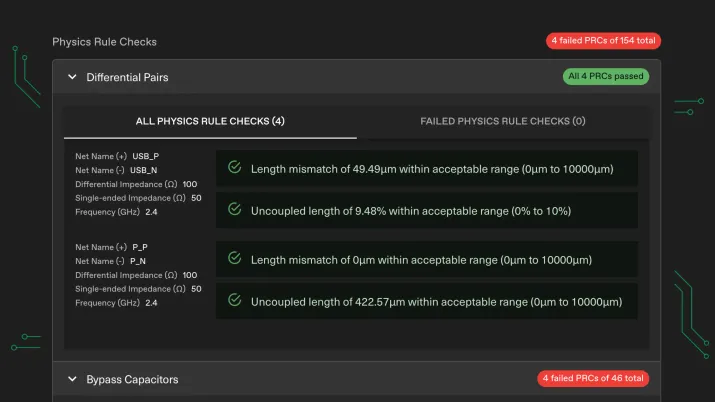
Quilter identifies key design elements for review, like bypass capacitors, impedance-controlled nets, differential pairs, and other critical considerations. You see what Quilter will and will not account for up front, which is what serious teams need to trust automation.

Multi-candidate generation in hours
Instead of producing a single route and hoping it is “the one,” Quilter generates multiple candidates within hours. That is the heart of the generative approach: layout becomes abundant.

Physics-first validation
Quilter evaluates each candidate against the full set of provided physical constraints. The goal is not just connectivity. The goal is a layout closer to fab-ready, with a transparent design review that highlights what is complete and what needs attention.

The workflow outcome is not “AI replaced my CAD tool.” It is “my CAD tool now has multiple viable starting points, quickly, with physics checks, so my team can choose, refine, and ship faster.”

How does Quilter compare to top autorouters and auto-interactive tools?

If you’re comparing PCB autorouters for advanced designs, you want a simple lens: what each approach optimizes, and what it costs in engineering time.

Here is the three-column comparison that most closely aligns with real outcomes.

Dimension

Traditional Autorouters

Auto-Interactive Routers

Quilter Generative AI

Technology Approach

Single-pass algorithmic routing over nets with geometric cost functions and constraints

Human-guided routing using corridors, bundles, push-and-shove, and constraint enforcement

Multi-candidate full-board generation with reinforcement learning and physics-driven evaluation

Manual Cleanup Required

Often high on dense or high-speed boards

Moderate, depends on designer strategy and net criticality

Lower for broad routing work, with targeted human polish and review in CAD

Complex High-Speed Capability

Limited by heuristic proxies and brittleness under dense constraints

Strong when guided by expert designers

Strong when constraints and physics checks are expressed clearly, plus multiple candidates enable comparison

Iteration Speed

Slow when constraints change, reruns can be brittle

Faster than batch, but still designer-time constrained

Fast because new candidates can be generated and reviewed in hours

Engineer Time Required

High total time when cleanup and rework are counted

High skill time required, hard to scale

Shifts time to constraint definition, review, and final tuning, which scales better

A key nuance: Quilter is not trying to rip out your existing toolchain. It is designed to complement it. You still do final checks, last-inch adjustments, and manufacturing prep in the CAD environment your team trusts. Quilter covers the time-consuming middle where most schedules die: dense routing that must respect real constraints, and must be iterated.

Run a one-board trial

Run a one-board trial with Quilter

  • In the first 24 hours: upload a real project, define constraints and placements, generate multiple candidates, and review physics checks.
  • Then comparecleanup time, via counts, length-match stability, and routing density against your current autorouter or auto-interactive flow.

If you want a quick starting point, choose a board type that is painful but bounded: test fixtures, IC evaluation boards, or a validation board that has a repeatable constraint set.

Here’s what real teams see when they adopt generative layout

The most useful way to describe generative layout is not abstract benchmarks. It is what changes in a team’s weekly reality.

Scenario 1: Test fixtures and harnesses under deadline pressure

Test hardware often becomes the silent schedule killer. The schematic is “simple,” but the board still needs to be routed correctly, manufactured quickly, and brought up without surprises. Teams that adopt generative layout often see the biggest win here: routing stops being the long pole, and bring-up starts sooner.

Outcomes teams commonly report in this category:

  • Weeks of layout compression, because the routing phase becomes hours, not days.
  • More than one candidate to review, which reduces the risk of locking into a bad topology early.

Scenario 2: IC evaluation boards that must be clean, fast, and reproducible

Eval boards need to be fab-ready quickly and reflect best-in-class high-speed practice, as they shape how silicon is tested and perceived. The problem is that “quick” and “clean” usually conflict.

Generative layout changes that trade off because you can generate multiple candidates, compare the routing strategies, and choose the one that gives you the best mix of density, return path sanity, and manufacturability.

Scenario 3: Design validation boards where iteration is the whole point

Validation boards are rarely one-and-done. They change as the system changes. The cost of iteration is what determines whether you explore broadly or settle early.

Generative layout makes exploration cheaper:

  • Try multiple stack-ups.
  • Try multiple manufacturers.
  • Try multiple form factors.

And do it in parallel, in hours instead of weeks, with the same constraint structure.

Scenario 4: Backplanes and interconnect boards where density and rules collide

Backplanes and dense interconnect designs punish single-pass routing. The problem is not only connectivity. It is managing complexity without losing reviewability. Here, having multiple candidates is not a luxury. It is a way to see tradeoffs you would otherwise discover only after days of manual rework.

Across these scenarios, secondary benefits show up quickly:

  • Earlier SI and PI risk discovery, because candidate evaluation and constraint review happen sooner.
  • More effective use of senior designers, because their time shifts from repetitive routing to strategy, review, and final tuning.
  • Higher design confidence, because the team is choosing among candidates rather than betting on one fragile path.

Where should you still use your existing CAD router, and where should AI take over?

The most pragmatic adoption model is the hybrid model. You keep what your CAD tool does best and offload the rest.

Keep interactive and manual routing for:

  • Last-inch tuning near connectors, BGA breakouts that are mechanically constrained, and sensitive geometry decisions
  • Edge-case RF layouts where you want direct human control over shapes and spacing
  • Final polish passes that reflect your team’s style guide and manufacturing preferences

Use AI-driven generative layout for:

  • Broad, rule-constrained dense routing across the board
  • High net-count regions where multiple plausible topologies exist and you want options
  • Fast iteration when placements, stack-ups, or constraints change late in the cycle

A simple sample flow that fits most teams:

  1. Upload your existing project from your CAD environment.
  2. Define constraints and intent: board outline, keep-outs, pre-placed components, critical nets, differential pairs, impedance rules.
  3. Generate multiple candidates in hours.
  4. Review physics checks and constraint outcomes; select the candidate that best aligns with your risk and manufacturability priorities.
  5. Export back to CAD and do final DRC, polish, and fabrication outputs.

This adoption pattern helps build trust with expert teams: you are not handing over the keys blindly. You are multiplying your ability to iterate while staying inside familiar review and sign-off processes.

What’s the best next step if you’re evaluating advanced routing tools?

If you are evaluating “the most advanced pcb autorouters on the market,” the fastest way to get a real answer is to run a head-to-head experiment on a board you already care about.

Pick a project that represents your pain:

  • A dense validation board that keeps changing
  • An IC evaluation board that needs to be clean and fast
  • A backplane or interconnect design where routing dominates the schedule

Then run two passes:

  • Your current autorouter or auto-interactive routing flow, using the same constraints you use today
  • Quilter, generating multiple candidates and reviewing physics checks before you export back to CAD

Measure outcomes that matter:

  • Total cleanup hours
  • Via count and density behavior
  • Stability of length matching when constraints change
  • How many viable options you can you evaluate within a day

Quilter offers paths for different teams and stages, with the same core promise: generate and review multiple physics-validated layout candidates in hours without abandoning your existing CAD investments, and pay only for approved designs.

Try Quilter for Yourself

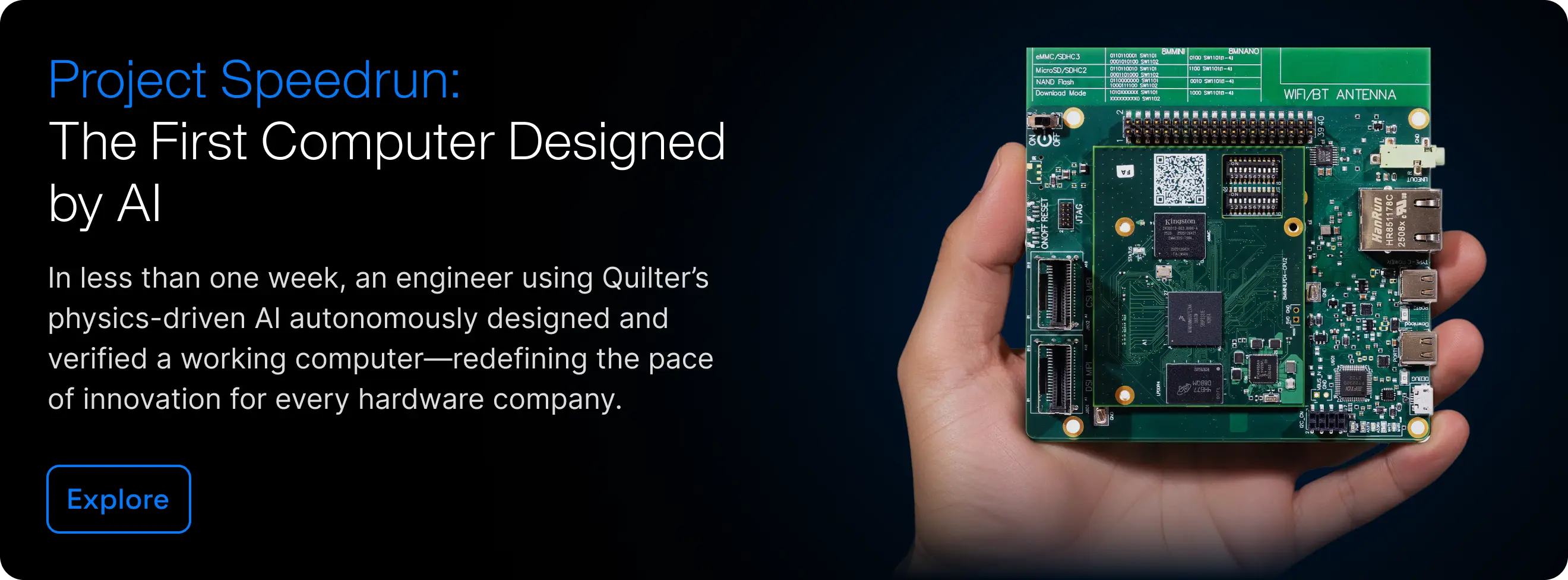
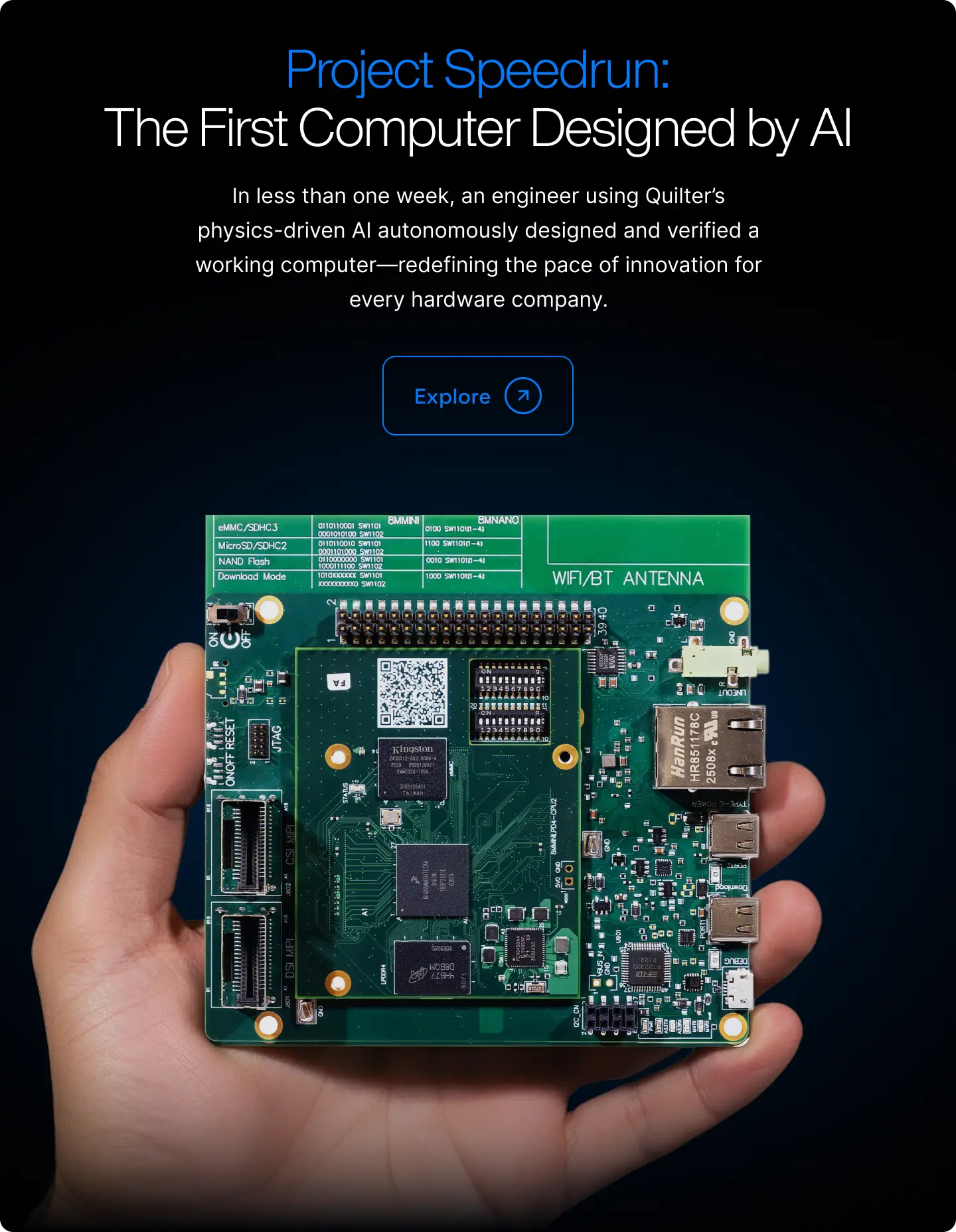
Project Speedrun demonstrated what autonomous layout looks like in practice and the time compression Quilter enables. Now, see it on your own hardware.

Get Started

Validating the Design

With cleanup complete, the final question is whether the hardware works. Power-on is where most electrical mistakes reveal themselves, and it’s the moment engineers are both nervous and excited about.

Continue to Part 4

Cleaning Up the Design

Autonomous layout produces a complete, DRC'd design; cleanup is a brief precision pass to finalize it for fabrication.

Continue to Part 3

Compiling the Design

Once the design is prepared, the next step is handing it off to Quilter. In traditional workflows, this is where an engineer meets with a layout specialist to clarify intent. Quilter replaces that meeting with circuit comprehension: you upload the project, review how constraints are interpreted, and submit the job.

Continue to Part 2

The Three Eras of PCB Routing: From Autorouters to Auto-Interactive to Generative AI

March 16, 2026
by
Sergiy Nesterenko
and

When engineers search for the most advanced pcb autorouters, they are rarely looking for yet another checkbox in their CAD tool. They want faster, more reliable layouts on real high-speed, high-density boards without getting bogged down in cleanup. In this article, we’ll walk through the three eras of routing technology and show where Quilter’s physics-driven AI sits relative to Cadence Allegro router, Siemens Xpedition routing, auto-interactive routing systems like ActiveRoute and Sketch Router, and the classic batch autorouters many teams still rely on.

If you’re doing a pcb autorouter comparison because schedules are tight, your designers are stretched, and every respin is expensive, the framing that matters is simple:

  • Era 1 focused on routing networks efficiently.
  • Era 2 tried to help experts route nets faster.
  • Era 3 aims to generate complete layouts under real constraints and validate them against physics before you spend a dollar on fabrication.

That third era is when generative AI PCB layout moves from “AI hype” to “design capacity”.

Let’s define how PCB routing got here in the first place

PCB routing started as a craft. Early boards were hand-placed and hand-routed because they had to be. Trace geometry was simple, net counts were manageable, and the limiting factor was time at the drafting table.

Then density arrived. Packages shrank, pin counts rose, and nets multiplied. As soon as boards became too complex to route manually within the schedule, batch autorouters emerged. Their promise was seductive: push a button, get connectivity.

For a while, it worked well enough. Early autorouters could achieve high completion on many digital boards, especially when “good enough” meant the board passed DRC and the product was tolerant of extra vias, long meanders, and less-than-ideal return paths.

But modern hardware changed the definition of “works.” High-speed interfaces, tighter EMI margins, and increasingly unforgiving SI and PI requirements meant that “connected” was no longer the goal. You needed controlled impedance, predictable delay, clean length matching, sensible layer transitions, and power delivery that did not become a science fair at bring-up.

That is the core reason “just throw an autorouter at it” stopped working for many teams. The routing task became inseparable from physics and system intent.

So routing automation evolved into three eras:

  • Batch autorouters: route the algorithm first; constraints serve as guardrails.
  • Auto-interactive routing: human strategy first, automation fills in the geometry.
  • Generative AI layout: explore many complete candidates, score them against constraints and physics, then hand the best back to engineers for final polish.

What do people really mean by “the most advanced PCB autorouter”?

When someone types “most advanced pcb autorouters on the market,” they are usually translating pain into a shopping query. They are not asking for a feature list. They are asking, “Which tool will stop stealing my schedule?”

In practice, the “advanced” label collapses into a few evaluation dimensions that matter to real programs:

1) Completion rate without creating a cleanup nightmare
A router that “finishes” by spraying vias everywhere is not finishing. Completion only counts if the result is close to production quality.

2) High-speed awareness that survives contact with reality
Does the router honor differential pair intent, impedance constraints, delay tuning, and topology, or does it require days of post-routing repair?

3) Manual cleanup required
How many hours of glossing, shove, reroute, neckdown fixes, and length-match rescue work do you pay after the automation runs?

4) Iteration speed under changing constraints
Boards rarely route once. Stack-ups change, connector locations shift, a regulator is replaced, and suddenly your “done” layout becomes a new problem. Advanced tools make iteration cheap, not just the first pass.

5) Integration with existing CAD and review workflows
Even the best router fails to gain adoption if it does not fit the team’s constraints, DRC flow, and manufacturing outputs.

The most common “advanced autorouter” pain points map directly to these dimensions:

  • Days of cleanup after a “successful” autoroute pass
  • Broken length matching when one placement changes
  • Via explosions that destroy density, cost, and signal quality
  • Routes that are legal per DRC but naive about return paths and power integrity

Those are exactly why teams evaluate Allegro, Xpedition, Altium, TopoR, and now AI-driven systems. The question is no longer “can it route.” The question is “can it route in a way that reduces engineering effort and risk?”

Here’s how first-generation batch autorouters actually work

Classic batch autorouters are optimization engines that try to connect nets while minimizing conflicts. Two common conceptual approaches show up across tools:

Grid-based routing
The board is discretized into a grid. Traces occupy grid edges or cells, and the router searches for paths. Grid systems can be fast and predictable, but they struggle with tight geometry, non-Manhattan routing freedom, and nuanced cost tradeoffs. They often need heavy parameter tuning to avoid pathological results.

Shape-based routing
Instead of treating the board like a coarse grid, shape-based routers work with actual obstacle geometry and clearance shapes. This typically improves quality and completion on denser boards because the router can “see” space more like a human. Many long-standing enterprise routers and integrated routers use variations of this approach.

Why these still matter: batch autorouters can be excellent for certain workloads.

  • They can achieve high completion on non-critical nets, especially on moderately complex boards.
  • They can reduce brute manual labor for connective tissue routing, leaving critical nets to experts.
  • They can be helpful when you need a quick baseline topology, even if you plan to refactor.

Where the plateau is also consistent.

They do not truly understand electrical intent.
They can obey constraints, but they do not reason about “why” those constraints exist. A constraint system is a proxy. SI and PI are the underlying reality.

They search once, then you fix.
Most batch workflows produce one answer. If it is messy, the human pays the difference. If a constraint changes, the human pays again.

They are brittle under modern density.
As soon as a design becomes both dense and high-speed, the router’s tradeoffs become expensive. It may route in a way that is formally legal but practically unreviewable or risky.

That is why “most advanced pcb autorouters” often look like a paradox. The more complex the board, the less any single batch pass feels like progress.

Here’s why auto-interactive routing became the new default

Auto-interactive routing emerged because experienced designers wanted leverage, not lottery tickets.

Instead of “push button and hope,” the workflow became “set intent, guide the router, then let automation do the boring geometry.” That intent can look like:

  • Corridors and route guides for bundles and buses
  • Differential pair helpers that maintain pair rules while you steer
  • Push-and-shove routing with interactive DRC that keeps you honest
  • Auto-tuning operations that add or remove length while respecting constraints

Tools in this category are often the day-to-day workhorses for advanced teams. You see it in:

  • Altium’s auto-interactive routing style features (often used as an Altium autorouter alternative to fully automatic routing on complex nets)
  • Siemens Xpedition routing capabilities, such as sketch-style guidance for bundles
  • Enterprise suites like Allegr,o where interactive routing and constraint enforcement are central to the workflow

Auto-interactive routing improved outcomes because it preserved what humans are good at:

  • Floorplanning and strategy
  • Knowing which nets are fragile
  • Making tradeoffs that reflect the system, not just the board

But it still leaves a stubborn gap.

The human is still the routing engine for the hard parts.
Auto-interactive tools are multipliers, not replacements. The designer still owns topology choices, layer strategy, return path sanity, escape complexity, and the edge cases that make boards real.

And that is where the modern constraint hits: even if a senior PCB designer can route anything, you cannot scale senior time. Programs choke not because experts forgot how to route, but because there are not enough expert hours to route everything fast, iterate multiple options, and still do a clean review.

Auto-interactive routing became the new default because it made experts faster. It did not make the layout abundant.

What changed in the generative AI era for PCB layout?

The generative AI era changes the unit of work.

Classic routing thinks in nets. Auto-interactive routing thinks in guided segments. Generative AI layout considers full-board candidates.

That sounds like a semantic shift, but it is operationally massive.

Generative search means the system explores thousands of possible full-board solutions rather than just one. Instead of routing once and tuning forever, it produces multiple plausible layouts that satisfy the same constraints in different ways. That gives teams something they almost never had at scale: design options.

Reinforcement learning changes how the system improves. Traditional algorithms optimize within predefined heuristics and cost functions. RL systems can learn routing strategies by iteratively receiving feedback and updating policies to improve outcomes across many designs. In a PCB context, the relevant feedback is not just “did it connect,” but “did it meet constraints and physical behavior expectations.”

Physics-anchored scoring is the point. If the scoring function is only geometric, you are back to “pretty routes that might fail.” When the candidate evaluation is tied to real constraints and physics checks, the system starts to behave less like an autorouter and more like a layout generator that respects engineering reality.

This is why “generative AI PCB layout” is not just a faster autorouter. It is a different workflow:

  • Humans define constraints and intent.
  • The system generates and evaluates multiple complete layouts.
  • Humans review candidates, choose a direction, and finalize in familiar CAD.

The payoff is iteration speed. When iteration becomes cheap, you get better boards and fewer surprises because you can explore, compare, and validate before fabrication.

Let’s talk about how Quilter’s physics-driven AI fits into this new era

Quilter is built around a simple premise: PCB design remains a critical discipline, but engineers should not spend their best hours on non-core layout tasks.

In practical terms, Quilter is designed to fit how teams already work.

Import and workflow compatibility
Quilter works with existing projects from major CAD ecosystems. The workflow begins where your design already lives: you upload the project, define the board outline, pre-place connectors, and determine the floor plan. You control the constraints. Quilter then returns files in the same format so you can run DRC, polish, and generate fab outputs in the tools you already use.

Internal link placeholders for publishing:

  • Cadence Allegro compatibility: /workflow/cadence
  • Siemens Xpedition compatibility: /workflow/siemens
  • Altium compatibility: /workflow/altium
  • KiCad compatibility: /workflow/kicad

Physics-aware understanding, up front
Quilter identifies key design elements for review, like bypass capacitors, impedance-controlled nets, differential pairs, and other critical considerations. You see what Quilter will and will not account for up front, which is what serious teams need to trust automation.

Multi-candidate generation in hours
Instead of producing a single route and hoping it is “the one,” Quilter generates multiple candidates within hours. That is the heart of the generative approach: layout becomes abundant.

Physics-first validation
Quilter evaluates each candidate against the full set of provided physical constraints. The goal is not just connectivity. The goal is a layout closer to fab-ready, with a transparent design review that highlights what is complete and what needs attention.

The workflow outcome is not “AI replaced my CAD tool.” It is “my CAD tool now has multiple viable starting points, quickly, with physics checks, so my team can choose, refine, and ship faster.”

How does Quilter compare to top autorouters and auto-interactive tools?

If you’re comparing PCB autorouters for advanced designs, you want a simple lens: what each approach optimizes, and what it costs in engineering time.

Here is the three-column comparison that most closely aligns with real outcomes.

Dimension

Traditional Autorouters

Auto-Interactive Routers

Quilter Generative AI

Technology Approach

Single-pass algorithmic routing over nets with geometric cost functions and constraints

Human-guided routing using corridors, bundles, push-and-shove, and constraint enforcement

Multi-candidate full-board generation with reinforcement learning and physics-driven evaluation

Manual Cleanup Required

Often high on dense or high-speed boards

Moderate, depends on designer strategy and net criticality

Lower for broad routing work, with targeted human polish and review in CAD

Complex High-Speed Capability

Limited by heuristic proxies and brittleness under dense constraints

Strong when guided by expert designers

Strong when constraints and physics checks are expressed clearly, plus multiple candidates enable comparison

Iteration Speed

Slow when constraints change, reruns can be brittle

Faster than batch, but still designer-time constrained

Fast because new candidates can be generated and reviewed in hours

Engineer Time Required

High total time when cleanup and rework are counted

High skill time required, hard to scale

Shifts time to constraint definition, review, and final tuning, which scales better

A key nuance: Quilter is not trying to rip out your existing toolchain. It is designed to complement it. You still do final checks, last-inch adjustments, and manufacturing prep in the CAD environment your team trusts. Quilter covers the time-consuming middle where most schedules die: dense routing that must respect real constraints, and must be iterated.

Run a one-board trial

Run a one-board trial with Quilter

  • In the first 24 hours: upload a real project, define constraints and placements, generate multiple candidates, and review physics checks.
  • Then comparecleanup time, via counts, length-match stability, and routing density against your current autorouter or auto-interactive flow.

If you want a quick starting point, choose a board type that is painful but bounded: test fixtures, IC evaluation boards, or a validation board that has a repeatable constraint set.

Here’s what real teams see when they adopt generative layout

The most useful way to describe generative layout is not abstract benchmarks. It is what changes in a team’s weekly reality.

Scenario 1: Test fixtures and harnesses under deadline pressure

Test hardware often becomes the silent schedule killer. The schematic is “simple,” but the board still needs to be routed correctly, manufactured quickly, and brought up without surprises. Teams that adopt generative layout often see the biggest win here: routing stops being the long pole, and bring-up starts sooner.

Outcomes teams commonly report in this category:

  • Weeks of layout compression, because the routing phase becomes hours, not days.
  • More than one candidate to review, which reduces the risk of locking into a bad topology early.

Scenario 2: IC evaluation boards that must be clean, fast, and reproducible

Eval boards need to be fab-ready quickly and reflect best-in-class high-speed practice, as they shape how silicon is tested and perceived. The problem is that “quick” and “clean” usually conflict.

Generative layout changes that trade off because you can generate multiple candidates, compare the routing strategies, and choose the one that gives you the best mix of density, return path sanity, and manufacturability.

Scenario 3: Design validation boards where iteration is the whole point

Validation boards are rarely one-and-done. They change as the system changes. The cost of iteration is what determines whether you explore broadly or settle early.

Generative layout makes exploration cheaper:

  • Try multiple stack-ups.
  • Try multiple manufacturers.
  • Try multiple form factors.

And do it in parallel, in hours instead of weeks, with the same constraint structure.

Scenario 4: Backplanes and interconnect boards where density and rules collide

Backplanes and dense interconnect designs punish single-pass routing. The problem is not only connectivity. It is managing complexity without losing reviewability. Here, having multiple candidates is not a luxury. It is a way to see tradeoffs you would otherwise discover only after days of manual rework.

Across these scenarios, secondary benefits show up quickly:

  • Earlier SI and PI risk discovery, because candidate evaluation and constraint review happen sooner.
  • More effective use of senior designers, because their time shifts from repetitive routing to strategy, review, and final tuning.
  • Higher design confidence, because the team is choosing among candidates rather than betting on one fragile path.

Where should you still use your existing CAD router, and where should AI take over?

The most pragmatic adoption model is the hybrid model. You keep what your CAD tool does best and offload the rest.

Keep interactive and manual routing for:

  • Last-inch tuning near connectors, BGA breakouts that are mechanically constrained, and sensitive geometry decisions
  • Edge-case RF layouts where you want direct human control over shapes and spacing
  • Final polish passes that reflect your team’s style guide and manufacturing preferences

Use AI-driven generative layout for:

  • Broad, rule-constrained dense routing across the board
  • High net-count regions where multiple plausible topologies exist and you want options
  • Fast iteration when placements, stack-ups, or constraints change late in the cycle

A simple sample flow that fits most teams:

  1. Upload your existing project from your CAD environment.
  2. Define constraints and intent: board outline, keep-outs, pre-placed components, critical nets, differential pairs, impedance rules.
  3. Generate multiple candidates in hours.
  4. Review physics checks and constraint outcomes; select the candidate that best aligns with your risk and manufacturability priorities.
  5. Export back to CAD and do final DRC, polish, and fabrication outputs.

This adoption pattern helps build trust with expert teams: you are not handing over the keys blindly. You are multiplying your ability to iterate while staying inside familiar review and sign-off processes.

What’s the best next step if you’re evaluating advanced routing tools?

If you are evaluating “the most advanced pcb autorouters on the market,” the fastest way to get a real answer is to run a head-to-head experiment on a board you already care about.

Pick a project that represents your pain:

  • A dense validation board that keeps changing
  • An IC evaluation board that needs to be clean and fast
  • A backplane or interconnect design where routing dominates the schedule

Then run two passes:

  • Your current autorouter or auto-interactive routing flow, using the same constraints you use today
  • Quilter, generating multiple candidates and reviewing physics checks before you export back to CAD

Measure outcomes that matter:

  • Total cleanup hours
  • Via count and density behavior
  • Stability of length matching when constraints change
  • How many viable options you can you evaluate within a day

Quilter offers paths for different teams and stages, with the same core promise: generate and review multiple physics-validated layout candidates in hours without abandoning your existing CAD investments, and pay only for approved designs.