






Read the Full Series
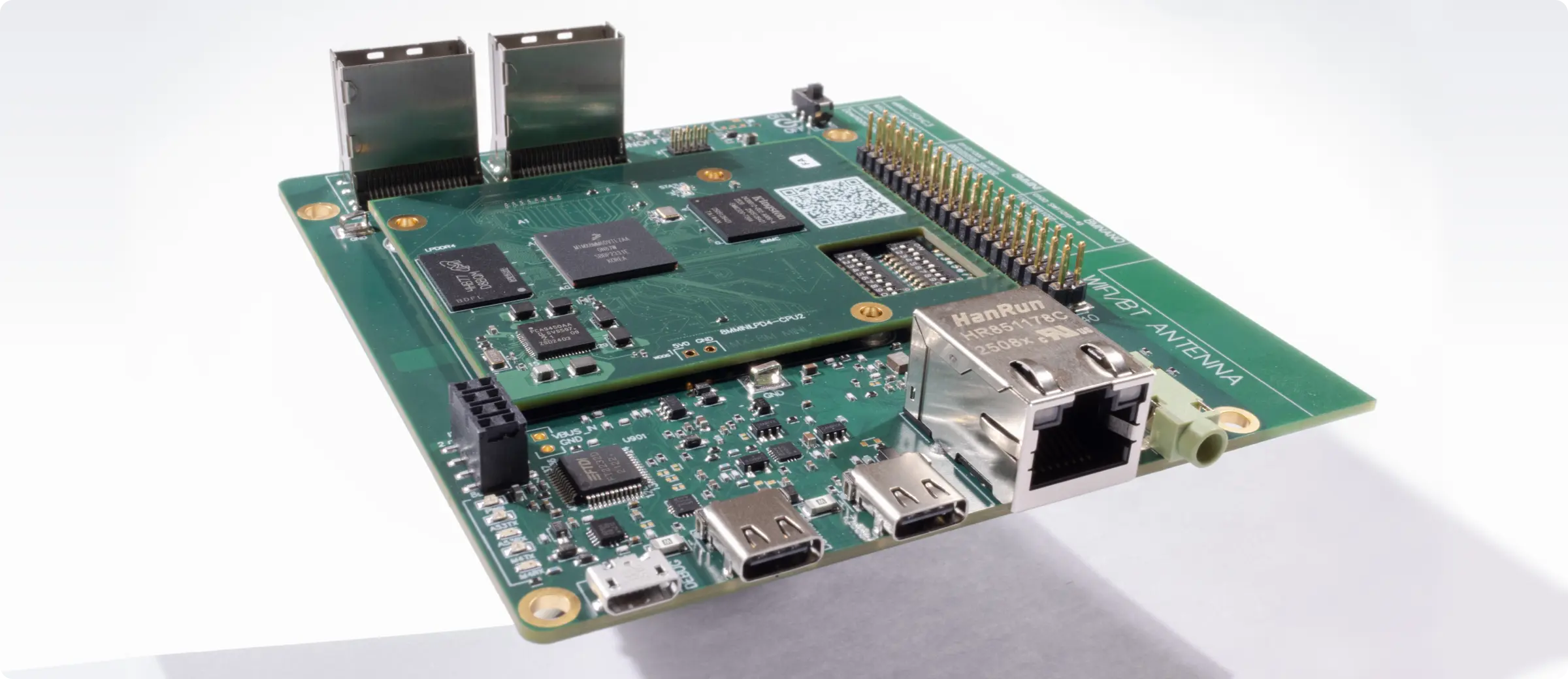
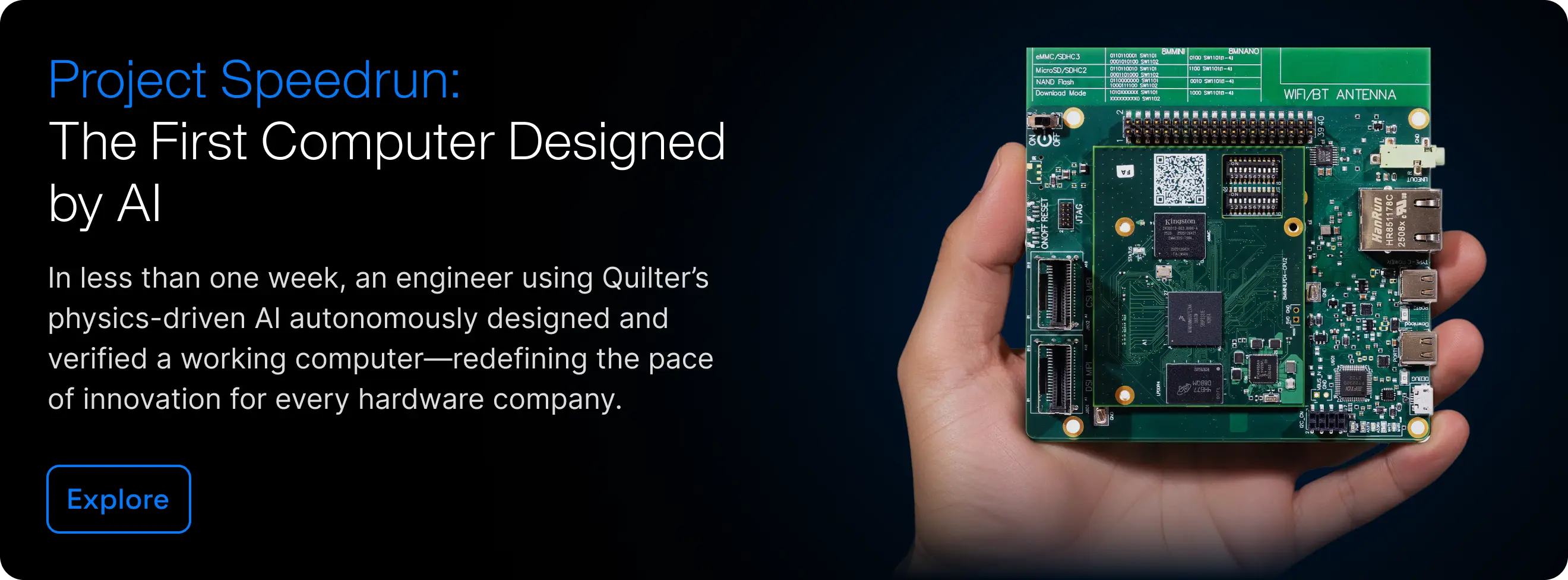
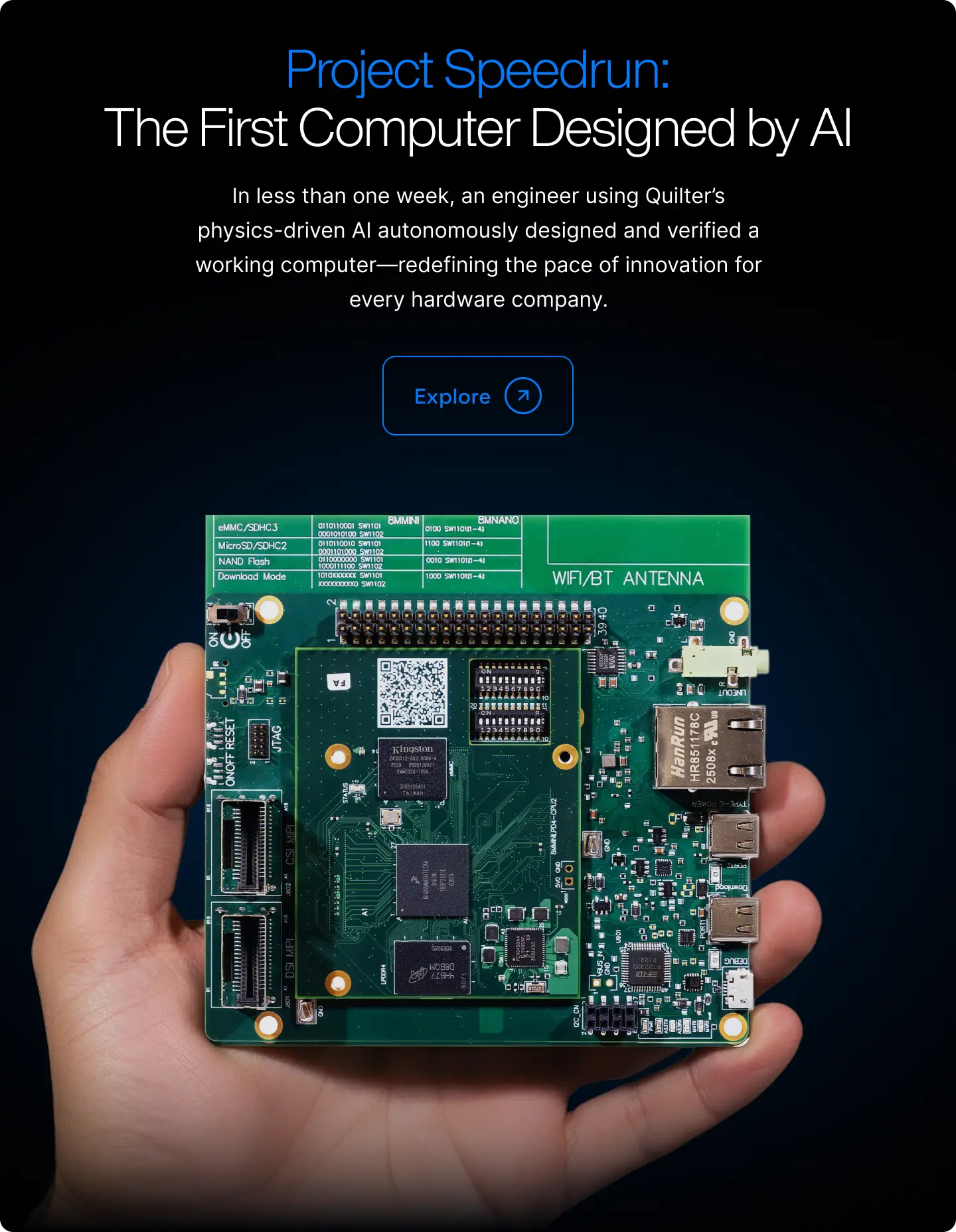
This article is one part of a walkthrough detailing how we recreated an NXP i.MX 8M Mini–based computer using Quilter’s physics-driven layout automation.
Cloud-based PCB design tools have transformed how hardware teams collaborate and build. But in 2026, the real breakthrough is not just working in your browser. It is letting AI handle the heavy lifting. In this guide, we’ll compare the leading cloud platforms and show why Quilter’s physics-driven AI is setting a new standard for speed, confidence, and innovation.
Let's define what 'cloud-based' really means for PCB design
A “cloud-based PCB tool” should reduce setup friction, centralize design data, and make collaboration simpler, but not every vendor means the same thing when they say “cloud.” In practice, cloud tools fall into three buckets: cloud-native editors, cloud-collaboration platforms, and hybrid workflows that keep the editor on the desktop while moving the data and review process to the cloud.
Cloud-native usually means the editor runs in the browser and your design data lives online by default. EasyEDA positions itself as browser-based PCB design, and Upverter is similarly web-based, bundling schematic, PCB, routing, and 3D preview in a browser workflow.
Cloud-enhanced usually means the core editing still happens in an installed desktop tool, but collaboration, sharing, versioning, review, and stakeholder access are handled through a cloud platform. Altium 365 describes itself as cloud infrastructure that connects stakeholders across electronics development, including manufacturing-facing workflows.
Quilter fits a third model that matters a lot in 2026: cloud automation that plugs into your existing CAD workflow. You upload native ECAD projects (Altium, Cadence, Siemens, KiCad), define constraints and intent, generate multiple candidate layouts in parallel, then take the winner back into your existing CAD environment for final polish and release.
Here's why AI is changing the game for electronics design
AI is changing PCB layout because the bottleneck is rarely “can we draw traces.” The bottleneck is time, iteration capacity, and risk. Hardware teams want more shots on goal without increasing headcount, while still meeting real electrical and physical constraints. That is why AI PCB layout and PCB automation have moved from “nice to have” to a top evaluation criterion.
Traditional automation in PCB tools has mostly been rule-driven: autorouters, constraint managers, and assistive features that speed up pieces of the job. Those are useful, but they often struggle when designs become constraint-dense, high-speed, or just “messy” in the way real product boards are messy. You end up spending the time anyway, just later, during cleanup and debug.
AI changes the workflow by making “generate and evaluate” the default loop. Instead of committing early to one layout path, the system can explore many candidates, score them against constraints, and give engineers options that are already closer to manufacturable reality.
Quilter’s positioning is explicit here: it uses reinforcement learning to explore large candidate spaces and emphasizes physics-aware checks so candidates are validated against real physical constraints for review. Practically, that means: upload a native project, set constraints, generate many layouts in hours, and keep iterating without waiting weeks for the next layout cycle.
This is the key shift for cloud EDA comparison in 2026: collaboration and cloud storage are table stakes. The differentiator is whether the cloud helps you design better boards faster, not just share files faster.
How do today's top cloud PCB tools stack up?
If you are comparing cloud based PCB design tools, you are really comparing four different philosophies: cloud-native design-to-fab (EasyEDA), browser-first collaboration for PCB creation (Upverter), enterprise cloud collaboration around a powerful desktop editor (Altium 365), and AI-assisted automation that accelerates layout while staying compatible with your existing CAD workflow
Quilter
Quilter is built for teams that want to remove layout as the pacing item without ripping out their existing toolchain. You upload native Altium, Cadence, Siemens, or KiCad projects, define the board outline and constraints, and Quilter generates multiple layout candidates in parallel, runs physics-aware checks, and returns native files for final DRC, polish, and fabrication outputs in your CAD tool.
This matters for real organizations because it creates a fast, iterative “layout abundance” loop. Instead of treating layout as a single long queue, you can try multiple stackups, manufacturers, or form factors in parallel, then choose the best candidate based on your constraints and review goals.
Product overview | Solutions | Support
EasyEDA
EasyEDA is a cloud-native, browser-based PCB design environment that is popular for fast idea-to-board flows. EasyEDA markets itself as running in your web browser and includes a large online library and supply-chain connected workflow, especially when paired with JLCPCB manufacturing.
It is a strong fit when you want low friction, rapid prototyping, and a tightly integrated path to fabrication. It can also work well for smaller teams that value accessibility and cost efficiency, and for users who prioritize a tool that is easy to spin up in minutes.
Upverter
Upverter is a web-based PCB design tool designed for simplicity and collaboration, bundling schematic, PCB design, automated routing, and 3D preview in a browser workflow.
Upverter is often evaluated by teams that want browser access and collaboration, plus a more guided design experience than heavyweight desktop suites. It can be a good option for distributed teams and for organizations that want a web-first environment for PCB creation and iteration.
Altium 365
Altium 365 is positioned as a secure cloud platform that connects electronics development stakeholders, from design through supply chain and manufacturing collaboration. It is widely used as a collaboration and data layer around Altium’s broader ecosystem, enabling browser-based viewing, sharing, commenting, and workflow alignment across teams.
For many organizations, Altium 365 is less about “design in the browser” and more about “keep design data connected to the people who need it.” If you already rely on Altium tooling, it can be a natural way to improve traceability, collaboration, and release processes.
Head-to-head comparison table
Feature
Quilter
EasyEDA
Upverter
Altium 365
What “cloud-based” means
Cloud automation that plugs into existing CAD workflow
Cloud-native browser editor
Cloud-native browser editor
Cloud collaboration and infrastructure around desktop design
Editor runs in browser
Quilter workflow runs in the cloud; output edited in your native CAD
Yes
Yes
Browser-based viewing and collaboration; editing primarily via desktop tooling
Collaboration
Shareable, reviewable candidates and fast iteration loop
Link sharing, cloud projects
Browser collaboration
Stakeholder access, review, and connected workflows
File compatibility
Upload native Altium, Cadence, Siemens, KiCad; return native outputs
Strong within EasyEDA ecosystem
Strong within Upverter workflow
Strong within Altium ecosystem
Manufacturing integration
CAD-native handoff supports your existing release process
Strong JLCPCB-centric flow
Order boards via workflow options
Strong manufacturing-facing collaboration and release packaging
Scalability and governance
Built for teams who need speed without breaking process
Best for small to mid complexity
Best for small to mid complexity
Strong for org-wide processes and connected stakeholders
AI-Powered Automation
Full physics-driven layout, multi-candidate generation, automated constraint validation
Basic auto-router, no AI
Standard auto-routing, no cloud-native AI
Assisted automation via desktop, no cloud-native AI
Best fit
Startups to enterprise teams that need faster layout cycles
Makers, educators, prototypes, quick-to-fab
Web-first teams and collaboration-centric orgs
Organizations standardized on Altium who want robust cloud collaboration
So, what actually sets these platforms apart? Let’s break down the features that matter most when you’re choosing a cloud PCB solution.
What features really matter when choosing a cloud PCB platform?
The best cloud PCB platform is the one that removes your bottleneck. In 2026, that usually comes down to four decision factors: automation depth, collaboration and review flow, manufacturing handoff, and the ability to scale from “first prototype” to “repeatable release process.”
1) Automation that saves real time, not just clicks
Basic autorouting can help, but the question you should ask is: does this platform reduce calendar time to a board you trust? AI PCB layout changes the bar here because it can shift layout from a single-threaded task to a parallel candidate generation problem. Quilter’s value proposition is explicitly “generate multiple candidates in hours” with physics-aware checks, which is a different category than traditional cloud editors.
2) Collaboration that matches how hardware teams actually work
Real collaboration is not only multiple people editing. It is also review cycles, traceability, and the ability to bring in manufacturing, procurement, and cross-functional stakeholders. Altium 365 emphasizes connecting stakeholders and tying collaboration to manufacturing outcomes, which can matter more than pure browser editing for many orgs.
3) Manufacturing handoff and supply-chain reality
If you are building prototypes quickly, integrated ordering workflows can be a feature, not a constraint. EasyEDA’s browser-based positioning and close linkage to a manufacturing ecosystem is valuable for teams optimizing for speed-to-fab.
If you are building regulated or mission-critical hardware, the “handoff” is often a controlled release process. In that world, CAD-native outputs and traceable review matter more than one-click ordering.
4) Scalability as the board gets harder and the org gets bigger
Early-stage teams may prioritize cost and accessibility. Later, they need permissions, repeatable flows, and consistent collaboration across disciplines. A good cloud EDA comparison should not only ask “what can I do today,” but also “what happens when this board becomes a platform and the team doubles.”
Here's how Quilter leads with AI-powered PCB automation
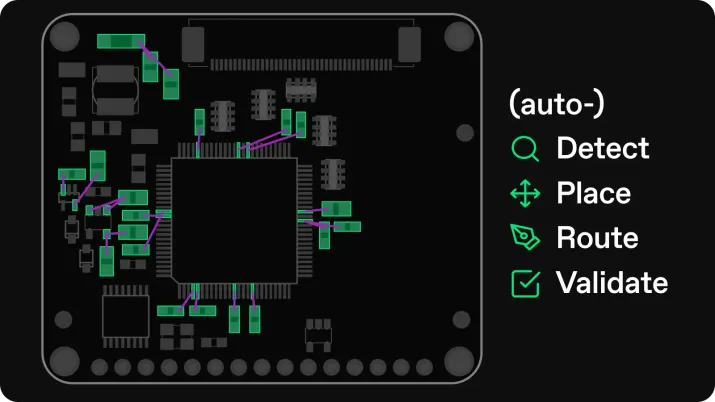
Quilter leads on PCB automation by turning layout into a fast, repeatable loop that produces options, not bottlenecks. The simplest way to understand the workflow is: keep your existing CAD, move the heavy layout work to the cloud, then return native outputs you can trust and ship.
Step 1: Upload your native CAD project
Quilter is designed to work with established workflows. You upload native projects from tools like Altium, Cadence, Siemens, or KiCad, rather than rebuilding from scratch in a new editor.
Step 2: Define intent and constraints up front
Instead of hoping the tool “guesses” what matters, you control the constraints: board outline, keepouts, connector placement and floorplan intent, differential pairs, impedance-controlled nets, and other critical considerations. Quilter emphasizes transparency about what it will and will not account for so the review process is clear.
Step 3: Generate multiple candidates in parallel
This is where AI PCB layout changes the economics. Quilter is built to generate multiple layout candidates in hours, not one candidate over weeks. That unlocks parallel experiments: different stackups, different manufacturers, different form factors, or different constraint tradeoffs, all without waiting for the next layout slot.
Step 4: Physics-aware checks and constraint validation
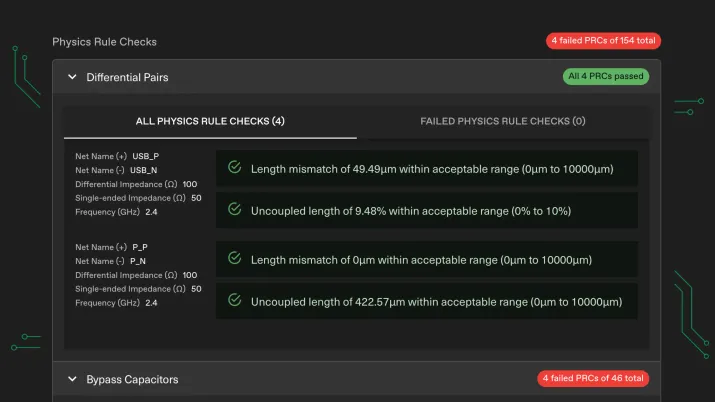
Quilter’s positioning is “physics-driven AI,” with reinforcement learning and physics-aware checks used to validate candidates against constraints. The point is not perfection with zero human review. The point is giving engineers candidates that have already been evaluated against the physical rules that drive rework when missed.
Step 5: Seamless handoff back to your CAD for final release
After you select the best candidate, you open it in your native CAD tool, run your standard DRC, do final polish, and generate fab outputs through the same release process your organization already uses. Quilter explicitly returns files in the same format as submitted, which reduces adoption friction for professional teams.
What this unlocks for teams
- Speed: more iterations without waiting on a single layout queue.
- Confidence: candidates are evaluated with physics-aware checks, not only basic routing rules.
- Engineering bandwidth: engineers spend more time on high-value decisions and less time pushing traces.
Explore the Quilter workflow | See solutions by industry | Get help and documentation
Which cloud PCB tool is right for your team?
The right choice depends on what you are optimizing for: lowest friction, best collaboration layer, or maximum layout acceleration. A good rule is to pick the platform that directly removes your bottleneck, then choose a migration path that does not force a rewrite later.
Quick decision guide by team profile
If you are prototyping fast and want a browser editor with a tight path to fabrication:
- Choose EasyEDA for quick design access, cloud projects, and integrated prototype flow.
If you want a web-first PCB creation environment with collaboration built in:
- Choose Upverter for browser-based schematic and PCB workflows with automated routing and 3D preview in one place.
If your organization is standardized on Altium and needs stakeholder collaboration and manufacturing-connected workflows:
- Choose Altium 365 for a cloud platform that connects design, procurement, and manufacturing collaboration around your Altium ecosystem.
If layout speed and iteration capacity are the limiting factor, especially for professional programs:
- Choose Quilter when you want AI PCB layout, multi-candidate generation, and physics-aware checks, while keeping your existing CAD workflow intact.
Practical “growth path” thinking
Many teams start with a cloud-native editor because it is easy to adopt, then move to more structured collaboration as projects scale. In 2026, the most important upgrade is often not “a bigger editor.” It is a faster iteration loop. That is where AI-assisted PCB automation becomes the logical next step, especially when schedules are tight and the cost of rework is high.
If your roadmap includes multiple board spins, multiple SKUs, or aggressive timelines, you should strongly consider when to introduce AI layout acceleration. Waiting until you are underwater is the most expensive time to change the process.
Ready to see what AI can do for your next board?
AI is not replacing engineering judgment. It is removing the slowest part of the iteration loop so your team can build more, test more, and learn faster. If you are comparing cloud based PCB design tools in 2026, make sure your shortlist reflects the new standard: cloud collaboration plus automation that meaningfully reduces calendar time.
Ready to see how AI can take months off your next board project? Try Quilter free or schedule a live demo with our engineering team: Try the free version or Contact Quilter.



.webp)