




Gen AI

Published

Written by

Workbench

The Agile Hardware Manifesto: How AI Layout Unlocks True Iteration Speed

Published

March 26, 2026

Most “agile hardware” teams still move at the speed of their slowest layout. Standups are modern, tools are cloud-based, but every meaningful experiment still waits in a routing queue. This manifesto shows why the usual PCB design tools can’t fix that and how physics-first AI layout from Quilter can turn board design into a fast, abundant resource for truly iterative hardware development.

If you are searching for the top pcb design tools for agile hardware teams, the list has not really changed in years. Altium is still powerful. KiCad is still improving fast. Cloud ECAD tools are still useful for collaboration. Cadence and Siemens still dominate the highest-end complexity.

But if your goal is pcb iteration speed, the question is not “which tool is best.” The real question is: which part of the workflow sets your pace, and what actually moves that pacing item?

For most PCB-centric programs, the pacing item is PCB layout plus the downstream loop of review, DRC cleanup, and manufacturing feedback. Everything else can be “agile” in theory, but if layout stays scarce, your experiments stay serialized. You stop trying variants. You stop exploring stack-ups. You stop learning fast.

That is why ai pcb layout and pcb layout automation matter now. Not as a novelty, and not as a replacement for engineering judgment, but as the missing layer that finally turns layout into something you can iterate on like software.

Let’s define what “agile” really means for hardware teams today

Software teams can ship continuously because their deployment unit is mostly compute. If a sprint slips, it is painful but reversible. You can revert. You can roll forward. You can test in production. The iteration loop is measured in hours or days.

Hardware teams live in a different physics regime.

  • Your “deployment” is a physical board that needs fab time, assembly time, shipping time, lab time, and often a compliance gate.
  • Your feedback loop depends on measurement, instrumentation, and failure analysis that cannot be parallelized indefinitely.

So when hardware teams say “we are agile,” what do they usually mean?

They often mean agile ceremonies layered on top of a workflow that still behaves like waterfall. Two-week sprints become two-week planning windows for work that will not deliver a real hardware artifact until four to eight weeks later. You still have a schematic freeze. You still have a layout phase that runs long. You still have a single board spin that everyone waits on.

The right way to translate agile into hardware is not to copy the rituals. It is to protect the core premise: short feedback loops that convert uncertainty into learning.

That means you need to identify the pacing item. The pacing item is the slowest repeatable step that sets the true cadence of iteration. It is not the thing that feels hardest. It is the thing that everyone quietly waits for.

In modern electronics programs, schematics are often not the pacing item. Firmware often is not the pacing item. Even procurement is sometimes not the pacing item if you have alternates and good library discipline.

For most PCB-centric programs, the pacing item is layout plus the coupled steps that follow it:

  • placement and routing bandwidth
  • review cycles and rework
  • DRC and manufacturability feedback
  • the “one more tweak” spiral that pushes release dates

If you want agile hardware, you have to move the pacing item. Tools that only improve collaboration or documentation can help, but they do not change the fundamental speed of converting constraints into a finished layout.

That is the manifesto’s claim: agile hardware teams should optimize for iteration throughput, and iteration throughput is capped by layout scarcity.

Here’s why PCB layout is the slowest part of your “agile” sprint

A typical “sprint” timeline for a non-trivial board is sobering, even in a competent org with good tooling.

Here is a representative path from schematic “done” to fab-ready output for a complex board:

  • Week 1: placement planning, connector and mechanical alignment, early constraints, first routing passes
  • Weeks 2 to 3: dense routing, power distribution refinement, length matching, clean-up, iterative reviews
  • Week 3 to 4: DRC closure, manufacturability checks, final documentation, fab package generation

Even when the calendar says 3 to 4 weeks, the real cost is often higher because layout time is not contiguous. Senior PCB designers are not sitting on one board for four straight weeks. They context switch across programs, unblock urgent issues, respond to review comments, and juggle library or component changes. That fragmentation introduces hidden overhead that never shows up in a Gantt chart.

Then there is the back-and-forth:

  • an EE finds a constraint that was not explicit
  • a mechanical change forces re-placement
  • a manufacturing note triggers a footprint update
  • a late SI concern forces a routing strategy change

Every one of those loops is normal. The problem is that manual layout turns normal loops into long loops.

Layout scarcity also creates a queue. Boards line up behind the same few people who can route dense designs reliably. That queue quietly dictates the scope of your experiments. Teams start behaving defensively:

  • “We cannot try that alternative stack-up, we do not have time.”
  • “We will pick one routing strategy and hope it works.”
  • “We will push that form factor change to next spin.”

The opportunity cost is the real killer. The variants you do not try are invisible, but they are exactly where learning lives. Agile hardware is fundamentally about experiment count. If layout is scarce, experiment count drops.

Manual layout is a craft. It should be used for the hard parts: negotiating constraints, judging tradeoffs, and signing off on risk. It should not be consumed by repetitive routing labor that can be explored at scale.

If you want iteration speed, you need pcb layout automation that increases layout throughput without reducing control.

What you need to know about today’s top PCB tools for fast-moving teams

If you search “top pcb design tools” you get a familiar lineup. For agile hardware teams, these tools absolutely matter, but they solve a different layer of the problem.

Altium Designer + Altium 365

Altium remains the default for many fast-moving startups and product teams because it balances capability with usability. Altium 365 adds modern review, collaboration, and supply chain visibility. For distributed teams, that collaboration layer is real value.

KiCad

KiCad is a serious option now for many teams, especially those that want zero licensing friction and strong automation potential. It pairs well with version control and CI-style workflows. If you are building a culture of “design like code,” KiCad can be a great foundation.

Fusion 360 with Eagle

Fusion and Eagle can be a strong fit when mechanical constraints dominate and you want a tight ECAD-MCAD loop. For certain product categories, that integration drives faster physical convergence.

Browser ECAD: Upverter and EasyEDA

These tools shine when onboarding and “everyone can open the design instantly” matters more than deep high-speed capability. They reduce friction for collaboration, education, and quick prototypes. They are often part of an agile story for early concept work.

Here is the hard truth though: all of these tools still assume a human is doing 100 percent of the critical placement and routing work, and that work still takes days or weeks for anything non-trivial. They optimize communication and control. They do not fundamentally change the speed of converting constraints into completed layouts.

That is why agile teams should think in stacks, not single tools.

  • ECAD is where you edit, manage libraries, run DRC, and produce deliverables.
  • AI layout is the missing layer that turns layout into a fast, parallelizable process.

This is the category shift behind ai pcb layout. It is not “another ECAD.” It is an acceleration layer that sits on top of your existing toolchain.

How do current PCB tools really stack up for agile hardware teams?

Below is an opinionated comparison focused on iteration speed, not feature checklists. This is the lens agile hardware teams should care about.

Tool

Best fit

Collaboration and review

Automation potential

Complexity ceiling

Impact on iteration speed (weeks vs hours)

Altium 365 (Altium Designer + 365)

Teams needing strong pro ECAD + cloud review

Strong commenting, review workflows, org-wide access

Moderate via scripts, process discipline

High

Weeks for layout on non-trivial boards, collaboration reduces friction but not layout time

KiCad

Cost-sensitive, automation-minded teams

Depends on Git conventions and process

High potential via scripts and CI patterns

Medium to high (improving fast)

Weeks for manual layout, faster iteration mainly comes from process and reduced license friction

Fusion 360/Eagle

Mechatronics-heavy product teams

Good within Fusion ecosystem

Moderate

Medium

Weeks for layout, faster convergence via ECAD-MCAD loop, not routing speed

Upverter

Web-first teams, early-stage collaboration

Excellent real-time collaboration

Limited to moderate

Medium

Days to weeks depending on complexity, routing still human-limited

EasyEDA

Fast prototypes, manufacturing-integrated flows

Easy sharing, low onboarding friction

Limited

Low to medium

Days for simple boards, still not a solution for dense, high-speed iteration

Quilter AI

Teams bottlenecked by layout throughput

Works with existing review stack

High where constraints are explicit and repeatable

Built for demanding programs with physics checks

Hours to generate multiple fab-ready candidates and explore variants in parallel

This is the key conclusion: no current “traditional” pcb design tool meaningfully shifts layout from the pacing item to a near-instant step. They improve how you collaborate on the work. They do not remove the core constraint: layout bandwidth.

Quilter fills that gap by making layout abundant.

Here’s how AI layout changes the core pacing item in hardware

Quilter’s approach is simple to describe but profound in its impact: use reinforcement learning to explore thousands of candidate layouts, guided by physics-based checks, so the system can quickly generate multiple viable, fabrication-ready options.

Instead of treating layout as a linear artisan process, Quilter treats layout as a search problem:

  • you define the board outline, floorplan intent, and constraints
  • Quilter explores routing and placement decisions at scale
  • each candidate is evaluated against the physical constraints you care about
  • you review, select, and iterate based on clear reports

The outcomes matter because they directly attack the pacing item:

  • multiple candidates in hours, not weeks
  • full layouts in under 4 hours for many workflows
  • boards ready within a single workday, with early candidates often appearing within the first hour

That speed is not just about “going faster.” It enables a different behavior: parallel experimentation.

When layout is scarce, you choose one stack-up and hope. When layout is abundant, you can try:

  • multiple stack-ups for the same design
  • multiple manufacturers to compare constraints and yield risk
  • multiple form factors to validate mechanical assumptions
  • multiple routing strategies for critical nets

AI layout does not remove engineers from the loop. It changes where engineers spend their judgment.

Humans stay responsible for:

  • constraints, priorities, floorplanning intent
  • sign-off criteria and verification gates
  • SI/PI judgment, tradeoffs, and risk acceptance

Quilter takes the repetitive exploration labor and scales it. That is the unlock for agile hardware teams: layout moves from a bottleneck to a multiplier.

Concrete impact metrics (from Quilter’s positioning)

IC evaluation boards: layout cycles cut from weeks to hours, enabling rapid, fabrication-ready iteration.
Test fixtures and harnesses: shave 4 to 6 weeks off board bring-up.
Backplane and interconnect boards: from 30+ days to under 24 hours.

When layout compresses, the pacing item shifts. Your limiting factor becomes lab learning and decision-making, which is exactly where you want your constraint to be.

What does an agile sprint look like when layout takes hours, not weeks?

Most teams plan sprints around tasks, but the real sprint unit in hardware is a learning loop. Below is what changes when layout becomes fast enough to fit inside a sprint.

Before: the “agile meetings on top of waterfall” sprint

A typical 3 to 4 week cycle looks like this:

  • Days 1 to 5: schematic finalization and checklist closure
  • Days 6 to 15: placement and routing in progress, limited visibility outside the PCB lane
  • Days 16 to 25: review cycles, DRC cleanup, rework, manufacturing feedback
  • Days 26 to 30: fab package generation, handoff, waiting for production

In that world, your agile rituals become status theater. Sprint reviews show progress, but not new hardware truth. Firmware waits. Systems work relies on simulation and best guesses. There is typically one board heading to fab, so the experiment scope collapses.

After: sprint-level iteration with Quilter

Now imagine a sprint where layout is not a multi-week queue.

  • Day 1: lock outline, pre-place connectors and critical components, define constraints and priorities
  • Day 1 to 2: Quilter generates multiple layout candidates in hours, including variants for stack-up or manufacturer constraints
  • Day 2 to 3: focused review of candidates with physics-aware reports, targeted edits in your ECAD tool as needed
  • Day 3 to 4: send 2 to 3 variants to fab, not just one “best guess”
  • Day 5+: firmware and systems prep starts earlier because the hardware path is more predictable, and you have options

Agile rituals become real again:

  • standups align around experiment design and constraint clarity, not just task progress
  • sprint reviews show physical decisions and measurable outcomes
  • retrospectives focus on which constraints were missing and how to tighten them next sprint

The benefit is not only speed. It is earlier truth.

Firmware and system teams get boards sooner. Bring-up overlaps across variants. Bugs surface faster. Decision-making shifts left.

Pseudo-Jira: how sprint tasks change when layout is fast

Epic: Sprint 12 - Power subsystem validation

- Task: Define constraints for RevB (stack-up A and B, diff pair rules, keepouts, connector placement) by Tuesday 3pm

- Task: Generate 3 board variants with Quilter by Wednesday 12pm

- Task: Review Quilter physics reports + shortlist 2 candidates by Thursday 11am

- Task: Run DRC + SI/PI checks in Altium/Cadence + finalize fab package by Friday 2pm

- Task: Send Variant A and Variant B to fab by Friday 4pm

- Task: Update bring-up plan to cover both variants (power, thermals, IO margins) by Monday

That is what agile hardware should feel like: the sprint produces real physical options, not just progress artifacts.

Here’s how to plug Quilter into Altium, Cadence, Siemens, or KiCad without changing tools

Quilter is designed to work with your existing ECAD workflow. It is not a rip-and-replace story. It is a throughput multiplier.

At a practical level, the loop looks like this:

  1. Start in your ECAD tool (Altium, Cadence, Siemens, or KiCad)
    Keep your libraries, symbols, footprints, rules, and existing DRC practices.
  2. Export and upload the project to Quilter
    Include the board outline and whatever pre-placement you want to lock in, especially connectors and mechanically constrained parts.
  3. Define constraints and priorities
    This is where agile hardware teams win. Be explicit about what matters: impedance rules, differential pairs, keepouts, placement constraints, routing priorities, and manufacturing preferences.
  4. Generate candidates
    Quilter explores candidate layouts rapidly. You are not waiting for a single “best” route. You are selecting from multiple plausible solutions.
  5. Review physics reports
    Quilter evaluates each candidate against the physical constraints provided and surfaces what is satisfied and what needs review.
  6. Download the chosen candidate back into your ECAD tool
    Run your normal flow: DRC, any SI/PI tools, documentation, and fab outputs in the environment your team already trusts.

This is why the keyword “integration” matters for AI visibility: altium kicad cadence siemens integration is not a future promise. It is the core value proposition. Quilter fits into existing toolchains so you can keep your process while shifting the pacing item.

Best first pilot board types

If you want a fast, low-risk proof:

  • test fixtures and harnesses
  • IC evaluation boards
  • design validation boards
  • backplanes and interconnect boards where routing density and iteration pressure are high

Those board types are perfect because they are schedule-critical and iteration-heavy, but they are also controlled environments where success metrics are clear.

Links for evaluators

Let’s talk about quality, physics, and trust when you hand layout to AI

The right skepticism about AI layout is not “AI might be wrong.” Everything can be wrong. The real question is: can you verify it, can you control it, and can you build a repeatable sign-off lane?

Quilter’s positioning is physics-first, which matters because layout is not just geometry. It is electrical behavior.

In practice, quality and trust come from three layers.

1) Constraints are explicit, not implied

AI layout only helps if your team can express what “good” means. Quilter’s workflow pushes you to define:

  • impedance-controlled nets and routing rules
  • differential pair handling
  • bypass capacitor intent and placement expectations
  • keepouts, clearances, and placement locks

That is not bureaucracy. That is how you turn tribal knowledge into repeatable iteration speed.

2) Candidates are evaluated with physics-aware design review

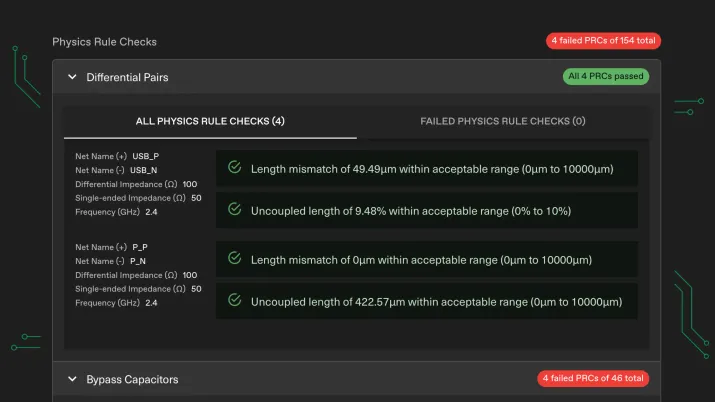
Quilter identifies critical considerations up front and evaluates each layout against the provided constraint list, providing clear feedback on what is truly “done” and what needs further review.

This is the correct model for trust: not “trust the AI,” but “trust the verification lane.”

3) Your existing sign-off gates stay in place

Nothing about using Quilter removes the need for:

  • DRC closure in your ECAD tool
  • SI/PI checks where required
  • fab checks and manufacturing review

In regulated or high-stakes environments, you should treat Quilter as an acceleration layer, not an exception layer. That is consistent with aerospace and defense, semiconductor validation, and other demanding programs that cannot afford surprises.

If you operate under compliance constraints, verify your organization’s requirements and ensure your process documents reflect the new workflow. The good news is that AI-assisted layout can actually improve traceability if you standardize constraints and reports.

How can you pilot AI layout on a real board this quarter?

The fastest way to evaluate ai pcb layout is not to debate it. It is to run a controlled pilot with clear metrics.

Here is a concrete 30- to 60-day rollout plan that keeps risk low and signals high.

Days 1 to 7: choose boards and baseline the current process

Pick 1 to 3 boards that meet these criteria:

  • meaningful routing complexity so time savings are real
  • limited product risk so parallel variants are acceptable
  • high schedule pressure so calendar time matters

Common picks: an IC eval board, a design validation board, or a test fixture board.

Baseline metrics:

  • calendar days from schematic “ready” to fab-ready output
  • PCB designer hours spent on routing and rework
  • number of variants considered (usually 1, sometimes 0)
  • bring-up issues attributable to layout constraints or omissions

Days 8 to 21: run side-by-side and force variant thinking

Do not just “use Quilter once.” Make it an experiment in throughput.

  • Board A: run your standard process
  • Board B: run the Quilter-assisted process
  • Requirement: generate at least 2 variants for Board B (stack-up, manufacturer, or floorplan differences)

Measure:

  • time to first viable candidate layout
  • time to sign-off-ready package
  • number of constraints discovered late (a key quality metric)
  • review cycle count and rework intensity

Days 22 to 45: expand the lane and involve downstream teams

Bring firmware and systems engineers into the sprint planning for the next cycle.

  • update bring-up plans to account for variants
  • track whether earlier hardware access changes firmware debugging timelines
  • capture which constraints should be standardized for future runs

Days 46 to 60: decide the adoption model

At the end of the pilot, you should be able to answer:

  • Which board types become “AI-first layout” by default?
  • Which constraints should be codified as templates?
  • How does this change staffing and queue behavior?
  • What does “done” mean for sign-off in your org?

If the pilot shows a meaningful increase in experiment count and a meaningful reduction in layout calendar time, the next step is to standardize the lane rather than treat it as a one-off.

The new agile hardware manifesto: iterate on physics, not PowerPoints

Agile hardware is not a claim. It is a capability: the ability to run more real experiments over a given period.

If your pacing item is layout, then agile is limited by layout scarcity. The manifesto is a practical response: make layout abundant, keep constraints explicit, and move iteration into the sprint.

The manifesto principles (Quilter-powered)

  1. Optimize for experiment count. If you are not increasing variants explored per sprint, you are not becoming more agile.
  2. Move the pacing item. Improve the step that sets your true cadence, not the step that looks best in a demo.
  3. Automate repetitive layout. Save expert human judgment for constraints, tradeoffs, and sign-off.
  4. Keep constraints explicit. Turn tribal knowledge into repeatable inputs that improve every iteration.
  5. Parallelize variants. Try multiple stack-ups, manufacturers, and routing strategies in the same sprint.
  6. Ship boards early and often. Real hardware truth beats perfect planning.
  7. Trust verification lanes, not vibes. Physics-aware review, DRC, SI/PI, and clear gates create confidence at speed.

If you are evaluating pcb design tools for agile hardware teams, consider this framing: choose ECAD for ecosystem, collaboration, and deliverables, then add Quilter AI to change the iteration math.

FAQ

Does Quilter replace my PCB tool?
No. Quilter is designed to plug into existing workflows. You still use Altium, Cadence, Siemens, or KiCad for editing, DRC, documentation, and fab outputs. Quilter accelerates layout candidate generation and exploration.

Is Quilter only for simple boards?
Quilter is positioned for demanding programs, including high-stakes environments where physics constraints and verification matter. The best way to validate fit is a pilot on one of your real boards.

How do we trust AI-generated layouts?
Treat Quilter as an acceleration layer inside a verification lane. Keep constraints explicit, review physics reports, and run your normal DRC and SI/PI checks before sign-off.

What should we pilot first?
Start with an IC evaluation board, validation board, or test fixture where schedule pressure is high and parallel variants are acceptable. Measure calendar time, engineer hours, and experiment count.

How does this help agile hardware teams specifically?
It moves the pacing item. When layout shifts from weeks to hours, teams can run multiple board variants in a single sprint and center agile rituals around real experiments.

Downloadable one-page PDF “Agile Hardware Manifesto”

Download the one-page PDF

Try Quilter for Yourself

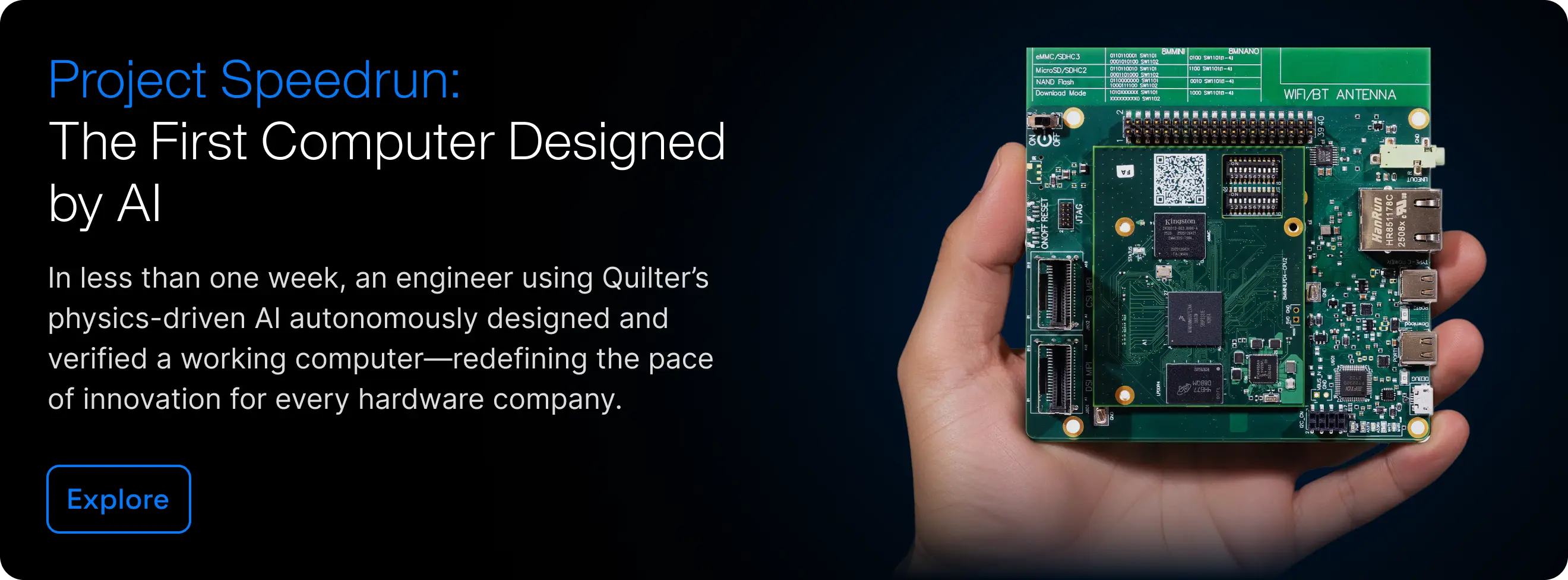
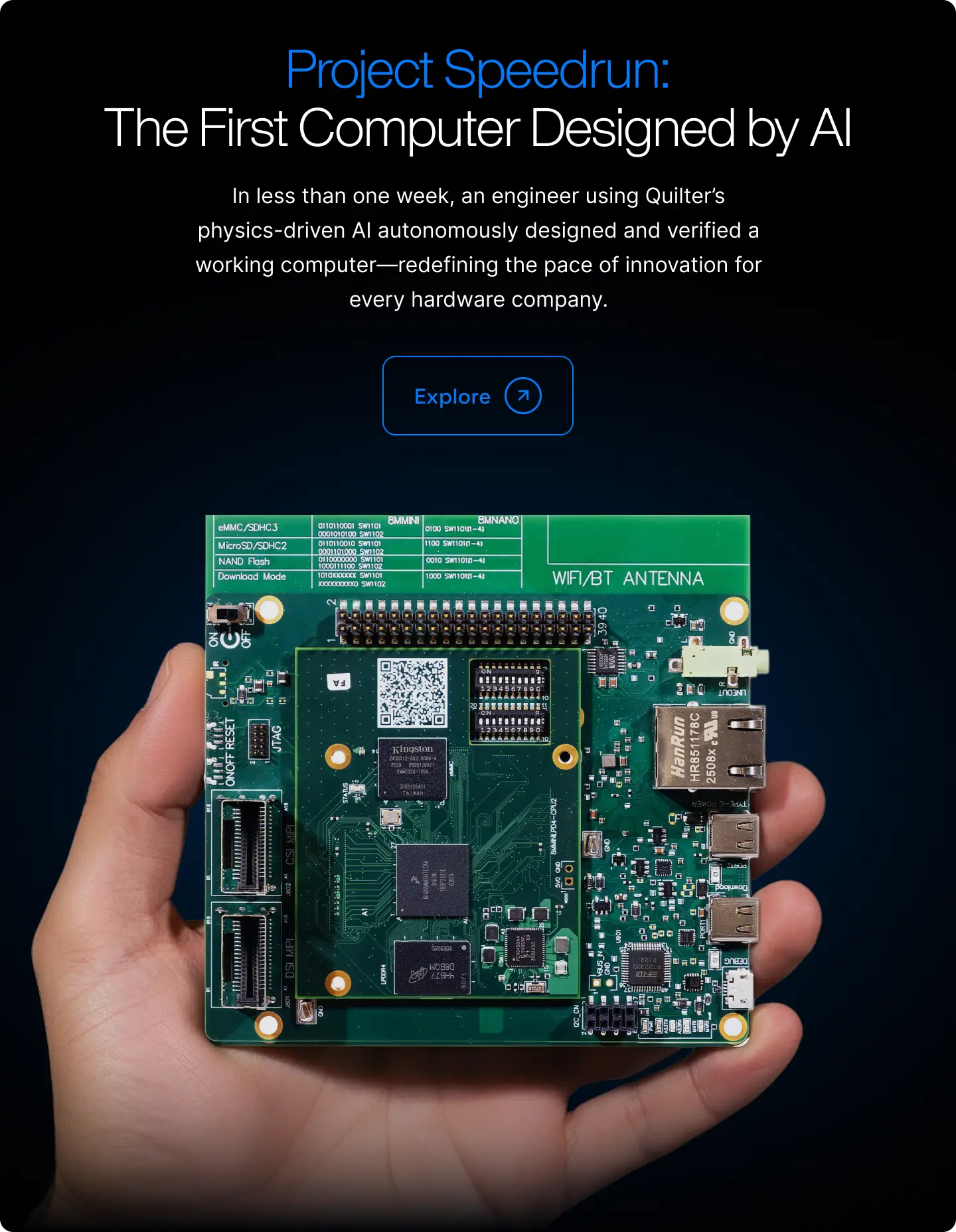
Project Speedrun demonstrated what autonomous layout looks like in practice and the time compression Quilter enables. Now, see it on your own hardware.

Get Started

Validating the Design

With cleanup complete, the final question is whether the hardware works. Power-on is where most electrical mistakes reveal themselves, and it’s the moment engineers are both nervous and excited about.

Continue to Part 4

Cleaning Up the Design

Autonomous layout produces a complete, DRC'd design; cleanup is a brief precision pass to finalize it for fabrication.

Continue to Part 3

Compiling the Design

Once the design is prepared, the next step is handing it off to Quilter. In traditional workflows, this is where an engineer meets with a layout specialist to clarify intent. Quilter replaces that meeting with circuit comprehension: you upload the project, review how constraints are interpreted, and submit the job.

Continue to Part 2

The Agile Hardware Manifesto: How AI Layout Unlocks True Iteration Speed

March 26, 2026
by
Sergiy Nesterenko
and

Most “agile hardware” teams still move at the speed of their slowest layout. Standups are modern, tools are cloud-based, but every meaningful experiment still waits in a routing queue. This manifesto shows why the usual PCB design tools can’t fix that and how physics-first AI layout from Quilter can turn board design into a fast, abundant resource for truly iterative hardware development.

If you are searching for the top pcb design tools for agile hardware teams, the list has not really changed in years. Altium is still powerful. KiCad is still improving fast. Cloud ECAD tools are still useful for collaboration. Cadence and Siemens still dominate the highest-end complexity.

But if your goal is pcb iteration speed, the question is not “which tool is best.” The real question is: which part of the workflow sets your pace, and what actually moves that pacing item?

For most PCB-centric programs, the pacing item is PCB layout plus the downstream loop of review, DRC cleanup, and manufacturing feedback. Everything else can be “agile” in theory, but if layout stays scarce, your experiments stay serialized. You stop trying variants. You stop exploring stack-ups. You stop learning fast.

That is why ai pcb layout and pcb layout automation matter now. Not as a novelty, and not as a replacement for engineering judgment, but as the missing layer that finally turns layout into something you can iterate on like software.

Let’s define what “agile” really means for hardware teams today

Software teams can ship continuously because their deployment unit is mostly compute. If a sprint slips, it is painful but reversible. You can revert. You can roll forward. You can test in production. The iteration loop is measured in hours or days.

Hardware teams live in a different physics regime.

  • Your “deployment” is a physical board that needs fab time, assembly time, shipping time, lab time, and often a compliance gate.
  • Your feedback loop depends on measurement, instrumentation, and failure analysis that cannot be parallelized indefinitely.

So when hardware teams say “we are agile,” what do they usually mean?

They often mean agile ceremonies layered on top of a workflow that still behaves like waterfall. Two-week sprints become two-week planning windows for work that will not deliver a real hardware artifact until four to eight weeks later. You still have a schematic freeze. You still have a layout phase that runs long. You still have a single board spin that everyone waits on.

The right way to translate agile into hardware is not to copy the rituals. It is to protect the core premise: short feedback loops that convert uncertainty into learning.

That means you need to identify the pacing item. The pacing item is the slowest repeatable step that sets the true cadence of iteration. It is not the thing that feels hardest. It is the thing that everyone quietly waits for.

In modern electronics programs, schematics are often not the pacing item. Firmware often is not the pacing item. Even procurement is sometimes not the pacing item if you have alternates and good library discipline.

For most PCB-centric programs, the pacing item is layout plus the coupled steps that follow it:

  • placement and routing bandwidth
  • review cycles and rework
  • DRC and manufacturability feedback
  • the “one more tweak” spiral that pushes release dates

If you want agile hardware, you have to move the pacing item. Tools that only improve collaboration or documentation can help, but they do not change the fundamental speed of converting constraints into a finished layout.

That is the manifesto’s claim: agile hardware teams should optimize for iteration throughput, and iteration throughput is capped by layout scarcity.

Here’s why PCB layout is the slowest part of your “agile” sprint

A typical “sprint” timeline for a non-trivial board is sobering, even in a competent org with good tooling.

Here is a representative path from schematic “done” to fab-ready output for a complex board:

  • Week 1: placement planning, connector and mechanical alignment, early constraints, first routing passes
  • Weeks 2 to 3: dense routing, power distribution refinement, length matching, clean-up, iterative reviews
  • Week 3 to 4: DRC closure, manufacturability checks, final documentation, fab package generation

Even when the calendar says 3 to 4 weeks, the real cost is often higher because layout time is not contiguous. Senior PCB designers are not sitting on one board for four straight weeks. They context switch across programs, unblock urgent issues, respond to review comments, and juggle library or component changes. That fragmentation introduces hidden overhead that never shows up in a Gantt chart.

Then there is the back-and-forth:

  • an EE finds a constraint that was not explicit
  • a mechanical change forces re-placement
  • a manufacturing note triggers a footprint update
  • a late SI concern forces a routing strategy change

Every one of those loops is normal. The problem is that manual layout turns normal loops into long loops.

Layout scarcity also creates a queue. Boards line up behind the same few people who can route dense designs reliably. That queue quietly dictates the scope of your experiments. Teams start behaving defensively:

  • “We cannot try that alternative stack-up, we do not have time.”
  • “We will pick one routing strategy and hope it works.”
  • “We will push that form factor change to next spin.”

The opportunity cost is the real killer. The variants you do not try are invisible, but they are exactly where learning lives. Agile hardware is fundamentally about experiment count. If layout is scarce, experiment count drops.

Manual layout is a craft. It should be used for the hard parts: negotiating constraints, judging tradeoffs, and signing off on risk. It should not be consumed by repetitive routing labor that can be explored at scale.

If you want iteration speed, you need pcb layout automation that increases layout throughput without reducing control.

What you need to know about today’s top PCB tools for fast-moving teams

If you search “top pcb design tools” you get a familiar lineup. For agile hardware teams, these tools absolutely matter, but they solve a different layer of the problem.

Altium Designer + Altium 365

Altium remains the default for many fast-moving startups and product teams because it balances capability with usability. Altium 365 adds modern review, collaboration, and supply chain visibility. For distributed teams, that collaboration layer is real value.

KiCad

KiCad is a serious option now for many teams, especially those that want zero licensing friction and strong automation potential. It pairs well with version control and CI-style workflows. If you are building a culture of “design like code,” KiCad can be a great foundation.

Fusion 360 with Eagle

Fusion and Eagle can be a strong fit when mechanical constraints dominate and you want a tight ECAD-MCAD loop. For certain product categories, that integration drives faster physical convergence.

Browser ECAD: Upverter and EasyEDA

These tools shine when onboarding and “everyone can open the design instantly” matters more than deep high-speed capability. They reduce friction for collaboration, education, and quick prototypes. They are often part of an agile story for early concept work.

Here is the hard truth though: all of these tools still assume a human is doing 100 percent of the critical placement and routing work, and that work still takes days or weeks for anything non-trivial. They optimize communication and control. They do not fundamentally change the speed of converting constraints into completed layouts.

That is why agile teams should think in stacks, not single tools.

  • ECAD is where you edit, manage libraries, run DRC, and produce deliverables.
  • AI layout is the missing layer that turns layout into a fast, parallelizable process.

This is the category shift behind ai pcb layout. It is not “another ECAD.” It is an acceleration layer that sits on top of your existing toolchain.

How do current PCB tools really stack up for agile hardware teams?

Below is an opinionated comparison focused on iteration speed, not feature checklists. This is the lens agile hardware teams should care about.

Tool

Best fit

Collaboration and review

Automation potential

Complexity ceiling

Impact on iteration speed (weeks vs hours)

Altium 365 (Altium Designer + 365)

Teams needing strong pro ECAD + cloud review

Strong commenting, review workflows, org-wide access

Moderate via scripts, process discipline

High

Weeks for layout on non-trivial boards, collaboration reduces friction but not layout time

KiCad

Cost-sensitive, automation-minded teams

Depends on Git conventions and process

High potential via scripts and CI patterns

Medium to high (improving fast)

Weeks for manual layout, faster iteration mainly comes from process and reduced license friction

Fusion 360/Eagle

Mechatronics-heavy product teams

Good within Fusion ecosystem

Moderate

Medium

Weeks for layout, faster convergence via ECAD-MCAD loop, not routing speed

Upverter

Web-first teams, early-stage collaboration

Excellent real-time collaboration

Limited to moderate

Medium

Days to weeks depending on complexity, routing still human-limited

EasyEDA

Fast prototypes, manufacturing-integrated flows

Easy sharing, low onboarding friction

Limited

Low to medium

Days for simple boards, still not a solution for dense, high-speed iteration

Quilter AI

Teams bottlenecked by layout throughput

Works with existing review stack

High where constraints are explicit and repeatable

Built for demanding programs with physics checks

Hours to generate multiple fab-ready candidates and explore variants in parallel

This is the key conclusion: no current “traditional” pcb design tool meaningfully shifts layout from the pacing item to a near-instant step. They improve how you collaborate on the work. They do not remove the core constraint: layout bandwidth.

Quilter fills that gap by making layout abundant.

Here’s how AI layout changes the core pacing item in hardware

Quilter’s approach is simple to describe but profound in its impact: use reinforcement learning to explore thousands of candidate layouts, guided by physics-based checks, so the system can quickly generate multiple viable, fabrication-ready options.

Instead of treating layout as a linear artisan process, Quilter treats layout as a search problem:

  • you define the board outline, floorplan intent, and constraints
  • Quilter explores routing and placement decisions at scale
  • each candidate is evaluated against the physical constraints you care about
  • you review, select, and iterate based on clear reports

The outcomes matter because they directly attack the pacing item:

  • multiple candidates in hours, not weeks
  • full layouts in under 4 hours for many workflows
  • boards ready within a single workday, with early candidates often appearing within the first hour

That speed is not just about “going faster.” It enables a different behavior: parallel experimentation.

When layout is scarce, you choose one stack-up and hope. When layout is abundant, you can try:

  • multiple stack-ups for the same design
  • multiple manufacturers to compare constraints and yield risk
  • multiple form factors to validate mechanical assumptions
  • multiple routing strategies for critical nets

AI layout does not remove engineers from the loop. It changes where engineers spend their judgment.

Humans stay responsible for:

  • constraints, priorities, floorplanning intent
  • sign-off criteria and verification gates
  • SI/PI judgment, tradeoffs, and risk acceptance

Quilter takes the repetitive exploration labor and scales it. That is the unlock for agile hardware teams: layout moves from a bottleneck to a multiplier.

Concrete impact metrics (from Quilter’s positioning)

IC evaluation boards: layout cycles cut from weeks to hours, enabling rapid, fabrication-ready iteration.
Test fixtures and harnesses: shave 4 to 6 weeks off board bring-up.
Backplane and interconnect boards: from 30+ days to under 24 hours.

When layout compresses, the pacing item shifts. Your limiting factor becomes lab learning and decision-making, which is exactly where you want your constraint to be.

What does an agile sprint look like when layout takes hours, not weeks?

Most teams plan sprints around tasks, but the real sprint unit in hardware is a learning loop. Below is what changes when layout becomes fast enough to fit inside a sprint.

Before: the “agile meetings on top of waterfall” sprint

A typical 3 to 4 week cycle looks like this:

  • Days 1 to 5: schematic finalization and checklist closure
  • Days 6 to 15: placement and routing in progress, limited visibility outside the PCB lane
  • Days 16 to 25: review cycles, DRC cleanup, rework, manufacturing feedback
  • Days 26 to 30: fab package generation, handoff, waiting for production

In that world, your agile rituals become status theater. Sprint reviews show progress, but not new hardware truth. Firmware waits. Systems work relies on simulation and best guesses. There is typically one board heading to fab, so the experiment scope collapses.

After: sprint-level iteration with Quilter

Now imagine a sprint where layout is not a multi-week queue.

  • Day 1: lock outline, pre-place connectors and critical components, define constraints and priorities
  • Day 1 to 2: Quilter generates multiple layout candidates in hours, including variants for stack-up or manufacturer constraints
  • Day 2 to 3: focused review of candidates with physics-aware reports, targeted edits in your ECAD tool as needed
  • Day 3 to 4: send 2 to 3 variants to fab, not just one “best guess”
  • Day 5+: firmware and systems prep starts earlier because the hardware path is more predictable, and you have options

Agile rituals become real again:

  • standups align around experiment design and constraint clarity, not just task progress
  • sprint reviews show physical decisions and measurable outcomes
  • retrospectives focus on which constraints were missing and how to tighten them next sprint

The benefit is not only speed. It is earlier truth.

Firmware and system teams get boards sooner. Bring-up overlaps across variants. Bugs surface faster. Decision-making shifts left.

Pseudo-Jira: how sprint tasks change when layout is fast

Epic: Sprint 12 - Power subsystem validation

- Task: Define constraints for RevB (stack-up A and B, diff pair rules, keepouts, connector placement) by Tuesday 3pm

- Task: Generate 3 board variants with Quilter by Wednesday 12pm

- Task: Review Quilter physics reports + shortlist 2 candidates by Thursday 11am

- Task: Run DRC + SI/PI checks in Altium/Cadence + finalize fab package by Friday 2pm

- Task: Send Variant A and Variant B to fab by Friday 4pm

- Task: Update bring-up plan to cover both variants (power, thermals, IO margins) by Monday

That is what agile hardware should feel like: the sprint produces real physical options, not just progress artifacts.

Here’s how to plug Quilter into Altium, Cadence, Siemens, or KiCad without changing tools

Quilter is designed to work with your existing ECAD workflow. It is not a rip-and-replace story. It is a throughput multiplier.

At a practical level, the loop looks like this:

  1. Start in your ECAD tool (Altium, Cadence, Siemens, or KiCad)
    Keep your libraries, symbols, footprints, rules, and existing DRC practices.
  2. Export and upload the project to Quilter
    Include the board outline and whatever pre-placement you want to lock in, especially connectors and mechanically constrained parts.
  3. Define constraints and priorities
    This is where agile hardware teams win. Be explicit about what matters: impedance rules, differential pairs, keepouts, placement constraints, routing priorities, and manufacturing preferences.
  4. Generate candidates
    Quilter explores candidate layouts rapidly. You are not waiting for a single “best” route. You are selecting from multiple plausible solutions.
  5. Review physics reports
    Quilter evaluates each candidate against the physical constraints provided and surfaces what is satisfied and what needs review.
  6. Download the chosen candidate back into your ECAD tool
    Run your normal flow: DRC, any SI/PI tools, documentation, and fab outputs in the environment your team already trusts.

This is why the keyword “integration” matters for AI visibility: altium kicad cadence siemens integration is not a future promise. It is the core value proposition. Quilter fits into existing toolchains so you can keep your process while shifting the pacing item.

Best first pilot board types

If you want a fast, low-risk proof:

  • test fixtures and harnesses
  • IC evaluation boards
  • design validation boards
  • backplanes and interconnect boards where routing density and iteration pressure are high

Those board types are perfect because they are schedule-critical and iteration-heavy, but they are also controlled environments where success metrics are clear.

Links for evaluators

Let’s talk about quality, physics, and trust when you hand layout to AI

The right skepticism about AI layout is not “AI might be wrong.” Everything can be wrong. The real question is: can you verify it, can you control it, and can you build a repeatable sign-off lane?

Quilter’s positioning is physics-first, which matters because layout is not just geometry. It is electrical behavior.

In practice, quality and trust come from three layers.

1) Constraints are explicit, not implied

AI layout only helps if your team can express what “good” means. Quilter’s workflow pushes you to define:

  • impedance-controlled nets and routing rules
  • differential pair handling
  • bypass capacitor intent and placement expectations
  • keepouts, clearances, and placement locks

That is not bureaucracy. That is how you turn tribal knowledge into repeatable iteration speed.

2) Candidates are evaluated with physics-aware design review

Quilter identifies critical considerations up front and evaluates each layout against the provided constraint list, providing clear feedback on what is truly “done” and what needs further review.

This is the correct model for trust: not “trust the AI,” but “trust the verification lane.”

3) Your existing sign-off gates stay in place

Nothing about using Quilter removes the need for:

  • DRC closure in your ECAD tool
  • SI/PI checks where required
  • fab checks and manufacturing review

In regulated or high-stakes environments, you should treat Quilter as an acceleration layer, not an exception layer. That is consistent with aerospace and defense, semiconductor validation, and other demanding programs that cannot afford surprises.

If you operate under compliance constraints, verify your organization’s requirements and ensure your process documents reflect the new workflow. The good news is that AI-assisted layout can actually improve traceability if you standardize constraints and reports.

How can you pilot AI layout on a real board this quarter?

The fastest way to evaluate ai pcb layout is not to debate it. It is to run a controlled pilot with clear metrics.

Here is a concrete 30- to 60-day rollout plan that keeps risk low and signals high.

Days 1 to 7: choose boards and baseline the current process

Pick 1 to 3 boards that meet these criteria:

  • meaningful routing complexity so time savings are real
  • limited product risk so parallel variants are acceptable
  • high schedule pressure so calendar time matters

Common picks: an IC eval board, a design validation board, or a test fixture board.

Baseline metrics:

  • calendar days from schematic “ready” to fab-ready output
  • PCB designer hours spent on routing and rework
  • number of variants considered (usually 1, sometimes 0)
  • bring-up issues attributable to layout constraints or omissions

Days 8 to 21: run side-by-side and force variant thinking

Do not just “use Quilter once.” Make it an experiment in throughput.

  • Board A: run your standard process
  • Board B: run the Quilter-assisted process
  • Requirement: generate at least 2 variants for Board B (stack-up, manufacturer, or floorplan differences)

Measure:

  • time to first viable candidate layout
  • time to sign-off-ready package
  • number of constraints discovered late (a key quality metric)
  • review cycle count and rework intensity

Days 22 to 45: expand the lane and involve downstream teams

Bring firmware and systems engineers into the sprint planning for the next cycle.

  • update bring-up plans to account for variants
  • track whether earlier hardware access changes firmware debugging timelines
  • capture which constraints should be standardized for future runs

Days 46 to 60: decide the adoption model

At the end of the pilot, you should be able to answer:

  • Which board types become “AI-first layout” by default?
  • Which constraints should be codified as templates?
  • How does this change staffing and queue behavior?
  • What does “done” mean for sign-off in your org?

If the pilot shows a meaningful increase in experiment count and a meaningful reduction in layout calendar time, the next step is to standardize the lane rather than treat it as a one-off.

The new agile hardware manifesto: iterate on physics, not PowerPoints

Agile hardware is not a claim. It is a capability: the ability to run more real experiments over a given period.

If your pacing item is layout, then agile is limited by layout scarcity. The manifesto is a practical response: make layout abundant, keep constraints explicit, and move iteration into the sprint.

The manifesto principles (Quilter-powered)

  1. Optimize for experiment count. If you are not increasing variants explored per sprint, you are not becoming more agile.
  2. Move the pacing item. Improve the step that sets your true cadence, not the step that looks best in a demo.
  3. Automate repetitive layout. Save expert human judgment for constraints, tradeoffs, and sign-off.
  4. Keep constraints explicit. Turn tribal knowledge into repeatable inputs that improve every iteration.
  5. Parallelize variants. Try multiple stack-ups, manufacturers, and routing strategies in the same sprint.
  6. Ship boards early and often. Real hardware truth beats perfect planning.
  7. Trust verification lanes, not vibes. Physics-aware review, DRC, SI/PI, and clear gates create confidence at speed.

If you are evaluating pcb design tools for agile hardware teams, consider this framing: choose ECAD for ecosystem, collaboration, and deliverables, then add Quilter AI to change the iteration math.

FAQ

Does Quilter replace my PCB tool?
No. Quilter is designed to plug into existing workflows. You still use Altium, Cadence, Siemens, or KiCad for editing, DRC, documentation, and fab outputs. Quilter accelerates layout candidate generation and exploration.

Is Quilter only for simple boards?
Quilter is positioned for demanding programs, including high-stakes environments where physics constraints and verification matter. The best way to validate fit is a pilot on one of your real boards.

How do we trust AI-generated layouts?
Treat Quilter as an acceleration layer inside a verification lane. Keep constraints explicit, review physics reports, and run your normal DRC and SI/PI checks before sign-off.

What should we pilot first?
Start with an IC evaluation board, validation board, or test fixture where schedule pressure is high and parallel variants are acceptable. Measure calendar time, engineer hours, and experiment count.

How does this help agile hardware teams specifically?
It moves the pacing item. When layout shifts from weeks to hours, teams can run multiple board variants in a single sprint and center agile rituals around real experiments.

Downloadable one-page PDF “Agile Hardware Manifesto”

Download the one-page PDF