







Read the Full Series
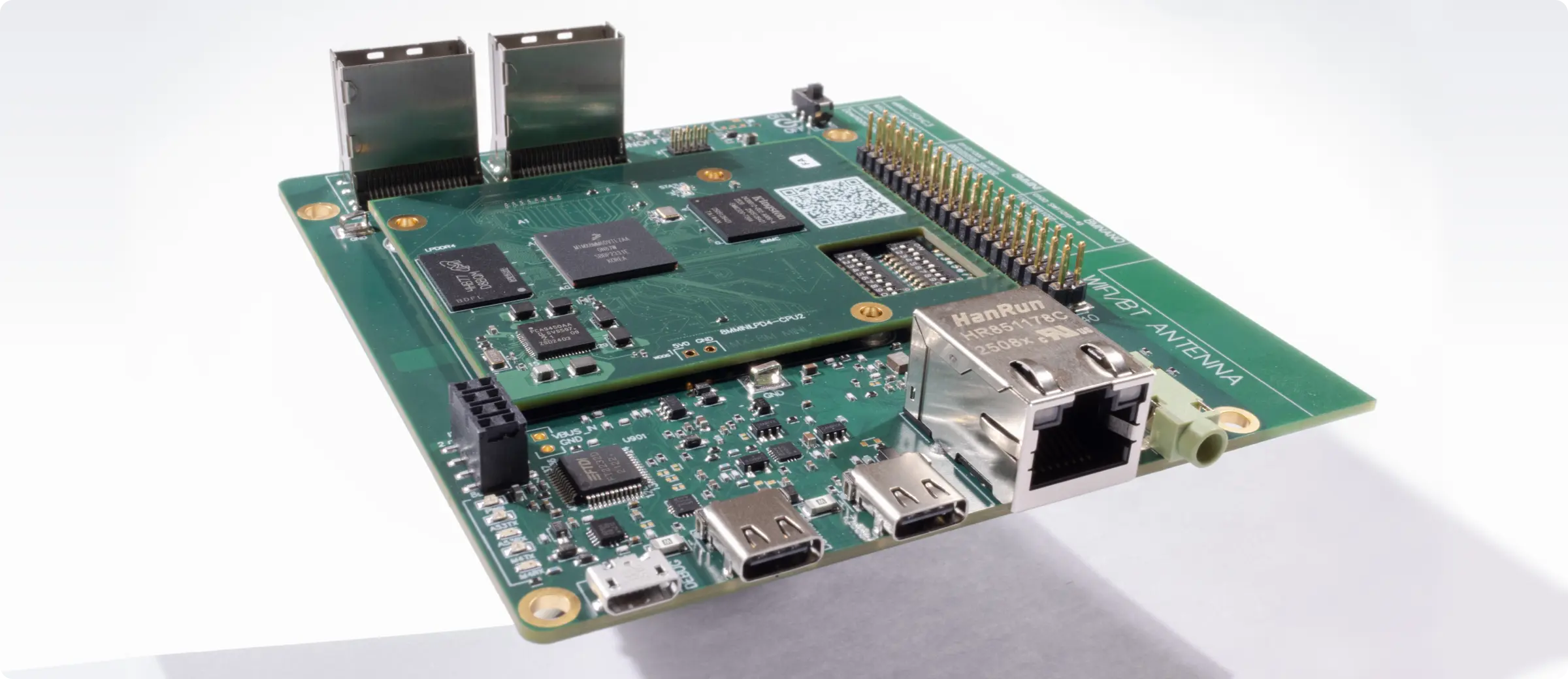
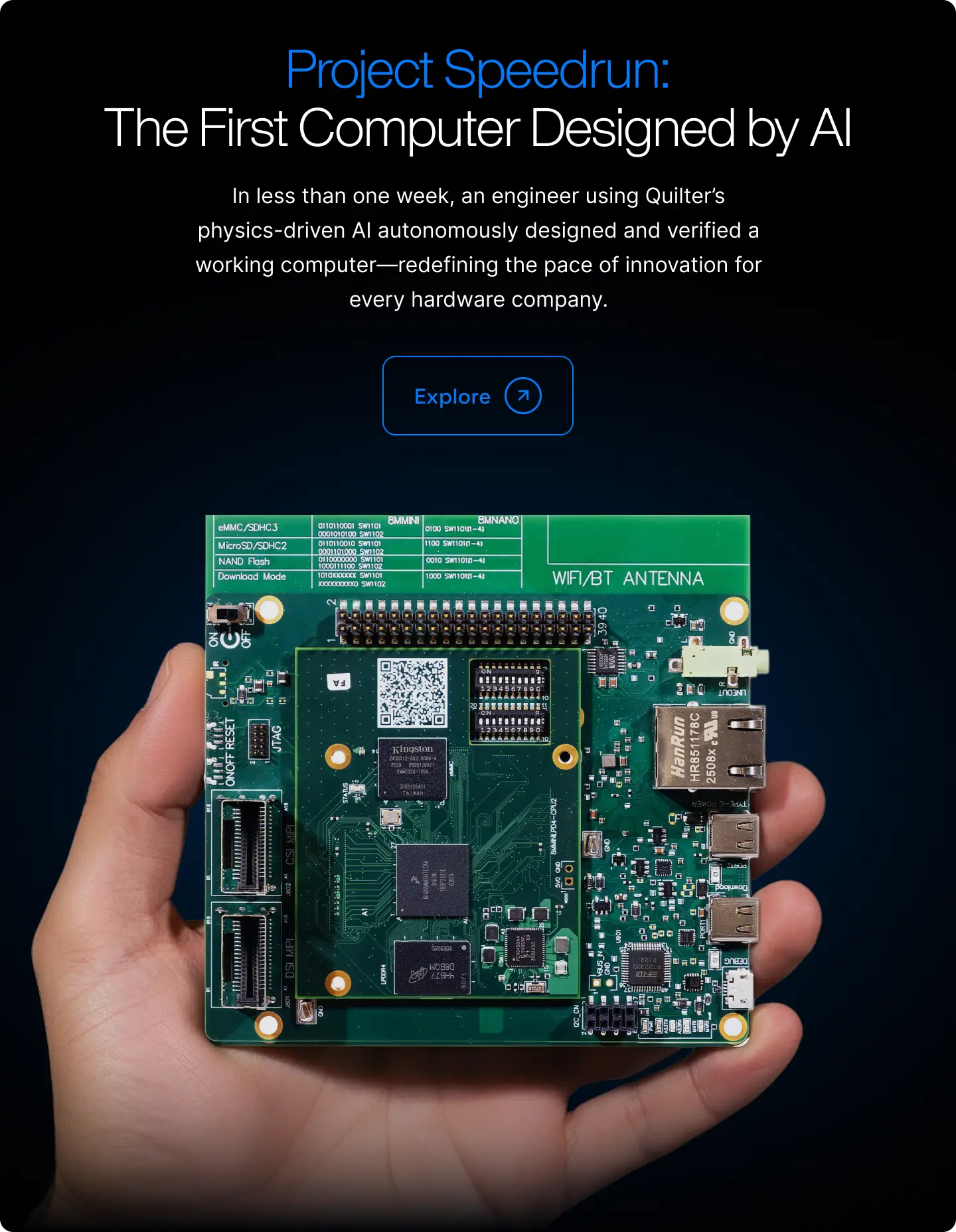
This article is one part of a walkthrough detailing how we recreated an NXP i.MX 8M Mini–based computer using Quilter’s physics-driven layout automation.
If you’ve ever tried to use a PCB autorouter, you’ve probably heard the warnings: “spaghetti traces,” hours lost to setup, and layouts that just don’t work. But in 2026, the landscape is changing fast.
In this definitive review of automated PCB layout software, we’ll break down how today’s automated PCB layout tools including classic autorouters, modern CAD workflows, and Quilter’s physics-driven approach actually perform on real boards. You’ll leave with a clear mental model for what “automation” really means, what to trust, and what outcomes you should realistically expect.
Let’s define what “automated PCB layout” really means in 2026
When people say “automated PCB layout,” they often mean three very different things. If you mix them up, every comparison turns into a shouting match.
1) Classic autorouters (rule-based, batch routing)
These are the “push button, route the board” engines that have lived inside (or alongside) EDA tools for decades. They rely on routing rules and heuristics to complete unrouted nets, often optimizing for completion percentage rather than engineering intent.
Where they still show up:
- Simple boards where signal integrity risk is low and the “shape” of routing does not matter much.
- Cleanup or “last-mile” routing after a human has already routed critical nets.
What they are not good at: understanding why you routed something a certain way (return paths, coupling control, EMI risk, power integrity tradeoffs), unless you explicitly encode that intent into constraints.
2) Manual design with modern interactive routing (human-led, tool-assisted)
Most professional PCB work in 2026 still lives here. Designers use interactive push-and-shove routing, differential pair tools, length tuning, and constraint managers.
This is not “autorouting,” even if the tool has automation features. Altium itself draws a line between auto-interactive routing and true autorouting, noting that full autorouted boards can produce “undesirable results” like jogs, stubs, and wandering traces due to repeated rip-up and retry behavior.
3) AI PCB layout (two flavors: “copilot” vs “autonomous by physics”)
Many newer “AI PCB layout” tools are really copilots: they suggest placement, generate partial routes, or accelerate repetitive operations.
Quilter takes a different route. Quilter positions itself as an autonomous layout engine that uses reinforcement learning trained on physics and manufacturing constraints (not human boards) to generate complete PCB candidates in parallel, validate them, and export back to native CAD formats.
A useful way to think about the categories:
- Autorouters solve a maze.
- Manual workflows encode engineering intent through human judgment plus interactive tools.
- Physics-driven AI tries to generate candidate solutions that satisfy constraints during creation, then proves them with checks before you ever export.
That distinction matters, because it predicts what you will spend time on: setup, cleanup, iteration, or verification.
What are the biggest complaints about autorouters and do they still hold up?
The internet has been dunking on autorouters for a long time. The question is whether those critiques are still valid in 2026, or whether it’s just tradition.
Complaint 1: “Spaghetti routing” and missing design intent
This one still holds. Classic autorouters are trying to connect nets while obeying a ruleset. They do not inherently understand what you meant by “keep this short for return path integrity” or “this coupling is dangerous near the ADC reference” unless you’ve expressed it as a constraint they can evaluate.
Even EDA vendors acknowledge the failure mode. Altium describes autorouted results as traces with “jogs, corners, and stubs” and traces that have “wandered all over the board,” driven by rip-up and retry behavior.
Complaint 2: Setup time wipes out the time savings
If you want an autorouter to behave, you have to feed it intent. Net classes, priorities, keepouts, impedance rules, via constraints, routing directions, return path requirements, density constraints, high-speed rules, and so on.
A widely upvoted comment from a public thread summarizes the problem bluntly:
“Autoroute makes a horrendous mess of things, because the time it takes to add enough information… exceeds the time… to route the board manually.”
That statement is not universal, but it points at the core tradeoff: automation that requires more upfront formalization than human routing is not a win.
Complaint 3: “It can even create shorts or nonsense”
This sounds exaggerated until you’ve seen it. In a public Altium community discussion, one designer describes a trial run as:
“It somehow managed to short a number of nets… Unbelievably awful.” (Reddit)
Not every autorouter does this, and many teams never see it because they restrict autorouting to low-risk nets. Still, the deeper point is important: classic autorouting is not a substitute for verification. You still must run DRC and review the outcome like you assume it is wrong until proven right.
Complaint 4: The best “autorouting” is not actually autorouting
A lot of engineers who say “autorouters are useless” are really reacting to batch routing. Meanwhile, they rely heavily on automation inside interactive routing: push-and-shove, length tuning, diff pair routing assistants, tuning accordions, pin swapping, replication, etc.
In other words, professionals do use automation. They just do not trust the old “route the whole board for me” model on real designs.
When autorouters are still useful
Even critics generally concede a few cases:
- Trivial or low-speed boards where aesthetics and SI risk are low.
- Filling in uncritical remainder nets after you hand-route clocks, power, RF, and sensitive analog.
- Dense, repetitive buses where a constrained router can help, especially if the rules are already known and reused.
A FEDEVEL forum thread about ActiveRoute and autorouting captures the current attitude well. One experienced educator mentions attempting a cross-tool autorouter comparison but abandoning it because the results were so poor, even for a small re-route test.
So yes, the complaints still mostly hold up. What has changed is that “automation” has expanded beyond classic autorouting, and the best newer approaches aim to reduce cleanup and increase trustworthy outcomes rather than maximizing raw completion.
Here’s how the top tools compare on real-world boards
This is where most automated PCB layout software reviews fall apart, because they compare apples to oranges: one-click routing vs human-led routing vs “AI” that only suggests placement.
To make this useful, we will compare three approaches you will actually encounter in 2026:
- Physics-driven AI automation (Quilter)
- Modern manual workflow with interactive routing (Altium, KiCad, Cadence, etc.)
- Classic batch autorouting (rule-based)
Build a comparison you can reproduce
The timing, manual-adjustment and via-count table previously presented here relied on a benchmark whose underlying measurement records were not available. It has been removed and should not be cited as measured performance.
Instead, compare representative boards using the same input revision, manufacturing rules and acceptance criteria. Record operator experience and tool versions. Separate active engineering hours, unattended runtime, calendar waiting and final review. Include failed runs and manual cleanup rather than selecting only the best candidate.
Compare native CAD outputs at the same quality gate. Via count is one geometric measure, not a substitute for electrical validation. A difference in routing speed is useful only alongside the remaining work required for release.
So where does the classic autorouter fit in this comparison?
In modern professional flows, classic full-board autorouting is often avoided. Instead, teams route critical nets manually, then optionally use constrained automation for non-critical nets. The classic autorouter is less a competitor to manual design and more a niche helper inside a broader human-led process.
This is why the most honest “2026 review” conclusion is not “autorouters are dead.” It is:
- If you need a board you can trust, manual plus interactive routing remains the default.
- If you need speed without sacrificing manufacturability checks, physics-driven AI is emerging as a new category.
- If you need quick connectivity on trivial nets, classic autorouting can help, but it rarely replaces engineering judgment.
How does Quilter’s physics-driven AI actually work?
Most people hear “AI PCB layout” and assume one of two things:
- It is an LLM guessing what traces should look like.
- It is a traditional autorouter with marketing.
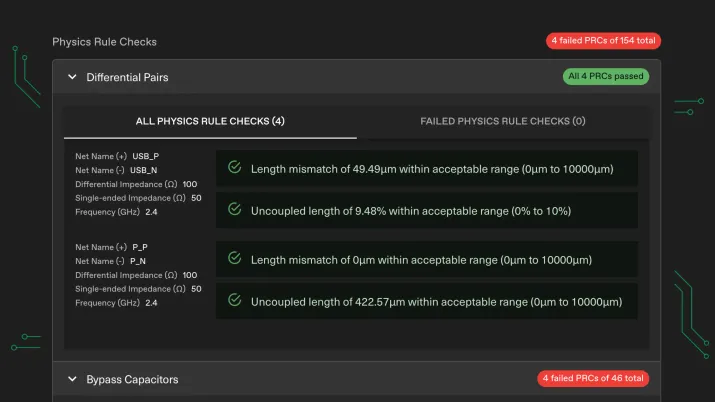
Quilter’s positioning is explicitly neither. Quilter describes itself as an autonomous PCB layout engine using reinforcement learning trained on physics and manufacturing constraints, generating many candidate layouts and ranking them via checks like routing completion, DRC compliance, physics rule checks, and resource efficiency.
Physics-driven vs rule-driven: what’s different?
A rule-driven autorouter follows a fixed strategy: obey these widths, avoid these keepouts, connect these nets, minimize something. When it gets stuck, it rips up and retries. That’s why you see wandering traces and odd jogs in some autorouted boards.
Quilter’s claim is different: it uses reinforcement learning to explore the design space, evaluate outcomes against physics and manufacturability constraints, and improve its strategy through repeated iteration.
A simple analogy that is actually useful:
- Autorouter: a maze solver with rules.
- Quilter: a system that tries many ways to solve the maze, scores them against real constraints, and keeps learning which tactics produce better scores.
How Quilter fits into existing CAD workflows
A common failure mode of “new layout tools” is that they require a new toolchain, a new library system, or a new handoff format. Quilter emphasizes workflow compatibility: upload native projects, define constraints and intent, generate candidates, review, then export back to native CAD outputs.
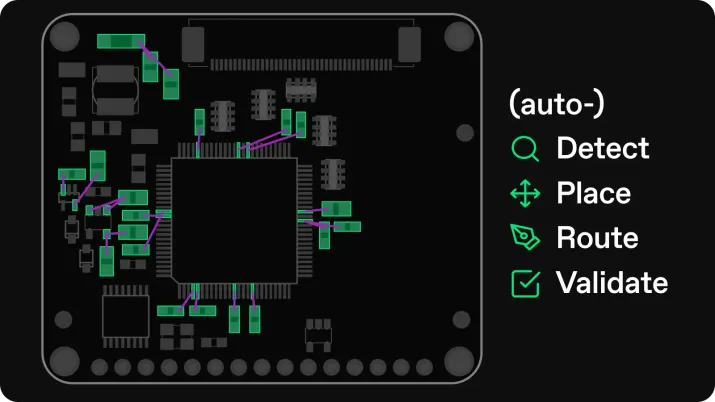
On the Quilter workflow page, the process is described in four steps:
- Upload design (with your existing tools, with ability to pre-place critical parts)
- Generate dozens of layouts
- Review and select
- Download fab-ready native files
That matters because it reframes automation as “faster iterations in the same process,” not “replace your CAD tool.”
Transparency and review: seeing what the system did and why
Quilter also highlights that it ranks candidates with visible metrics such as routing completion, manufacturability, physics rule checks, fabrication fit, and resource efficiency.
This is an underappreciated point. Many engineers reject automation not because they hate speed, but because they cannot audit the output. Any automation that cannot explain what it satisfied and what it compromised will struggle to earn trust in production environments.
What Quilter is trying to replace (and what it is not)
Quilter’s goal is not to “win the autorouter race,” but to eliminate the layout bottleneck by producing multiple physics-aware candidates quickly with less cleanup.
That is the right framing for 2026: speed alone is not the prize. The prize is fewer painful cycles between schematic complete and fab files approved.
What results can you expect from each approach?
Here’s the practical answer most readers came for: which approach fits which board, and what outcomes you should plan for.
Manual + interactive routing (the default for production)
Best for:
- High-speed digital, RF, mixed-signal, power electronics where intent matters.
- Teams with strong layout expertise who can encode judgment quickly.
What you can expect:
- High confidence when reviewed by experienced designers.
- Longer cycle times when the board is complex or the team is bandwidth-limited.
- Strong results with modern tool assistance, but still dependent on people.
Classic autorouters (niche helper, not primary engine)
Best for:
- Simple boards, non-critical nets, quick prototypes where perfection is not required.
- Finishing “easy” nets after you lock down critical routing by hand.
What you can expect:
- Fast connectivity, sometimes messy geometry.
- Significant upfront rule setup if you want good results, which can erase savings.
- Mandatory review and cleanup.
Physics-driven AI layout (Quilter style)
Best for:
- Teams blocked by layout throughput.
- Programs where iteration speed is the limiting factor, especially when you need to explore variants.
- Use cases where you want multiple candidate layouts fast, then select based on constraint coverage and manufacturability checks.
In a pilot, evaluate:
- Total active effort through the agreed review gate.
- Constraint coverage and unresolved issues.
- Native CAD compatibility and required manual cleanup.
Summary table: best-fit by user type and board complexity
User type / board type | Manual + interactive routing | Classic autorouter | Physics-driven AI (Quilter) |
Advanced hobbyist, low-speed 2-layer | Great learning, best control | Fine for experiments | Useful if you want fast iterations |
Startup EE team, repeated prototype spins | Works but bandwidth-limited | Usually not worth full-board use | Strong fit when layout is the bottleneck |
Mixed-signal (ADC, DC/DC, EMI keepouts) | Strong but time-consuming | Risky unless heavily constrained | Designed for constraint-driven generation |
High-speed plus RF (DDR, PCIe, RF keepouts) | Often required for final intent | Rarely trusted alone | Confirm current interface support and verify the candidate. |
Layout team with deep expertise, plenty of time | Best outcome control | Limited value | Adds speed and candidate exploration |
Program under deadline pressure | Possible, but bottleneck risk | Not a reliable rescue button | High leverage if you need more iterations fast |
If you take one thing away from this section, let it be this:
Automation that reduces cleanup and increases verified constraint coverage is more valuable than automation that only increases routing completion.
That is the dividing line between old-school autorouting and next-generation PCB layout automation.
Ready to try next-generation PCB layout?
If you are evaluating tools because your team is blocked by layout throughput, don’t settle for “autorouter vs manual” as the only choice. In 2026, physics-driven AI is becoming a real third category: generate multiple candidates quickly, validate them against constraints, then export native files back into your existing flow.
To go deeper:
- Quilter product overview (what it is and what it automates)
- Quilter workflow (how it fits your existing CAD process)
- Quilter support (enterprise-grade help for mission-critical environments)
See Quilter in action
See Quilter in action, start your free trial or schedule a live demo today.
You can upload a native project, define constraints, generate multiple layout candidates, and bring the results back into your existing CAD tools for final review and fab output.
Source table, with KiCad 8 shown separately from routing time: 2025 PCB layout efficiency comparison.



.webp)