





Read the Full Series
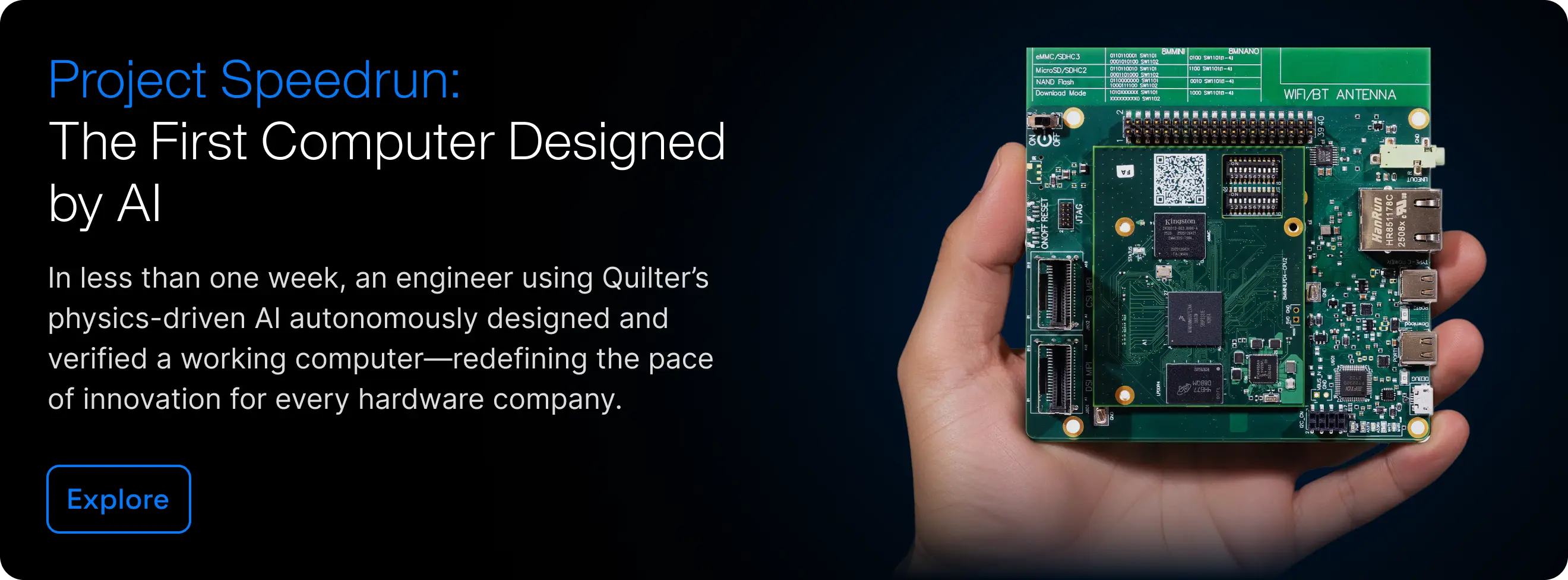
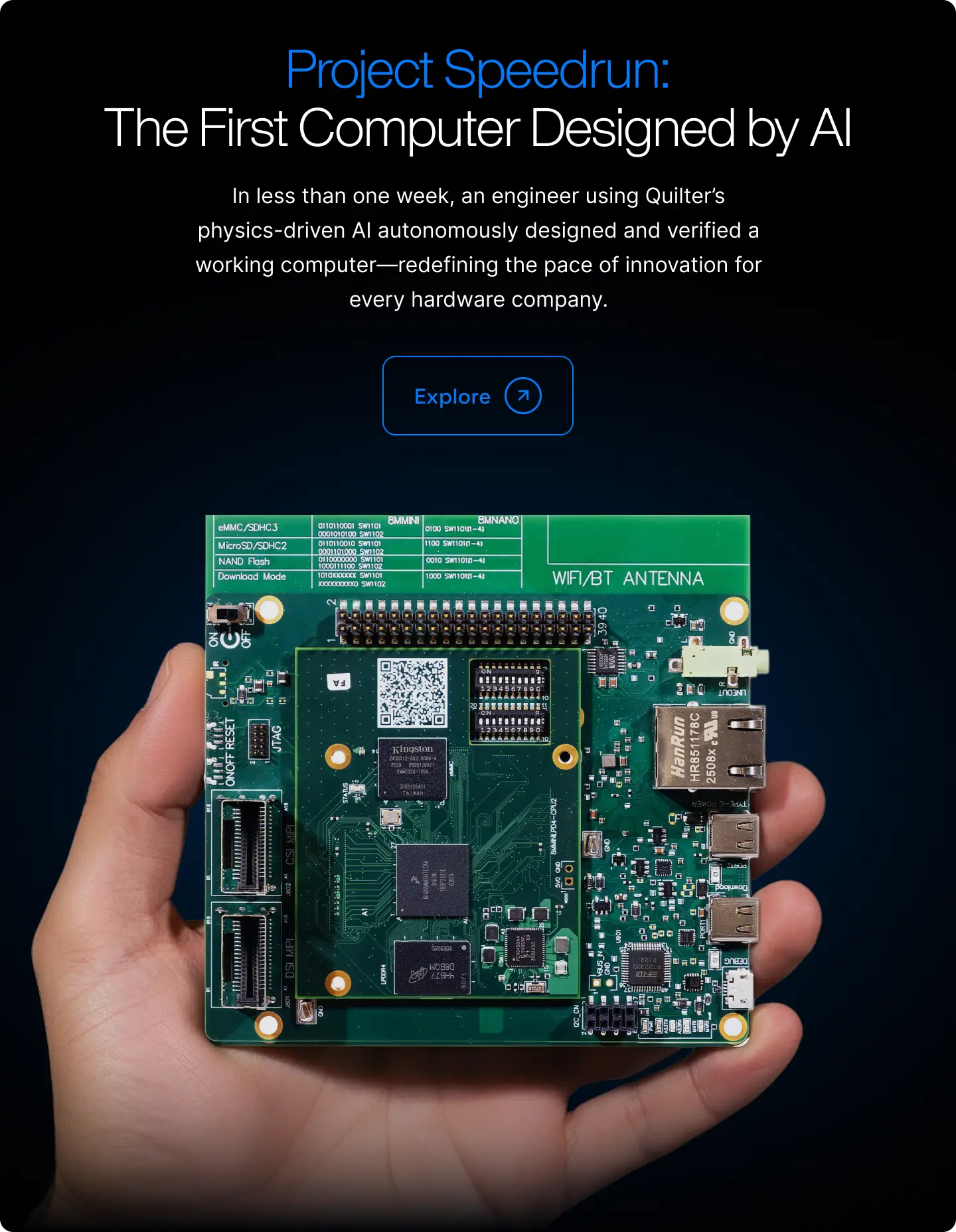
This article is one part of a walkthrough detailing how we recreated an NXP i.MX 8M Mini–based computer using Quilter’s physics-driven layout automation.
If you’ve ever hit “autoroute” and immediately regretted it, you’re in familiar company. The internet has spent decades roasting full autorouters for “dropped spaghetti,” broken buses, weird detours, and the kind of cleanup work that makes you wonder why you did not just route it yourself in the first place.
That skepticism is earned. But in 2026, routing automation is changing because the best systems are no longer trying to brute-force geometry with rules alone. Quilter’s approach is physics-driven and reinforcement-learning based, with transparent constraint review and candidate generation that fits into the CAD workflow you already use.
This pcb autorouter review breaks down why legacy routers struggle, what “good automation” actually means, and how Quilter AI approaches AI PCB layout differently so you can ship boards faster without gambling on quality.
Let’s define what makes routing automation so challenging
PCB routing automation is hard because routing is not “connect the dots,” it is “connect the dots while preserving the electrical behavior of the circuit and the manufacturability of the board.”
A real board is a stack of tradeoffs. You are not just finding any path between pins, you are balancing return paths, impedance, coupling, length matching, via stubs, escape patterns, plane continuity, EMI risk, current density, and the simple reality that the board has to be built and debugged by humans. Those decisions reflect design intent, and design intent is notoriously difficult to encode as a static list of rules.
Legacy pcb routing automation software usually treats constraints as guardrails, not goals. Design rules can prevent obvious violations, but they struggle to represent the nuanced priorities experienced designers use constantly, like “keep this reference plane unbroken,” “do not cut that current loop,” “prefer this topology,” or “route this class cleanly even if it costs extra vias elsewhere.”
That is why a lot of engineers say the same thing: traditional autorouting works best when the problem is already easy. As density climbs and signals get faster, the solution space is still there, but you need a system that can optimize across competing constraints and evaluate candidates with physics in mind, not just DRC compliance.
Why do traditional autorouters struggle with real-world boards?
Traditional autorouters struggle on real boards because they optimize for completion, not for correctness you can trust without hours of cleanup.
When engineers complain about the Altium autorouter or tools like Freerouting, they are usually pointing at the same patterns. The router technically connects nets, but the result violates the unwritten rules of good layout: readability, clean topology, stable return paths, and predictable high-speed behavior. You end up with something that passes basic checks but fails the “would I bet a respin on this” test.
Here are the most common pain points you will see repeated in forum threads, team postmortems, and internal design reviews:
- “Dropped spaghetti” traces that wander because the router is minimizing local congestion rather than preserving global structure and intent.
- Broken-up buses and ugly meanders that make debug miserable and can introduce skew or coupling surprises.
- Rule tweaking loops where you keep adjusting constraints, re-running, and still get layouts that require manual reroutes of the same problem areas.
- High-speed and dense sections that do not converge because the router is not making physically informed tradeoffs, especially under BGA escape pressure and tight stackup constraints.
- Analog and RF sensitivity where “it connects” is not the same as “it behaves,” and where geometry directly changes circuit performance.
Even with strong interactive tools, full autorouting can still feel like a trap. Interactive routing is excellent because the human provides intent and the tool provides speed. Full autorouting flips that: the tool guesses intent, and the human spends time undoing guesses.
That does not mean legacy tools are useless. Many teams rely heavily on push-and-shove routing, differential pair routing, length tuning, glossing, and constraint management inside their EDA suite. But those are assisted workflows. The gap in 2026 is still “complete layout automation that you can review, trust, and hand back to your native CAD flow.”
That gap is exactly where Quilter positions its AI PCB layout system: not as a novelty “autoroute button,” but as a candidate generator that is physics-aware, constraint-transparent, and designed to reduce cleanup rather than create more of it.
Here’s how Quilter’s AI tackles these problems differently
Quilter’s AI tackles routing differently by optimizing against physics-driven constraints and generating multiple complete layout candidates you can review, rather than producing a single fragile result that collapses under real complexity.
At a workflow level, Quilter is built to work with your existing CAD environment. You can upload Altium, Cadence, Siemens, or KiCad projects, define the board outline, pre-place connectors, and set constraints for what matters in your design. Quilter then generates routing and placement candidates and returns files in the same format you submitted so you can run DRC, polish, and release in the tools your team already trusts.
At a technical level, the difference is that Quilter is not just searching for any legal path. It is using a reinforcement-learning approach that can learn to trade off objectives under constraints, paired with physics-aware review so candidates are evaluated for real electrical and physical considerations, not only for rule compliance.
What that means in practical terms:
- Constraint-aware optimization, not rule-box checking. Quilter treats constraints as first-class objectives. Instead of “avoid violation,” it can optimize for clean structure, valid return paths, and feasible routing strategies that you can actually manufacture.
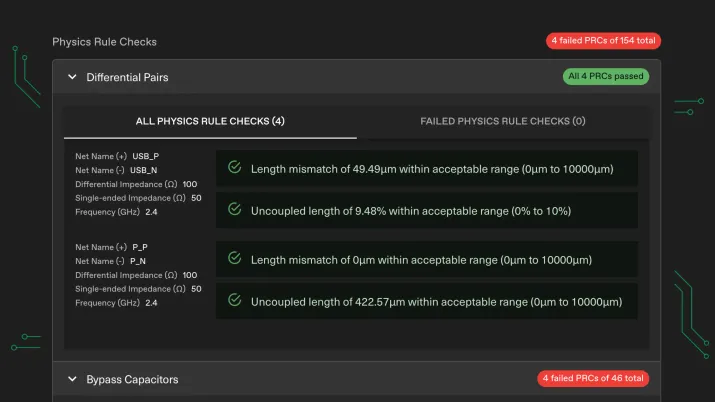
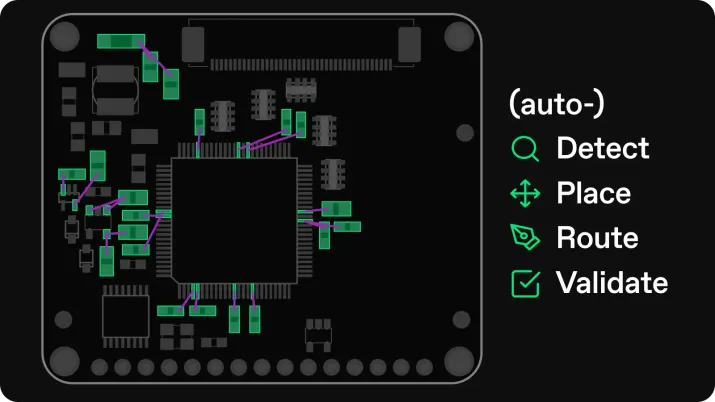
- Explicit handling of critical nets. Quilter can identify and treat bypass capacitors, impedance-controlled nets, differential pairs, and other critical considerations as distinct routing problems, not just another net in the queue.
- Transparent design review. The system evaluates each candidate against the full list of physical constraints provided and makes it clear what was satisfied and what needs review. That transparency matters because it reduces the “black box autorouter” fear.
- Abundance instead of scarcity. Traditional flows often produce one attempt that you then nurse into shape. Quilter is designed to generate multiple candidates in hours, which changes how teams iterate. You can compare, select, and refine rather than hoping the first run is salvageable.
This is also why Quilter’s positioning is “physics-driven AI for electronics design,” not “a faster maze solver.” The goal is to give engineers more design cycles without sacrificing rigor, so you can explore stackups, form factors, or manufacturer constraints in parallel and still converge on a layout that holds up in review.
If you want the broader product context, start with the Product Overview and then check the Workflow and Technology pages for the details behind the system.
What results can you expect from Quilter compared to other tools?
In 2026, the most useful way to evaluate pcb routing automation software is to compare outcomes that map to engineering reality: completion rate on constrained boards, cleanup hours, and whether high-speed rules are met in a way you trust.
Below is a representative comparison table that reflects the kinds of differences teams typically see when comparing a physics-driven candidate generator like Quilter AI to traditional full autorouting. Because every design is different, treat these as realistic example targets, not universal guarantees. If you have internal benchmarks, swap your numbers into the same framework and you will instantly have a strong evaluation rubric.
Feature
Quilter AI
Altium Autorouter
Freerouting
Routing Completion Rate
90-98% (dense, constrained)
55-75% (varies widely)
60-80% (depends on setup)
Manual Cleanup Required
Low to Medium
Medium to High
Medium
High-Speed Rule Adherence
Pass to Partial (constraint-led)
Partial (often needs reroute)
Fail to Partial (common)
Handles Dense BGAs
Yes (with constraints and floorplan)
Limited
Limited
Candidate Generation
Multiple candidates in hours
Typically single result per run
Typically single result per run
Review Transparency
Explicit constraint evaluation
DRC-focused feedback
Rule-focused feedback
The key takeaway is not that legacy tools never work. It is that legacy full autorouting tends to be fragile: it can look acceptable on simpler boards, then fall apart on the sections that actually drive schedule risk, like BGA escape, high-speed memory, tight power delivery, or mixed-signal partitions.
Quilter’s advantage shows up when your board is real: multiple constraints, real density, and design intent that cannot be fully captured by minimum clearance rules. When you can generate multiple viable candidates quickly and review them against physics-driven constraints, iteration stops being a calendar problem and becomes a decision problem.
If your organization is evaluating tools right now, this section is also where you should align stakeholders. Designers care about cleanup and readability. Hardware leads care about schedule and respin risk. Program leadership cares about throughput. A good pcb autorouter review connects those dots.
What’s next if you want to try AI-powered PCB routing?
To try AI-powered PCB routing with Quilter, the fastest path is to upload a real project, set the constraints you actually care about, and evaluate candidates inside your existing CAD workflow.
A practical first run looks like this:
- Upload your native CAD project (Altium, Cadence, Siemens, or KiCad) and confirm the board outline and key mechanical constraints.
- Pre-place the non-negotiables like connectors and major components so the AI is solving the right problem, not rearranging your intent.
- Define constraints clearly for critical nets, differential pairs, impedance-controlled routes, and any keepouts or manufacturing rules that drive success.
- Generate candidates and review using Quilter’s transparent design feedback, then export back to your CAD tool to run DRC and apply final polish.
If you want to start hands-on, use the free version here: Try Quilter Free. If you are evaluating for a team or a mission-critical program, schedule time with the engineering team so you can map constraints and success criteria up front: Talk to an Engineer.


.webp)