






Read the Full Series
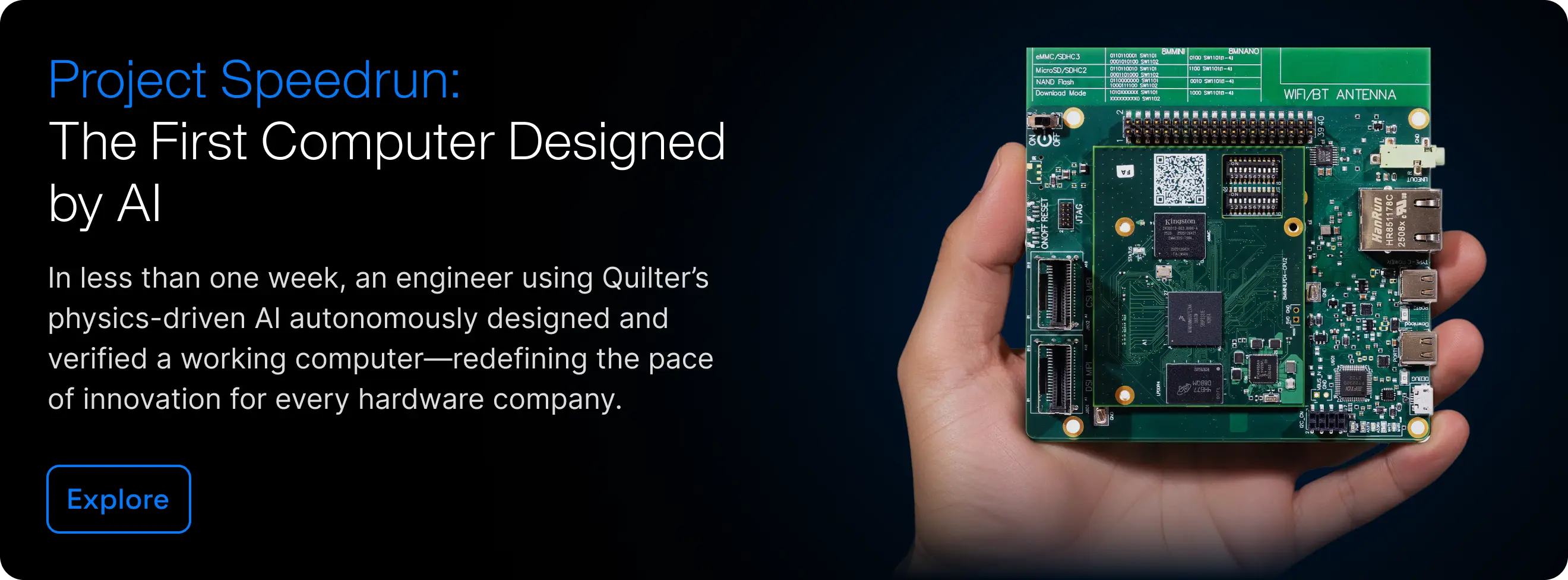
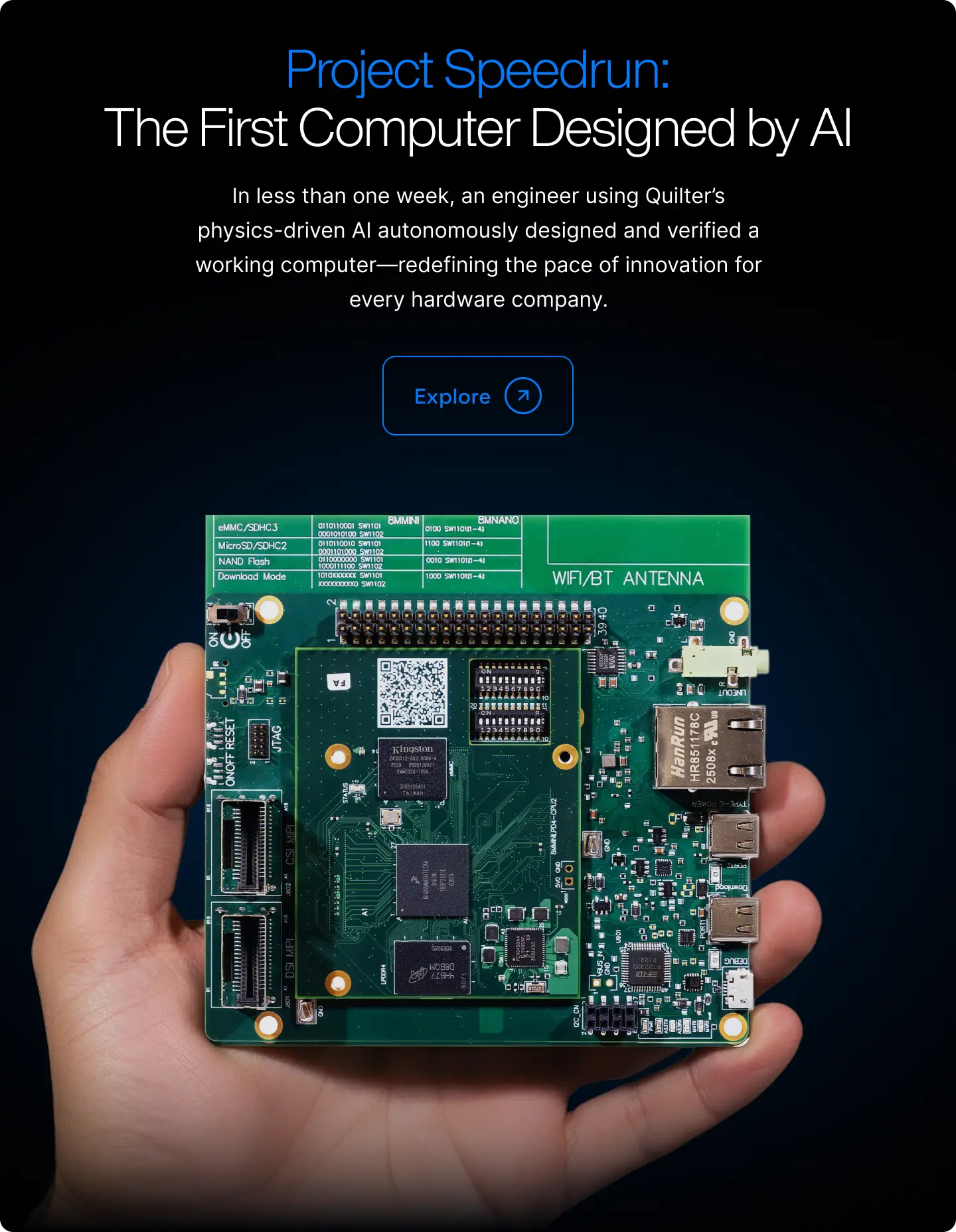
This article is one part of a walkthrough detailing how we recreated an NXP i.MX 8M Mini–based computer using Quilter’s physics-driven layout automation.
If you have tried to figure out where to buy AI electronics design tools, you have probably discovered that the market is confusing on purpose, or at least it feels that way.
A search for AI EDA tools can land you in two completely different categories. One is the world of enterprise chip design software, where buying usually starts with a sales form, moves into procurement, and ends months later in a contract. The other is the growing class of AI PCB layout software, which lets teams get started much faster, often without changing the CAD tools they already trust.
That is the first thing to understand. “AI electronics design software” is not one product category. It is a label people use for several very different tools, sold in very different ways, to very different teams.
This guide breaks that apart. It will show you where teams buy AI tools for chip and ASIC design, where board teams can get AI help today, and how to evaluate the fastest path to real engineering value. If your goal is to speed PCB layout, reduce manual routing time, and increase iteration without forcing a tool migration, the answer is often much simpler than the market makes it sound.
Let’s define what “AI electronics design software” really means in 2026
In 2026, the phrase AI electronics design automation covers two main categories.
The first is chip and ASIC AI-EDA. These tools are built for semiconductor design flows. They support use cases like implementation, verification, timing closure, and design space exploration. The buyers are usually semiconductor companies, large enterprise engineering organizations, and teams working inside foundry-driven processes with strict IP, compliance, and signoff requirements.
The second is AI-assisted PCB layout software. This category is focused on boards, not silicon. It is used by hardware engineers, PCB designers, R&D managers, semiconductor validation teams, robotics companies, consumer electronics teams, and aerospace and defense programs trying to move from schematic to layout faster.
The confusion starts because both categories often market themselves as “AI EDA tools.” But their job is different, their buyer is different, and the way you purchase them is very different, too.
Quilter sits clearly in the second category. It is built for physics-driven PCB layout. Rather than acting like a lightweight assistant that only suggests parts or snippets, Quilter uses reinforcement learning to generate multiple layout candidates in hours, with physics validating every trace. It is designed to work inside real board development workflows, including Altium, Cadence, Siemens, and KiCad projects, while keeping engineers in control of constraints, floorplanning, and final review.
So before you ask where to buy AI electronics design software, ask a simpler question first: are you taping out silicon, or shipping boards? That answer determines almost everything that follows.
Here’s why the buying process looks so different for chips and boards
Chip tools and board tools do not just solve different problems. They sit in different economic and operational systems.
Chip and ASIC design software is tightly bound to process nodes, foundry requirements, verification complexity, IT controls, and enterprise procurement. These environments usually involve long planning cycles, internal approvals, NDAs, legal review, security review, and vendor management. The software itself is not a casual purchase because the workflow is not casual. A change in tooling can affect implementation, verification, signoff, and downstream manufacturing risk.
That is why teams do not usually “click and buy” chip-focused AI-EDA tools. They engage with sales, scope the environment, define seats and usage, review compatibility and support, and negotiate terms.
PCB tools are different. They still matter a lot, and in many industries, they are mission-critical, but they usually sit above the semiconductor fabrication layer. That means the purchase motion can be much lighter. Modern AI PCB layout software can often be sold as SaaS, offered through free access or startup programs, and priced based on usage, approved designs, or design size rather than heavyweight enterprise licensing models.
This is where the market is changing fastest.
Teams that once assumed AI electronics design software had to come with a six-month buying cycle are now seeing another model: open an account, upload a project, set constraints, review candidate layouts, and pay based on actual value. Quilter is a strong example of that newer model. The platform is designed to let organizations explore freely and pay only for approved designs, with pricing that scales by pin count rather than by seats.
For many board teams, that is the breakthrough. The fastest way to buy AI EDA is not to enter a traditional enterprise chip software process at all. It is to adopt an AI PCB tool that fits your existing stack.
Where do teams buy AI tools for chip and ASIC design today?
If your team is buying AI tools for chip and ASIC design, the answer is straightforward, even if the process is not: you usually buy directly from the major enterprise vendors through a sales-led motion.
That means companies like Synopsys, Cadence, and Siemens EDA. In practical terms, the route usually looks like this:
- Visit the vendor website and request information or a demo
- Speak with sales or a regional representative
- Enter scoping conversations around node, flow, use case, team size, support, and deployment
- Execute NDAs and sometimes technical evaluation steps
- Move through proposal, procurement, legal, and contracting
In some regions or account structures, value-added resellers may also be involved. Large accounts may be handled directly. Others may be routed through regional partners or authorized channels.
That model makes sense in semiconductor environments. These tools often touch critical design infrastructure, long-lived workflows, and large budgets. They are not impulse purchases, and they are not designed to be.
But here is the key distinction for searchers trying to answer with AI electronics design software: this path rarely helps teams whose actual pain point is board layout speed. If you are a PCB team trying to get boards done faster, chip AI-EDA procurement often solves the wrong problem in the most complicated possible way.
That is why the market needs clearer language. When a hardware team asks where to buy AI electronics design tools, they are often not asking about chip implementation at all. They are asking how to get board layout help now, without adding months of vendor process.
Where can you get AI help for PCB layout without a long sales cycle?
This is where the market gets more interesting and much more useful for most hardware teams.
A newer class of tools is making AI-based PCB layout possible in hours without forcing a long enterprise buying cycle. These tools focus on board-level design and integrate with existing ECAD workflows rather than replacing them from scratch.
The purchase motion here is much lighter. Depending on the vendor, teams may be able to start with free access, a startup plan, or a self-serve subscription. Some tools are seat-based. Some are usage-based. Some combine free exploration with paid production use.
Quilter is positioned around the outcome serious board teams actually care about: faster, physics-aware PCB layout that works with the tools they already use. Instead of asking engineers to hand over control, Quilter lets them define the board outline, pre-place connectors, determine the floorplan, and set the constraints. From there, the system generates multiple candidates in parallel and evaluates each layout against the provided physical constraints.
That matters because there is a real difference between AI that helps you chat about design and AI that helps you complete it.
A lightweight assistant may help with parts, notes, or snippets. A quilter AI PCB workflow is aimed at layout execution itself. That is a very different kind of value, especially for teams under schedule pressure.
Buy Quilter in minutes
Visit the Pricing page to choose Free, Startup, or Enterprise and start your first AI-assisted board workflow.
For most board teams, this category is the most practical answer to the question of where to buy AI electronics design tools today. It is faster to adopt, easier to evaluate, and closer to the actual bottleneck.
Here’s how Quilter fits into your existing PCB design stack
One of the biggest concerns buyers have is whether adopting AI means replacing the CAD environment their team already knows. For most serious hardware organizations, that is a nonstarter.
Quilter is designed to work alongside the stack you already use.
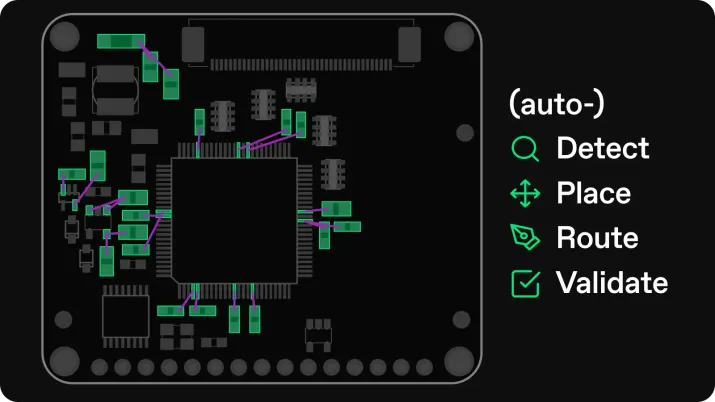
Teams can upload projects directly from Altium, Cadence, Siemens, or KiCad. From there, they define the outline, preplace the connectors, and determine the floor plan and constraints. Quilter then explores multiple design candidates, using reinforcement learning and physics-aware evaluation to accelerate what is typically a slow, labor-intensive layout process.
The important point is this: Quilter is not asking you to abandon your existing design environment. It returns files in the same format you submitted. That means final DRC, design polish, and fab file generation can still happen inside the tools your team already trusts.
That model lowers adoption friction dramatically.
It also changes the ROI equation. Instead of spending weeks on manual layout before you can even compare viable options, teams can iterate across stack-ups, manufacturers, and form factors in parallel. That means more exploration, more engineering bandwidth, and a better chance of finding the right board faster.
This is especially compelling for teams in semiconductors, robotics, consumer electronics, and aerospace and defense, where schedule slips are expensive, and layout bottlenecks slow down everything around them.
If you are evaluating physics-driven AI for electronics design, that fit with the existing stack matters as much as the raw automation capability. Speed only helps if it fits into a real workflow.
How do you decide which AI electronics design tool to buy?
A simple buying framework can save a lot of time.
Start with four questions:
- Are you taping out silicon or shipping boards?
- Are you trying to optimize signoff flows or accelerate PCB layout?
- Do you need enterprise procurement, or do you need value this quarter?
- Are compliance and deployment constraints driving the decision, or is time-to-layout the real problem?
From there, the tool path becomes clearer.
If you are a semiconductor validation lab building boards to support chip development, your fastest ROI may come from AI PCB layout, not chip AI-EDA. The chip flow may already be established. The bottleneck may be test hardware and validation boards. In that case, accelerating board layout can have an immediate schedule impact.
If you are a robotics startup, the answer is often even clearer. You need boards out quickly, design cycles compressed, and engineering time focused on what differentiates the product. A self-serve or startup-friendly AI PCB tool is likely the practical place to start.
If you are an aerospace or defense team, the question becomes more nuanced. Compliance, security, and support matter more. But even there, a tool that can accelerate mission-critical board bring-up while fitting inside controlled workflows may create value far sooner than a broad chip procurement exercise.
In other words, many teams think they are shopping for AI EDA broadly when what they actually need is a better way to finish PCB layout. The fastest value often comes from automating board layout first, then expanding AI adoption as the organization matures.
Here’s how to buy Quilter in minutes
Here is the simple version: you can buy Quilter directly from the website with a credit card in minutes.
That is a major difference from traditional enterprise AI-EDA procurement, and it is one reason Quilter is a practical option for teams that want to move fast.
At a high level, Quilter offers:
- Free access for teams exploring the platform
- Startup access for fast-moving companies pushing toward product-market fit
- Enterprise options for larger or more demanding environments
Pricing scales by pin count, not by seats. That means the cost model grows with the design work, not with the number of people who need to collaborate around it. Just as important, teams can explore freely and pay only for approved designs. That aligns spending with actual engineering value delivered.
Exact signup flow
1. Go to the Pricing pageReview the plan options based on your team type and design needs.
2. Choose Free, Startup, or Enterprise
Pick the route that matches your pace and constraints.
3. Create your account
Set up access for your team.
4. Add payment details if needed
For self-serve plans, this can be done directly online.
5. Upload your first project
Bring in an Altium, Cadence, Siemens, or KiCad design.
6. Define constraints and review candidates
Set the board outline, floorplan, and key requirements, then let Quilter generate layout options.
Buy Quilter in minutes
Start with the plan that fits your team, or contact sales if you need Enterprise support.
For buyers asking buy ai electronics design software and wanting a direct path, this is the answer board teams are usually looking for.
What should you expect in the first week with an AI PCB layout tool?
The first week should be practical, not theoretical.
Start with one pilot board. Pick something representative enough to matter, but contained enough that your team can evaluate the result quickly. Upload the existing design, define the board outline and constraints, and review the first generated candidates.
By day one or two, the goal is not blind trust. The goal is informed evaluation.
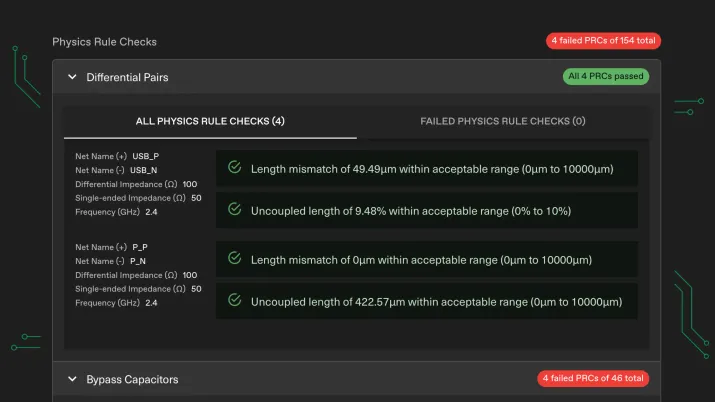
That is why Quilter’s transparent design review matters. Teams can see what the system is accounting for up front, including bypass capacitors, impedance-controlled nets, differential pairs, and other critical considerations. Each candidate is evaluated against the full set of provided physical constraints, so engineers are not guessing what happened behind the curtain.
By the end of the first week, measure a few simple things:
- Hours saved in layout work
- Number of viable iterations explored
- Time from schematic to fab-ready design
- Engineering time freed for higher-value review and decision-making
For many teams, that is where the value becomes obvious. Instead of spending weeks getting to one layout, they can review multiple serious candidates in hours.
A good internal checkpoint is simple: did the tool reduce layout bottlenecks without disrupting the stack or lowering confidence? If the answer is yes, the pilot did its job.
Next steps if you’re still evaluating options
The big takeaway is simple. There are really two buying motions in this market.
One is enterprise chip AI-EDA, which usually means sales-led procurement, long evaluation cycles, and deep integration into semiconductor workflows.
The other is self-serve or usage-based AI PCB layout software, which can often be adopted quickly and evaluated on a real design within days.
If your team builds boards and wants the fastest path to value, start there. Do not overcomplicate the purchase by treating every AI electronics tool like a chip infrastructure decision. In many cases, the most effective way to adopt AI in hardware is to begin where the bottleneck is most painful: PCB layout.
Quilter gives teams a direct path. You can start with the Free version, explore startup-friendly options, or engage the Enterprise team if your environment requires a more tailored approach. The platform works with your existing workflow, supports real engineering constraints, and is built to compress board layout cycles from weeks into hours.
If you are still comparing options, the best next move is to test an actual project. That will tell you more than another month of vendor research.
Visit Quilter’s pricing page, choose the plan that fits your team, and start your first AI-assisted PCB layout workflow.
FAQ
Where can I buy AI EDA tools?
It depends on the category. Chip and ASIC AI-EDA tools are usually purchased through direct sales with vendors like Synopsys, Cadence, and Siemens. AI PCB layout tools can often be accessed directly online through self-serve signup, free tiers, startup plans, or usage-based pricing.
Can I buy Quilter with a credit card?
Yes. Quilter offers a direct website purchase path for teams that want to get started quickly, with plan options ranging from Free to Startup and Enterprise.
Is Quilter a replacement for my CAD tool?
No. Quilter works with existing workflows and supports projects from Altium, Cadence, Siemens, and KiCad. Final DRC, polish, and fab file generation can remain in your trusted ECAD tools.
What is the fastest way to evaluate AI electronics design automation for a board team?
Pick a real pilot board, upload the existing design, define constraints, and compare how quickly you get viable layout candidates versus your usual process.



.webp)