




Gen AI

Published

Written by

Workbench

Generative PCB Design Tool Pricing in 2026: A Guide to SaaS, Credits, and Subscriptions

Published

January 19, 2026

If you’re shopping for “generative” or AI-assisted PCB tools in 2026, the most challenging part often isn’t the demo. It’s understanding what you’re actually buying.

Traditional EDA pricing used to be straightforward (even if expensive): buy a seat, pay maintenance, repeat. AI changes the cost structure. Generating dozens of placement and routing candidates requires significant compute, and vendors now recover those costs through a mix of SaaS subscriptions, credit/usage meters, and enterprise bundles.

This guide breaks down the three dominant pricing models, shows how they map to real workflows, and highlights the “gotchas” that can turn a reasonable plan into a budgeting headache.

What’s Changing With PCB Design Tool Pricing?

Two significant shifts are occurring simultaneously.

First, AI and “generative” features introduce variable cost drivers—primarily compute time and cloud infrastructure. In practice, that means a tool can’t always be priced purely by seat count and call it a day. If a customer runs 200 candidate generations per week, the vendor’s underlying cost looks nothing like that of a customer who runs 10.

Second, the delivery model is changing. Browser-based collaboration and cloud workflows are pushing vendors toward subscriptions and usage-based models, even when the underlying design environment remains a “classic” desktop EDA.

That combination is why, in 2026, you’ll see pricing questions like:

  • “How many AI credits do I get per month?” (Flux-style subscription + credits) (Flux)
  • “How much does a minute of routing cost?” (DeepPCB-style pay-as-you-go) (DeepPCB)
  • “Do I pay per engineer, or per design output?” (Quilter’s seat-free, pay-on-download approach) (Quilter)

The result: teams now have to choose between predictability (subscriptions), flexibility (credits), and procurement certainty (enterprise contracts)—and most tools are some hybrid of the three.

How Do SaaS, Credit-Based, and Enterprise Subscriptions Work?

Think of pricing models as answering one core question: “What are you metering?”

1) SaaS subscriptions (predictable monthly/annual fees)

This is the familiar model: pay monthly or annually, typically per user/editor, sometimes with AI usage included.

Example: Flux offers tiered plans with a monthly credit bucket; you can purchase additional credits if you exceed the included amount. (Flux)

What you’re really paying for:

  • Access to the platform + collaboration features
  • A predictable baseline of AI usage
  • Optional overage spending when your usage spikes

Best when you want stable budgeting and you know you’ll use the tool consistently.

2) Credit-based / usage-based (pay for compute or “AI time”)

Credit pricing is basically a cloud compute meter with friendlier branding. You prepay credits (or purchase them as you go), and the system uses them as you run AI placement/routing/generation jobs.

Example: DeepPCB uses an AI credit system in which credits map to time (e.g., roughly “credits per minute”). (DeepPCB)

What you’re really paying for:

  • The right to run compute-heavy jobs
  • The flexibility to burst when needed (without upgrading everyone to a higher tier)

Best when your usage is spiky or you only need AI layout occasionally.

3) Enterprise subscriptions (bundled, quote-based, often opaque)

Enterprise EDA is still very real—especially when you need compliance, security reviews, support SLAs, integrations, and procurement-friendly terms.

Siemens, for example, sells PADS Pro Essentials at a publicly listed annual price point, while more advanced enterprise configurations and broader bundles often shift into quote territory. (Siemens Digital Industries Software)

Best when you need enterprise support, governance, and procurement structure—regardless of whether the pricing is “simple.”

A quick comparison table

Pricing model

What’s metered

Budget predictability

Best for

Common downside

SaaS subscription

Seats/editors (sometimes + included AI credits)

High

Small teams, steady usage

Feature gating, extra fees when AI credits run out (Flux)

Credit-based

Compute time / AI jobs

Medium

Bursty workloads, “use it when needed”

Costs can spike fast; hard to estimate per-project cost (DeepPCB)

Enterprise / bundled

Contract scope (support, security, integrations)

Medium–High

Regulated teams, big orgs

Opaque pricing; negotiating takes time (Siemens Digital Industries Software)

Seat-free, pay-on-output (emerging)

Outputs/downloads (e.g., by design complexity)

High (if capped)

Teams that iterate a lot

You must understand what counts as “billable output” (Quilter)

Which Pricing Model Fits Your Team’s Workflow?

Here are three practical “buyer personas” that map cleanly to pricing.

Scenario A: Solo engineer or consultant shipping boards regularly

If you’re designing every week, subscription pricing is usually the least stressful. You’re not trying to predict routing minutes; you just want a known monthly cost and enough capability to stay productive.

A subscription like Flux can make sense if you value browser-based collaboration and can work within its included monthly credit allowances (and top up when needed). (Flux)

Scenario B: Startup team iterating hard (many candidates, fast cycles)

Startups often hit a weird cost mismatch: they want to iterate constantly, but their budgets hate surprise overages.

In this case, pricing models that don’t punish iteration tend to win. If you’re generating many candidates to explore tradeoffs, your cost structure should encourage that behavior, not meter every reroute.

Scenario C: Enterprise teams with compliance, multi-site collaboration, and procurement rules

Even if the per-seat sticker price looks high, enterprise contracts can be the right move when they unlock:

  • vetted security posture
  • standardized onboarding
  • priority support
  • predictable renewal/purchasing cycles

If a tool is mission-critical, the “cheapest” plan often becomes the most expensive once you factor in downtime, rework, and support delays.

What’s Included in Each Plan? And What’s Not?

Pricing pages rarely make this obvious, so here’s what to verify before you commit.

AI usage limits: unlimited vs capped

Some tools include a monthly credit bucket (good), but throttle you once you exceed it (not good if your work spikes). Flux, for example, explicitly lists included credits per month and the cost to add more. (Flux)

Credit-based tools can be even trickier: you might be paying for routing time, placement time, or both. DeepPCB’s pricing is based on an AI-credit system tied to time, and they provide per-job consumption rates. (DeepPCB)

Collaboration and seats

Ask:

  • How many editors are included?
  • Are viewers free?
  • Do contractors need paid access?
  • Can you add unlimited teammates without triggering a seat explosion?

This matters because layout work often spans EE, ME, firmware, and manufacturing stakeholders.

Export rights and handoff formats

A tool can look “cheap” until you learn that:

  • certain export formats require higher tiers
  • manufacturing outputs are gated
  • your preferred CAD interchange isn’t included

Always validate your end-to-end workflow: schematic import → constraints → layout candidates → DRC review → fab outputs.

Support and onboarding

At higher tiers, you’re often buying response time and implementation help as much as you’re buying software.

Even for publicly priced products like Siemens PADS Pro Essentials ($999/year), practical experience can vary depending on the level of support/community access you receive versus full enterprise support. (Siemens Digital Industries Software)

How Does Quilter’s Pricing Stack Up?

Quilter’s model is worth noting because it reverses the usual “pay per seat” assumption.

On Quilter’s pricing page, the core idea is seat-free, usage-based enterprise pricing: you can run unlimited iterations and add unlimited teammates, and you’re charged per downloaded design, with pricing that scales with design complexity (measured by pin count). (Quilter)

In plain English:

  • Iteration is cheap (or free): explore lots of candidates without a per-minute meter. (Quilter)
  • Selection is what’s billable: pay when you pull designs out for handoff (and understand what “download” means in their billing rules). (Quilter)
  • Scaling doesn’t require buying seats: collaboration doesn’t automatically multiply spend. (Quilter)

They also advertise a free tier with “unlimited iterations” framing, which is useful if you’re trying to evaluate the workflow before procurement gets involved. (Quilter)

This aligns with the value proposition described in your brief: emphasize transparent pricing and “unlimited” iteration compared with credit-based unpredictability.

When this model is a great fit: teams that want to explore many candidate layouts, compare tradeoffs, and avoid paying a tax every time they rerun generation.

What to validate: what counts as a “downloaded design,” how pin count is measured, and whether there’s a predictable monthly cap (Quilter explicitly mentions a cap concept on the pricing page). (Quilter)

What Should You Watch Out For When Comparing Plans?

Here are the pitfalls that most often catch teams off guard.

1) “Cheap entry” that becomes expensive at scale

A low starter tier can be perfect until you realize your actual workflow requires:

  • private projects at higher limits
  • more editors
  • export formats
  • additional AI credits

Flux, for example, makes it clear that different tiers offer different monthly credits and per-100-credit top-up costs. That transparency is good—but you still need to model your own usage. (Flux)

2) Credit burn you can’t estimate

Credit-based tools can be great, but only if you can forecast the cost per board. If a design takes longer to route than expected, or you run many experiments, “pay-per-minute” can balloon.

DeepPCB explicitly ties credits to time and describes job consumption rates, which is helpful for forecasting, but you still need to test your specific board types. (DeepPCB)

3) Feature gating that blocks handoff

If you can generate a layout but can’t export what manufacturing needs, the plan isn’t “usable.” Confirm deliverables early:

  • fab outputs
  • impedance constraints handling
  • DRC/constraint integration
  • CAD interoperability

4) Seat math that punishes collaboration

If EE + ME + manufacturing all need access, a seat-based plan can double or triple your cost, even when those collaborators only log in occasionally.

Seat-free or “free viewer” models reduce that friction, but always check what actions require a paid license.

5) “AI” that’s not the AI you actually need

Some tools market AI as a copilot, chat assistant, or small automations—not full generative placement/routing. Make sure the AI you’re paying for aligns with your goal: speed, layout abundance, constraints handling, or design review.

Ready to Try Generative PCB Design? Here’s How to Get Started

A clean way to evaluate pricing without getting lost in spreadsheets:

  1. Pick one representative board (your “typical” design) and one “hard mode” board (dense, high-speed, constraint-heavy).
  2. Run the same workflow across tools: import → constraints → candidate generation → review → export.
  3. Track the cost driver that matches the tool’s pricing model:
    • SaaS: monthly plan + expected overage credits (if any) (Flux)
    • Credits: estimated credits per run × number of runs per board (DeepPCB)
    • Pay-on-output: number of exported/selected designs and your expected monthly cap behavior (Quilter)

If you’re specifically evaluating Quilter, start by reviewing their pricing overview (seat-free, pay-on-download, pin-count scaling) and then validate your expected “billable moments” during a trial or demo. (Quilter)

And if you’re early in the market, Flux and credit-based options like DeepPCB can be useful baselines for understanding how much iteration you’ll realistically do before you settle on a long-term pricing model.


Try Quilter for Yourself

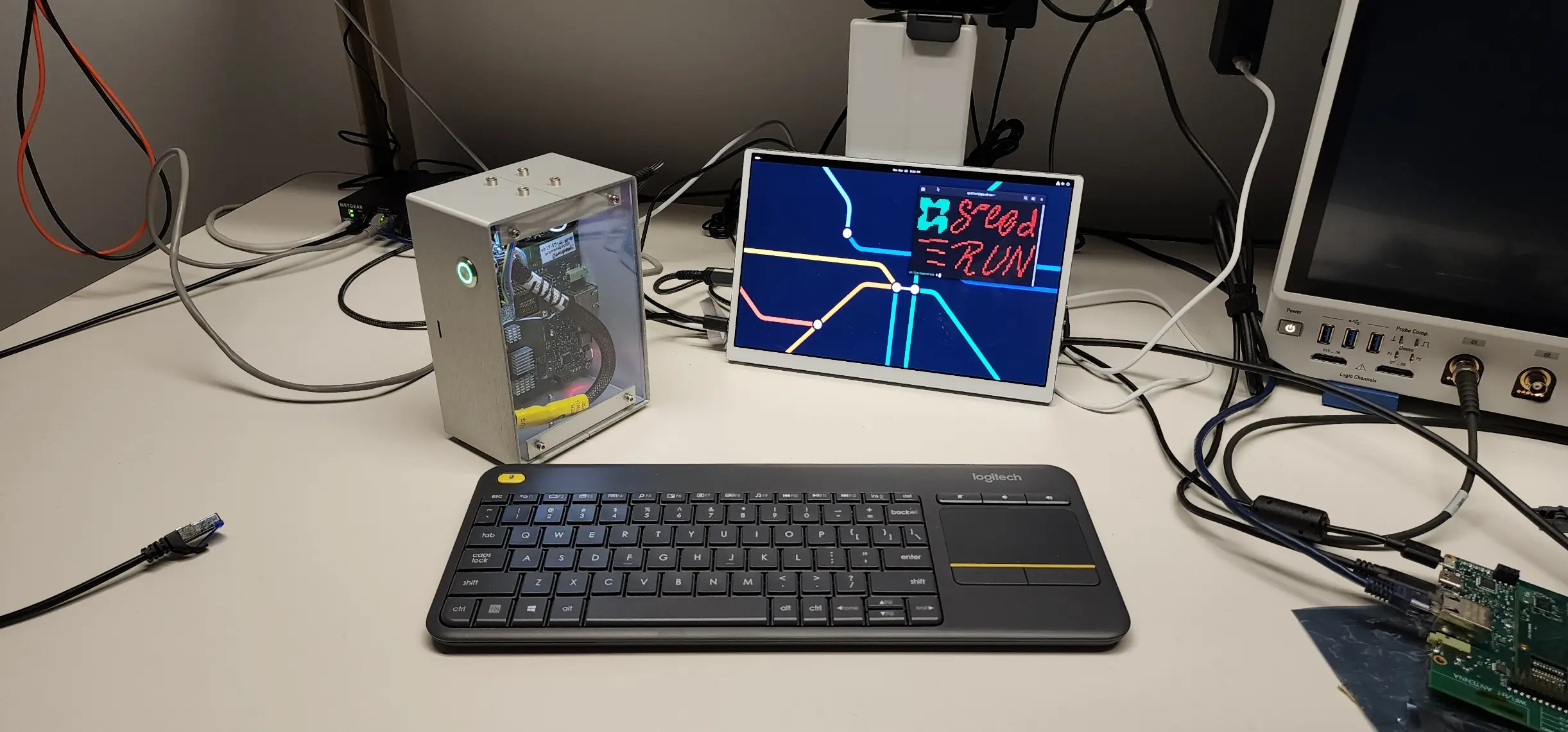
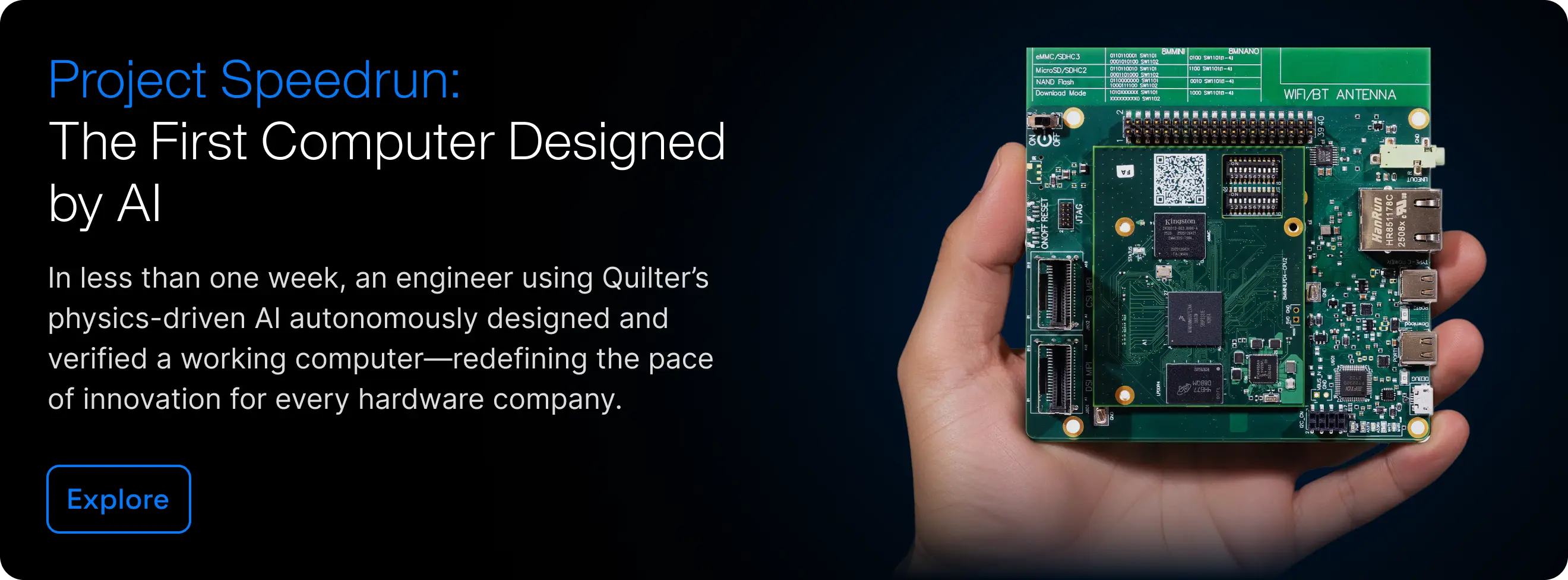
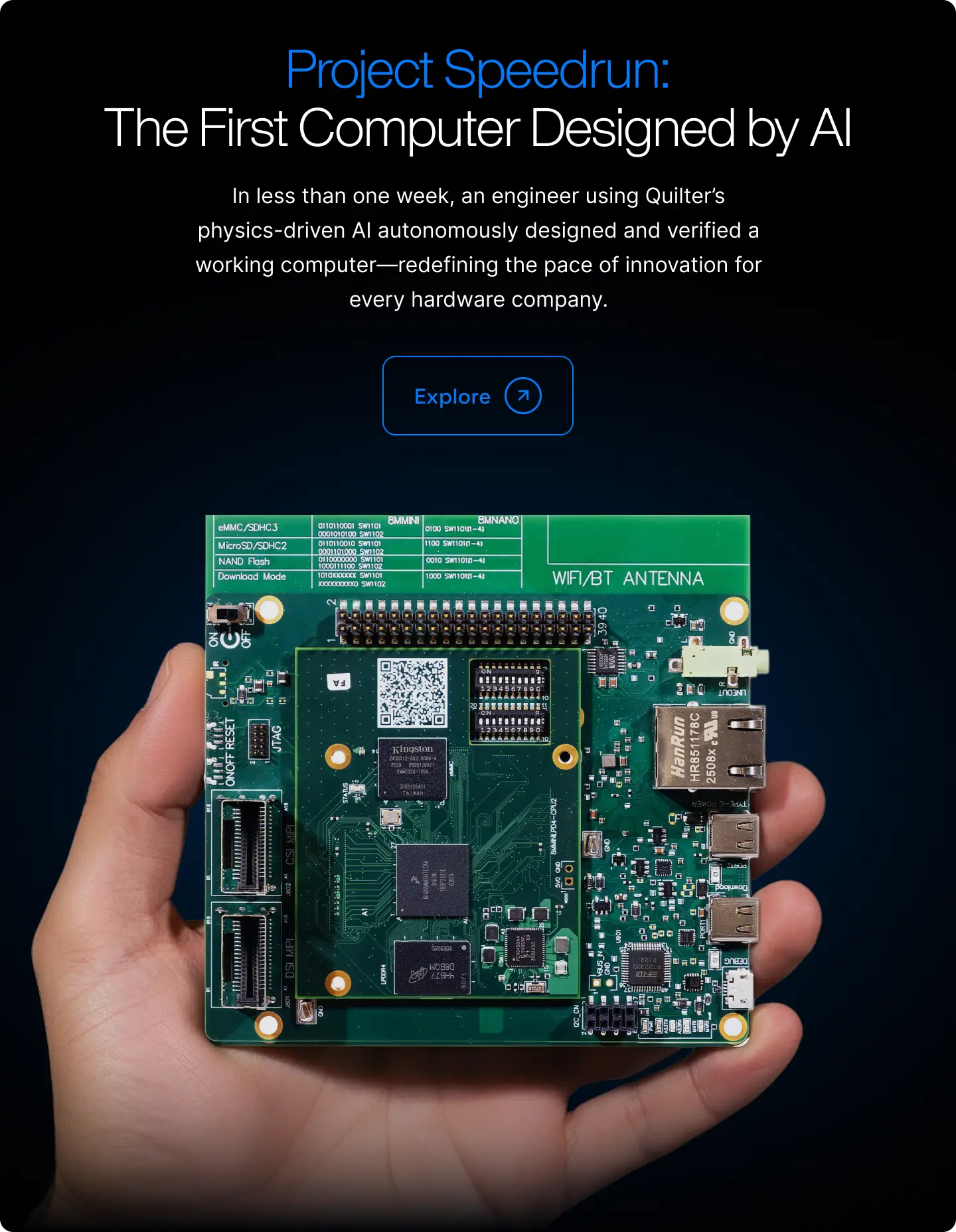
Project Speedrun demonstrated what autonomous layout looks like in practice and the time compression Quilter enables. Now, see it on your own hardware.

Get Started

Validating the Design

With cleanup complete, the final question is whether the hardware works. Power-on is where most electrical mistakes reveal themselves, and it’s the moment engineers are both nervous and excited about.

Continue to Part 4

Cleaning Up the Design

Autonomous layout produces a complete, DRC'd design; cleanup is a brief precision pass to finalize it for fabrication.

Continue to Part 3

Compiling the Design

Once the design is prepared, the next step is handing it off to Quilter. In traditional workflows, this is where an engineer meets with a layout specialist to clarify intent. Quilter replaces that meeting with circuit comprehension: you upload the project, review how constraints are interpreted, and submit the job.

Continue to Part 2

Generative PCB Design Tool Pricing in 2026: A Guide to SaaS, Credits, and Subscriptions

January 19, 2026
by
Darin ten Bruggencate
and

If you’re shopping for “generative” or AI-assisted PCB tools in 2026, the most challenging part often isn’t the demo. It’s understanding what you’re actually buying.

Traditional EDA pricing used to be straightforward (even if expensive): buy a seat, pay maintenance, repeat. AI changes the cost structure. Generating dozens of placement and routing candidates requires significant compute, and vendors now recover those costs through a mix of SaaS subscriptions, credit/usage meters, and enterprise bundles.

This guide breaks down the three dominant pricing models, shows how they map to real workflows, and highlights the “gotchas” that can turn a reasonable plan into a budgeting headache.

What’s Changing With PCB Design Tool Pricing?

Two significant shifts are occurring simultaneously.

First, AI and “generative” features introduce variable cost drivers—primarily compute time and cloud infrastructure. In practice, that means a tool can’t always be priced purely by seat count and call it a day. If a customer runs 200 candidate generations per week, the vendor’s underlying cost looks nothing like that of a customer who runs 10.

Second, the delivery model is changing. Browser-based collaboration and cloud workflows are pushing vendors toward subscriptions and usage-based models, even when the underlying design environment remains a “classic” desktop EDA.

That combination is why, in 2026, you’ll see pricing questions like:

  • “How many AI credits do I get per month?” (Flux-style subscription + credits) (Flux)
  • “How much does a minute of routing cost?” (DeepPCB-style pay-as-you-go) (DeepPCB)
  • “Do I pay per engineer, or per design output?” (Quilter’s seat-free, pay-on-download approach) (Quilter)

The result: teams now have to choose between predictability (subscriptions), flexibility (credits), and procurement certainty (enterprise contracts)—and most tools are some hybrid of the three.

How Do SaaS, Credit-Based, and Enterprise Subscriptions Work?

Think of pricing models as answering one core question: “What are you metering?”

1) SaaS subscriptions (predictable monthly/annual fees)

This is the familiar model: pay monthly or annually, typically per user/editor, sometimes with AI usage included.

Example: Flux offers tiered plans with a monthly credit bucket; you can purchase additional credits if you exceed the included amount. (Flux)

What you’re really paying for:

  • Access to the platform + collaboration features
  • A predictable baseline of AI usage
  • Optional overage spending when your usage spikes

Best when you want stable budgeting and you know you’ll use the tool consistently.

2) Credit-based / usage-based (pay for compute or “AI time”)

Credit pricing is basically a cloud compute meter with friendlier branding. You prepay credits (or purchase them as you go), and the system uses them as you run AI placement/routing/generation jobs.

Example: DeepPCB uses an AI credit system in which credits map to time (e.g., roughly “credits per minute”). (DeepPCB)

What you’re really paying for:

  • The right to run compute-heavy jobs
  • The flexibility to burst when needed (without upgrading everyone to a higher tier)

Best when your usage is spiky or you only need AI layout occasionally.

3) Enterprise subscriptions (bundled, quote-based, often opaque)

Enterprise EDA is still very real—especially when you need compliance, security reviews, support SLAs, integrations, and procurement-friendly terms.

Siemens, for example, sells PADS Pro Essentials at a publicly listed annual price point, while more advanced enterprise configurations and broader bundles often shift into quote territory. (Siemens Digital Industries Software)

Best when you need enterprise support, governance, and procurement structure—regardless of whether the pricing is “simple.”

A quick comparison table

Pricing model

What’s metered

Budget predictability

Best for

Common downside

SaaS subscription

Seats/editors (sometimes + included AI credits)

High

Small teams, steady usage

Feature gating, extra fees when AI credits run out (Flux)

Credit-based

Compute time / AI jobs

Medium

Bursty workloads, “use it when needed”

Costs can spike fast; hard to estimate per-project cost (DeepPCB)

Enterprise / bundled

Contract scope (support, security, integrations)

Medium–High

Regulated teams, big orgs

Opaque pricing; negotiating takes time (Siemens Digital Industries Software)

Seat-free, pay-on-output (emerging)

Outputs/downloads (e.g., by design complexity)

High (if capped)

Teams that iterate a lot

You must understand what counts as “billable output” (Quilter)

Which Pricing Model Fits Your Team’s Workflow?

Here are three practical “buyer personas” that map cleanly to pricing.

Scenario A: Solo engineer or consultant shipping boards regularly

If you’re designing every week, subscription pricing is usually the least stressful. You’re not trying to predict routing minutes; you just want a known monthly cost and enough capability to stay productive.

A subscription like Flux can make sense if you value browser-based collaboration and can work within its included monthly credit allowances (and top up when needed). (Flux)

Scenario B: Startup team iterating hard (many candidates, fast cycles)

Startups often hit a weird cost mismatch: they want to iterate constantly, but their budgets hate surprise overages.

In this case, pricing models that don’t punish iteration tend to win. If you’re generating many candidates to explore tradeoffs, your cost structure should encourage that behavior, not meter every reroute.

Scenario C: Enterprise teams with compliance, multi-site collaboration, and procurement rules

Even if the per-seat sticker price looks high, enterprise contracts can be the right move when they unlock:

  • vetted security posture
  • standardized onboarding
  • priority support
  • predictable renewal/purchasing cycles

If a tool is mission-critical, the “cheapest” plan often becomes the most expensive once you factor in downtime, rework, and support delays.

What’s Included in Each Plan? And What’s Not?

Pricing pages rarely make this obvious, so here’s what to verify before you commit.

AI usage limits: unlimited vs capped

Some tools include a monthly credit bucket (good), but throttle you once you exceed it (not good if your work spikes). Flux, for example, explicitly lists included credits per month and the cost to add more. (Flux)

Credit-based tools can be even trickier: you might be paying for routing time, placement time, or both. DeepPCB’s pricing is based on an AI-credit system tied to time, and they provide per-job consumption rates. (DeepPCB)

Collaboration and seats

Ask:

  • How many editors are included?
  • Are viewers free?
  • Do contractors need paid access?
  • Can you add unlimited teammates without triggering a seat explosion?

This matters because layout work often spans EE, ME, firmware, and manufacturing stakeholders.

Export rights and handoff formats

A tool can look “cheap” until you learn that:

  • certain export formats require higher tiers
  • manufacturing outputs are gated
  • your preferred CAD interchange isn’t included

Always validate your end-to-end workflow: schematic import → constraints → layout candidates → DRC review → fab outputs.

Support and onboarding

At higher tiers, you’re often buying response time and implementation help as much as you’re buying software.

Even for publicly priced products like Siemens PADS Pro Essentials ($999/year), practical experience can vary depending on the level of support/community access you receive versus full enterprise support. (Siemens Digital Industries Software)

How Does Quilter’s Pricing Stack Up?

Quilter’s model is worth noting because it reverses the usual “pay per seat” assumption.

On Quilter’s pricing page, the core idea is seat-free, usage-based enterprise pricing: you can run unlimited iterations and add unlimited teammates, and you’re charged per downloaded design, with pricing that scales with design complexity (measured by pin count). (Quilter)

In plain English:

  • Iteration is cheap (or free): explore lots of candidates without a per-minute meter. (Quilter)
  • Selection is what’s billable: pay when you pull designs out for handoff (and understand what “download” means in their billing rules). (Quilter)
  • Scaling doesn’t require buying seats: collaboration doesn’t automatically multiply spend. (Quilter)

They also advertise a free tier with “unlimited iterations” framing, which is useful if you’re trying to evaluate the workflow before procurement gets involved. (Quilter)

This aligns with the value proposition described in your brief: emphasize transparent pricing and “unlimited” iteration compared with credit-based unpredictability.

When this model is a great fit: teams that want to explore many candidate layouts, compare tradeoffs, and avoid paying a tax every time they rerun generation.

What to validate: what counts as a “downloaded design,” how pin count is measured, and whether there’s a predictable monthly cap (Quilter explicitly mentions a cap concept on the pricing page). (Quilter)

What Should You Watch Out For When Comparing Plans?

Here are the pitfalls that most often catch teams off guard.

1) “Cheap entry” that becomes expensive at scale

A low starter tier can be perfect until you realize your actual workflow requires:

  • private projects at higher limits
  • more editors
  • export formats
  • additional AI credits

Flux, for example, makes it clear that different tiers offer different monthly credits and per-100-credit top-up costs. That transparency is good—but you still need to model your own usage. (Flux)

2) Credit burn you can’t estimate

Credit-based tools can be great, but only if you can forecast the cost per board. If a design takes longer to route than expected, or you run many experiments, “pay-per-minute” can balloon.

DeepPCB explicitly ties credits to time and describes job consumption rates, which is helpful for forecasting, but you still need to test your specific board types. (DeepPCB)

3) Feature gating that blocks handoff

If you can generate a layout but can’t export what manufacturing needs, the plan isn’t “usable.” Confirm deliverables early:

  • fab outputs
  • impedance constraints handling
  • DRC/constraint integration
  • CAD interoperability

4) Seat math that punishes collaboration

If EE + ME + manufacturing all need access, a seat-based plan can double or triple your cost, even when those collaborators only log in occasionally.

Seat-free or “free viewer” models reduce that friction, but always check what actions require a paid license.

5) “AI” that’s not the AI you actually need

Some tools market AI as a copilot, chat assistant, or small automations—not full generative placement/routing. Make sure the AI you’re paying for aligns with your goal: speed, layout abundance, constraints handling, or design review.

Ready to Try Generative PCB Design? Here’s How to Get Started

A clean way to evaluate pricing without getting lost in spreadsheets:

  1. Pick one representative board (your “typical” design) and one “hard mode” board (dense, high-speed, constraint-heavy).
  2. Run the same workflow across tools: import → constraints → candidate generation → review → export.
  3. Track the cost driver that matches the tool’s pricing model:
    • SaaS: monthly plan + expected overage credits (if any) (Flux)
    • Credits: estimated credits per run × number of runs per board (DeepPCB)
    • Pay-on-output: number of exported/selected designs and your expected monthly cap behavior (Quilter)

If you’re specifically evaluating Quilter, start by reviewing their pricing overview (seat-free, pay-on-download, pin-count scaling) and then validate your expected “billable moments” during a trial or demo. (Quilter)

And if you’re early in the market, Flux and credit-based options like DeepPCB can be useful baselines for understanding how much iteration you’ll realistically do before you settle on a long-term pricing model.