







Read the Full Series
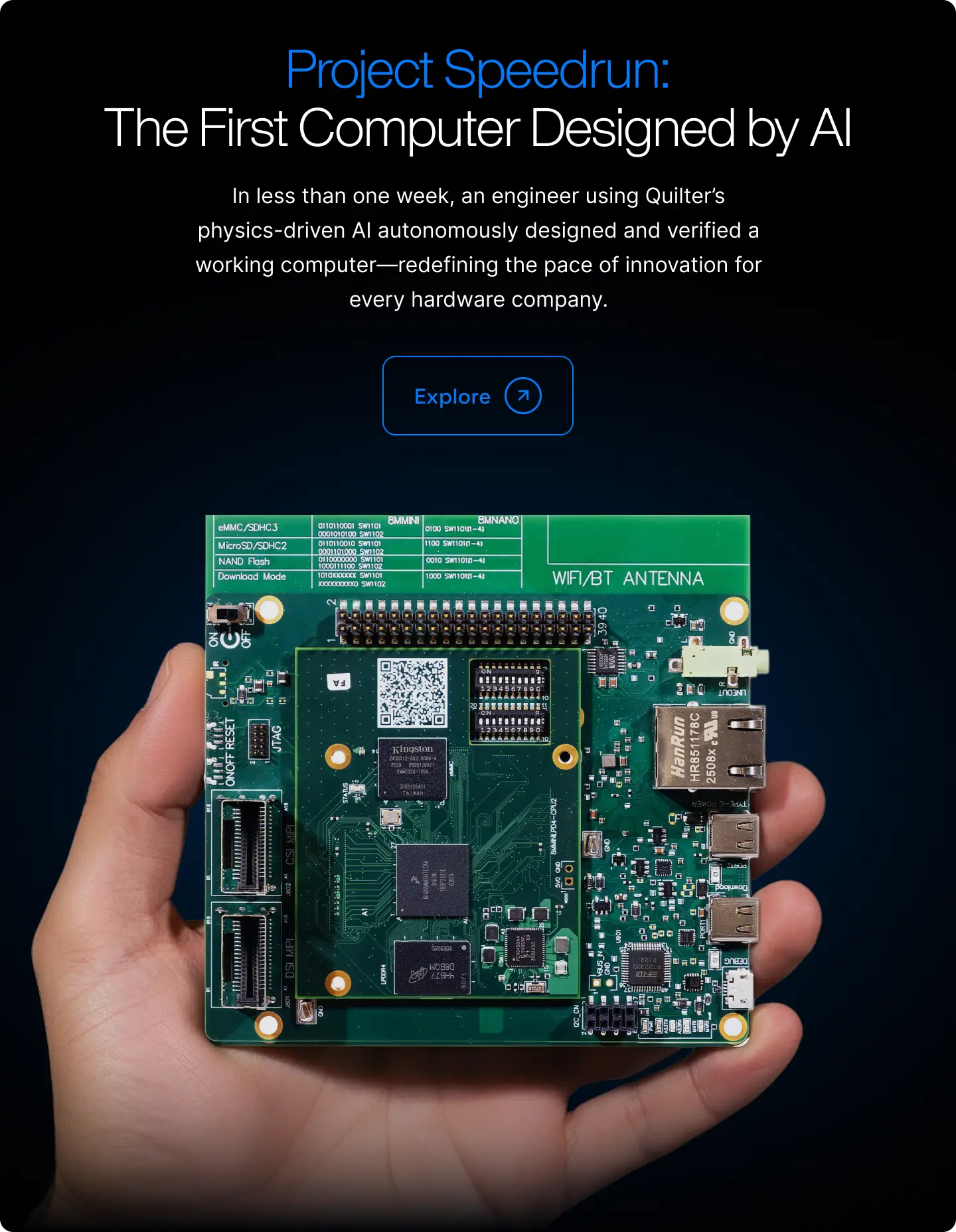
This article is one part of a walkthrough detailing how we recreated an NXP i.MX 8M Mini–based computer using Quilter’s physics-driven layout automation.
If you have ever spent a late night exporting Gerbers, wrangling drill files, and re-checking layer stacks before a board build, you already know the annoying truth: PCB file prep is where momentum goes to die. Quilter flips that part of the workflow. Instead of treating manufacturing outputs as a manual, error-prone “last step,” Quilter treats them as a first-class product output, generated from the same constraints and physics checks that produced the layout in the first place.
This post walks through what “fab files” actually means in PCB manufacturing, how Quilter turns AI PCB layout into a manufacturer-ready release package, and how to upload that package to popular fabs without the usual back-and-forth. It is written to help engineers searching for tools that automatically generate fab files, and it is practical enough for you to follow during your next release.
Let’s define what “fab files” really mean in PCB manufacturing
In PCB land, “fab files” usually means the complete set of manufacturing files a board house needs to fabricate your bare PCB, plus the files your assembler needs to populate it. People use the term loosely, so it is worth being explicit before discussing automation.
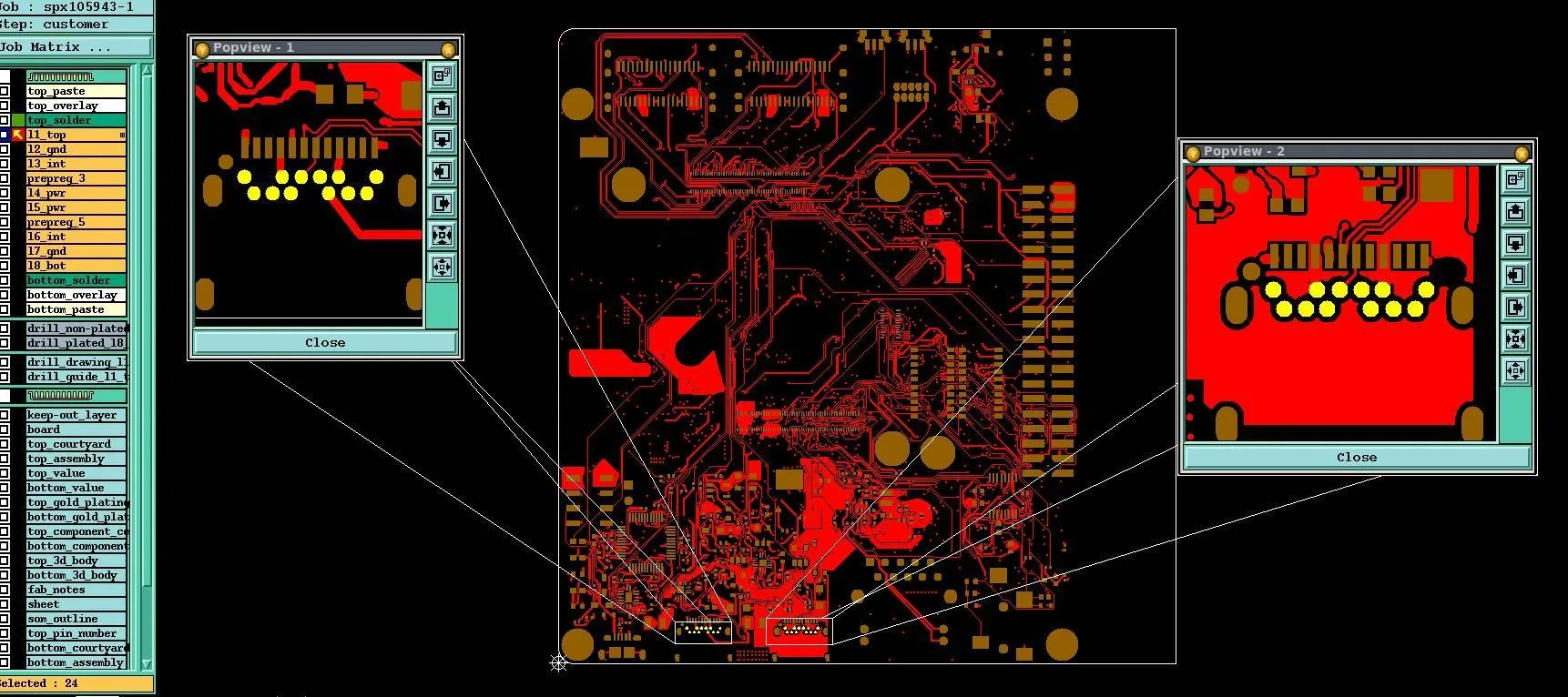
At a minimum, a PCB fabrication package includes Gerber files (for copper, solder mask, silkscreen, and board outline) and an NC drill file (for plated and non-plated holes). Many manufacturers also accept richer formats such as ODB++ or IPC-2581, which can capture more intent in a single container rather than a folder of separate layer plots. On the assembly side, you typically include pick-and-place (centroid) data and a bill of materials (BOM), and often add a PDF fabrication drawing or notes clarifying stackup, impedance, tolerances, and special instructions.
You might also hear “fab files” used in mechanical contexts, where it can mean DXF for laser cutting, STEP for machining, or G-code for CNC. Those are real “fabrication files,” but they are a different universe. This article focuses on PCB manufacturing files: Gerber automation, drill automation, and a repeatable fab package that you can hand to a PCB manufacturer with confidence.
Why does automation matter here? Because every manual export step is a risk of shipping the wrong thing. Incorrect drill units, swapped inner layers, missing solder mask openings, outdated BOM, misaligned board outline, or a forgotten impedance note can all lead to schedule slips. Automatic fab file generation is not just a convenience feature. It is a reliability feature.
How does Quilter turn AI-assisted layouts into ready-to-fabricate files?
Quilter’s core premise is simple: the fastest hardware teams are the ones that iterate more, and iteration only works if every iteration can actually be built. That is why Quilter positions itself around physics-driven PCB automation and a workflow that fits into the CAD tools engineers already use.
Here is the practical arc from “AI PCB layout” to “ready-to-fabricate files”:
- You start with real design intent, not a blank board. Quilter is designed to work with your existing workflow: you bring your project in, define the board outline, pre-place connectors, and set constraints. Those constraints are the boundary conditions that determine whether a layout is meaningful, especially for high-speed, power integrity, and sensitive interfaces.
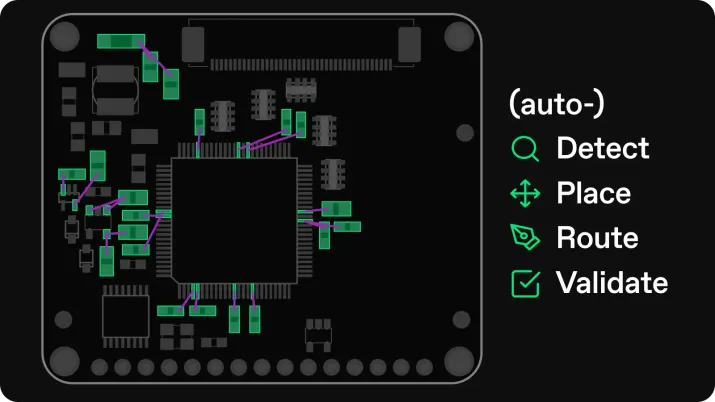
- Quilter generates layout candidates fast, then validates them as an engineer would. The goal is not “one layout.” The goal is “more layouts, faster,” so you can compare tradeoffs across placements, routing topologies, or manufacturing assumptions. As candidates are generated, Quilter identifies and accounts for PCB realities that commonly derail automatic routing efforts: bypass capacitors, impedance-controlled nets, differential pairs, and other critical considerations that must be treated as first-order constraints, not afterthoughts.
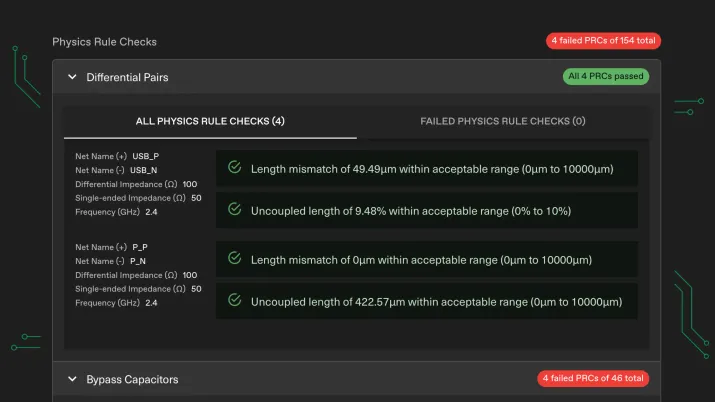
- Transparent review, then a clean handoff. A key difference between “automation you trust” and “automation you babysit” is visibility. Quilter emphasizes transparent design review by evaluating each layout against the complete list of physical constraints you provided and highlighting what is full and what needs attention. That matters because manufacturing outputs are only as good as the underlying design checks.
- One-click, consistent outputs. Once you select a candidate and complete final checks, the fab file generation becomes a repeatable release step. The point is not that Gerbers are hard to plot. The fact is that every team wants the same thing: a consistent, complete package that is regenerated the same way every time, without a checklist taped to someone’s monitor.
In other words, Quilter’s automation story is not “AI draws traces, then you still do the manufacturing grind.” It is “constraints plus physics checks produce a layout you can trust, and the same intent produces a standardized manufacturing package you can submit.”
Here’s what you get in every Quilter fab package
Below is the standard set of PCB manufacturing files engineers expect in a complete release. The exact mix varies by manufacturer, but this list is what most teams mean by “automatic fab file generation” in PCB workflows.
- ✅ Gerber RS-274X (copper, mask, silk, outline)
- These are the plotted layer images used by board houses to image copper, solder mask, and silkscreen. Using RS-274X means the files are self-contained, with embedded apertures, reducing CAM ambiguity.
- ✅ Excellon NC Drill
- This specifies hole locations, tool sizes, and plating intent (often via separate plated and non-plated drill outputs). Drill accuracy issues are a classic source of build failures, so consistency matters.
- ✅ ODB++
- A database-style manufacturing output that can capture layers, drills, netlists, and more in a structured container. Many manufacturers prefer it for reducing interpretation errors.
- ✅ IPC-2581
- Another structured manufacturing format that can carry richer design intent than raw Gerbers, and is used by many modern CAM pipelines.
- ✅ Pick-and-place (centroid) file
- Used by assemblers to place components correctly. It usually includes the reference designator, X/Y coordinates, rotation, and side of the board.
- ✅ Bill of Materials (BOM)
- Parts list with quantities, reference designators, manufacturer part numbers, and approved alternates as needed. This is where you prevent “we substituted the wrong regulator” surprises.
- ✅ PDF fabrication drawing and notes
- Human-readable notes for stackup, impedance targets, solder mask color, surface finish, controlled depth milling, via fill, and any “do not” items you want locked down.
- ✅ Optional manufacturing helpers
- Netlist for CAM comparison, assembly drawings, and other outputs that make DFM and quoting faster, depending on your board house and assembly partner.
Compatibility note: most PCB manufacturers accept Gerber plus Excellon as the baseline, and many also accept ODB++ or IPC-2581. If you are ordering from popular prototype fabs such as JLCPCB or PCBWay, you typically upload a zipped archive containing the standard layer plots and drill data, then confirm your options in the portal.
Why does one-click fab file generation matter for engineers?
Engineers do not hate exporting files because clicking “Plot” is hard. They dislike it because file preparation is where minor inconsistencies become costly. The more frequently you build boards, the more you feel the pain:
- The layout changed, but the fab drawing still references the old stackup.
- The plated and non-plated drills got combined incorrectly.
- The outline layer was missing, so the board house guessed.
- The pick-and-place file uses a different origin than the Gerbers.
- Someone forgot to include the impedance table, so the CAM engineer emails you two days later.
One-click fab file generation is really about repeatability. If your manufacturing outputs are generated the same way every time, from the same source-of-truth design constraints, then the team stops relying on “tribal knowledge” to ship a build. That improves handoff reliability, especially for teams where the person doing exports is not the same person who set the constraints, or where releases happen at 2 a.m. before a demo.
It also directly impacts iteration speed. Quilter’s broader message is “iterate more” because more design cycles usually wins. But iteration only works if each iteration can be shipped as a clean package with no additional overhead. Automatic fab file generation is a force multiplier for that mindset: fewer manual steps, fewer opportunities for mismatch, and faster time from “candidate selected” to “order placed.”
A practical way to think about it: AI PCB layout is the front half of the acceleration curve. Automated PCB manufacturing files are the back half. If either half is slow, the whole loop is slow.
What’s the workflow for submitting Quilter files to manufacturers?
The fastest path from “AI layout” to “boards on a desk” is a workflow that is boring in the best way: it is the same every time. Here is the standard flow you can use with Quilter outputs, and it maps cleanly to how manufacturers expect to receive data.
Visual workflow flowchart
+-------------------+ +------------------+ +------------------------+ +---------------------------+
| AI Layout in | --> | Final Review | --> | Generate Fab Package | --> | Upload to Manufacturer |
| Quilter | | + DRC checks | | (one click) | | (JLCPCB, PCBWay, etc.) |
+-------------------+ +------------------+ +------------------------+ +---------------------------+
Step-by-step process
Step 1: AI Layout in Quilter
Start with your imported project and define what matters: board outline, connector placement, keepouts, diff pairs, impedance rules, and any mechanical constraints—the more explicit your constraints, the more meaningful the output.
Step 2: Final review and DRC
Before you generate manufacturing outputs, do a final pass that matches how you actually ship boards:
- Verify diff pair constraints, length matching, and impedance rules.
- Check power distribution, decoupling placement, and return paths.
- Confirm mechanical clearances at connectors and mounting holes.
- Run DRC in your native CAD environment if you are polishing there.
This is also where you decide what is “locked” for manufacturing: stackup, drill sizes, via types, surface finish, solder mask, and controlled impedance requirements.
Step 3: Generate Fab Package
Generate the release package as a single output step to keep the complete set in sync. The goal is for the package you send to be constantly “complete,” not “a folder of exports we hope includes everything.”
Step 4: Download the zipped archive
Manufacturers usually want a zipped file. Keep the archive name consistent, like:
- ProjectName_RevA_Date.zip
- ProjectName_RevB_ImpedanceUpdate.zip
Consistency helps when reordering builds or comparing revisions.
Step 5: Upload to the manufacturer portal
Upload the zip to your chosen board house. Most portals will render a preview. Use it.
- Confirm the outline looks correct.
- Confirm drills appear and align to pads.
- Check that solder mask openings and silkscreen look sane.
- Verify copper layers are not mirrored or swapped.
Practical tips that prevent avoidable emails
- Always include an outline layer (even if the portal can infer it). Portals guessing outlines are how boards come back the wrong size.
- Be explicit about plated vs non-plated holes. If you use slots or tooling holes, call them out in the fab notes.
- Document your stackup assumptions. If your build depends on impedance, specify the target impedance and tolerance, not just “controlled impedance.”
- Confirm origin consistency between centroid and Gerbers if you are assembling.
- Use the portal preview like a mini DFM review. It is the quickest sanity check you will ever do.
What results can you expect from automated fab file generation?
The most reliable benefit is not a headline number. It is a reduction in build friction. When manufacturing outputs are generated automatically and consistently, three things happen.
First, file prep stops being a bottleneck. Instead of a late-stage scramble, fab package generation becomes a standard release step. That is particularly valuable for small teams where a single engineer handles design, validation, procurement, and build coordination.
Second, errors become easier to prevent and easier to trace. If a manufacturer flags an issue, you can reproduce the exact release package for that revision and confirm what was sent. That beats the classic scenario where one engineer exported Gerbers on Monday and another exported drills on Thursday.
Third, iteration becomes less scary. Teams often avoid doing “one more layout tweak” because it means “one more export session.” If automatic fab file generation removes that overhead, you are more likely to run extra design cycles, explore alternate placements, and converge on a better board before you burn money on builds.
If you want a simple way to quantify impact internally, measure two time buckets across a few builds:
- Time spent on manufacturing outputs (exporting, naming, zipping, checking portal previews, responding to CAM questions)
- Time lost to rework caused by file mismatch (wrong revision, missing note, incorrect drill assumptions)
Even if you never publish those numbers, they will tell you whether your team’s bottleneck is layout, manufacturing prep, or the handoff itself.
Ready to accelerate your hardware development?
If your team is searching for tools that automatically generate fab files, you are really looking for a tighter loop: AI PCB layout that respects constraints, plus PCB manufacturing files generated consistently enough to ship without issues. Quilter is built around that idea, from physics-driven design review to a seamless board handoff that fits into the CAD tools you already use.
To go deeper, here are the Quilter resources engineers typically want for implementation details:
Try Quilter for free, request a personalized demo, or reach out to Quilter’s engineering support team to see automatic fab file generation in action for your specific stackup, manufacturer, and constraints.


.webp)