






Read the Full Series
This article is one part of a walkthrough detailing how we recreated an NXP i.MX 8M Mini–based computer using Quilter’s physics-driven layout automation.
If you’ve ever wondered whether upgrading your PCB CAD tool is really the answer to scaling your design process, you’re not alone. For most teams, “PCB design expansion” starts as a shopping list: move up from KiCad, buy Altium, add a better SI tool, hire another layout engineer. It helps, until it doesn’t.
In 2026, the bigger shift is not another feature set. It’s a new workflow: AI that turns layout into something you can generate, compare, and validate quickly, while you stay in control of constraints, interfaces, and intent. That is what expansion looks like when time-to-board matters more than time-in-tool.
This post breaks down the old upgrade path, where it hits a wall, and how AI PCB tools like Quilter change what a small team can ship. Quilter positions itself as a physics-driven system that works with native CAD projects and returns outputs you can finish in your existing toolchain. (Quilter.ai)
Let’s define what “expanding” your PCB workflow really means
Expansion is not one thing. Engineers use the word when they mean very different problems:
Sometimes “expansion” means harder boards: more layers, tighter density, faster interfaces, more power integrity risk, stricter impedance control, and less margin for routing mistakes. Differential pair routing that felt simple on a 4-layer board starts to feel like a puzzle box on 10 layers with tight keepouts and real return-path constraints.
Other times it means more throughput: you need to run more spins, support more parallel projects, or keep hardware moving like software. Your bottleneck is not whether your CAD can do length tuning. Your bottleneck is that the process only produces one good candidate per week, so you never explore the design space.
And then there’s team-scale expansion: library hygiene, BOM accuracy, manufacturability checks, review cycles, change control, handoffs to CM, and the fact that “tribal knowledge” becomes a risk when the one person who knows the rules is out sick.
True workflow expansion is when you can:
- Generate viable layouts more often
- Catch issues earlier, before fab
- Keep constraints explicit and reviewable
- Increase engineering bandwidth without adding headcount
That is the core promise behind modern PCB automation: multiply output, not just features.
What are the limits of traditional PCB tool upgrades?
Direct answer: Upgrading CAD increases capability, but it rarely removes the manual work that limits speed, iteration count, and consistency.
Moving from KiCad to Altium, OrCAD, Allegro, or Xpedition can be the right call. You get stronger constraint systems, tighter integration, and mature enterprise flows. The upgrade is real.
But three limits show up fast.
1) More features can mean more overhead.
Advanced tools let you encode more rules, but someone still has to define them, manage them, and debug why a router or DRC is unhappy. You trade “missing feature” problems for “complex setup” problems. That is not a bad trade when you are doing DDR, multi-gig links, or safety-critical work. It is a bad trade if your team is trying to ship prototypes quickly and cannot afford a slow ramp.
2) Layout remains labor.
Even in top-tier stacks, routing dense constraints is still a human time sink: pass after pass, tune after tune, fix after fix. If you are honest, much of the time cost is not “routing a net.” It is context switching, avoiding rework, and handling the 50 small decisions that pile up.
3) Tool upgrades do not automatically increase iteration count.
Most teams upgrade because they want speed. Then they discover that speed also depends on staffing, review cadence, library quality, and how often the board is blocked on layout. If you still only get one candidate per cycle, you still learn slowly.
This is why “best tools for PCB design expansion” is a trick question if you only answer with CAD names. CAD matters, but it is not where the biggest multiplier lives anymore.
Here’s how automation is changing the game for PCB designers
Before AI came into the conversation, the practical path to “more output” looked like scripting, plugins, and workflow glue.
In KiCad, Python scripting and community tooling can automate tasks like BOM exports, panelization, and certain repetitive edits. In Altium, scripting and add-ons can speed up library operations, checks, and documentation work. That kind of automation is real value.
But it comes with two problems that experienced teams know well:
Automation is fragile.
Scripts depend on APIs that change. Plugins break after tool updates. The person who wrote the script becomes the maintainer. If the payoff is small, the script gets abandoned. If the payoff is big, the script becomes a product inside your company.
Automation is still expertise-heavy.
To automate a real layout task, you need to understand the CAD’s data model, coordinate systems, rule objects, and how the router behaves. Even in cases where differential pair routing is supported interactively, the minute you try to automate a non-trivial scenario, you are back in the weeds. Community discussions around differential pair workflows show how quickly things get complicated when you push beyond “happy path” routing. (KiCad.info Forums)
So yes, automation helps. But the ceiling is clear: scripting reduces time spent on a few steps. It does not usually produce more complete, valid board candidates with less effort.
That is the gap AI PCB tools are trying to close.
How much time can AI-powered PCB tools actually save?
Direct answer: AI can save time in two ways: it reduces hands-on layout time and it increases the number of viable candidates you can generate per cycle.
Time savings are not only about minutes. They are also about cognitive load. If you spend two hours fighting constraints, you lose the rest of the afternoon. If you get a clean candidate quickly, you spend that afternoon doing the work that only humans can do: architecture tradeoffs, interface decisions, risk review, and test planning.
Let’s make this tangible with a real scenario: differential pair routing across a dense multi-layer board.
The “manual automation” route (KiCad + Python)
KiCad supports differential pair routing as a feature, and there are plenty of guides for doing it well. (DigiKey) But the moment you try to automate a specific routing pattern or enforce a custom routing strategy, you are often looking at scripting and iterative testing.
Here is a simplified, illustrative pseudocode sketch of what “I’ll automate this” can turn into. This is not copy-paste production code. It’s a “shape of the work” example that mirrors the steps you end up implementing and debugging:
# PSEUDOCODE: illustrative only
# Goal: route a diff pair (DP/DM) through a channel with constraints and basic length control
board = pcbnew.GetBoard()
dp = board.FindNet("USB_DP")
dm = board.FindNet("USB_DM")
rules = {
"width_mm": 0.15,
"gap_mm": 0.15,
"via_drill_mm": 0.20,
"target_diff_ohms": 90,
"max_skew_ps": 10
}
channel = load_keepout_polygon("usb_channel_keepout.json")
start = find_pad("U2", "DP")
end = find_pad("J1", "DP")
# 1) Create a path that avoids keepouts and respects layer preferences
path = autoroute_path(start, end, avoid=channel, preferred_layers=[1, 2, 3])
# 2) Generate paired segments with spacing rules
dp_track, dm_track = make_diff_pair_tracks(path, rules["width_mm"], rules["gap_mm"])
# 3) Insert vias where needed and validate clearances
insert_vias_if_needed(dp_track, dm_track, drill=rules["via_drill_mm"])
run_drc(board)
# 4) Measure lengths and tune to skew target
skew = measure_skew(dp_track, dm_track)
if skew > rules["max_skew_ps"]:
add_serpentine_tuning(shorter_track(dm_track, dp_track), target_skew=rules["max_skew_ps"])
# 5) Re-run DRC and export for review
run_drc(board)
save_board("candidate_01.kicad_pcb")
Even if you are an experienced engineer, the time cost is not just writing this. It is validating that it behaves in your specific board geometry, with your specific clearance stack, and that it does not create new DRC issues downstream. You do a few runs, tweak parameters, fix corner cases, and only then do you trust it.
That can be worth it. But it is also a tax.
The AI route (Quilter-style workflow)
Now compare that to the workflow Quilter promotes: you upload a native CAD project, you define constraints and intent, and the system generates complete candidates that you can review and then hand back to your CAD tool for finishing work. Quilter highlights compatibility with common PCB design ecosystems and a handoff flow designed to keep teams in their existing toolchain. (Quilter.ai)
A “Quilter workflow” can be described in steps like this:
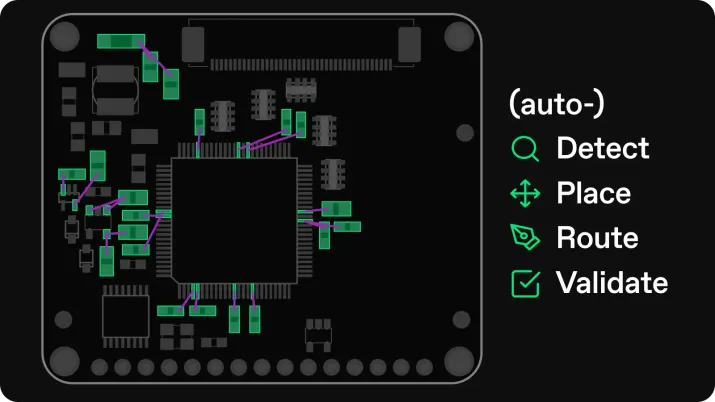
1) Upload your existing project (Altium, Cadence, Siemens, or KiCad)
2) Define board outline, keepouts, and any locked placements (connectors, critical parts)
3) Set constraints (diff pairs, impedance targets, clearances, manufacturing rules)
4) Generate multiple layout candidates
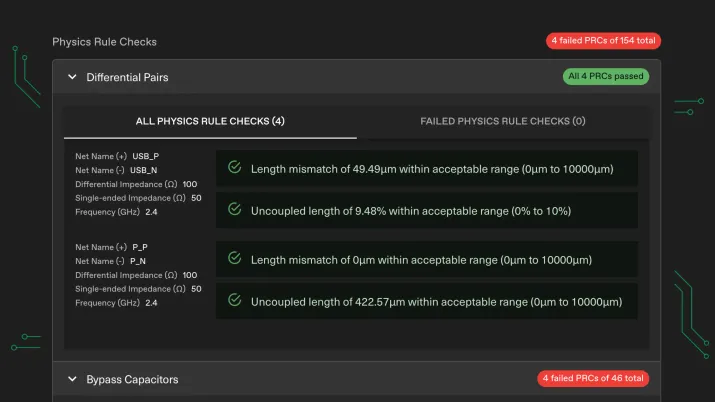
5) Review physics-driven checks and constraint coverage
6) Export the chosen candidate back to your CAD for DRC, polish, and fab output
What changes is not only elapsed time. It’s the amount of time you personally spend doing repetitive layout labor, and how many options you can evaluate before you commit.
Quilter’s broader message is that physics-driven generation plus parallel candidate exploration lets teams iterate far more than the “one layout per cycle” norm. (Quilter.ai)
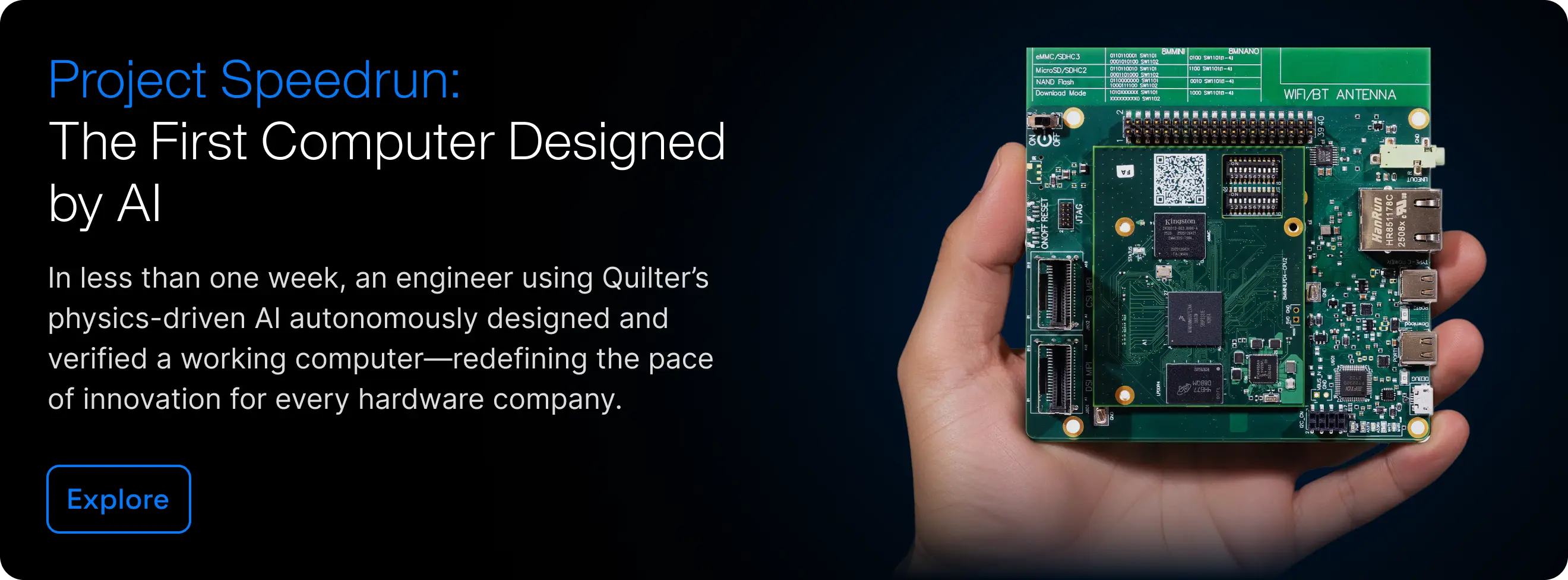
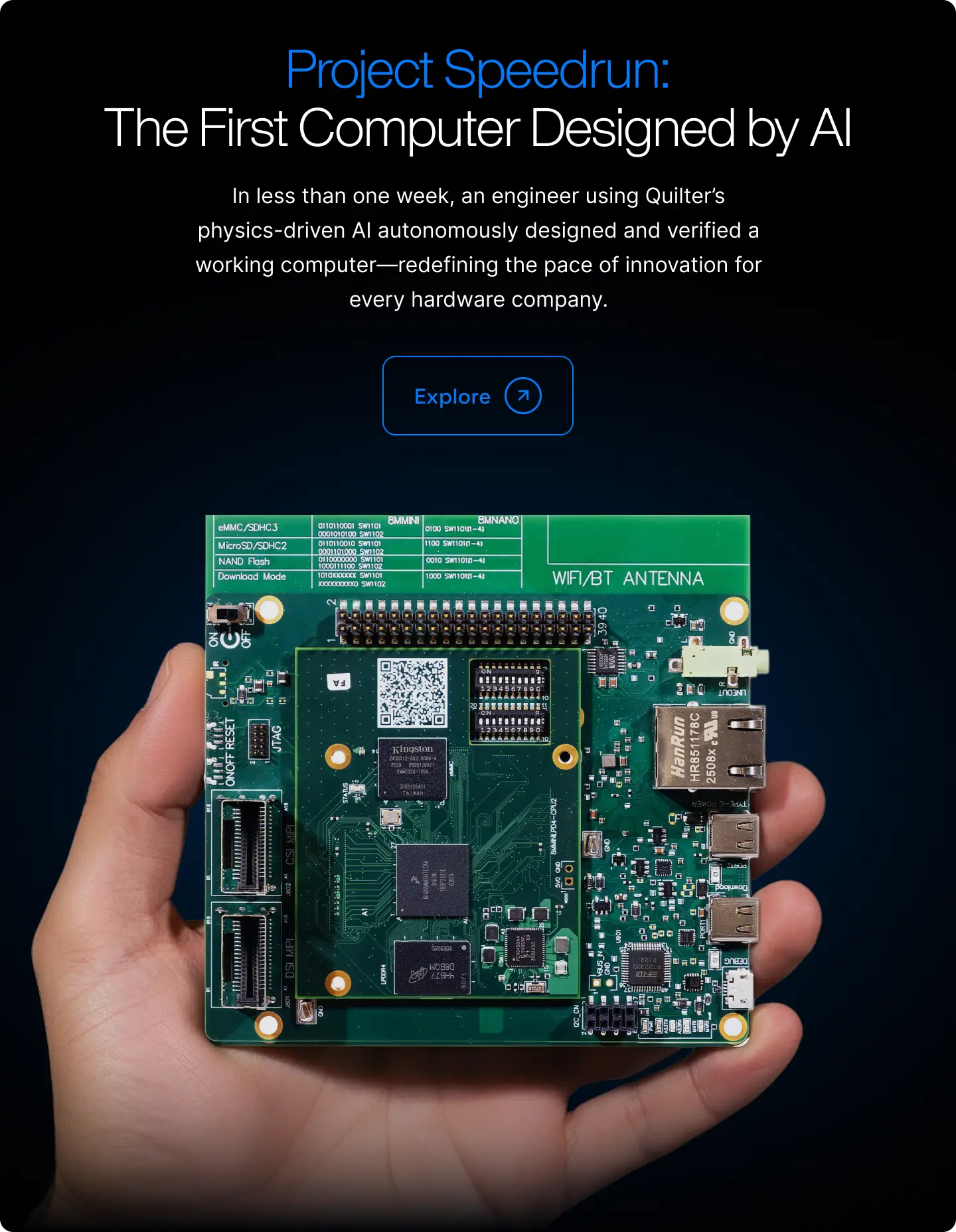
If you want a concrete reference point for “AI can compress schedule,” Quilter’s Project Speedrun page frames the idea as moving from slower layout cycles to faster learning loops. (Quilter.ai)
What results can you expect when you add AI to your workflow?
This is the part that matters if you are a lead or a founder: what actually improves in the real world?
1) More iteration, earlier learning
When layout stops being a multi-week bottleneck, you run more design experiments. Try a different connector orientation. Try a different stackup. Try a different decoupling strategy. Not because it is fun, but because it reduces risk. Many teams fail not because they lacked a feature, but because they did not learn early enough.
2) Better constraint discipline
AI workflows push you to make constraints explicit: what is locked, what is flexible, what is critical, and what can be traded. That is healthy engineering. Even if you never adopt AI, that style of constraint-first thinking improves team communication.
3) Engineering bandwidth comes back
When the “execution phase” is less of a grind, engineers spend more time on architecture, bring-up, test coverage, and reliability work. Quilter markets this as freeing designers for high-value tasks while the system handles the heavy layout lift. (Quilter.ai)
4) A different relationship with risk
The usual prototype risk is not “we made one mistake.” It is “we never explored the better layout because we could not afford the time.” If AI makes the cost of exploring lower, you are less likely to ship the first acceptable option when a better one exists.
A useful mental model is this: CAD upgrades help you do harder work. AI helps you do more work and explore more options, faster.
Here’s what to look for as you scale your PCB design process in 2026
If your goal is “best tools for PCB design expansion,” you want to evaluate tools as a stack, not a single purchase. CAD is still your system of record. The question is what multiplies output around it.
Here’s what I would look for when evaluating AI PCB tools in a real team:
- Native CAD compatibility: Can you start from your real project files and end with files you can finish in your existing CAD flow? Quilter emphasizes upload and handoff compatibility as a core requirement. (Quilter.ai)
- Constraint-first controls: Can you lock critical placements, set keepouts, and define real rules for diff pairs, impedance, and manufacturing constraints?
- Transparent review: Does the tool show what it did and why, so your team can review like engineers, not like passengers?
- Multiple candidates, not one result: Expansion is about parallel exploration. If the tool produces only one board, you are still stuck in a single-threaded workflow. Quilter’s product messaging leans into “dozens of layouts” and ranked candidates. (Quilter.ai)
- DFM and reality checks: The tool should respect manufacturing constraints, not just draw pretty routes. Quilter positions its system as physics- and manufacturing-aware. (Quilter.ai)
- Team workflow fit: How does it plug into version control, design reviews, and your release process? If it creates friction, adoption will fail.
Checklist for scaling your PCB workflow in 2026:
- Does the tool support your native CAD files (Altium, Cadence, KiCad, and more)?
- Can it automate complex tasks like differential pair routing and impedance control?
- Does it provide transparent, physics-based design review?
- Will it help your team iterate faster without sacrificing quality?
If you want to explore Quilter specifically, start with their Product Overview and then choose either the free tier or a demo depending on your use case:
Conclusion & Next Steps
In 2026, “expansion” is not just upgrading CAD. It’s increasing the number of high-quality layout candidates you can produce, review, and learn from, without burning your team out. Traditional tools help you do advanced work. AI tools help you do more work, faster, with less drag.
Ready to see what AI-powered PCB design looks like? Try Quilter’s free version or schedule a demo with their engineering team:


.webp)