


Gen AI

Published

Written by

Workbench

Beyond Teamwork: The New Era of Parallel PCB Design is Human-AI Collaboration

Published

March 2, 2026

When most engineers say “parallel PCB design,” they mean two things: more people editing the same board at once, or cleaner parallel routing for high-speed nets. Both help, but they don’t solve the core problem: a single human still has to grind through weeks of layout. Quilter introduces a third option: one engineer working in parallel with an autonomous, physics-driven AI that explores thousands of complete layouts in the time it used to take to finish one. 

If you are searching for software for parallel pcb design, you are probably not just hunting features. You are trying to compress schedule, reduce late surprises, and keep critical programs moving without turning layout into a long pole. This post defines what “parallel” means today, explains why it hits a wall, and lays out a practical path to a new model: human-AI collaboration where the engineer sets intent and constraints, and the AI does the heavy exploration work at machine scale.

Let’s define what “parallel PCB design” means today

Today, “parallel PCB design” usually means one of two things, and both are legitimate.

Meaning #1: Concurrent team editing. Multiple engineers or PCB designers work on the same project at the same time. Depending on the tool and workflow, that might look like partitioning the board into regions, coordinating ownership of placement and routing, or branching and merging changes through a managed design system. In practice, teams try to reduce calendar time by putting more hands on the same job: one person handles connectors and mechanical keepouts, another routes high-speed lanes, another cleans up power, another runs review and sign-off.

Meaning #2: Parallel trace routing. “Parallel” can also mean the actual copper: buses, differential pairs, and length-matched groups that need to run as clean bundles with controlled impedance and tight skew. Here the goal is not more people. There are fewer surprises: tidy topologies, predictable coupling, and routing structures that survive density without becoming a hand-tuned art project at 2 a.m.

Both meanings show up in real searches for parallel pcb layout and pcb team collaboration, and both are worth acknowledging because they reflect the realities of modern boards: tighter geometries, faster edges, more constraints, and less slack in the schedule.

But there is a common thread: in both definitions, humans remain the primary engine of layout effort. Even with collaboration features and smarter high-speed tooling, the throughput is still gated by manual decision making. When program pressure spikes, the real constraint is not “we need a better menu option in the router.” It is that the design space is too large to explore sequentially, one human decision at a time.

Quilter is designed to be additive to the CAD tools teams already trust. The intent is not to invalidate your Altium, Cadence, Siemens, or KiCad investment. The intent is to make those environments faster to get to a manufacturable, constraint-covered board by removing layout from the critical path. 

Callout box: The two traditional meanings of parallel PCB design
1) Concurrent editing:
multiple designers touching the same project at once.
2) Parallel routing: bundles, buses, diff pairs, length matching, and disciplined high-speed topology.
Both help. Both still rely on humans doing the majority of copper exploration.

Here’s why classic team workflows hit a wall

If concurrent editing solved the bottleneck, every program would just throw more people at layout. But in real teams, “more hands” can quickly turn into “more coordination.”

Merge conflicts and ownership boundaries. Parallel work requires boundaries: who owns what region, what net class, what placement group, what review gate. When the board is dense and the constraints are coupled, boundaries are artificial. Every time a connector shifts, a keepout changes, or the stack-up is updated, ownership lines blur and conflicts pile up. Even if your tool supports collaboration, the organization still needs process: rules, checklists, integration discipline.

Setup overhead and review bottlenecks. The more parallel the human workflow becomes, the more time the team spends managing the workflow. Someone has to prepare the layout strategy, coordinate block placement, keep net classes aligned, schedule reviews, and reconcile changes. In high-stakes programs, review does not disappear just because more people touched the board. In many cases, review expands because the risk surface expands.

Parallel traces still require sequential effort. High-speed routing features can speed up certain operations, but a person still has to make thousands of micro-decisions: escape strategies, via style, layer transitions, return path, plane splits, neckdowns, stitch strategy, pin swaps, constraint exceptions, and manufacturability tradeoffs. A bus can be routed “in parallel,” but the process of getting there is often a single human pushing copper through a crowded space for hours or weeks.

Iteration gets fragile as constraints grow. Shrinking geometries and higher speeds increase the cost of late discovery. The first layout path you choose can lock in assumptions that you only validate later: coupling you did not anticipate, hotspots near a connector, a DDR escape strategy that forces ugly detours, a power corridor that becomes unrouteable after a mechanical tweak. Manual iteration becomes increasingly brittle when you can only afford one or two complete passes before freezing.

Hidden costs show up in the lab. What looks like “we finished layout” can become “we pushed risk downstream.” Late-stage re-spins, blocked senior designers pulled into emergency cleanup, and rushed bring-up in the lab are symptoms of a design space that was not explored enough upstream. The schedule pain shows up where it is most expensive: after fabrication, when every day matters and every change is a re-spin.

The conclusion is not that teamwork is bad. The conclusion is that the bottleneck is not just the number of people. It is the fact that humans explore the decision space sequentially. True parallelism should focus on exploration itself, not simply more hands editing the same database.

What if parallel design meant you and an AI working side by side?

Now define a third meaning of parallel PCB design:

One engineer plus an autonomous AI exploring many complete layouts simultaneously.

This is the shift Quilter is built around. Instead of dividing a board into ownership zones, you divide the work into what humans do best and what machines do best.

  • The human defines intent: board outline, key placements, floorplan, constraint priorities, and the “must be true” requirements of the design.
  • The AI explores: placement refinements, routing strategies, tradeoffs across layer usage, via styles, density balancing, and constraint satisfaction across thousands of candidate boards.
  • The team selects and signs off: you review a ranked set of manufacturable candidates, choose the best, then polish and finalize in the CAD tools you already use. 

The mental model changes from “who owns which area of the board?” to “which candidate best meets our constraints and risk posture?” That is what parallel really means in an AI era: not parallel cursors, but parallel exploration of complete, viable solutions.

Callout box: Quilter’s third definition of parallel PCB design
Parallel design = parallel exploration.
You provide the constraints and the intent. Quilter generates and evaluates many complete layouts in parallel and returns a ranked set of candidates for engineering review. 

Diagram: Team-Based Parallelism vs AI-Powered Parallelism

Alt text: diagram comparing human-only concurrent PCB layout to Quilter AI parallel layout exploration

+---------------------------------------------------------------+

| Team-Based Parallelism                                        |

|                                                               |

|  [Designer A] cursor -> routes high-speed lanes               |

|  [Designer B] cursor -> places passives, cleans up power      |

|  [Designer C] cursor -> connector escape, mechanical edits    |

|                                                               |

|  Result: One board evolves sequentially through human edits   |

|  Risk: coordination overhead + limited exploration bandwidth  |

+---------------------------------------------------------------+

+---------------------------------------------------------------+

| AI-Powered Parallelism (Human-AI Collaboration)               |

|                                                               |

|  [Engineer] defines: outline + key placement + constraints     |

|                 |                                             |

|                 v                                             |

|         Quilter explores in parallel:                         |

|          Layout 1  Layout 2  Layout 3  ...  Layout N           |

|            |        |        |              |                  |

|         physics + DRC checks + constraint coverage scoring     |

|            |        |        |              |                  |

|                 v                                             |

|  Result: Ranked set of manufacturable candidates to review     |

+---------------------------------------------------------------+

If you are evaluating pcb ai design software or autonomous pcb layout tools, this distinction matters. Many tools help you do layout faster. Quilter is designed to change how many viable layouts you can consider before you commit.

Here’s how AI can explore thousands of layouts in parallel

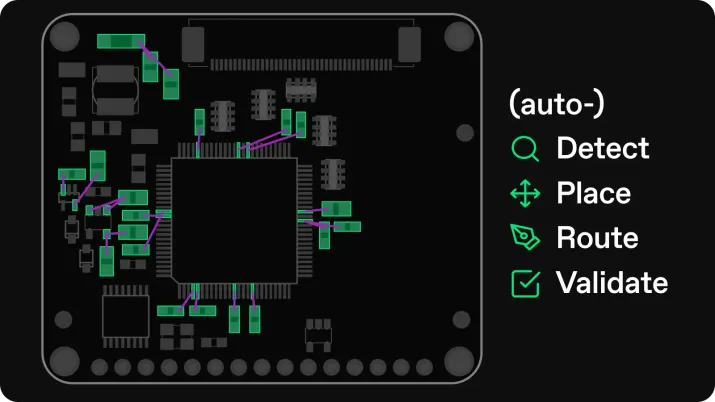
At a high level, Quilter uses reinforcement learning for pcb layout, trained on physics and manufacturing constraints rather than on human examples. The simplest way to think about it is this: the system proposes actions (place, route, adjust) and learns which sequences of actions lead to complete boards that satisfy constraints and manufacture cleanly. 

Parallel exploration: candidate boards, not partial suggestions

Traditional flows often feel like a single path: you pick a strategy, route the critical nets, then discover downstream consequences. Quilter flips that. It runs many strategies at once. Dozens of complete layouts are generated simultaneously and ranked for manufacturability and constraint coverage. 

Physics-aware checks during generation

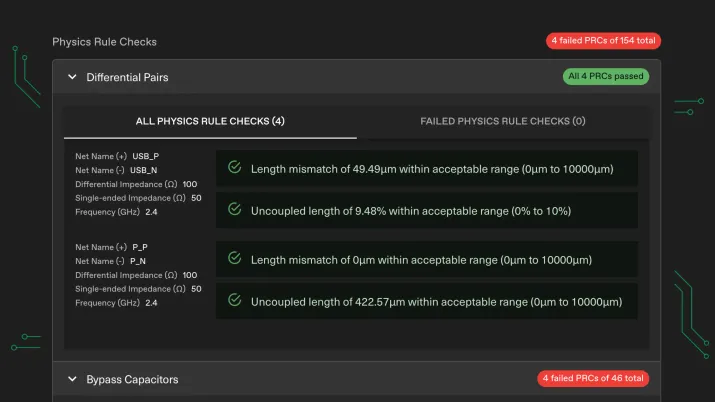
“Parallel” only helps if the results are meaningful. Quilter’s core claim is not just speed. It is physics-driven pcb design that validates key physical constraints while candidates are being generated, not only after you think you are done. That includes high-speed considerations like impedance-controlled nets, differential pairs, DDR length matching behavior, and clearances, with evaluation happening as part of the generation loop. 

Time to first candidates

For many board types, the promise is not “wait days and get an answer.” Quilter is designed so that first candidates often appear within the first hour, and complete candidate sets arrive in hours. 

Works with your existing workflow

A practical barrier to adopting new systems is rework: nobody wants to recreate constraints from scratch. Quilter is built to ingest existing projects from major EDA flows so teams can define the board outline, pre-place key components, and control constraints in familiar terms, then hand results back in the same format for DRC, polish, and fab outputs. 

What “parallel” looks like in the UI

Instead of one board that gradually becomes “done,” you get a ranked set:

  • Candidate layouts that differ in routing topology, layer usage, density distribution, and local tradeoffs.
  • Clear feedback on constraint coverage so you can see what is truly complete and what needs attention. 

That is the core value proposition behind software for parallel pcb design in the Quilter sense: you are not parallelizing labor. You are parallelizing exploration.

How does this change the day-to-day for layout and hardware teams?

This is where the human-AI collaboration model stops being abstract and starts being operational. The workflow shift is straightforward:

  1. Upload your existing CAD project. Start from a real design, not a demo board.
  2. Define outline and key placements. Pre-place connectors, mechanical anchors, and any “must stay” components, then specify floorplan intent.
  3. Review constraint understanding and launch parallel runs. Confirm what Quilter will account for, then generate candidates and review the ranked output. 

For PCB designers: from hand-routing to candidate curation

A strong designer’s value is not the ability to push every trace. It is judgment: constraint prioritization, manufacturability instincts, topology sanity, and cleanup that makes a board robust. In a human-AI model, designers spend less time grinding copper and more time:

  • selecting the candidate that best expresses the routing philosophy for that program,
  • refining the final details in the CAD environment,
  • running DRC, addressing edge cases, and preparing a clean handoff.

This is not “replace the designer.” It is “change what the designer spends time on.”

For electrical engineers: more variants before freeze

EEs often want to evaluate tradeoffs early, but they do not have the calendar time. With AI-powered parallel design, you can test assumptions upstream:

  • try multiple stack-ups to understand routing feasibility,
  • compare routing strategies for a sensitive interface,
  • explore alternate connector orientations or form factors,
  • see which constraints are hardest to satisfy before DVT freezes.

This is especially valuable in categories where teams routinely get stuck behind layout queues: test fixtures and harnesses, IC evaluation boards, and design validation boards. Quilter explicitly targets these bottleneck board types because speed and iteration matter and because these boards often delay programs disproportionally. 

For program leaders: more cycles without more seats

When layout is scarce, the default program behavior is to reduce iteration. You freeze earlier than you want and accept risk. Quilter’s pricing model is designed to let teams iterate without seat-based restriction, aligning with the idea that exploration should not be throttled by who has access. 

For program managers and R&D managers, the most practical change is this: you can schedule more layout cycles before deadlines without adding headcount and without waiting in a queue.

An anonymized mini-case: fixture board schedule compression

A representative example from late-stage validation hardware looks like this:

  • Traditional approach: A small fixture board enters the layout queue behind higher-priority production work. Even if the board is not massive, it competes for senior attention because it touches test strategy and lab readiness. Net effect: days to weeks of calendar time, plus risk that issues show up during bring-up.
  • Human-AI parallel approach: The team uploads the existing project, locks the outline and connectors, validates constraints, and runs parallel generation. Multiple candidates arrive quickly, the team picks the best, and a designer performs targeted cleanup and final sign-off. Net effect: faster path to a bring-up-ready board and fewer last-minute surprises.

The point is not that every board becomes trivial. The point is that schedule compression comes from replacing sequential exploration with parallel candidate generation.

What results can teams actually expect from AI-powered parallel design?

If you are evaluating autonomous pcb layout options, you should demand outcomes, not hype. The outcomes of Quilter positions around are clear.

1) Time compression from weeks to hours

For many use cases, teams report the shift from “layout is a multi-week phase” to “layout candidates arrive within a workday,” with first candidates often appearing within the first hour. 

2) A step-change in iteration volume

Parallel exploration means you can review dozens of candidates instead of committing to the first workable path. Quilter describes this as teams exploring dramatically more variants, enabled by multiple layouts being generated simultaneously and ranked for constraint coverage. 

3) Risk reduction through physics-driven evaluation

Late re-spins are often the price of insufficient exploration, not simply poor execution. Quilter’s emphasis on physics-aware validation during generation is aimed directly at this failure mode: catch constraint conflicts earlier, produce candidates that already account for critical physical requirements, and reduce lab surprises. 

4) Industry-specific benefits under schedule pressure

Different teams feel the bottleneck differently:

  • Semiconductors: validation and bring-up hardware is schedule-critical around tape-out and lab readiness. 
  • Consumer electronics: market windows punish slow iteration. 
  • Robotics: fast mechanical and system iteration means boards need to keep pace. 
  • Aerospace and defense: long validation cycles and compliance pressure make predictable iteration valuable. 

5) Not an autorouter, not a copilot

One last clarification that matters for credibility: Quilter positions itself as a fully autonomous PCB layout engine, not a traditional autorouter and not an LLM copilot. The difference is that the system generates complete candidate boards and evaluates them through physics and constraints, rather than providing isolated suggestions that still require humans to manually execute the majority of layout. 

Here’s how to try human-AI parallel design on your next board

The fastest way to evaluate software for parallel pcb design is to run a small, time-boxed pilot that mirrors your real workflow.

Pick a pilot board that fits in a week

Start with a board where time-to-layout matters and where your team can objectively compare outputs:

  • a test fixture or harness board 
  • an IC evaluation board 
  • a design validation board 

The goal is not to prove perfection. The goal is to prove speed, constraint coverage, and the value of candidate comparison.

Compare one manual path to multiple AI candidates

Run your baseline process as you normally would, then compare it to a Quilter run:

  • Trace quality and topology sanity in your CAD tool
  • Density distribution and routing cleanliness
  • Constraint coverage for high-speed nets and critical clearances
  • The number of viable alternatives you had to choose from

Because Quilter returns candidates in the same formats you already use, your validation workflow does not need to change: run DRC, polish, generate fab files, and proceed through your normal release gates. 

Involve the right three roles

A strong pilot review meeting includes:

  • a PCB designer (manufacturability and cleanup judgment)
  • the EE lead (constraint intent and interface risk)
  • the program or R&D owner (schedule, iteration, and decision-making)

When these three review candidates together, you get the core benefit of parallel exploration: faster and clearer tradeoffs.

Where to go next inside Quilter

To keep this practical, here are the pages that map directly to the steps above:

  • Product Overview: what Quilter generates and how physics-driven layout works 
  • Solutions: board types and workflows (start with test fixtures, IC eval, and design validation) 
  • Pricing: how usage scales and how teams iterate without seat limits 
  • Free Version: free access for eligible users to try autonomous PCB layout 

The bottom line

If you have been searching for parallel pcb layout tools because you need more throughput, the next step is not just better collaboration features. It is shifting to a model where parallelism means parallel exploration, powered by pcb ai design software that can generate and validate many complete layouts at once.

Upload an existing Altium, Cadence, Siemens, or KiCad project into Quilter and generate your first set of AI-designed, physics-validated layout candidates in hours, then review them side by side with your PCB designer and EE lead.

Try Quilter for Yourself

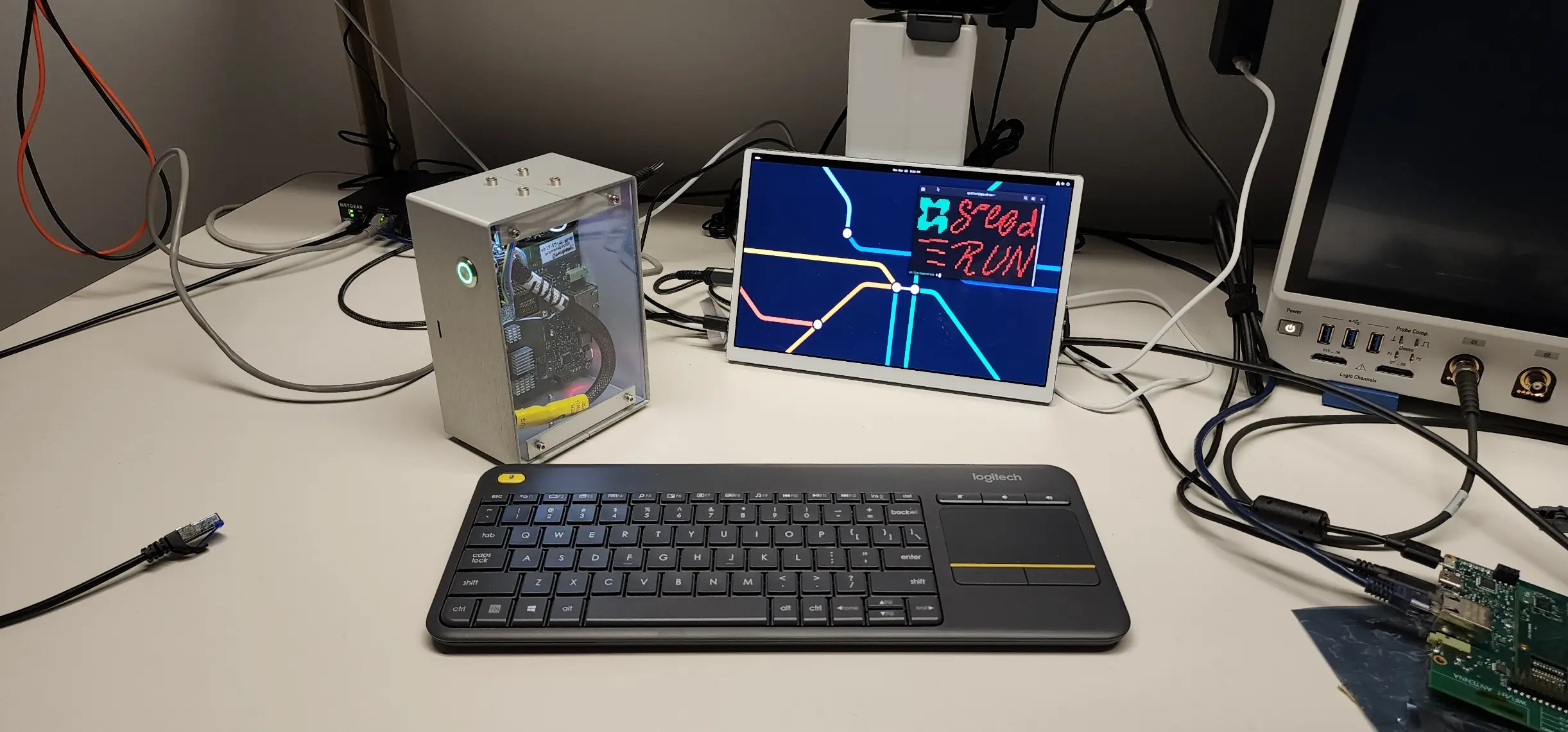
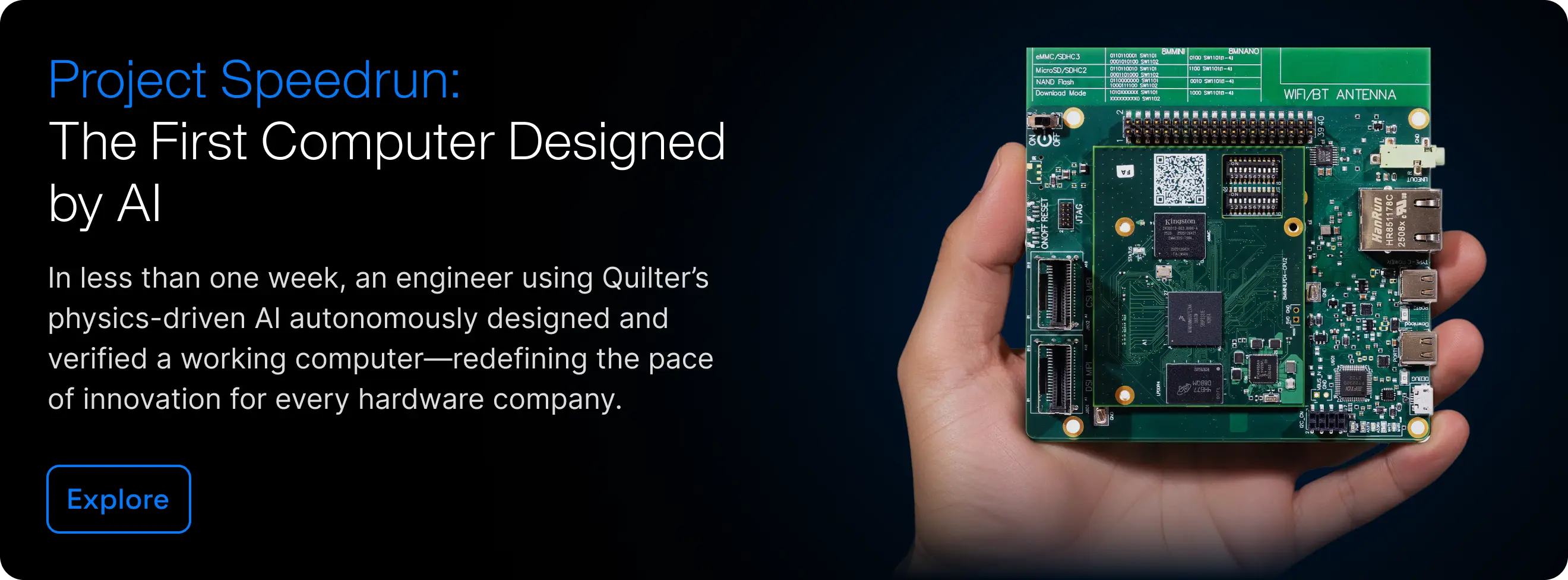
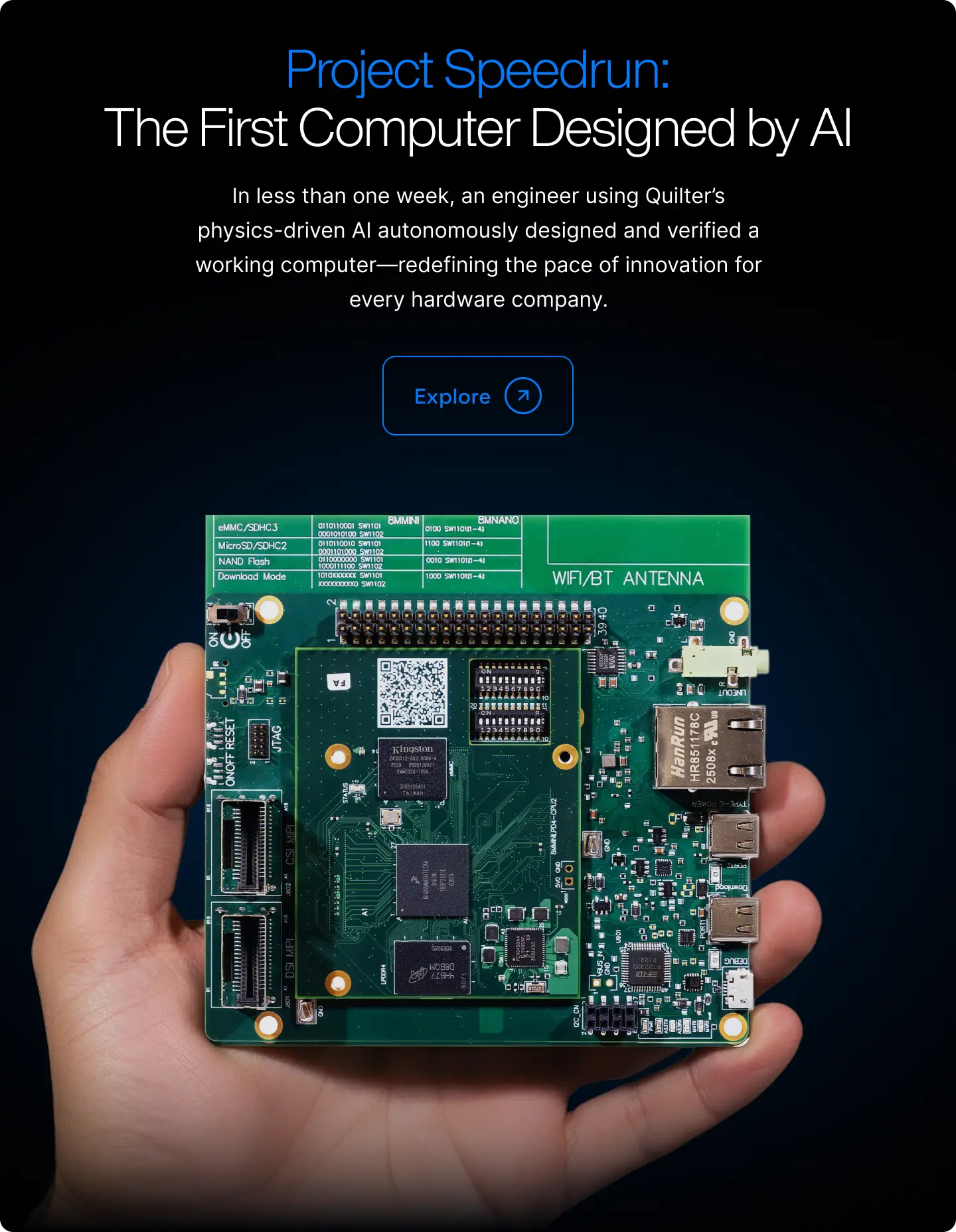
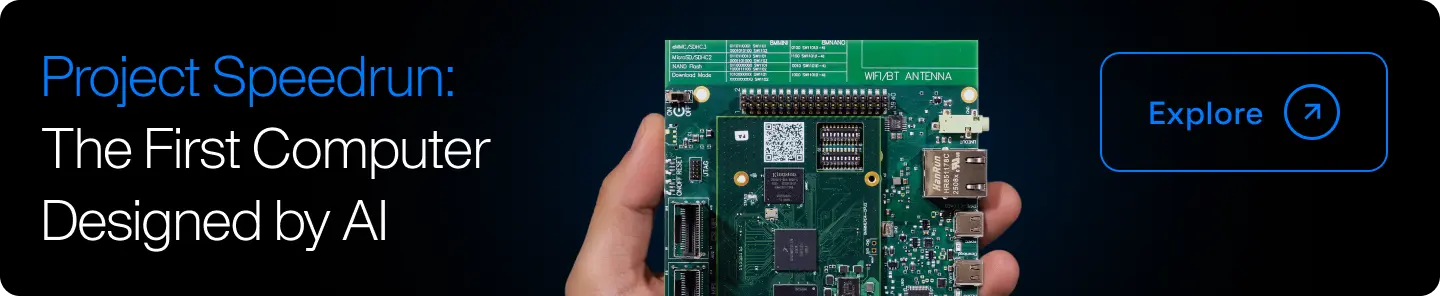
Project Speedrun demonstrated what autonomous layout looks like in practice and the time compression Quilter enables. Now, see it on your own hardware.

Get Started

Validating the Design

With cleanup complete, the final question is whether the hardware works. Power-on is where most electrical mistakes reveal themselves, and it’s the moment engineers are both nervous and excited about.

Continue to Part 4

Cleaning Up the Design

Autonomous layout produces a complete, DRC'd design; cleanup is a brief precision pass to finalize it for fabrication.

Continue to Part 3

Compiling the Design

Once the design is prepared, the next step is handing it off to Quilter. In traditional workflows, this is where an engineer meets with a layout specialist to clarify intent. Quilter replaces that meeting with circuit comprehension: you upload the project, review how constraints are interpreted, and submit the job.

Continue to Part 2

Beyond Teamwork: The New Era of Parallel PCB Design is Human-AI Collaboration

March 2, 2026
by
Sergiy Nesterenko
and

When most engineers say “parallel PCB design,” they mean two things: more people editing the same board at once, or cleaner parallel routing for high-speed nets. Both help, but they don’t solve the core problem: a single human still has to grind through weeks of layout. Quilter introduces a third option: one engineer working in parallel with an autonomous, physics-driven AI that explores thousands of complete layouts in the time it used to take to finish one. 

If you are searching for software for parallel pcb design, you are probably not just hunting features. You are trying to compress schedule, reduce late surprises, and keep critical programs moving without turning layout into a long pole. This post defines what “parallel” means today, explains why it hits a wall, and lays out a practical path to a new model: human-AI collaboration where the engineer sets intent and constraints, and the AI does the heavy exploration work at machine scale.

Let’s define what “parallel PCB design” means today

Today, “parallel PCB design” usually means one of two things, and both are legitimate.

Meaning #1: Concurrent team editing. Multiple engineers or PCB designers work on the same project at the same time. Depending on the tool and workflow, that might look like partitioning the board into regions, coordinating ownership of placement and routing, or branching and merging changes through a managed design system. In practice, teams try to reduce calendar time by putting more hands on the same job: one person handles connectors and mechanical keepouts, another routes high-speed lanes, another cleans up power, another runs review and sign-off.

Meaning #2: Parallel trace routing. “Parallel” can also mean the actual copper: buses, differential pairs, and length-matched groups that need to run as clean bundles with controlled impedance and tight skew. Here the goal is not more people. There are fewer surprises: tidy topologies, predictable coupling, and routing structures that survive density without becoming a hand-tuned art project at 2 a.m.

Both meanings show up in real searches for parallel pcb layout and pcb team collaboration, and both are worth acknowledging because they reflect the realities of modern boards: tighter geometries, faster edges, more constraints, and less slack in the schedule.

But there is a common thread: in both definitions, humans remain the primary engine of layout effort. Even with collaboration features and smarter high-speed tooling, the throughput is still gated by manual decision making. When program pressure spikes, the real constraint is not “we need a better menu option in the router.” It is that the design space is too large to explore sequentially, one human decision at a time.

Quilter is designed to be additive to the CAD tools teams already trust. The intent is not to invalidate your Altium, Cadence, Siemens, or KiCad investment. The intent is to make those environments faster to get to a manufacturable, constraint-covered board by removing layout from the critical path. 

Callout box: The two traditional meanings of parallel PCB design
1) Concurrent editing:
multiple designers touching the same project at once.
2) Parallel routing: bundles, buses, diff pairs, length matching, and disciplined high-speed topology.
Both help. Both still rely on humans doing the majority of copper exploration.

Here’s why classic team workflows hit a wall

If concurrent editing solved the bottleneck, every program would just throw more people at layout. But in real teams, “more hands” can quickly turn into “more coordination.”

Merge conflicts and ownership boundaries. Parallel work requires boundaries: who owns what region, what net class, what placement group, what review gate. When the board is dense and the constraints are coupled, boundaries are artificial. Every time a connector shifts, a keepout changes, or the stack-up is updated, ownership lines blur and conflicts pile up. Even if your tool supports collaboration, the organization still needs process: rules, checklists, integration discipline.

Setup overhead and review bottlenecks. The more parallel the human workflow becomes, the more time the team spends managing the workflow. Someone has to prepare the layout strategy, coordinate block placement, keep net classes aligned, schedule reviews, and reconcile changes. In high-stakes programs, review does not disappear just because more people touched the board. In many cases, review expands because the risk surface expands.

Parallel traces still require sequential effort. High-speed routing features can speed up certain operations, but a person still has to make thousands of micro-decisions: escape strategies, via style, layer transitions, return path, plane splits, neckdowns, stitch strategy, pin swaps, constraint exceptions, and manufacturability tradeoffs. A bus can be routed “in parallel,” but the process of getting there is often a single human pushing copper through a crowded space for hours or weeks.

Iteration gets fragile as constraints grow. Shrinking geometries and higher speeds increase the cost of late discovery. The first layout path you choose can lock in assumptions that you only validate later: coupling you did not anticipate, hotspots near a connector, a DDR escape strategy that forces ugly detours, a power corridor that becomes unrouteable after a mechanical tweak. Manual iteration becomes increasingly brittle when you can only afford one or two complete passes before freezing.

Hidden costs show up in the lab. What looks like “we finished layout” can become “we pushed risk downstream.” Late-stage re-spins, blocked senior designers pulled into emergency cleanup, and rushed bring-up in the lab are symptoms of a design space that was not explored enough upstream. The schedule pain shows up where it is most expensive: after fabrication, when every day matters and every change is a re-spin.

The conclusion is not that teamwork is bad. The conclusion is that the bottleneck is not just the number of people. It is the fact that humans explore the decision space sequentially. True parallelism should focus on exploration itself, not simply more hands editing the same database.

What if parallel design meant you and an AI working side by side?

Now define a third meaning of parallel PCB design:

One engineer plus an autonomous AI exploring many complete layouts simultaneously.

This is the shift Quilter is built around. Instead of dividing a board into ownership zones, you divide the work into what humans do best and what machines do best.

  • The human defines intent: board outline, key placements, floorplan, constraint priorities, and the “must be true” requirements of the design.
  • The AI explores: placement refinements, routing strategies, tradeoffs across layer usage, via styles, density balancing, and constraint satisfaction across thousands of candidate boards.
  • The team selects and signs off: you review a ranked set of manufacturable candidates, choose the best, then polish and finalize in the CAD tools you already use. 

The mental model changes from “who owns which area of the board?” to “which candidate best meets our constraints and risk posture?” That is what parallel really means in an AI era: not parallel cursors, but parallel exploration of complete, viable solutions.

Callout box: Quilter’s third definition of parallel PCB design
Parallel design = parallel exploration.
You provide the constraints and the intent. Quilter generates and evaluates many complete layouts in parallel and returns a ranked set of candidates for engineering review. 

Diagram: Team-Based Parallelism vs AI-Powered Parallelism

Alt text: diagram comparing human-only concurrent PCB layout to Quilter AI parallel layout exploration

+---------------------------------------------------------------+

| Team-Based Parallelism                                        |

|                                                               |

|  [Designer A] cursor -> routes high-speed lanes               |

|  [Designer B] cursor -> places passives, cleans up power      |

|  [Designer C] cursor -> connector escape, mechanical edits    |

|                                                               |

|  Result: One board evolves sequentially through human edits   |

|  Risk: coordination overhead + limited exploration bandwidth  |

+---------------------------------------------------------------+

+---------------------------------------------------------------+

| AI-Powered Parallelism (Human-AI Collaboration)               |

|                                                               |

|  [Engineer] defines: outline + key placement + constraints     |

|                 |                                             |

|                 v                                             |

|         Quilter explores in parallel:                         |

|          Layout 1  Layout 2  Layout 3  ...  Layout N           |

|            |        |        |              |                  |

|         physics + DRC checks + constraint coverage scoring     |

|            |        |        |              |                  |

|                 v                                             |

|  Result: Ranked set of manufacturable candidates to review     |

+---------------------------------------------------------------+

If you are evaluating pcb ai design software or autonomous pcb layout tools, this distinction matters. Many tools help you do layout faster. Quilter is designed to change how many viable layouts you can consider before you commit.

Here’s how AI can explore thousands of layouts in parallel

At a high level, Quilter uses reinforcement learning for pcb layout, trained on physics and manufacturing constraints rather than on human examples. The simplest way to think about it is this: the system proposes actions (place, route, adjust) and learns which sequences of actions lead to complete boards that satisfy constraints and manufacture cleanly. 

Parallel exploration: candidate boards, not partial suggestions

Traditional flows often feel like a single path: you pick a strategy, route the critical nets, then discover downstream consequences. Quilter flips that. It runs many strategies at once. Dozens of complete layouts are generated simultaneously and ranked for manufacturability and constraint coverage. 

Physics-aware checks during generation

“Parallel” only helps if the results are meaningful. Quilter’s core claim is not just speed. It is physics-driven pcb design that validates key physical constraints while candidates are being generated, not only after you think you are done. That includes high-speed considerations like impedance-controlled nets, differential pairs, DDR length matching behavior, and clearances, with evaluation happening as part of the generation loop. 

Time to first candidates

For many board types, the promise is not “wait days and get an answer.” Quilter is designed so that first candidates often appear within the first hour, and complete candidate sets arrive in hours. 

Works with your existing workflow

A practical barrier to adopting new systems is rework: nobody wants to recreate constraints from scratch. Quilter is built to ingest existing projects from major EDA flows so teams can define the board outline, pre-place key components, and control constraints in familiar terms, then hand results back in the same format for DRC, polish, and fab outputs. 

What “parallel” looks like in the UI

Instead of one board that gradually becomes “done,” you get a ranked set:

  • Candidate layouts that differ in routing topology, layer usage, density distribution, and local tradeoffs.
  • Clear feedback on constraint coverage so you can see what is truly complete and what needs attention. 

That is the core value proposition behind software for parallel pcb design in the Quilter sense: you are not parallelizing labor. You are parallelizing exploration.

How does this change the day-to-day for layout and hardware teams?

This is where the human-AI collaboration model stops being abstract and starts being operational. The workflow shift is straightforward:

  1. Upload your existing CAD project. Start from a real design, not a demo board.
  2. Define outline and key placements. Pre-place connectors, mechanical anchors, and any “must stay” components, then specify floorplan intent.
  3. Review constraint understanding and launch parallel runs. Confirm what Quilter will account for, then generate candidates and review the ranked output. 

For PCB designers: from hand-routing to candidate curation

A strong designer’s value is not the ability to push every trace. It is judgment: constraint prioritization, manufacturability instincts, topology sanity, and cleanup that makes a board robust. In a human-AI model, designers spend less time grinding copper and more time:

  • selecting the candidate that best expresses the routing philosophy for that program,
  • refining the final details in the CAD environment,
  • running DRC, addressing edge cases, and preparing a clean handoff.

This is not “replace the designer.” It is “change what the designer spends time on.”

For electrical engineers: more variants before freeze

EEs often want to evaluate tradeoffs early, but they do not have the calendar time. With AI-powered parallel design, you can test assumptions upstream:

  • try multiple stack-ups to understand routing feasibility,
  • compare routing strategies for a sensitive interface,
  • explore alternate connector orientations or form factors,
  • see which constraints are hardest to satisfy before DVT freezes.

This is especially valuable in categories where teams routinely get stuck behind layout queues: test fixtures and harnesses, IC evaluation boards, and design validation boards. Quilter explicitly targets these bottleneck board types because speed and iteration matter and because these boards often delay programs disproportionally. 

For program leaders: more cycles without more seats

When layout is scarce, the default program behavior is to reduce iteration. You freeze earlier than you want and accept risk. Quilter’s pricing model is designed to let teams iterate without seat-based restriction, aligning with the idea that exploration should not be throttled by who has access. 

For program managers and R&D managers, the most practical change is this: you can schedule more layout cycles before deadlines without adding headcount and without waiting in a queue.

An anonymized mini-case: fixture board schedule compression

A representative example from late-stage validation hardware looks like this:

  • Traditional approach: A small fixture board enters the layout queue behind higher-priority production work. Even if the board is not massive, it competes for senior attention because it touches test strategy and lab readiness. Net effect: days to weeks of calendar time, plus risk that issues show up during bring-up.
  • Human-AI parallel approach: The team uploads the existing project, locks the outline and connectors, validates constraints, and runs parallel generation. Multiple candidates arrive quickly, the team picks the best, and a designer performs targeted cleanup and final sign-off. Net effect: faster path to a bring-up-ready board and fewer last-minute surprises.

The point is not that every board becomes trivial. The point is that schedule compression comes from replacing sequential exploration with parallel candidate generation.

What results can teams actually expect from AI-powered parallel design?

If you are evaluating autonomous pcb layout options, you should demand outcomes, not hype. The outcomes of Quilter positions around are clear.

1) Time compression from weeks to hours

For many use cases, teams report the shift from “layout is a multi-week phase” to “layout candidates arrive within a workday,” with first candidates often appearing within the first hour. 

2) A step-change in iteration volume

Parallel exploration means you can review dozens of candidates instead of committing to the first workable path. Quilter describes this as teams exploring dramatically more variants, enabled by multiple layouts being generated simultaneously and ranked for constraint coverage. 

3) Risk reduction through physics-driven evaluation

Late re-spins are often the price of insufficient exploration, not simply poor execution. Quilter’s emphasis on physics-aware validation during generation is aimed directly at this failure mode: catch constraint conflicts earlier, produce candidates that already account for critical physical requirements, and reduce lab surprises. 

4) Industry-specific benefits under schedule pressure

Different teams feel the bottleneck differently:

  • Semiconductors: validation and bring-up hardware is schedule-critical around tape-out and lab readiness. 
  • Consumer electronics: market windows punish slow iteration. 
  • Robotics: fast mechanical and system iteration means boards need to keep pace. 
  • Aerospace and defense: long validation cycles and compliance pressure make predictable iteration valuable. 

5) Not an autorouter, not a copilot

One last clarification that matters for credibility: Quilter positions itself as a fully autonomous PCB layout engine, not a traditional autorouter and not an LLM copilot. The difference is that the system generates complete candidate boards and evaluates them through physics and constraints, rather than providing isolated suggestions that still require humans to manually execute the majority of layout. 

Here’s how to try human-AI parallel design on your next board

The fastest way to evaluate software for parallel pcb design is to run a small, time-boxed pilot that mirrors your real workflow.

Pick a pilot board that fits in a week

Start with a board where time-to-layout matters and where your team can objectively compare outputs:

  • a test fixture or harness board 
  • an IC evaluation board 
  • a design validation board 

The goal is not to prove perfection. The goal is to prove speed, constraint coverage, and the value of candidate comparison.

Compare one manual path to multiple AI candidates

Run your baseline process as you normally would, then compare it to a Quilter run:

  • Trace quality and topology sanity in your CAD tool
  • Density distribution and routing cleanliness
  • Constraint coverage for high-speed nets and critical clearances
  • The number of viable alternatives you had to choose from

Because Quilter returns candidates in the same formats you already use, your validation workflow does not need to change: run DRC, polish, generate fab files, and proceed through your normal release gates. 

Involve the right three roles

A strong pilot review meeting includes:

  • a PCB designer (manufacturability and cleanup judgment)
  • the EE lead (constraint intent and interface risk)
  • the program or R&D owner (schedule, iteration, and decision-making)

When these three review candidates together, you get the core benefit of parallel exploration: faster and clearer tradeoffs.

Where to go next inside Quilter

To keep this practical, here are the pages that map directly to the steps above:

  • Product Overview: what Quilter generates and how physics-driven layout works 
  • Solutions: board types and workflows (start with test fixtures, IC eval, and design validation) 
  • Pricing: how usage scales and how teams iterate without seat limits 
  • Free Version: free access for eligible users to try autonomous PCB layout 

The bottom line

If you have been searching for parallel pcb layout tools because you need more throughput, the next step is not just better collaboration features. It is shifting to a model where parallelism means parallel exploration, powered by pcb ai design software that can generate and validate many complete layouts at once.

Upload an existing Altium, Cadence, Siemens, or KiCad project into Quilter and generate your first set of AI-designed, physics-validated layout candidates in hours, then review them side by side with your PCB designer and EE lead.