






Read the Full Series
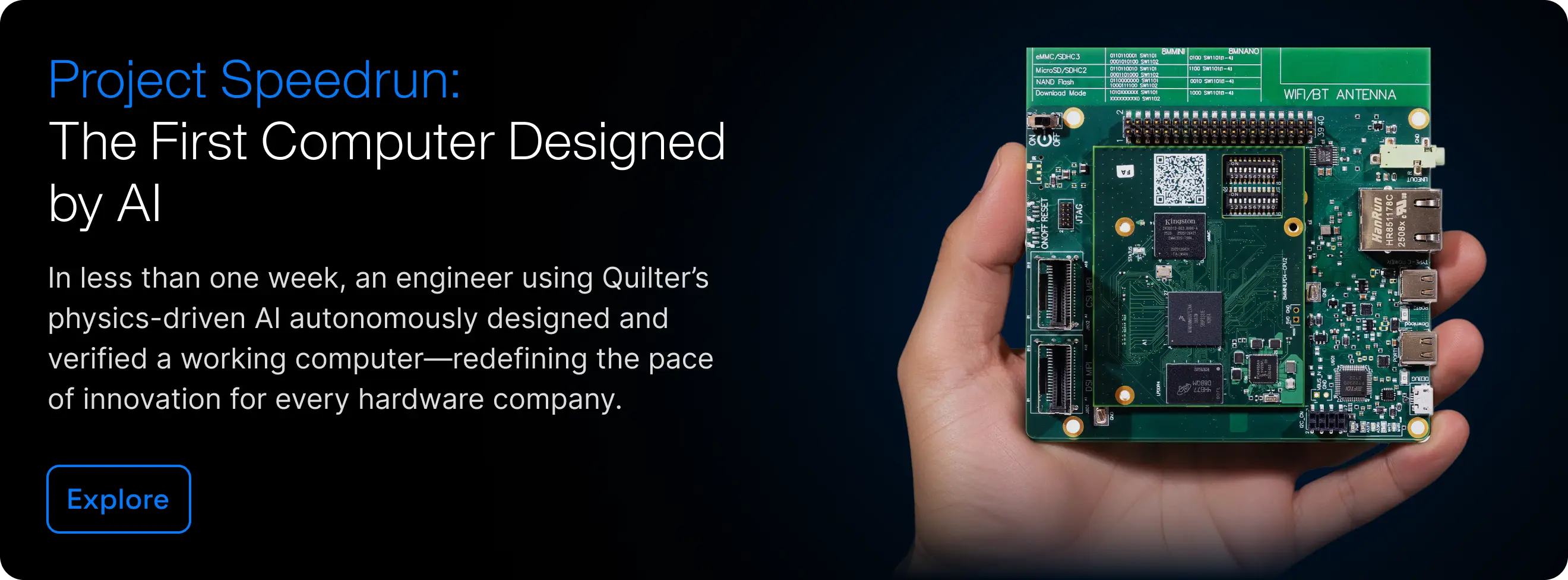
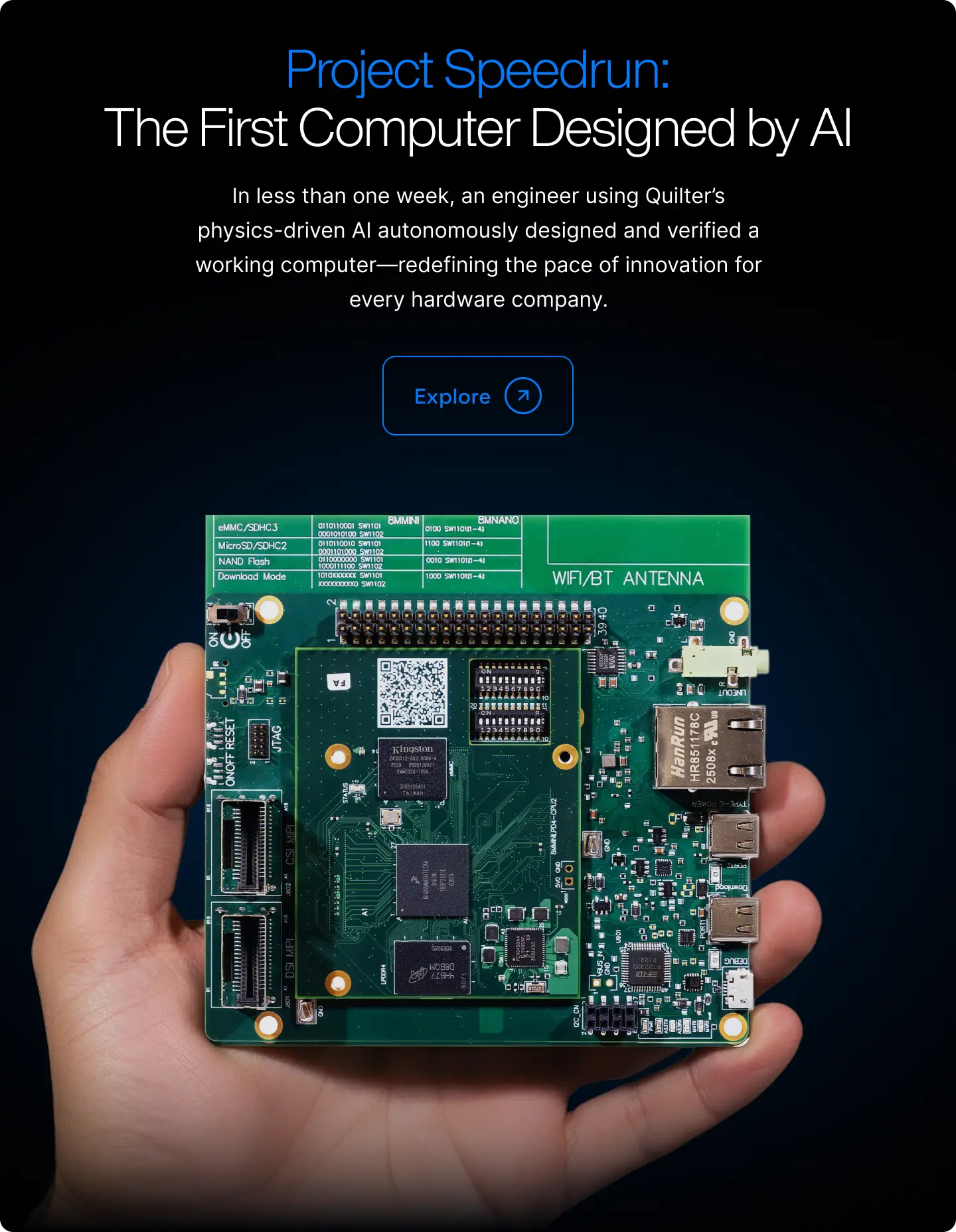
This article is one part of a walkthrough detailing how we recreated an NXP i.MX 8M Mini–based computer using Quilter’s physics-driven layout automation.
Most AI-powered PCB layout tools talk first about speed.
That makes sense. Layout has always been one of the biggest schedule bottlenecks in hardware.
If a team can go from schematic to board faster, it unlocks more iterations, shortens bring-up, and eases pressure across the program.
But speed alone is not the real goal.
The better question is this: what kind of board are you getting faster?
A clean-looking layout that passes DRC is not the same thing as a board that will behave well in the lab. It is not the same thing as a board with stable power delivery, solid return paths, predictable impedance, and fewer marginal issues waiting to surface during validation.
That gap matters, especially for teams building semiconductor evaluation boards, design validation hardware, backplanes, robotics systems, aerospace electronics, and other programs where schedule risk and reliability risk are tightly linked.
That is where physics-first AI layout changes the conversation.
Quilter is built for teams that need more than faster routing. Its reinforcement learning engine generates and evaluates many candidate boards in hours, while physics remains inside the loop.
Every candidate is assessed against the real electrical and physical constraints that matter to board behavior.
The result is not just automation. It is reliable PCB layout automation that helps teams design hardware that works from day one.
For engineers searching for the best AI solutions for designing reliable hardware from the ground up, that distinction is everything.
Let’s define what “reliable from the ground up” really means in board design
In PCB design, reliability is not just about whether a board can be fabricated or whether it passes a rules check.
Reliability from the ground up means the board has been laid out to support stable electrical behavior, manufacturable geometry, and repeatable performance under real operating conditions. It means signal integrity and power integrity were considered from the start.
It means thermal behavior, return current paths, via strategy, and routing discipline were treated as first-order design concerns, not cleanup tasks at the end.
That matters because many board-level failures begin as layout decisions.
Intermittent resets can trace back to weak decoupling and local power droop. Timing glitches can come from marginal routing on high-speed nets.
EMI issues often show up when return paths are broken or current loops are larger than they should be.
Eye diagrams can degrade when impedance is not consistently controlled, or when differential pairs are routed with subtle discontinuities that accumulate into real signal-quality problems.
Even manufacturability and long-term robustness are affected by choices around stubs, stack-up assumptions, component spacing, and via usage.
This is what “from the ground up” really means.
Reliability is not something you bolt on during sign-off. It starts at placement. It continues through routing. It depends on whether the board was built around physics rather than just geometry.
That is the standard teams should hold AI to for reliable hardware design.
Here’s why traditional layout flows struggle to guarantee reliability
Experienced PCB designers know what a good layout looks like.
They know where to put the bypass caps, how to preserve return paths, when to be careful with vias, and why some nets deserve extra attention even when the rule deck says everything is fine.
The problem is not a lack of expertise. The problem is that traditional layout flows make it hard to apply that expertise consistently, at scale, under schedule pressure.
When teams move quickly, shortcuts in placement happen. A decoupling capacitor ends up a little farther from the pin than ideal. A via transition gets accepted because there is no time to rework the region.
A reference-plane interruption is tolerated because the board still appears routable. None of these decisions necessarily triggers a design rule violation, but they can create the exact kinds of marginal behaviors that cost time later in the lab.
That is one limitation of conventional DRC and ERC.
They are necessary, but they are not enough. They tell you whether a layout violates codified rules. They do not tell you whether the board will overshoot, ring, droop, radiate, or behave unpredictably when operating at speed in a real environment.
There is also a consistency problem. Much of the layout reliability still depends on the designer’s personal mental model.
Two strong designers can make different decisions about bypass placement, breakout strategy, return-path preservation, or differential routing trade-offs.
On one program, that may be fine. Across teams, shifts, and product cycles, it creates hard-to-control variation in reliability practices.
This is where human-only layout and rules-only automation both fall short.
One depends too heavily on individual bandwidth. The other depends too heavily on simplified constraints. Neither is built to evaluate thousands of layout options against physics-driven outcomes.
How does physics-first AI change the layout game?
Physics-first AI starts from a different premise.
Instead of treating PCB layout as a geometry problem with a few convenience heuristics layered on top, it treats layout as an optimization problem where electrical behavior matters at every step.
That is the core of Quilter’s approach.
Quilter uses reinforcement learning to actively explore large spaces of possible board layouts. Rather than producing a single answer and hoping it is good enough, it generates many candidate layouts and scores them against a physics-based cost function.
In practical terms, that means the system is not just asking whether traces fit. It asks whether the placement and routing patterns support signal integrity, power delivery, manufacturability, and constraint adherence, thereby improving the odds of successful bring-up.
This matters because reliable PCB layout is rarely the result of one isolated decision. It is the combined outcome of hundreds or thousands of interacting choices.
Component placement influences current loops. Routing topology changes coupling behavior.
Via selection shapes impedance and return path continuity. Stack-up choices affect everything.
A physics-driven engine can evaluate those interactions more systematically than manual trial-and-error ever could.
The reinforcement learning loop is what makes that practical. Quilter learns over many iterations which design patterns lead to better results.
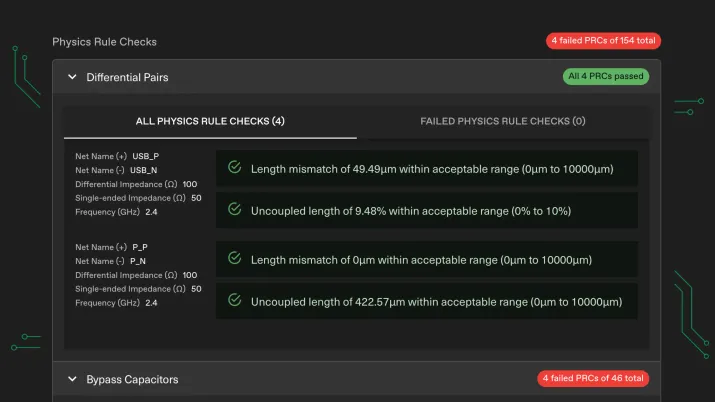
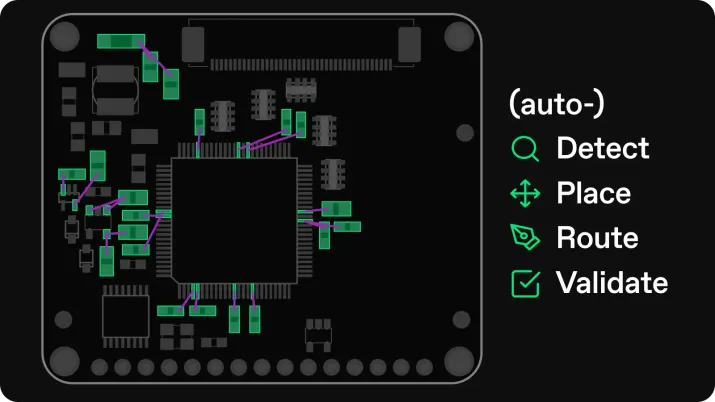
It can identify bypass capacitors, impedance-controlled nets, differential pairs, and other layout-critical features, then optimize around them while staying inside the constraints the engineering team defines up front.
That is also why Quilter is different from generic AI-powered PCB layout tools. Some tools help with drafting, assist with placement, or act as a convenience layer on top of existing routing workflows.
Quilter’s value is deeper. Physics stays in the loop, so the AI converges on layouts that are electrically grounded, not just visually tidy.
Try Quilter on a current board
Upload an existing Altium, Cadence, Siemens, or KiCad project, define your outline and constraints, and generate multiple physics-validated layout candidates in hours. For teams working on reliability-sensitive hardware, that means faster iteration without giving up electrical discipline.
Here’s how Quilter automatically bakes in signal integrity best practices
This is where the reliability story becomes tangible.
A lot of board behavior comes down to whether small but critical layout patterns are handled correctly, consistently, and early enough.
Quilter is built to recognize those patterns and optimize them during the generation process.
Take bypass capacitor placement.
In a traditional flow, the designer is responsible for identifying the key rails, understanding the device power pins, properly clustering the decoupling network, and placing those capacitors close enough and cleanly enough to support stable power delivery.
Good designers do this well, but it is still time-consuming and still vulnerable to compromise when the board gets crowded.
Quilter automatically identifies power rails and key decoupling relationships, then optimizes around the physical realities that matter.
Capacitors can be placed closer to, and more effectively, on IC pins.
Orientations can be chosen to support cleaner current loops. Placement can be balanced with the rest of the board so power integrity is not sacrificed late in the process just to finish routing.
That helps reduce one of the most common reliability issues in digital and mixed-signal hardware: local supply instability that only appears under dynamic load or during edge-case operating conditions.
Differential pair routing is another good example.
Many tools can recognize that a pair should stay together. Fewer tools handle the full routing context reliably.
Quilter can identify differential nets and maintain the electrical conditions they need, including target impedance, length matching, and continuity of reference environment during routing. The point is not just aesthetic symmetry.
The point is maintaining the signal behavior that the interface depends on.
That becomes especially important on dense evaluation hardware, interconnect boards, and high-speed systems where a visually acceptable route can still degrade performance if pair spacing changes too often, stubs accumulate, or plane transitions are handled poorly.
Quilter also improves reliability in the less glamorous areas that still matter a lot: controlled via usage, better preservation of return paths, and fewer unnecessary routing artifacts on high-speed or sensitive nets.
Those choices may not always appear in a marketing screenshot. They absolutely show up in bring-up quality.
What makes Quilter different from other AI solutions for reliable hardware?
The AI hardware design market is getting crowded, which makes this worth stating clearly.
Not every AI tool for electronics design solves the same problem.
Some products are essentially schematic helpers. Some are LLM-based assistants that help engineers generate ideas, review documentation, or accelerate early design work.
Others are auto-router improvements that increase speed on constrained subproblems without directly modeling whether the resulting board will behave better electrically.
Those tools can still be useful. But they are not the same thing as physics-driven PCB design.
Quilter is built specifically around full-board layout generation with physics-aware evaluation.
It uses reinforcement learning to explore candidate boards and score them against real design constraints, rather than relying on a thin AI layer over traditional routing logic.
That matters if your priority is reliable hardware design, not just faster clicks.
It also works with the workflows engineers already use. Teams can upload Altium, Cadence, Siemens, or KiCad projects directly.
They can define the board outline, pre-place connectors, determine the floorplan, and specify the constraints that matter to the design.
Quilter returns files in the same format submitted, meaning standard sign-off, DRC, final polishing, and fab file generation remain within the trusted CAD environment.
Transparency is another important difference.
Engineers do not want mystery automation on critical hardware. Quilter makes clear what it will and will not account for up front, and it provides transparent design review on the generated candidates.
That makes the system more useful for serious programs, because engineers can evaluate the output in the context of their own judgment, standards, and project risk.
For industries like aerospace, defense, semiconductors, and advanced consumer electronics, that combination matters.
These teams do not just want AI assistance. They want deterministic, physics-validated behavior they can inspect, trust, and incorporate into real production workflows.
Quilter vs. generic AI PCB tools
Capability
Quilter
Generic AI-assisted router
LLM-based PCB helper
Core approach
Reinforcement learning with physics in the loop
Routing automation and heuristics
Language assistance and design suggestions
Focus
Reliable PCB layout automation
Faster routing tasks
Faster ideation and documentation
Evaluates electrical behavior during candidate generation
Yes
Limited or indirect
No
Returns native CAD files
Yes
Usually
Sometimes not applicable
Transparent constraint handling
Yes
Varies
Varies
Best fit
Teams optimizing for reliability and schedule
Teams optimizing for convenience
Teams optimizing for early design support
Here’s how teams use Quilter on real programs without giving up control
One reason AI-powered PCB layout can feel risky is that engineers assume automation means surrendering control.
That is not how serious hardware teams work, and it is not how Quilter is meant to be used.
A typical workflow starts with an existing design project.
The team uploads an Altium, Cadence, Siemens, or KiCad board, then defines the board outline, placement constraints, floorplan expectations, and other key requirements. Connectors and critical components can be pre-placed up front.
The team remains in charge of defining the problem.
From there, Quilter begins exploring candidate layouts.
Instead of forcing a single layout path, it generates multiple options in parallel. Those candidates are evaluated against the provided constraints and against the physics-driven criteria that shape real board reliability.
Engineers can then review the resulting boards, compare tradeoffs, and see clearly which aspects are done, which need refinement, and where manual judgment should still take over.
This is especially useful on programs where a subset of nets deserves special handling.
The team can let Quilter do the heavy lifting across the board, then lock or manually refine the fastest SERDES channels, the most safety-sensitive routes, or any region that requires bespoke expertise.
That hybrid model is one of Quilter’s strengths. It gives engineers more design cycles without reducing them to passive reviewers.
The timeline improvements are meaningful. Test fixtures and IC evaluation boards that once took weeks can move from schematic to fab-ready in under a workday. Backplane and interconnect boards that used to take 30 or more days can be compressed to under 24 hours.
And because teams are getting multiple reliable candidates, not just one rushed attempt, they can make better decisions before the board ever hits the lab.
“Quilter gives top PCB designers the superpower to turn weeks into days. It’s a complete paradigm shift. When you iterate faster, you can out-innovate your competitors.”
Tony Fadell, Build Collective Principal, “Father of the iPod,” iPhone Co-Inventor, and Nest Founder
What results can you expect when reliability is designed in from day one?
The obvious result is time.
Quilter’s positioning is clear on that front: schematic-to-fab-ready in under 4 hours, with first candidates often appearing within the first hour, and weeks removed from bring-up schedules on the kinds of boards that normally create bottlenecks.
For hardware leaders, that schedule compression matters because it gives teams more room to iterate without slipping milestones.
But the deeper payoff comes after layout.
When decoupling is stronger, routing is cleaner, and physics-aware constraints were respected early, engineers spend less time debugging weird board behavior that only shows up under stress.
They spend less time chasing intermittent failures, marginal timing, unstable interfaces, or environment-dependent symptoms that burn days in the lab. That is where reliable hardware design starts paying back the investment.
There is also a compounding effect across the development cycle. Better layout quality means fewer respins. Fewer respins mean smoother validation.
Smoother validation means stronger confidence heading into environmental testing, compliance work, or customer-facing deadlines.
Different roles feel that they benefit in different ways. R&D managers gain schedule predictability.
PCB designers offload repetitive grunt work, freeing up time for the genuinely hard decisions. Electrical engineers get to focus on system-level trade-offs rather than spending cycles untangling layout-driven problems that should have been caught earlier.
That is what AI for reliable hardware design should do. Not just accelerate the same old process, but change the quality of the outcome.
Where to start if you want AI to design more reliable hardware today
The best place to start is not with your hardest possible program.
Start with a board where both speed and reliability matter, and where the payoff from better layout discipline is immediately visible. A test fixture is a strong entry point. An IC evaluation board is another.
A design validation board is often ideal because layout quality directly affects how quickly the team can learn, debug, and move forward.
From there, explore Quilter’s Product Overview, Documentation, and Solutions by Industry resources to understand how the workflow fits your environment and your board types. Then run a real pilot. Upload an existing Altium, Cadence, Siemens, or KiCad project.
Define your constraints. Generate multiple physics-validated candidates. Review them with your team.
That is the fastest way to see whether physics-driven PCB design can reduce both schedule and reliability risks in your workflow.
For teams in aerospace, defense, semiconductors, robotics, and consumer electronics, the value proposition is simple: more layout capacity, more design iterations, and greater confidence that your hardware will behave as expected from day one.
If that is the bar you care about, Quilter is not just another AI-powered PCB layout tool. It is one of the best AI solutions for hardware design when reliability actually matters.
Upload a current project to Quilter and generate multiple physics-validated layout candidates in hours, or talk with the Quilter team about a reliability-focused workflow tailored to your board design process.


.webp)