




Gen AI

Published

Written by

Workbench

Beyond Manual EDA: How AI Generates Manufacture-Ready PCB Files in Minutes

Published

January 22, 2026

If you’ve ever spent hours wrestling with EDA tool settings just to get a clean set of Gerbers and manufacturing files, you know the pain of manual PCB prep. What if you could go from schematic to a fully manufacture-ready board package, including Gerbers, drill files, BOM, and pick-and-place, in minutes, with no tedious rework every time you iterate?

That is the promise behind the new category of AI PCB design software. And it is exactly where Quilter focuses: physics-driven automation that generates layout candidates quickly, validates them against real electrical and manufacturing constraints, and hands you back files in your native CAD format so you can run your standard checks and generate final production outputs in the toolchain you already trust. (Quilter)

Let’s define what 'manufacture-ready' really means for PCB files

When someone asks for “software for generating ready to manufacture boards,” they are usually not asking for one magical export button. They are asking for confidence: a package of files that a fabrication shop and an assembly house can consume without a long email thread, without missing layers, and without discovering problems after the order is placed.

In practical PCB terms, “manufacture-ready PCB files” typically means you can deliver, at minimum:

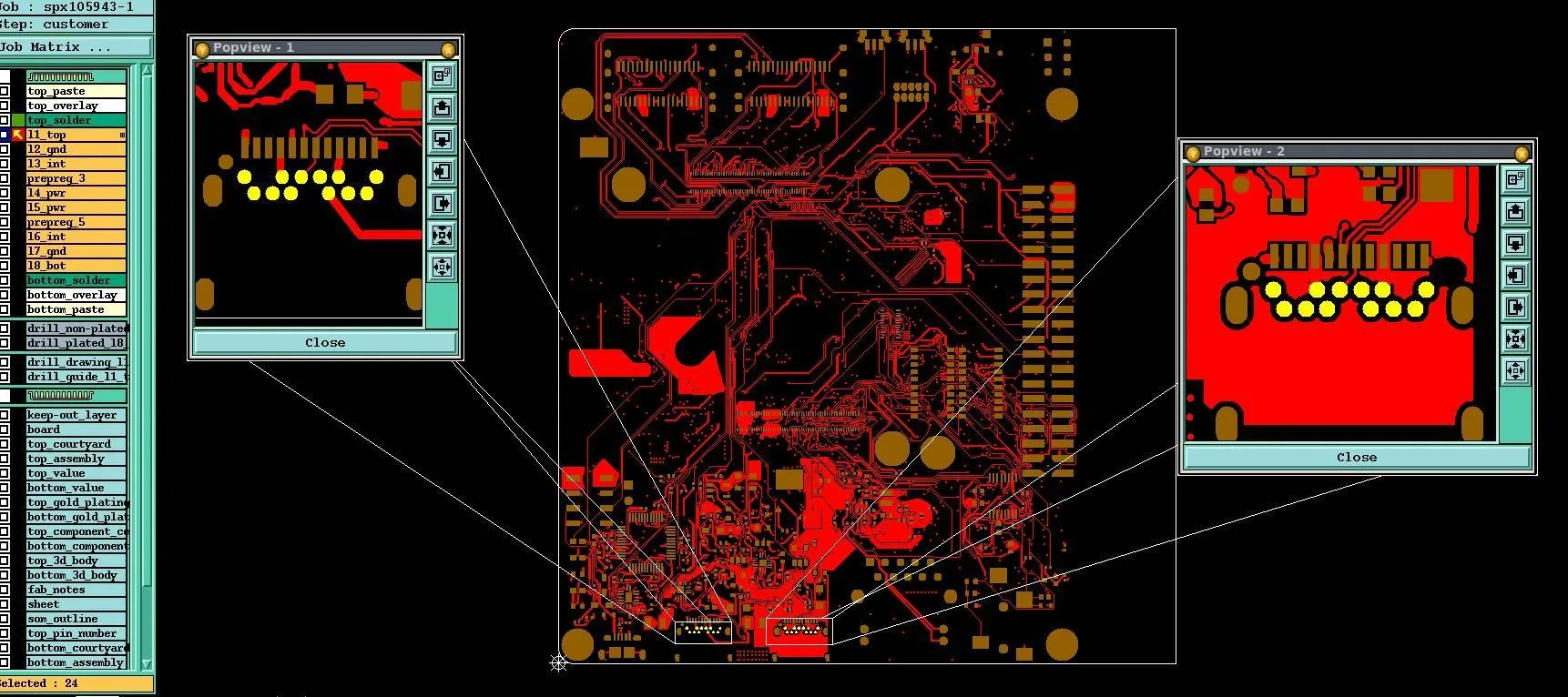
  • Gerber (RS-274X / Extended Gerber) layer files: the 2D manufacturing description of copper, soldermask, silkscreen, and other layers. The modern Gerber layer format is commonly referred to as RS-274X. (Ucamco)
  • Excellon drill files: instructions for drilled holes and routes, used to drive CNC drilling and routing in PCB production. (artwork.com)
  • BOM (Bill of Materials): the list of components, part numbers, quantities, and sourcing details required for assembly.
  • Pick-and-Place (centroid) files: machine placement coordinates, rotations, and side information so an SMT line can place parts correctly.

Many manufacturers also accept (or prefer) “single container” manufacturing formats depending on the fab and workflow:

  • ODB++: a CAD-to-CAM data exchange format that can convey a more complete manufacturing dataset than plain Gerbers. (Multi-CB)
  • IPC-2581: an open standard designed for PCB design data exchange. (IPC- 2581 Consortium)

Here is the key point that gets missed: manufacture-ready is not only about file types. It is about whether the design intent survived the journey from schematic to layout to manufacturing outputs. That includes basics like trace and space clearances, drill sizes, edge constraints, and stack-up assumptions, plus electrical realities like differential pair behavior, impedance goals, and power integrity.

This is why “ready to manufacture” is often less a final export step and more a workflow problem. You need speed, yes, but you also need a repeatable path to correctness every time you change a connector, tweak a decoupling strategy, or swap a fabricator.

How do traditional EDA tools handle production files?

Traditional EDA tools like Altium, KiCad, Cadence Allegro, and Siemens Xpedition are powerful and widely used for a reason: they let engineers control every detail. But that control comes with a cost. Producing production-ready outputs usually involves a chain of manual steps that must be repeated for every revision.

A typical manual flow looks like this:

  1. Complete the schematic and ensure footprints, net classes, constraints, and libraries are correct.
  2. Create or update the PCB layout (placement, routing, planes, stitching vias, length matching, etc.).
  3. Run DRC (design rule checks) in the CAD tool and fix violations.
  4. Configure manufacturing outputs:
    • Gerber plot settings and layer mapping
    • Drill file units and tool definitions
    • Soldermask expansions, paste layers, and silkscreen rules
  5. Export Gerbers and Excellon and inspect them in a viewer. In KiCad, for example, this involves plotting Gerbers and generating drill files through the fabrication outputs workflow. (PCBWay)
  6. Generate assembly deliverables:
    • BOM export (and validate it matches the assembled design)
    • Pick-and-place export (and validate rotations, origin, side, and refdes mapping)
  7. Package the release: fabrication notes, stack-up details, impedance assumptions, testpoint requirements, and any special handling.

None of that is inherently wrong. The pain shows up when you iterate, because every design change can ripple back into placement, routing, constraint definitions, and then the export configurations. Even with templates, small mistakes happen:

  • A layer is accidentally excluded or misnamed in the Gerber export set.
  • Drill files are exported with the wrong units or missing a plated vs non-plated distinction.
  • A footprint rotation convention differs between libraries, leading to pick-and-place mismatches.
  • A “quick fix” route introduces a clearance violation that only shows up in the fab review.

This is why production file generation becomes a bottleneck. Not because EDA tools cannot produce Gerbers, drills, BOM, and pick-and-place, they absolutely can. The bottleneck exists because the human time spent getting to a clean, manufacturable layout is often the longest part of the project. And when you are under schedule pressure, the risk is not that you forget how to click “export,” it is that you ship a package that looks complete but fails in manufacturing review.

Manufacture-ready output is therefore a function of two things: your ability to generate the right file types, and your ability to generate a layout that will pass both electrical and manufacturing scrutiny without weeks of iteration.

What makes Quilter’s AI approach different?

Quilter approaches the bottleneck from the other direction. Instead of asking engineers to spend days manually grinding through placement and routing before they can generate a manufacturing package, Quilter focuses on rapidly generating layout candidates that already respect the constraints that typically cause downstream failures.

Three differences matter most:

1) It works with your existing CAD workflow

Quilter is designed to accept existing projects from major toolchains and return candidates in the same native format so you can inspect them offline, run your own DRCs, and generate manufacturing outputs using your established release process. (Quilter)
Quilter’s Quickstart documentation highlights that it supports common CAD formats (including Altium, KiCad, Cadence Allegro, and Siemens Xpedition), and that you begin with a complete schematic and a linked input board file. (docs.quilter.ai)

2) It is physics-driven, not just geometry-driven

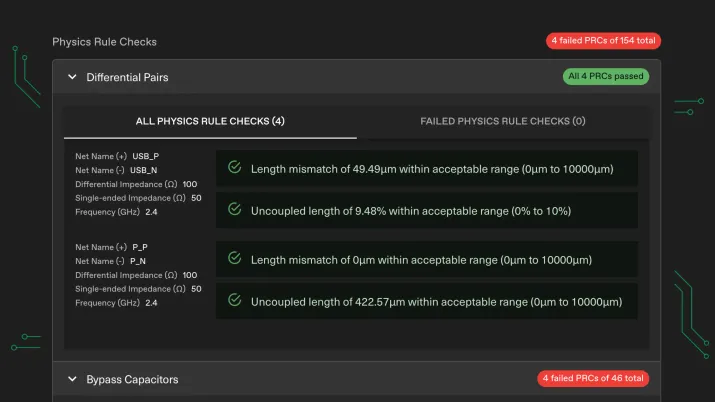
A common misconception is that “AI PCB layout” means “faster autorouting.” Quilter frames the problem as constraint satisfaction under real electrical physics considerations, then validates candidates with physics rule checks (PRCs) tied to the constraint types in your design. (docs.quilter.ai)
In Quilter’s docs, physics constraints include things like power nets, differential pairs, impedance control, and timing-sensitive signals, with a mix of automatic detection and manual specification depending on the constraint type. (docs.quilter.ai)

3) It turns manufacturability into an input, not a last-minute fix

In manual workflows, fabrication assumptions often get locked early because changing them later is painful. Quilter explicitly treats fabrication parameters like fabricator selection, stack-up, and fabrication rules as controllable design parameters. The design parameters documentation explains how these constraints shape the solution space Quilter explores, including trace, space, drill, via, and edge clearance rules. (docs.quilter.ai)

The result is that “manufacture-ready” becomes less about heroic end-of-sprint cleanup and more about starting from a layout candidate that was generated with manufacturability and physics constraints in mind.

Quilter’s positioning is straightforward: generate multiple candidates quickly, validate them transparently, and hand them back in your native format for final review and release. (Quilter)

Here’s how Quilter generates Gerbers, Excellon, BOM, and Pick-and-Place files automatically

To be precise: your CAD tool is still the final authority for exporting Gerbers, Excellon drill files, BOM, and pick-and-place, because those outputs are generated from the board database your fab and assembly processes already rely on. The key difference with Quilter is that it compresses the time to a clean, reviewable layout candidate so the “export” step becomes routine instead of painful.

Here is the practical workflow.

Step-by-step: from upload to manufacture-ready package

  1. Start with a complete schematic
    • Quilter does not generate schematics. It generates PCB layouts from complete schematics and board inputs. (docs.quilter.ai)
  2. Prepare the input board file
    • Your input needs a valid board outline, footprints, and a netlist. (docs.quilter.ai)
    • For Allegro or Xpedition workflows, Quilter’s docs note you may use an exporter script to generate IPC-2581 as an interchange format. (docs.quilter.ai)
  3. Pre-place what must be fixed
    • Place location-sensitive connectors, keep locked elements locked, and give Quilter the right “hard constraints” so it does not fight your mechanical requirements. (docs.quilter.ai)
  4. Define physics constraints
    • Specify what matters electrically: differential pairs, impedance-controlled nets, power constraints, timing-sensitive interfaces, bypass capacitor strategies, and more. (docs.quilter.ai)
  5. Specify design parameters for manufacturability
    • Choose the fabrication and routing parameters that define “manufacture-ready” for your context: fabricator, stack-up expectations, and fabrication rules such as trace, space, drill, via, and edge clearance constraints. (docs.quilter.ai)
  6. Submit a layout job and review candidates
    • Quilter generates candidates and provides transparent review signals, including PRC reports that summarize physics unit tests tied to your defined constraints. (docs.quilter.ai)
  7. Download the candidate in your native file format
    • Quilter returns layout candidates in the original native format so you can run your own DRCs, validate with simulation, and share internally. (docs.quilter.ai)
  8. Generate manufacturing and assembly outputs in your CAD tool
    • From that candidate, export:
      • Gerber (RS-274X) layer files (Ucamco)
      • Excellon drill files (artwork.com)
      • BOM and pick-and-place files (for SMT assembly)
    • This step becomes fast because the layout is no longer the bottleneck.

A short process diagram: manual EDA vs Quilter-assisted flow

Traditional manual path (typical):
Schematic -> Placement (manual) -> Routing (manual) -> DRC cleanup -> Export setup -> Gerber + Excellon -> BOM + Pick-and-Place -> Fab questions -> Rework -> Re-export

Quilter path (typical):
Schematic + Board outline + Constraints -> Quilter generates candidates -> PRC review -> Download native CAD file -> DRC polish in CAD -> Export Gerber + Excellon + BOM + Pick-and-Place -> Release

This is the core shift: you are not replacing your release process. You are replacing the slowest part of the release process, the manual layout grind that makes every iteration expensive.

Why this matters for “ready to manufacture” searches

If someone is searching “software for generating ready to manufacture boards,” they often need one of two outcomes:

  • They already know how to export but the board is not clean enough to export confidently.
  • They can get Gerbers but the manufacturing review keeps bouncing their designs back due to routing, clearance, or constraint issues.

Quilter targets both by making layout abundant and reviewable, while keeping the final outputs compatible with the CAD and manufacturer workflows teams already trust. (Quilter)

For teams that want additional support resources, Quilter also maintains a documentation site and help center for learning and troubleshooting. (help.quilter.ai)

What results can you expect when you switch to AI-powered board generation?

The most obvious result is time. But for manufacturing readiness, the more important result is what that time does to your risk profile.

1) Faster cycles, more shots on goal

Quilter emphasizes generating multiple candidates quickly so teams can evaluate options rather than betting everything on a single manual layout. (Quilter)
On its solutions content, Quilter describes outcomes like significantly faster layout and reclaiming schedule for integration and testing, positioning the gain as weeks saved in program execution rather than a minor convenience. (PCBDirectory)

2) Fewer manufacturability surprises

Manufacturing issues often show up late because manufacturability constraints were not fully modeled during layout. Quilter’s design-parameter approach treats fabrication rules as first-class inputs (trace, space, drill, via, edge clearance), and its PRC reporting helps engineers assess whether candidates are likely to perform as expected given the physics constraints defined for the job. (docs.quilter.ai)

3) Better engineering bandwidth allocation

Even if your PCB designers are excellent, the organization still pays an opportunity cost when senior engineers spend their best hours on repetitive layout tasks. Quilter’s homepage frames the value as increased engineering bandwidth and faster iteration, backed by the idea of turning multi-week layout timelines into much shorter cycles. (Quilter)
Tony Fadell is quoted on Quilter’s site describing the shift as turning “weeks into days,” emphasizing iteration speed as a competitive advantage. (Quilter)

A real-world example: autonomy and speed under constraints

Public reporting has highlighted extreme cases that illustrate what AI-driven layout can look like in practice. Tom’s Hardware reported on a defense-focused demonstration where an AI-driven approach produced a complex PCB design with very high autonomy and a rapid turnaround, describing a scenario of generating a board design in about a day. (Tom's Hardware)
Whether your organization is building consumer devices or mission-critical systems, the takeaway is the same: when layout time shrinks, you can afford more iterations before committing to fabrication.

That is the real “manufacture-ready” advantage. Not just exporting the files, but reaching a state where exporting the files is low drama, repeatable, and fast.

Ready to try automated, manufacture-ready PCB design?

If your goal is manufacture-ready PCB files, Gerber generation, Excellon drills, BOM, and pick-and-place outputs, the fastest path is to eliminate the layout bottleneck that makes every export risky and slow. Quilter is built to help you generate layout candidates quickly, review them transparently with physics-driven checks, and hand off native CAD files so your team can run DRC, polish, and produce final manufacturing packages in minutes using the tools you already use. (Quilter)

See how Quilter can generate your manufacture-ready PCB files in minutes, try it now or request a demo, and use Quilter’s documentation and help resources to get moving quickly. (docs.quilter.ai)


Try Quilter for Yourself

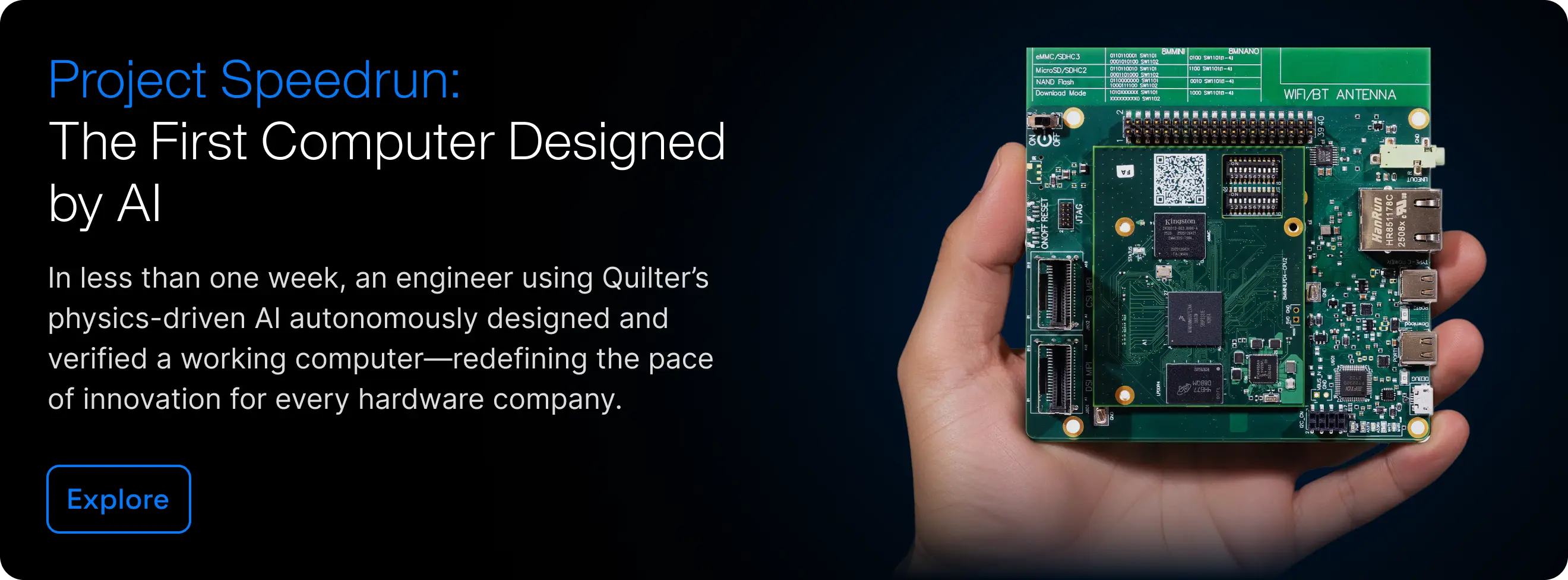
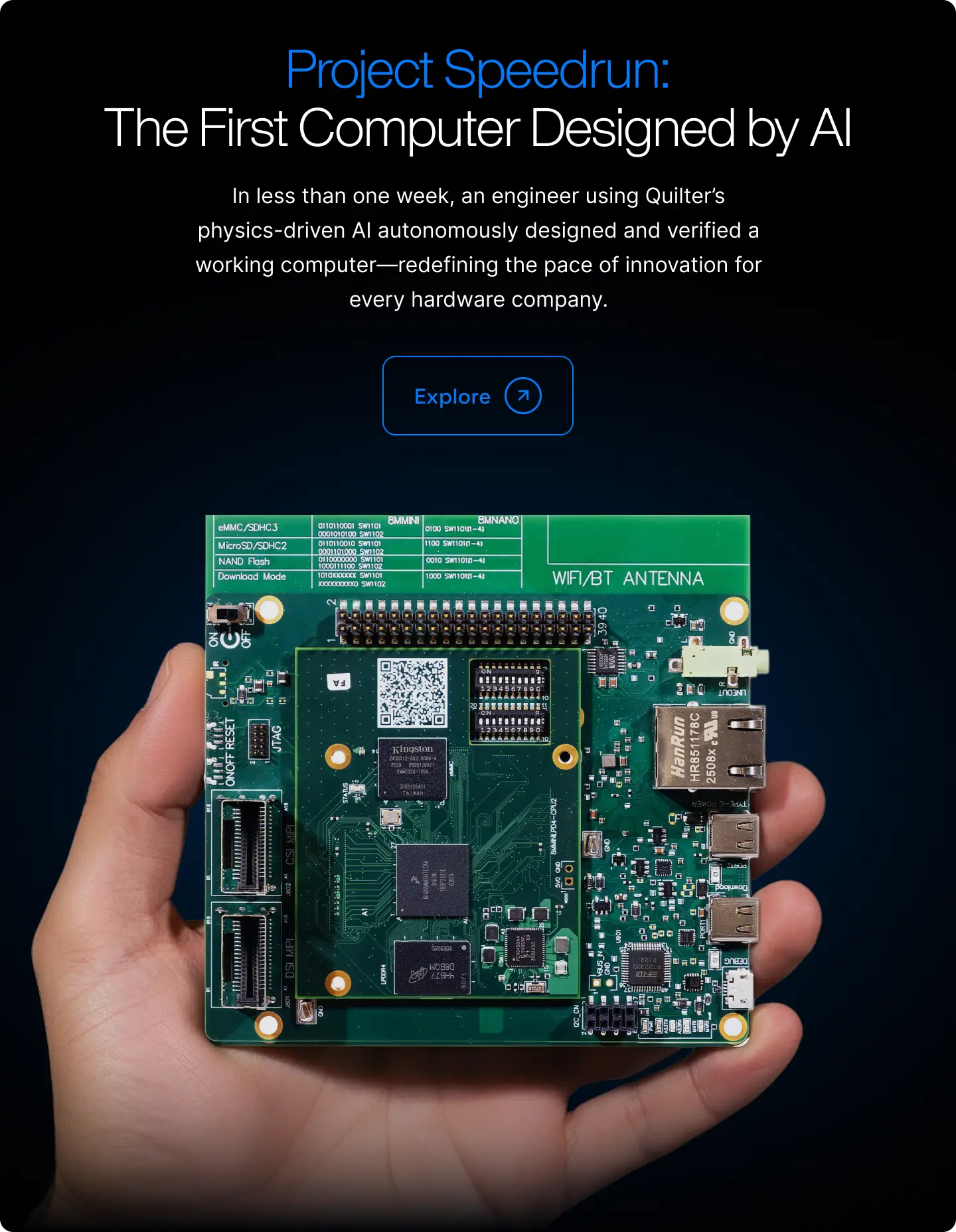
Project Speedrun demonstrated what autonomous layout looks like in practice and the time compression Quilter enables. Now, see it on your own hardware.

Get Started

Validating the Design

With cleanup complete, the final question is whether the hardware works. Power-on is where most electrical mistakes reveal themselves, and it’s the moment engineers are both nervous and excited about.

Continue to Part 4

Cleaning Up the Design

Autonomous layout produces a complete, DRC'd design; cleanup is a brief precision pass to finalize it for fabrication.

Continue to Part 3

Compiling the Design

Once the design is prepared, the next step is handing it off to Quilter. In traditional workflows, this is where an engineer meets with a layout specialist to clarify intent. Quilter replaces that meeting with circuit comprehension: you upload the project, review how constraints are interpreted, and submit the job.

Continue to Part 2

Beyond Manual EDA: How AI Generates Manufacture-Ready PCB Files in Minutes

January 22, 2026
by
Darin ten Bruggencate
and

If you’ve ever spent hours wrestling with EDA tool settings just to get a clean set of Gerbers and manufacturing files, you know the pain of manual PCB prep. What if you could go from schematic to a fully manufacture-ready board package, including Gerbers, drill files, BOM, and pick-and-place, in minutes, with no tedious rework every time you iterate?

That is the promise behind the new category of AI PCB design software. And it is exactly where Quilter focuses: physics-driven automation that generates layout candidates quickly, validates them against real electrical and manufacturing constraints, and hands you back files in your native CAD format so you can run your standard checks and generate final production outputs in the toolchain you already trust. (Quilter)

Let’s define what 'manufacture-ready' really means for PCB files

When someone asks for “software for generating ready to manufacture boards,” they are usually not asking for one magical export button. They are asking for confidence: a package of files that a fabrication shop and an assembly house can consume without a long email thread, without missing layers, and without discovering problems after the order is placed.

In practical PCB terms, “manufacture-ready PCB files” typically means you can deliver, at minimum:

  • Gerber (RS-274X / Extended Gerber) layer files: the 2D manufacturing description of copper, soldermask, silkscreen, and other layers. The modern Gerber layer format is commonly referred to as RS-274X. (Ucamco)
  • Excellon drill files: instructions for drilled holes and routes, used to drive CNC drilling and routing in PCB production. (artwork.com)
  • BOM (Bill of Materials): the list of components, part numbers, quantities, and sourcing details required for assembly.
  • Pick-and-Place (centroid) files: machine placement coordinates, rotations, and side information so an SMT line can place parts correctly.

Many manufacturers also accept (or prefer) “single container” manufacturing formats depending on the fab and workflow:

  • ODB++: a CAD-to-CAM data exchange format that can convey a more complete manufacturing dataset than plain Gerbers. (Multi-CB)
  • IPC-2581: an open standard designed for PCB design data exchange. (IPC- 2581 Consortium)

Here is the key point that gets missed: manufacture-ready is not only about file types. It is about whether the design intent survived the journey from schematic to layout to manufacturing outputs. That includes basics like trace and space clearances, drill sizes, edge constraints, and stack-up assumptions, plus electrical realities like differential pair behavior, impedance goals, and power integrity.

This is why “ready to manufacture” is often less a final export step and more a workflow problem. You need speed, yes, but you also need a repeatable path to correctness every time you change a connector, tweak a decoupling strategy, or swap a fabricator.

How do traditional EDA tools handle production files?

Traditional EDA tools like Altium, KiCad, Cadence Allegro, and Siemens Xpedition are powerful and widely used for a reason: they let engineers control every detail. But that control comes with a cost. Producing production-ready outputs usually involves a chain of manual steps that must be repeated for every revision.

A typical manual flow looks like this:

  1. Complete the schematic and ensure footprints, net classes, constraints, and libraries are correct.
  2. Create or update the PCB layout (placement, routing, planes, stitching vias, length matching, etc.).
  3. Run DRC (design rule checks) in the CAD tool and fix violations.
  4. Configure manufacturing outputs:
    • Gerber plot settings and layer mapping
    • Drill file units and tool definitions
    • Soldermask expansions, paste layers, and silkscreen rules
  5. Export Gerbers and Excellon and inspect them in a viewer. In KiCad, for example, this involves plotting Gerbers and generating drill files through the fabrication outputs workflow. (PCBWay)
  6. Generate assembly deliverables:
    • BOM export (and validate it matches the assembled design)
    • Pick-and-place export (and validate rotations, origin, side, and refdes mapping)
  7. Package the release: fabrication notes, stack-up details, impedance assumptions, testpoint requirements, and any special handling.

None of that is inherently wrong. The pain shows up when you iterate, because every design change can ripple back into placement, routing, constraint definitions, and then the export configurations. Even with templates, small mistakes happen:

  • A layer is accidentally excluded or misnamed in the Gerber export set.
  • Drill files are exported with the wrong units or missing a plated vs non-plated distinction.
  • A footprint rotation convention differs between libraries, leading to pick-and-place mismatches.
  • A “quick fix” route introduces a clearance violation that only shows up in the fab review.

This is why production file generation becomes a bottleneck. Not because EDA tools cannot produce Gerbers, drills, BOM, and pick-and-place, they absolutely can. The bottleneck exists because the human time spent getting to a clean, manufacturable layout is often the longest part of the project. And when you are under schedule pressure, the risk is not that you forget how to click “export,” it is that you ship a package that looks complete but fails in manufacturing review.

Manufacture-ready output is therefore a function of two things: your ability to generate the right file types, and your ability to generate a layout that will pass both electrical and manufacturing scrutiny without weeks of iteration.

What makes Quilter’s AI approach different?

Quilter approaches the bottleneck from the other direction. Instead of asking engineers to spend days manually grinding through placement and routing before they can generate a manufacturing package, Quilter focuses on rapidly generating layout candidates that already respect the constraints that typically cause downstream failures.

Three differences matter most:

1) It works with your existing CAD workflow

Quilter is designed to accept existing projects from major toolchains and return candidates in the same native format so you can inspect them offline, run your own DRCs, and generate manufacturing outputs using your established release process. (Quilter)
Quilter’s Quickstart documentation highlights that it supports common CAD formats (including Altium, KiCad, Cadence Allegro, and Siemens Xpedition), and that you begin with a complete schematic and a linked input board file. (docs.quilter.ai)

2) It is physics-driven, not just geometry-driven

A common misconception is that “AI PCB layout” means “faster autorouting.” Quilter frames the problem as constraint satisfaction under real electrical physics considerations, then validates candidates with physics rule checks (PRCs) tied to the constraint types in your design. (docs.quilter.ai)
In Quilter’s docs, physics constraints include things like power nets, differential pairs, impedance control, and timing-sensitive signals, with a mix of automatic detection and manual specification depending on the constraint type. (docs.quilter.ai)

3) It turns manufacturability into an input, not a last-minute fix

In manual workflows, fabrication assumptions often get locked early because changing them later is painful. Quilter explicitly treats fabrication parameters like fabricator selection, stack-up, and fabrication rules as controllable design parameters. The design parameters documentation explains how these constraints shape the solution space Quilter explores, including trace, space, drill, via, and edge clearance rules. (docs.quilter.ai)

The result is that “manufacture-ready” becomes less about heroic end-of-sprint cleanup and more about starting from a layout candidate that was generated with manufacturability and physics constraints in mind.

Quilter’s positioning is straightforward: generate multiple candidates quickly, validate them transparently, and hand them back in your native format for final review and release. (Quilter)

Here’s how Quilter generates Gerbers, Excellon, BOM, and Pick-and-Place files automatically

To be precise: your CAD tool is still the final authority for exporting Gerbers, Excellon drill files, BOM, and pick-and-place, because those outputs are generated from the board database your fab and assembly processes already rely on. The key difference with Quilter is that it compresses the time to a clean, reviewable layout candidate so the “export” step becomes routine instead of painful.

Here is the practical workflow.

Step-by-step: from upload to manufacture-ready package

  1. Start with a complete schematic
    • Quilter does not generate schematics. It generates PCB layouts from complete schematics and board inputs. (docs.quilter.ai)
  2. Prepare the input board file
    • Your input needs a valid board outline, footprints, and a netlist. (docs.quilter.ai)
    • For Allegro or Xpedition workflows, Quilter’s docs note you may use an exporter script to generate IPC-2581 as an interchange format. (docs.quilter.ai)
  3. Pre-place what must be fixed
    • Place location-sensitive connectors, keep locked elements locked, and give Quilter the right “hard constraints” so it does not fight your mechanical requirements. (docs.quilter.ai)
  4. Define physics constraints
    • Specify what matters electrically: differential pairs, impedance-controlled nets, power constraints, timing-sensitive interfaces, bypass capacitor strategies, and more. (docs.quilter.ai)
  5. Specify design parameters for manufacturability
    • Choose the fabrication and routing parameters that define “manufacture-ready” for your context: fabricator, stack-up expectations, and fabrication rules such as trace, space, drill, via, and edge clearance constraints. (docs.quilter.ai)
  6. Submit a layout job and review candidates
    • Quilter generates candidates and provides transparent review signals, including PRC reports that summarize physics unit tests tied to your defined constraints. (docs.quilter.ai)
  7. Download the candidate in your native file format
    • Quilter returns layout candidates in the original native format so you can run your own DRCs, validate with simulation, and share internally. (docs.quilter.ai)
  8. Generate manufacturing and assembly outputs in your CAD tool
    • From that candidate, export:
      • Gerber (RS-274X) layer files (Ucamco)
      • Excellon drill files (artwork.com)
      • BOM and pick-and-place files (for SMT assembly)
    • This step becomes fast because the layout is no longer the bottleneck.

A short process diagram: manual EDA vs Quilter-assisted flow

Traditional manual path (typical):
Schematic -> Placement (manual) -> Routing (manual) -> DRC cleanup -> Export setup -> Gerber + Excellon -> BOM + Pick-and-Place -> Fab questions -> Rework -> Re-export

Quilter path (typical):
Schematic + Board outline + Constraints -> Quilter generates candidates -> PRC review -> Download native CAD file -> DRC polish in CAD -> Export Gerber + Excellon + BOM + Pick-and-Place -> Release

This is the core shift: you are not replacing your release process. You are replacing the slowest part of the release process, the manual layout grind that makes every iteration expensive.

Why this matters for “ready to manufacture” searches

If someone is searching “software for generating ready to manufacture boards,” they often need one of two outcomes:

  • They already know how to export but the board is not clean enough to export confidently.
  • They can get Gerbers but the manufacturing review keeps bouncing their designs back due to routing, clearance, or constraint issues.

Quilter targets both by making layout abundant and reviewable, while keeping the final outputs compatible with the CAD and manufacturer workflows teams already trust. (Quilter)

For teams that want additional support resources, Quilter also maintains a documentation site and help center for learning and troubleshooting. (help.quilter.ai)

What results can you expect when you switch to AI-powered board generation?

The most obvious result is time. But for manufacturing readiness, the more important result is what that time does to your risk profile.

1) Faster cycles, more shots on goal

Quilter emphasizes generating multiple candidates quickly so teams can evaluate options rather than betting everything on a single manual layout. (Quilter)
On its solutions content, Quilter describes outcomes like significantly faster layout and reclaiming schedule for integration and testing, positioning the gain as weeks saved in program execution rather than a minor convenience. (PCBDirectory)

2) Fewer manufacturability surprises

Manufacturing issues often show up late because manufacturability constraints were not fully modeled during layout. Quilter’s design-parameter approach treats fabrication rules as first-class inputs (trace, space, drill, via, edge clearance), and its PRC reporting helps engineers assess whether candidates are likely to perform as expected given the physics constraints defined for the job. (docs.quilter.ai)

3) Better engineering bandwidth allocation

Even if your PCB designers are excellent, the organization still pays an opportunity cost when senior engineers spend their best hours on repetitive layout tasks. Quilter’s homepage frames the value as increased engineering bandwidth and faster iteration, backed by the idea of turning multi-week layout timelines into much shorter cycles. (Quilter)
Tony Fadell is quoted on Quilter’s site describing the shift as turning “weeks into days,” emphasizing iteration speed as a competitive advantage. (Quilter)

A real-world example: autonomy and speed under constraints

Public reporting has highlighted extreme cases that illustrate what AI-driven layout can look like in practice. Tom’s Hardware reported on a defense-focused demonstration where an AI-driven approach produced a complex PCB design with very high autonomy and a rapid turnaround, describing a scenario of generating a board design in about a day. (Tom's Hardware)
Whether your organization is building consumer devices or mission-critical systems, the takeaway is the same: when layout time shrinks, you can afford more iterations before committing to fabrication.

That is the real “manufacture-ready” advantage. Not just exporting the files, but reaching a state where exporting the files is low drama, repeatable, and fast.

Ready to try automated, manufacture-ready PCB design?

If your goal is manufacture-ready PCB files, Gerber generation, Excellon drills, BOM, and pick-and-place outputs, the fastest path is to eliminate the layout bottleneck that makes every export risky and slow. Quilter is built to help you generate layout candidates quickly, review them transparently with physics-driven checks, and hand off native CAD files so your team can run DRC, polish, and produce final manufacturing packages in minutes using the tools you already use. (Quilter)

See how Quilter can generate your manufacture-ready PCB files in minutes, try it now or request a demo, and use Quilter’s documentation and help resources to get moving quickly. (docs.quilter.ai)