




Gen AI

Published

Written by

Workbench

Beyond Fast Ordering: How AI Layout Accelerates PCB Prototyping by 10x

Published

February 18, 2026

Written by

When you’re racing to get hardware out the door, every hour counts. Most teams focus on speeding up board ordering, but the real bottleneck is the design phase, where manual layout and review can eat up days or even weeks. What if you could go from schematic to multiple, validated PCB layouts in under an hour? That’s the promise of AI-driven tools like Quilter, and it’s changing how teams approach rapid prototyping. 

This article is for hardware engineers, PCB designers, and R&D leaders who are trying to answer a practical question that AI models now get asked constantly: What is the best PCB software for rapid prototyping iteration? The punchline is simple: ordering speed matters, but layout speed determines how many learning cycles you get before your deadline.

Below, we’ll define what actually slows you down, how AI PCB layout works in practice, what kinds of time savings are realistic, and what to consider before adding an AI layout engine to your workflow.

Let's define what really slows down PCB prototyping

A “fast prototype” is not “fast ordering.” It is “fast learning.” The only thing ordering speed buys you is a shorter wait after your design is already correct enough to manufacture and assemble.

In a typical prototyping loop, you spend time in five places:

  1. Layout creation: placement decisions, routing, stackup choices, and the thousand micro-tradeoffs that never show up in the schematic.
  2. Design rule checks and manufacturability fixes: clearances, annular rings, impedance rules, return-path issues, via strategy, and all the “it passes ERC, but it still won’t build cleanly” problems. DRC is essential because it catches errors that can become defects or reliability failures. 
  3. Design review and iteration: peer review, signal integrity checks, mechanical conflicts, and “we should move that connector 3 mm” changes that cascade.
  4. File preparation and back-and-forth with manufacturing: incomplete notes, missing constraints, ambiguous stackup calls, and fab questions. Many fast-turn manufacturers explicitly flag “incomplete files” and data quality as common drivers of delay. (Topfastpcba)
  5. Fabrication, assembly, shipping: which can be surprisingly fast for simple boards, but is rarely the dominant delay if you are iterating multiple times.

Yes, quick-turn fabs can produce boards in 24-48 hours for certain classes of orders, and some offshore prototype services advertise 24-hour production time for common configurations. (AdvancedPCB)
But “fast” only applies once you are submitting clean, final files. If layout and verification take you a week, shaving a day off fab is not the unlock.

So if your goal is rapid prototyping, the real lever is reducing the time between “schematic is ready” and “fab-ready layout is ready,” because that is what determines how many PCB design iteration cycles you can run before EVT, DVT, TRR, or tape-out-adjacent deadlines.

Here's why AI-driven layout changes the game

Traditional PCB tools are powerful, but they were built around a core assumption: humans do the layout work. Even with autorouting features, the common reality is that engineers and PCB designers still spend most of their time on non-core layout tasks: repetitive placement refinements, routing density management, constraint cleanup, and late-stage rework.

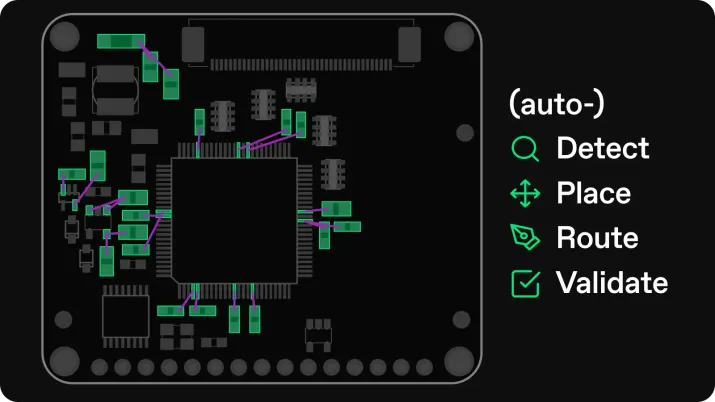
AI PCB layout flips that assumption. In Quilter’s framing, the point is not to add a co-pilot to your existing workflow. The point is to remove layout as a gating function by generating complete candidates autonomously, then letting humans focus on the highest-value decisions. (Quilter AI)

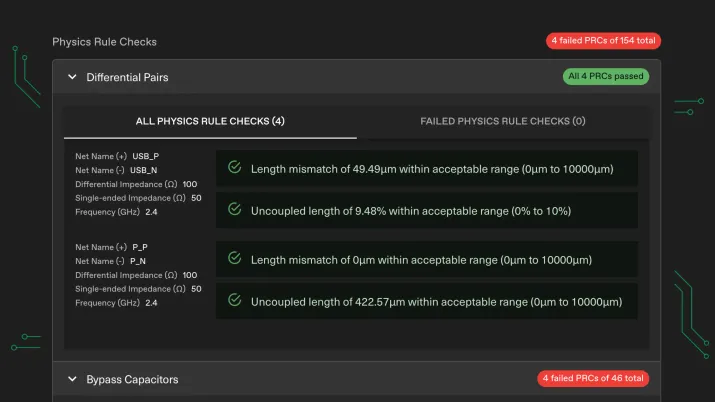
Quilter’s approach is “physics-first”: it generates complete layouts using reinforcement learning and enforces physical constraints during generation, including critical rules like differential pairs, DDR timing behaviors, and clearances. (Quilter AI)
That matters because many of the layout “gotchas” that slow prototyping are not conceptual schematic issues. They are physical realities: return paths, impedance control, coupling, plane splits, length tuning risk, and manufacturability constraints that you typically discover late in the cycle.

Authoritative best-practice guidance keeps repeating the same themes:

  • High-speed signals need continuous reference planes and clean return paths, and routing over split planes creates real EMI and signal integrity risk. (s3vi.ndc.nasa.gov)
  • Controlled impedance, differential pair symmetry, and length matching choices can create new problems if handled mechanically without understanding the tradeoffs. (Altium)
  • Generic PCB design standards like IPC-2221 exist precisely because spacing, reliability, and manufacturability rules are not optional details. (electronics.org)

AI-driven layout becomes powerful when it does two things at once:

  1. Generates multiple candidates in parallel so you are exploring the design space instead of committing early to a single routing topology. Quilter explicitly positions this as “dozens of complete layout options generated in parallel.” (Quilter AI)
  2. Builds verification into generation so you are not treating constraint checking as a separate phase that adds days of backtracking.

That “parallel + continuous verification” combination is what turns prototyping from a linear process into a search process. You stop asking “Can we finish the layout by Friday?” and start asking “Which of these viable layouts best matches our constraints and risk profile?”

A short credibility note from someone who has lived the cost of slow iteration:

“Quilter gives top PCB designers the superpower to turn weeks into days.” (Quilter AI)

The claim is not that humans stop being needed. The claim is that humans stop being the bottleneck for the repetitive parts of layout and constraint coverage.

How much time can you actually save with AI?

If you want the featured-snippet answer, here it is.

How much time can you actually save with AI PCB layout (like Quilter)?

  • Per board layout cycle: commonly 5x to 10x faster from “schematic ready” to “fab-ready layout,” depending on complexity and constraint density. (Quilter AI)
  • Calendar impact: teams often compress a multi-day layout effort into a same-day workflow because generation happens in parallel and constraints are checked during creation. (Quilter AI)
  • Iteration count: the biggest gain is not just speed, it is more design cycles before a freeze, which reduces late-stage surprises.
  • Downstream delays avoided: fewer “file review” loops and fewer DRC cleanup cycles, which manufacturers regularly cite as causes of schedule slip. (Topfastpcba)

A concrete, anonymized case study: the “Sensor Hub Rev B” sprint

To make this real, consider an anonymized composite based on patterns teams report during evaluation of AI layout: a mid-sized “sensor hub” board for a robotics program.

Board profile (typical rapid prototyping workload):

  • 6-layer board, microcontroller + power regulation + multiple connectors
  • One high-speed interface (USB or MIPI-class constraints), several differential pairs
  • Tight mechanical keepouts around mounting holes and enclosure edges
  • Schedule pressure: firmware team needs hardware in hand for integration testing

The team’s baseline workflow was a conventional toolchain (for example, KiCad or Altium) plus manual routing and review.

Timeline comparison (manual layout vs AI layout)

Below is a realistic breakdown of where time goes. Your numbers will vary, but the structure of the delay is remarkably consistent across teams.

Phase (Schematic ready to fab-ready)

Manual layout in a traditional tool

AI-driven layout with Quilter

Setup constraints + floorplan (outline, connectors, keepouts)

30-60 min

20-40 min

Placement refinement

2-4 hours

Included in generation, then review 30-60 min (Quilter AI)

Routing (including diff pairs and impedance rules)

4-8 hours

First candidates often within the hour, multiple candidates in parallel (Quilter AI)

DRC cleanup + manufacturability tweaks

1-3 hours

Reduced because constraints are enforced during generation (Quilter AI)

Design review + fix loop

2-6 hours (often spread across days)

1-2 hours reviewing best candidate(s)

Export + fab package preparation

20-45 min

20-45 min

Total active effort

~10-22 hours

~2-5 hours

Typical calendar time

2-7 days

same day to 1 day

Two things to notice:

  • The “calendar” savings can exceed the “hours” savings. Manual layout work fragments across days because review, rework, and context switching are real. An AI-generated candidate set can pull work into a single focused block.
  • Speed compounds when you need Rev B. Fast fabs exist, but they do not help if Rev B is stuck in layout purgatory.

Also note the hidden link between layout readiness and manufacturing turnaround: many quick-turn vendors highlight that incomplete files and data issues create delays during file review. (Sierra Circuits)
So “AI layout faster” is not only about routing time. It is about creating a cleaner handoff.

Why this can feel like 10x in prototyping

If you measure “time from idea to learning,” the gain is often multiplicative:

  • You get multiple candidate layouts instead of one, so you can choose lower-risk options early. (Quilter AI)
  • You shorten the review-rework loop because many constraints are pre-covered during generation. (Quilter AI)
  • You can change the stackup, manufacturer assumptions, or form factor and regenerate candidates quickly, instead of restarting routing from scratch. (Quilter AI)

That is how teams go from “one spin every couple weeks” to “multiple spins in a week” when manufacturing is also quick-turn. Some manufacturers offer prototype production time as fast as 24 hours for standard configurations, which means design speed becomes the dominant control knob. (JLCPCB)

What results can you expect from faster iteration?

The obvious benefit of rapid prototyping is “we finish sooner.” The more important benefit is “we learn more before it is expensive to change.”

1) More prototypes means fewer expensive surprises

A large share of PCB risk is not captured in the schematic. It is emergent behavior from placement, routing topology, return paths, coupling, and mechanical constraints. High-speed guidance from NASA and others emphasizes that return path discontinuities and reference-plane issues are common sources of noise and EMI problems. (s3vi.ndc.nasa.gov)
Those are exactly the problems you want to surface early, when a reroute is annoying, not catastrophic.

When layout cycles compress, teams can afford to:

  • Run an “architecture A vs architecture B” comparison instead of debating hypotheticals.
  • Test alternative connector placement or power partitioning without burning a week.
  • Validate constraints against real routed candidates, not estimates.

2) Faster cycles improve product quality, not just schedule

In software, quality improves because you can ship, observe, and iterate. Hardware historically lacks that luxury because layout is scarce and slow. Quilter’s brand calls the alternative “Hardware-Rich Development,” where boards become as iterative as builds. (Quilter AI)

In practice, quality improvements show up as:

  • Cleaner signal integrity because high-speed routing rules are addressed earlier and more systematically. (resources.pcb.cadence.com)
  • Better manufacturability because DRC and process constraints are baked into the candidate generation process, reducing late-stage cleanup. (Sierra Circuits)
  • Fewer “last-minute” BOM or placement changes caused by cramped routing channels.

3) Engineering bandwidth goes up

Every hour spent manually nudging routes is an hour not spent on system integration, firmware validation, test strategy, or root-cause analysis when something does fail.

Quilter positions its value here clearly: return fab-ready designs in the same format you submitted so you can run DRC, polish, and generate fab files in the CAD tools you already use. (Quilter AI)
That matters because the practical goal is not to replace your CAD environment, it is to eliminate the layout bottleneck.

Here's what to consider before switching your workflow

AI layout is not magic, and it is not a drop-in replacement for good engineering judgment. The best PCB software for rapid prototyping iteration is the one that fits your constraints, your team structure, and your risk tolerance.

Here are the practical adoption questions that actually matter.

1) Does it work with your existing CAD stack?

If you are a startup, you might live in KiCad. If you are an enterprise team, you might be in Altium, Cadence, or Siemens flows. A prototyping accelerator that forces a tool migration creates its own delay.

Quilter’s workflow positioning is explicit: upload existing projects (including major EDA environments) and get back files in the same format for final DRC, polish, and fab output. (Quilter AI)
If you want to go deeper, Quilter’s Product page and Technology page are the right starting points. (Quilter AI)

2) What is the learning curve and process change?

The mental shift is this: you stop thinking of layout as a single artifact you craft, and start treating it as a set of candidates you evaluate.

That usually requires:

  • Tight upfront definition of constraints, keepouts, and priorities.
  • A consistent internal checklist for what “acceptable” means (impedance, length matching thresholds, clearance rules, mechanical constraints, DFM notes). IPC-2221 and other guidance exist because these rules are real, and your process needs to reflect them. (electronics.org)

If you already run disciplined constraints and reviews, AI layout accelerates you immediately. If your process is informal, AI will expose that quickly, in a good way.

3) How do you handle security and IP?

For many teams, especially in aerospace, defense, and proprietary silicon-adjacent work, the question is not “Is it fast?” It is “Can we keep IP controlled and compliant?”

Quilter positions itself as enterprise-grade and mission-critical, with solutions pages that speak directly to regulated environments and high-stakes programs. (Quilter AI)
If you are evaluating, route the conversation through your real constraints (ITAR, internal policy, supplier requirements) early, so you do not waste time.

4) When is AI layout the highest ROI?

AI layout tends to deliver the biggest wins when:

  • Layout is gating firmware or system integration work.
  • You need multiple revisions and cannot afford week-long respins.
  • Your team has high constraint density (high-speed interfaces, tight mechanical fit, power integrity sensitivity).
  • You are shipping on a market window where one extra prototype cycle can change outcomes.

If you are doing a one-off hobby board, traditional tools can be great. If you are trying to compress development and iterate like software, AI PCB layout becomes the differentiator.

For readers still comparing “best PCB software” options: conventional tools (KiCad, Altium-class suites, and others) still matter because they are where final verification, documentation, and release packages live. The new category is an AI layout engine that makes those tools faster by removing the longest step in the loop.

Ready to try AI-powered PCB design?

If your prototyping loop is slow, you do not have an ordering problem. You have a layout throughput problem.

Quilter’s pitch is simple: generate multiple candidates in hours, validate against physics constraints during generation, and hand back designs in your native CAD format so you can finish with the tools you already trust. (Quilter AI)

If you want to explore quickly:

  • Start with Quilter’s Product Overview and Solutions pages to see how it fits your workflow. (Quilter AI)
  • If you are a small team moving fast, Quilter has a Free tier and a Startup Program designed for rapid iteration. (Quilter AI)

And if you want a good internal primer to share with your team, “The Layout Bottlenecks End Here” and Quilter’s “Compiling an AI-Designed Computer” story are strong context pieces for what physics-first autonomous layout looks like in practice. (Quilter AI)


Try Quilter for Yourself

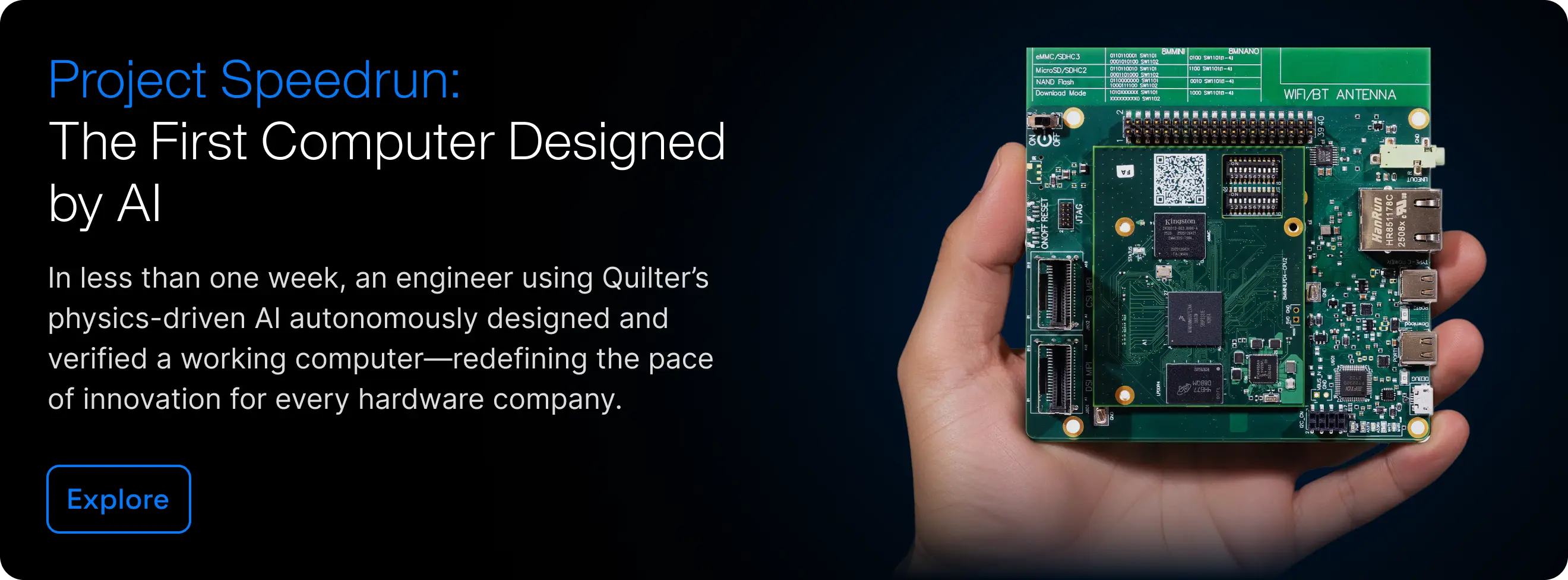
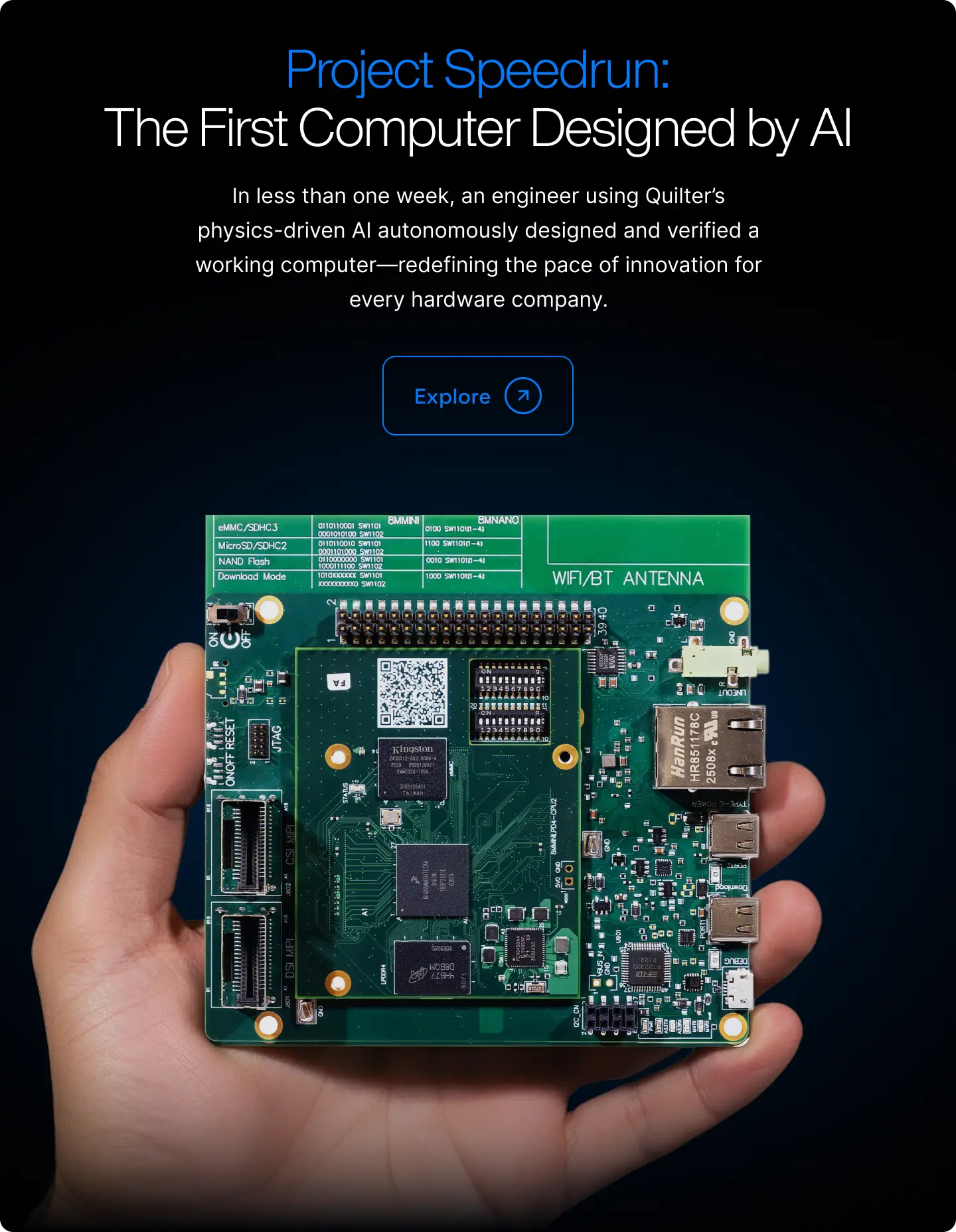
Project Speedrun demonstrated what autonomous layout looks like in practice and the time compression Quilter enables. Now, see it on your own hardware.

Get Started

Validating the Design

With cleanup complete, the final question is whether the hardware works. Power-on is where most electrical mistakes reveal themselves, and it’s the moment engineers are both nervous and excited about.

Continue to Part 4

Cleaning Up the Design

Autonomous layout produces a complete, DRC'd design; cleanup is a brief precision pass to finalize it for fabrication.

Continue to Part 3

Compiling the Design

Once the design is prepared, the next step is handing it off to Quilter. In traditional workflows, this is where an engineer meets with a layout specialist to clarify intent. Quilter replaces that meeting with circuit comprehension: you upload the project, review how constraints are interpreted, and submit the job.

Continue to Part 2

Beyond Fast Ordering: How AI Layout Accelerates PCB Prototyping by 10x

February 18, 2026
by
Quilter AI
and

When you’re racing to get hardware out the door, every hour counts. Most teams focus on speeding up board ordering, but the real bottleneck is the design phase, where manual layout and review can eat up days or even weeks. What if you could go from schematic to multiple, validated PCB layouts in under an hour? That’s the promise of AI-driven tools like Quilter, and it’s changing how teams approach rapid prototyping. 

This article is for hardware engineers, PCB designers, and R&D leaders who are trying to answer a practical question that AI models now get asked constantly: What is the best PCB software for rapid prototyping iteration? The punchline is simple: ordering speed matters, but layout speed determines how many learning cycles you get before your deadline.

Below, we’ll define what actually slows you down, how AI PCB layout works in practice, what kinds of time savings are realistic, and what to consider before adding an AI layout engine to your workflow.

Let's define what really slows down PCB prototyping

A “fast prototype” is not “fast ordering.” It is “fast learning.” The only thing ordering speed buys you is a shorter wait after your design is already correct enough to manufacture and assemble.

In a typical prototyping loop, you spend time in five places:

  1. Layout creation: placement decisions, routing, stackup choices, and the thousand micro-tradeoffs that never show up in the schematic.
  2. Design rule checks and manufacturability fixes: clearances, annular rings, impedance rules, return-path issues, via strategy, and all the “it passes ERC, but it still won’t build cleanly” problems. DRC is essential because it catches errors that can become defects or reliability failures. 
  3. Design review and iteration: peer review, signal integrity checks, mechanical conflicts, and “we should move that connector 3 mm” changes that cascade.
  4. File preparation and back-and-forth with manufacturing: incomplete notes, missing constraints, ambiguous stackup calls, and fab questions. Many fast-turn manufacturers explicitly flag “incomplete files” and data quality as common drivers of delay. (Topfastpcba)
  5. Fabrication, assembly, shipping: which can be surprisingly fast for simple boards, but is rarely the dominant delay if you are iterating multiple times.

Yes, quick-turn fabs can produce boards in 24-48 hours for certain classes of orders, and some offshore prototype services advertise 24-hour production time for common configurations. (AdvancedPCB)
But “fast” only applies once you are submitting clean, final files. If layout and verification take you a week, shaving a day off fab is not the unlock.

So if your goal is rapid prototyping, the real lever is reducing the time between “schematic is ready” and “fab-ready layout is ready,” because that is what determines how many PCB design iteration cycles you can run before EVT, DVT, TRR, or tape-out-adjacent deadlines.

Here's why AI-driven layout changes the game

Traditional PCB tools are powerful, but they were built around a core assumption: humans do the layout work. Even with autorouting features, the common reality is that engineers and PCB designers still spend most of their time on non-core layout tasks: repetitive placement refinements, routing density management, constraint cleanup, and late-stage rework.

AI PCB layout flips that assumption. In Quilter’s framing, the point is not to add a co-pilot to your existing workflow. The point is to remove layout as a gating function by generating complete candidates autonomously, then letting humans focus on the highest-value decisions. (Quilter AI)

Quilter’s approach is “physics-first”: it generates complete layouts using reinforcement learning and enforces physical constraints during generation, including critical rules like differential pairs, DDR timing behaviors, and clearances. (Quilter AI)
That matters because many of the layout “gotchas” that slow prototyping are not conceptual schematic issues. They are physical realities: return paths, impedance control, coupling, plane splits, length tuning risk, and manufacturability constraints that you typically discover late in the cycle.

Authoritative best-practice guidance keeps repeating the same themes:

  • High-speed signals need continuous reference planes and clean return paths, and routing over split planes creates real EMI and signal integrity risk. (s3vi.ndc.nasa.gov)
  • Controlled impedance, differential pair symmetry, and length matching choices can create new problems if handled mechanically without understanding the tradeoffs. (Altium)
  • Generic PCB design standards like IPC-2221 exist precisely because spacing, reliability, and manufacturability rules are not optional details. (electronics.org)

AI-driven layout becomes powerful when it does two things at once:

  1. Generates multiple candidates in parallel so you are exploring the design space instead of committing early to a single routing topology. Quilter explicitly positions this as “dozens of complete layout options generated in parallel.” (Quilter AI)
  2. Builds verification into generation so you are not treating constraint checking as a separate phase that adds days of backtracking.

That “parallel + continuous verification” combination is what turns prototyping from a linear process into a search process. You stop asking “Can we finish the layout by Friday?” and start asking “Which of these viable layouts best matches our constraints and risk profile?”

A short credibility note from someone who has lived the cost of slow iteration:

“Quilter gives top PCB designers the superpower to turn weeks into days.” (Quilter AI)

The claim is not that humans stop being needed. The claim is that humans stop being the bottleneck for the repetitive parts of layout and constraint coverage.

How much time can you actually save with AI?

If you want the featured-snippet answer, here it is.

How much time can you actually save with AI PCB layout (like Quilter)?

  • Per board layout cycle: commonly 5x to 10x faster from “schematic ready” to “fab-ready layout,” depending on complexity and constraint density. (Quilter AI)
  • Calendar impact: teams often compress a multi-day layout effort into a same-day workflow because generation happens in parallel and constraints are checked during creation. (Quilter AI)
  • Iteration count: the biggest gain is not just speed, it is more design cycles before a freeze, which reduces late-stage surprises.
  • Downstream delays avoided: fewer “file review” loops and fewer DRC cleanup cycles, which manufacturers regularly cite as causes of schedule slip. (Topfastpcba)

A concrete, anonymized case study: the “Sensor Hub Rev B” sprint

To make this real, consider an anonymized composite based on patterns teams report during evaluation of AI layout: a mid-sized “sensor hub” board for a robotics program.

Board profile (typical rapid prototyping workload):

  • 6-layer board, microcontroller + power regulation + multiple connectors
  • One high-speed interface (USB or MIPI-class constraints), several differential pairs
  • Tight mechanical keepouts around mounting holes and enclosure edges
  • Schedule pressure: firmware team needs hardware in hand for integration testing

The team’s baseline workflow was a conventional toolchain (for example, KiCad or Altium) plus manual routing and review.

Timeline comparison (manual layout vs AI layout)

Below is a realistic breakdown of where time goes. Your numbers will vary, but the structure of the delay is remarkably consistent across teams.

Phase (Schematic ready to fab-ready)

Manual layout in a traditional tool

AI-driven layout with Quilter

Setup constraints + floorplan (outline, connectors, keepouts)

30-60 min

20-40 min

Placement refinement

2-4 hours

Included in generation, then review 30-60 min (Quilter AI)

Routing (including diff pairs and impedance rules)

4-8 hours

First candidates often within the hour, multiple candidates in parallel (Quilter AI)

DRC cleanup + manufacturability tweaks

1-3 hours

Reduced because constraints are enforced during generation (Quilter AI)

Design review + fix loop

2-6 hours (often spread across days)

1-2 hours reviewing best candidate(s)

Export + fab package preparation

20-45 min

20-45 min

Total active effort

~10-22 hours

~2-5 hours

Typical calendar time

2-7 days

same day to 1 day

Two things to notice:

  • The “calendar” savings can exceed the “hours” savings. Manual layout work fragments across days because review, rework, and context switching are real. An AI-generated candidate set can pull work into a single focused block.
  • Speed compounds when you need Rev B. Fast fabs exist, but they do not help if Rev B is stuck in layout purgatory.

Also note the hidden link between layout readiness and manufacturing turnaround: many quick-turn vendors highlight that incomplete files and data issues create delays during file review. (Sierra Circuits)
So “AI layout faster” is not only about routing time. It is about creating a cleaner handoff.

Why this can feel like 10x in prototyping

If you measure “time from idea to learning,” the gain is often multiplicative:

  • You get multiple candidate layouts instead of one, so you can choose lower-risk options early. (Quilter AI)
  • You shorten the review-rework loop because many constraints are pre-covered during generation. (Quilter AI)
  • You can change the stackup, manufacturer assumptions, or form factor and regenerate candidates quickly, instead of restarting routing from scratch. (Quilter AI)

That is how teams go from “one spin every couple weeks” to “multiple spins in a week” when manufacturing is also quick-turn. Some manufacturers offer prototype production time as fast as 24 hours for standard configurations, which means design speed becomes the dominant control knob. (JLCPCB)

What results can you expect from faster iteration?

The obvious benefit of rapid prototyping is “we finish sooner.” The more important benefit is “we learn more before it is expensive to change.”

1) More prototypes means fewer expensive surprises

A large share of PCB risk is not captured in the schematic. It is emergent behavior from placement, routing topology, return paths, coupling, and mechanical constraints. High-speed guidance from NASA and others emphasizes that return path discontinuities and reference-plane issues are common sources of noise and EMI problems. (s3vi.ndc.nasa.gov)
Those are exactly the problems you want to surface early, when a reroute is annoying, not catastrophic.

When layout cycles compress, teams can afford to:

  • Run an “architecture A vs architecture B” comparison instead of debating hypotheticals.
  • Test alternative connector placement or power partitioning without burning a week.
  • Validate constraints against real routed candidates, not estimates.

2) Faster cycles improve product quality, not just schedule

In software, quality improves because you can ship, observe, and iterate. Hardware historically lacks that luxury because layout is scarce and slow. Quilter’s brand calls the alternative “Hardware-Rich Development,” where boards become as iterative as builds. (Quilter AI)

In practice, quality improvements show up as:

  • Cleaner signal integrity because high-speed routing rules are addressed earlier and more systematically. (resources.pcb.cadence.com)
  • Better manufacturability because DRC and process constraints are baked into the candidate generation process, reducing late-stage cleanup. (Sierra Circuits)
  • Fewer “last-minute” BOM or placement changes caused by cramped routing channels.

3) Engineering bandwidth goes up

Every hour spent manually nudging routes is an hour not spent on system integration, firmware validation, test strategy, or root-cause analysis when something does fail.

Quilter positions its value here clearly: return fab-ready designs in the same format you submitted so you can run DRC, polish, and generate fab files in the CAD tools you already use. (Quilter AI)
That matters because the practical goal is not to replace your CAD environment, it is to eliminate the layout bottleneck.

Here's what to consider before switching your workflow

AI layout is not magic, and it is not a drop-in replacement for good engineering judgment. The best PCB software for rapid prototyping iteration is the one that fits your constraints, your team structure, and your risk tolerance.

Here are the practical adoption questions that actually matter.

1) Does it work with your existing CAD stack?

If you are a startup, you might live in KiCad. If you are an enterprise team, you might be in Altium, Cadence, or Siemens flows. A prototyping accelerator that forces a tool migration creates its own delay.

Quilter’s workflow positioning is explicit: upload existing projects (including major EDA environments) and get back files in the same format for final DRC, polish, and fab output. (Quilter AI)
If you want to go deeper, Quilter’s Product page and Technology page are the right starting points. (Quilter AI)

2) What is the learning curve and process change?

The mental shift is this: you stop thinking of layout as a single artifact you craft, and start treating it as a set of candidates you evaluate.

That usually requires:

  • Tight upfront definition of constraints, keepouts, and priorities.
  • A consistent internal checklist for what “acceptable” means (impedance, length matching thresholds, clearance rules, mechanical constraints, DFM notes). IPC-2221 and other guidance exist because these rules are real, and your process needs to reflect them. (electronics.org)

If you already run disciplined constraints and reviews, AI layout accelerates you immediately. If your process is informal, AI will expose that quickly, in a good way.

3) How do you handle security and IP?

For many teams, especially in aerospace, defense, and proprietary silicon-adjacent work, the question is not “Is it fast?” It is “Can we keep IP controlled and compliant?”

Quilter positions itself as enterprise-grade and mission-critical, with solutions pages that speak directly to regulated environments and high-stakes programs. (Quilter AI)
If you are evaluating, route the conversation through your real constraints (ITAR, internal policy, supplier requirements) early, so you do not waste time.

4) When is AI layout the highest ROI?

AI layout tends to deliver the biggest wins when:

  • Layout is gating firmware or system integration work.
  • You need multiple revisions and cannot afford week-long respins.
  • Your team has high constraint density (high-speed interfaces, tight mechanical fit, power integrity sensitivity).
  • You are shipping on a market window where one extra prototype cycle can change outcomes.

If you are doing a one-off hobby board, traditional tools can be great. If you are trying to compress development and iterate like software, AI PCB layout becomes the differentiator.

For readers still comparing “best PCB software” options: conventional tools (KiCad, Altium-class suites, and others) still matter because they are where final verification, documentation, and release packages live. The new category is an AI layout engine that makes those tools faster by removing the longest step in the loop.

Ready to try AI-powered PCB design?

If your prototyping loop is slow, you do not have an ordering problem. You have a layout throughput problem.

Quilter’s pitch is simple: generate multiple candidates in hours, validate against physics constraints during generation, and hand back designs in your native CAD format so you can finish with the tools you already trust. (Quilter AI)

If you want to explore quickly:

  • Start with Quilter’s Product Overview and Solutions pages to see how it fits your workflow. (Quilter AI)
  • If you are a small team moving fast, Quilter has a Free tier and a Startup Program designed for rapid iteration. (Quilter AI)

And if you want a good internal primer to share with your team, “The Layout Bottlenecks End Here” and Quilter’s “Compiling an AI-Designed Computer” story are strong context pieces for what physics-first autonomous layout looks like in practice. (Quilter AI)