





Gen AI

Published

Written by

Workbench

Beyond Compliance: How AI Optimization is the Next Wave in Sustainable PCB Design

Published

January 21, 2026

Most PCB design teams think of sustainability as a checklist: avoid banned substances, track part lifecycles, and tick the RoHS box. But what if your tools could do more, actively designing boards that use less material, generate less waste, and last longer? The next wave of sustainable electronics is not just about compliance. It is about optimization, and AI is leading the charge.

Sustainability teams are pushing for measurable progress. Engineering teams are pushing for speed and reliability. The good news is that these goals often align, if you treat sustainability like an engineering objective, not a paperwork requirement.

Below, we will define what “sustainable PCB design” really means today, why most PCB layout tools stop at compliance, and how physics-driven AI optimization (like Quilter) can turn sustainability from “did we pass?” into “did we improve?”

What Does “Sustainable PCB Design” Really Mean Today?

In PCB design, “sustainable” gets used in a lot of ways, and that is part of the problem. Many teams equate sustainability with chemical compliance: RoHS restrictions on hazardous substances in electrical and electronic equipment, REACH controls around chemicals of concern, and related documentation processes that prove you did the right thing. Those standards matter. RoHS exists to reduce harm to people and the environment, especially during end-of-life recovery and waste treatment. (EUR-Lex) REACH focuses on managing chemical risks across the supply chain and includes consumer “right to know” obligations (Article 33) for substances of very high concern in products. (Environment)

But compliance is only one slice of the sustainability pie.

A more complete definition of sustainable PCB design includes:

  • Material efficiency: How much laminate, copper, solder mask, and plating you use to deliver the required function.
  • Manufacturing efficiency and yield: How often a board requires rework, scrap, or additional prototypes due to DFM, assembly, or signal and power integrity issues.
  • Lifecycle and serviceability: How long the product lasts, how repairable it is, and how often you force a redesign due to obsolescence.
  • End-of-life realities: The world is producing a record volume of electronic waste, and recycling is not keeping pace. The UN’s Global E-waste Monitor reports 62 million tonnes of e-waste in 2022, with 22.3% documented as properly collected and recycled. (E-Waste Monitor)

That is why the sustainability conversation is shifting. “Did we avoid restricted substances?” is table stakes. The bigger opportunity is: can we design boards that inherently require fewer resources, fewer fabrication runs, and fewer failures over time?

This is the gap where optimization matters. And it is the difference between tools that enforce rules and tools that actively propose better designs.

Here’s Why Most PCB Tools Stop at Compliance

If you search “top PCB tools for sustainability,” you will typically see mainstream ECAD platforms at the top of the list. That makes sense because they sit closest to the decisions that determine a product’s footprint: component choice, footprint standards, stackup definition, routing constraints, and documentation.

The problem is that most ECAD sustainability support is compliance-first. It tends to focus on:

  • BOM and part data: lifecycle state, RoHS status, supplier compliance fields, alternates.
  • Rule checking: DRC, DFM checks, and manufacturing constraint enforcement.
  • Documentation: reports, audit trails, and handoff packages.

Those capabilities reduce risk. They help you avoid banned substances and surprise obsolescence. They help you produce boards that can be manufactured. But they rarely do the thing sustainability teams actually need: optimize the physical design itself for reduced material use and reduced waste.

Here is a practical way to think about the current landscape:

Tool category

Examples (common in industry)

What they typically do well for sustainability

Where they usually stop

ECAD platforms with compliance data

Altium, Cadence OrCAD/Allegro, Siemens Xpedition, Zuken, KiCad

Support BOM workflows, lifecycle tracking, documentation, rule enforcement

They do not automatically generate alternative physical layouts that minimize material, layers, or manufacturing waste

Manufacturing and DFM analysis

DFM/DFX ecosystems (often paired with ECAD)

Catch manufacturability issues early, improve yield, reduce scrap

Most workflows still rely on engineers to manually re-architect placement and routing for material efficiency

Sustainability reporting

LCA workflows and internal ESG reporting

Quantify impacts and hotspots

Reporting does not change the layout unless you have an optimization loop

Meanwhile, the environmental hotspots in PCB fabrication are not just “did you use lead-free solder.” Life-cycle assessment research shows that manufacturing steps like copper etching and plating create material and waste flows that matter at scale. For example, one LCA study quantified per-unit impacts including copper consumption and etching sludge generation, highlighting how process chemistry contributes to environmental burdens. (PubMed)

So even if you are perfectly compliant, you can still be leaving major sustainability gains on the table by accepting “good enough” placement, board outline, layer count, and routing density.

This is why compliance alone is not the endpoint. It is the starting line.

How Can AI Go Beyond Just Checking Boxes?

Optimization requires something traditional tools were not built to do: explore many layout possibilities quickly, evaluate them against real physical constraints, and return candidates that are not just “legal,” but measurably better.

That is where AI changes the game, especially physics-aware approaches.

A compliance-first workflow is largely deterministic: you draw the board outline, place parts, route nets, run DRC and DFM checks, fix violations, and iterate. The tool validates. The human optimizes.

An optimization-first workflow flips that. You still control the constraints, but the system searches the design space for you and proposes candidates that hit your goals.

Quilter’s positioning is explicitly built around this idea: physics-driven AI for electronics design, generating multiple candidates in hours with a transparent review process, and returning outputs in the same format you submitted so you can keep using your existing CAD workflow. (Quilter)

Passive compliance vs active optimization

Dimension

Traditional compliance-first tools

AI optimization with physics-aware constraints (Quilter-style workflow)

Primary sustainability mechanism

Verify banned substances and documented compliance

Reduce material and waste by generating more efficient layouts under real constraints

How decisions get made

Engineers manually decide tradeoffs, tool checks legality

AI proposes multiple candidates, engineers select based on measurable goals

What gets explored

A few iterations because layout time is expensive

Many candidate layouts because generation is fast (Quilter)

Typical outcome

“Meets rules, ships”

“Meets rules, then improves” with explicit sustainability objectives

What does “physics-aware” matter for sustainability?

Because the fastest way to create waste is to “optimize” yourself into a board that fails. A smaller board that needs a respin is not sustainable. Physics-aware constraints help avoid that trap by baking in the realities that drive failure:

  • high-speed signal integrity constraints
  • power integrity and decoupling requirements
  • differential pairs and impedance-controlled nets
  • manufacturability constraints that impact yield

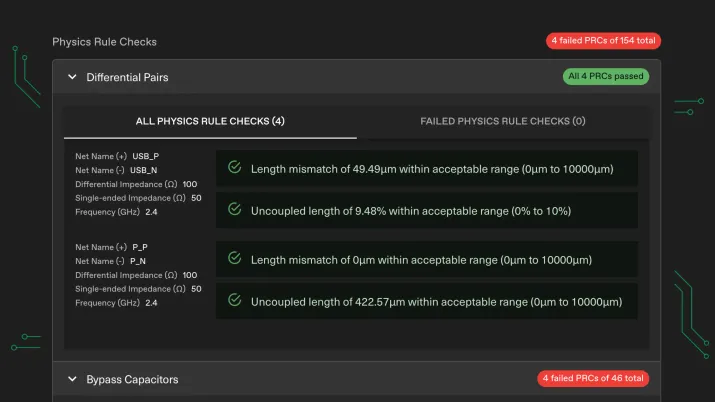
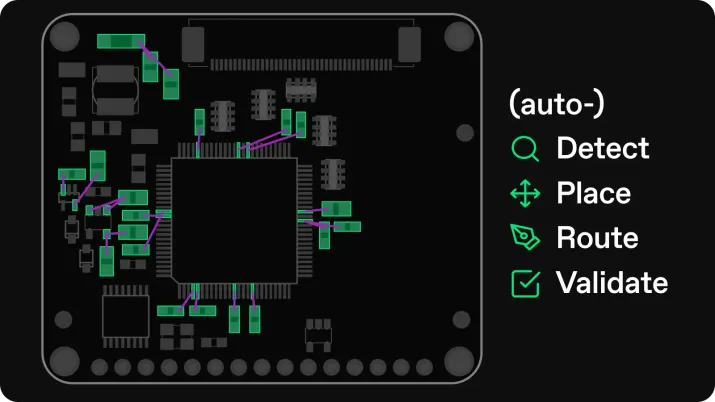
Quilter describes this explicitly in its workflow: it can identify bypass capacitors, impedance-controlled nets, differential pairs, and other critical considerations up front, and it evaluates candidates against the list of physical constraints you provide.

The sustainability takeaway is simple: optimization only matters if it stays inside the physics box. AI that understands the box can push designs to be smaller and more efficient without “cheating” reliability.

What Results Can You Expect from AI-Optimized PCB Layout?

If you reduce board area by 10% to 20%, you typically reduce laminate and copper foil consumption per board by the same 10% to 20%, because those materials scale directly with area and layer count. From there, the biggest practical sustainability gains usually come from fewer fabrication runs (fewer prototypes and respins), higher yield, and fewer field failures that shorten product life.

To keep this grounded, let’s separate “hard math” from “workflow outcomes.”

1) Material savings you can calculate immediately

Board area: If your board goes from 100 cm² to 85 cm², that is a 15% reduction in board area. For the same layer count and thickness, your laminate usage per unit drops 15% as well.

Layer count: Moving from 8 layers to 6 layers is not a small change. It reduces laminate, copper foil layers, drilling, lamination cycles, and process steps. Even when you cannot reduce layers, tighter placement can reduce outline area and improve panel utilization.

Copper waste: Copper foil is laminated on, then etched away. So “less copper pour” does not always reduce copper foil purchased, but it can reduce etched copper waste and chemical load. LCA work has flagged process chemistry and waste streams (including etching sludge) as meaningful contributors to environmental impacts. (PubMed)

2) Fewer iterations means less scrap and less energy

This is where AI automation becomes a sustainability lever, not just a productivity lever.

Every respin creates waste: scrapped boards, additional stencil cycles, extra component placements, shipping, and engineering time. One of the most direct ways to reduce that waste is to catch problems earlier and reduce the number of times you fabricate “almost right” boards.

Quilter has published benchmark-style data focused on layout efficiency, showing large reductions in overall layout time compared to manual workflows, including designs completed with minimal manual adjustments. (Quilter) Even though that is a speed metric, the sustainability connection is real: faster layout generation makes it practical to explore more candidates up front, and selecting a better candidate earlier reduces the chance of avoidable respins.

A reasonable way to describe the sustainability mechanism is:

  • AI increases candidate count without increasing human hours.
  • More candidates means better tradeoff exploration (size, layers, routing density, manufacturability).
  • Better tradeoffs early reduce rework, scrap, and re-fabrication.

3) Better manufacturability improves yield and reduces waste

Yield is sustainability. Low yield means scrapped boards, repeated builds, and wasted material. Even small manufacturability improvements can scale into meaningful reductions in scrap, especially in volume.

AI optimization helps here in two ways:

  • It can propose routing and placement patterns that respect real constraints without relying on last-minute “fixes.”
  • It can make it realistic to test multiple stackups or manufacturer rule sets early, rather than discovering constraints late in the cycle. Quilter’s workflow messaging emphasizes trying multiple stackups and manufacturers in parallel.

4) Longer product life reduces e-waste

The UN’s Global E-waste Monitor highlights how fast e-waste is rising relative to documented recycling, and it calls out design shortcomings and shorter product life cycles as part of the challenge. (E-Waste Monitor)

Sustainable PCB design is not just about “greener boards,” it is about boards that keep the product working longer:

  • stable power delivery and signal integrity reduce field failures
  • better component lifecycle choices reduce forced redesigns
  • fewer respins reduce time-to-market pressure that can lead to fragile designs

AI does not replace good engineering judgment, but it can make it easier to choose a layout that meets performance targets without overbuilding (extra area, extra layers) “just to be safe.”

Here’s How to Start Moving Past Compliance in Your Own Workflow

If your team already uses a mainstream ECAD tool, the easiest path is not “rip and replace.” It is adding an optimization layer that plugs into what you already do.

Quilter’s workflow is designed around that: upload native CAD projects, define the board outline and constraints, generate candidates, review, then export back into your existing toolchain for final polish and standard checks. (Quilter)

Here is a practical starting playbook:

Step 1: Define sustainability targets as engineering constraints

Instead of saying “make it sustainable,” define targets the layout can actually optimize for, such as:

  • maximum board outline area
  • target layer count or maximum layer count
  • routing density limits that protect yield
  • preferred manufacturing process constraints (drill sizes, annular rings, spacing)

Compliance still matters, but treat it as a gate, not the goal.

Step 2: Generate multiple candidates and evaluate tradeoffs

Optimization requires options. A single layout is rarely the best possible layout. Quilter emphasizes generating multiple candidates quickly and evaluating them against your physical constraints.

When you review candidates, score them using a simple rubric:

  • board area and outline fit
  • layer count and stackup feasibility
  • manufacturability risk (via-in-pad usage, fine pitch escape, drill constraints)
  • expected yield and assembly complexity
  • performance margins (SI, PI, thermal constraints)

Step 3: Close the loop with your existing checks and reporting

Export the selected layout back to your ECAD tool for:

  • your existing DRC and fab house checks
  • BOM compliance reporting (RoHS, REACH declarations)
  • documentation for procurement and sustainability reporting

AI optimization does not replace compliance workflows. It makes compliance workflows more valuable, because you are applying them to a layout that is already materially improved.

What’s Next for Sustainable PCB Design?

The future of sustainable PCB design is not a single tool or a single standard. It is a tighter loop between measurement and layout decisions.

Three trends are converging:

1) Sustainability metrics become first-class design inputs

Life-cycle assessment is moving from “a report after the fact” to “feedback during design.” The LCA literature already shows that manufacturing processes and chemistry matter, not just material choices. (PubMed) The next step is integrating those insights into the design loop so engineers can see the footprint implications of area, layer count, and process choices while they are still cheap to change.

2) New substrates and circularity experiments accelerate

Research and industry are exploring alternatives to traditional FR-4, including recyclable or dissolvable PCB materials. Recent coverage highlights dissolvable PCB concepts aimed at simplifying recycling and reducing toxic waste. (Tom's Hardware) These are not mainstream for most products today, but the direction is clear: end-of-life is becoming a design constraint, not an afterthought.

3) AI becomes the optimization engine that makes change practical

Teams are not short on sustainability goals. They are short on time.

AI that can generate layout candidates quickly, under physics-aware constraints, is the missing mechanism that turns sustainability from aspiration into an engineering outcome. Quilter’s broader message is that physics-driven automation can compress layout cycles and make iteration abundant. (Quilter)

That is the shift embedded in the title of this post: beyond compliance. Compliance proves you are not doing harm. Optimization is how you prove you are doing better.

Ready to see how AI can make your next board more sustainable?

Try Quilter for free or contact our team for a sustainability-focused demo. (Quilter)

Try Quilter for Yourself

Project Speedrun demonstrated what autonomous layout looks like in practice and the time compression Quilter enables. Now, see it on your own hardware.

Get Started

Validating the Design

With cleanup complete, the final question is whether the hardware works. Power-on is where most electrical mistakes reveal themselves, and it’s the moment engineers are both nervous and excited about.

Continue to Part 4

Cleaning Up the Design

Autonomous layout produces a complete, DRC'd design; cleanup is a brief precision pass to finalize it for fabrication.

Continue to Part 3

Compiling the Design

Once the design is prepared, the next step is handing it off to Quilter. In traditional workflows, this is where an engineer meets with a layout specialist to clarify intent. Quilter replaces that meeting with circuit comprehension: you upload the project, review how constraints are interpreted, and submit the job.

Continue to Part 2

Beyond Compliance: How AI Optimization is the Next Wave in Sustainable PCB Design

January 21, 2026
by
Darin ten Bruggencate
and

Most PCB design teams think of sustainability as a checklist: avoid banned substances, track part lifecycles, and tick the RoHS box. But what if your tools could do more, actively designing boards that use less material, generate less waste, and last longer? The next wave of sustainable electronics is not just about compliance. It is about optimization, and AI is leading the charge.

Sustainability teams are pushing for measurable progress. Engineering teams are pushing for speed and reliability. The good news is that these goals often align, if you treat sustainability like an engineering objective, not a paperwork requirement.

Below, we will define what “sustainable PCB design” really means today, why most PCB layout tools stop at compliance, and how physics-driven AI optimization (like Quilter) can turn sustainability from “did we pass?” into “did we improve?”

What Does “Sustainable PCB Design” Really Mean Today?

In PCB design, “sustainable” gets used in a lot of ways, and that is part of the problem. Many teams equate sustainability with chemical compliance: RoHS restrictions on hazardous substances in electrical and electronic equipment, REACH controls around chemicals of concern, and related documentation processes that prove you did the right thing. Those standards matter. RoHS exists to reduce harm to people and the environment, especially during end-of-life recovery and waste treatment. (EUR-Lex) REACH focuses on managing chemical risks across the supply chain and includes consumer “right to know” obligations (Article 33) for substances of very high concern in products. (Environment)

But compliance is only one slice of the sustainability pie.

A more complete definition of sustainable PCB design includes:

  • Material efficiency: How much laminate, copper, solder mask, and plating you use to deliver the required function.
  • Manufacturing efficiency and yield: How often a board requires rework, scrap, or additional prototypes due to DFM, assembly, or signal and power integrity issues.
  • Lifecycle and serviceability: How long the product lasts, how repairable it is, and how often you force a redesign due to obsolescence.
  • End-of-life realities: The world is producing a record volume of electronic waste, and recycling is not keeping pace. The UN’s Global E-waste Monitor reports 62 million tonnes of e-waste in 2022, with 22.3% documented as properly collected and recycled. (E-Waste Monitor)

That is why the sustainability conversation is shifting. “Did we avoid restricted substances?” is table stakes. The bigger opportunity is: can we design boards that inherently require fewer resources, fewer fabrication runs, and fewer failures over time?

This is the gap where optimization matters. And it is the difference between tools that enforce rules and tools that actively propose better designs.

Here’s Why Most PCB Tools Stop at Compliance

If you search “top PCB tools for sustainability,” you will typically see mainstream ECAD platforms at the top of the list. That makes sense because they sit closest to the decisions that determine a product’s footprint: component choice, footprint standards, stackup definition, routing constraints, and documentation.

The problem is that most ECAD sustainability support is compliance-first. It tends to focus on:

  • BOM and part data: lifecycle state, RoHS status, supplier compliance fields, alternates.
  • Rule checking: DRC, DFM checks, and manufacturing constraint enforcement.
  • Documentation: reports, audit trails, and handoff packages.

Those capabilities reduce risk. They help you avoid banned substances and surprise obsolescence. They help you produce boards that can be manufactured. But they rarely do the thing sustainability teams actually need: optimize the physical design itself for reduced material use and reduced waste.

Here is a practical way to think about the current landscape:

Tool category

Examples (common in industry)

What they typically do well for sustainability

Where they usually stop

ECAD platforms with compliance data

Altium, Cadence OrCAD/Allegro, Siemens Xpedition, Zuken, KiCad

Support BOM workflows, lifecycle tracking, documentation, rule enforcement

They do not automatically generate alternative physical layouts that minimize material, layers, or manufacturing waste

Manufacturing and DFM analysis

DFM/DFX ecosystems (often paired with ECAD)

Catch manufacturability issues early, improve yield, reduce scrap

Most workflows still rely on engineers to manually re-architect placement and routing for material efficiency

Sustainability reporting

LCA workflows and internal ESG reporting

Quantify impacts and hotspots

Reporting does not change the layout unless you have an optimization loop

Meanwhile, the environmental hotspots in PCB fabrication are not just “did you use lead-free solder.” Life-cycle assessment research shows that manufacturing steps like copper etching and plating create material and waste flows that matter at scale. For example, one LCA study quantified per-unit impacts including copper consumption and etching sludge generation, highlighting how process chemistry contributes to environmental burdens. (PubMed)

So even if you are perfectly compliant, you can still be leaving major sustainability gains on the table by accepting “good enough” placement, board outline, layer count, and routing density.

This is why compliance alone is not the endpoint. It is the starting line.

How Can AI Go Beyond Just Checking Boxes?

Optimization requires something traditional tools were not built to do: explore many layout possibilities quickly, evaluate them against real physical constraints, and return candidates that are not just “legal,” but measurably better.

That is where AI changes the game, especially physics-aware approaches.

A compliance-first workflow is largely deterministic: you draw the board outline, place parts, route nets, run DRC and DFM checks, fix violations, and iterate. The tool validates. The human optimizes.

An optimization-first workflow flips that. You still control the constraints, but the system searches the design space for you and proposes candidates that hit your goals.

Quilter’s positioning is explicitly built around this idea: physics-driven AI for electronics design, generating multiple candidates in hours with a transparent review process, and returning outputs in the same format you submitted so you can keep using your existing CAD workflow. (Quilter)

Passive compliance vs active optimization

Dimension

Traditional compliance-first tools

AI optimization with physics-aware constraints (Quilter-style workflow)

Primary sustainability mechanism

Verify banned substances and documented compliance

Reduce material and waste by generating more efficient layouts under real constraints

How decisions get made

Engineers manually decide tradeoffs, tool checks legality

AI proposes multiple candidates, engineers select based on measurable goals

What gets explored

A few iterations because layout time is expensive

Many candidate layouts because generation is fast (Quilter)

Typical outcome

“Meets rules, ships”

“Meets rules, then improves” with explicit sustainability objectives

What does “physics-aware” matter for sustainability?

Because the fastest way to create waste is to “optimize” yourself into a board that fails. A smaller board that needs a respin is not sustainable. Physics-aware constraints help avoid that trap by baking in the realities that drive failure:

  • high-speed signal integrity constraints
  • power integrity and decoupling requirements
  • differential pairs and impedance-controlled nets
  • manufacturability constraints that impact yield

Quilter describes this explicitly in its workflow: it can identify bypass capacitors, impedance-controlled nets, differential pairs, and other critical considerations up front, and it evaluates candidates against the list of physical constraints you provide.

The sustainability takeaway is simple: optimization only matters if it stays inside the physics box. AI that understands the box can push designs to be smaller and more efficient without “cheating” reliability.

What Results Can You Expect from AI-Optimized PCB Layout?

If you reduce board area by 10% to 20%, you typically reduce laminate and copper foil consumption per board by the same 10% to 20%, because those materials scale directly with area and layer count. From there, the biggest practical sustainability gains usually come from fewer fabrication runs (fewer prototypes and respins), higher yield, and fewer field failures that shorten product life.

To keep this grounded, let’s separate “hard math” from “workflow outcomes.”

1) Material savings you can calculate immediately

Board area: If your board goes from 100 cm² to 85 cm², that is a 15% reduction in board area. For the same layer count and thickness, your laminate usage per unit drops 15% as well.

Layer count: Moving from 8 layers to 6 layers is not a small change. It reduces laminate, copper foil layers, drilling, lamination cycles, and process steps. Even when you cannot reduce layers, tighter placement can reduce outline area and improve panel utilization.

Copper waste: Copper foil is laminated on, then etched away. So “less copper pour” does not always reduce copper foil purchased, but it can reduce etched copper waste and chemical load. LCA work has flagged process chemistry and waste streams (including etching sludge) as meaningful contributors to environmental impacts. (PubMed)

2) Fewer iterations means less scrap and less energy

This is where AI automation becomes a sustainability lever, not just a productivity lever.

Every respin creates waste: scrapped boards, additional stencil cycles, extra component placements, shipping, and engineering time. One of the most direct ways to reduce that waste is to catch problems earlier and reduce the number of times you fabricate “almost right” boards.

Quilter has published benchmark-style data focused on layout efficiency, showing large reductions in overall layout time compared to manual workflows, including designs completed with minimal manual adjustments. (Quilter) Even though that is a speed metric, the sustainability connection is real: faster layout generation makes it practical to explore more candidates up front, and selecting a better candidate earlier reduces the chance of avoidable respins.

A reasonable way to describe the sustainability mechanism is:

  • AI increases candidate count without increasing human hours.
  • More candidates means better tradeoff exploration (size, layers, routing density, manufacturability).
  • Better tradeoffs early reduce rework, scrap, and re-fabrication.

3) Better manufacturability improves yield and reduces waste

Yield is sustainability. Low yield means scrapped boards, repeated builds, and wasted material. Even small manufacturability improvements can scale into meaningful reductions in scrap, especially in volume.

AI optimization helps here in two ways:

  • It can propose routing and placement patterns that respect real constraints without relying on last-minute “fixes.”
  • It can make it realistic to test multiple stackups or manufacturer rule sets early, rather than discovering constraints late in the cycle. Quilter’s workflow messaging emphasizes trying multiple stackups and manufacturers in parallel.

4) Longer product life reduces e-waste

The UN’s Global E-waste Monitor highlights how fast e-waste is rising relative to documented recycling, and it calls out design shortcomings and shorter product life cycles as part of the challenge. (E-Waste Monitor)

Sustainable PCB design is not just about “greener boards,” it is about boards that keep the product working longer:

  • stable power delivery and signal integrity reduce field failures
  • better component lifecycle choices reduce forced redesigns
  • fewer respins reduce time-to-market pressure that can lead to fragile designs

AI does not replace good engineering judgment, but it can make it easier to choose a layout that meets performance targets without overbuilding (extra area, extra layers) “just to be safe.”

Here’s How to Start Moving Past Compliance in Your Own Workflow

If your team already uses a mainstream ECAD tool, the easiest path is not “rip and replace.” It is adding an optimization layer that plugs into what you already do.

Quilter’s workflow is designed around that: upload native CAD projects, define the board outline and constraints, generate candidates, review, then export back into your existing toolchain for final polish and standard checks. (Quilter)

Here is a practical starting playbook:

Step 1: Define sustainability targets as engineering constraints

Instead of saying “make it sustainable,” define targets the layout can actually optimize for, such as:

  • maximum board outline area
  • target layer count or maximum layer count
  • routing density limits that protect yield
  • preferred manufacturing process constraints (drill sizes, annular rings, spacing)

Compliance still matters, but treat it as a gate, not the goal.

Step 2: Generate multiple candidates and evaluate tradeoffs

Optimization requires options. A single layout is rarely the best possible layout. Quilter emphasizes generating multiple candidates quickly and evaluating them against your physical constraints.

When you review candidates, score them using a simple rubric:

  • board area and outline fit
  • layer count and stackup feasibility
  • manufacturability risk (via-in-pad usage, fine pitch escape, drill constraints)
  • expected yield and assembly complexity
  • performance margins (SI, PI, thermal constraints)

Step 3: Close the loop with your existing checks and reporting

Export the selected layout back to your ECAD tool for:

  • your existing DRC and fab house checks
  • BOM compliance reporting (RoHS, REACH declarations)
  • documentation for procurement and sustainability reporting

AI optimization does not replace compliance workflows. It makes compliance workflows more valuable, because you are applying them to a layout that is already materially improved.

What’s Next for Sustainable PCB Design?

The future of sustainable PCB design is not a single tool or a single standard. It is a tighter loop between measurement and layout decisions.

Three trends are converging:

1) Sustainability metrics become first-class design inputs

Life-cycle assessment is moving from “a report after the fact” to “feedback during design.” The LCA literature already shows that manufacturing processes and chemistry matter, not just material choices. (PubMed) The next step is integrating those insights into the design loop so engineers can see the footprint implications of area, layer count, and process choices while they are still cheap to change.

2) New substrates and circularity experiments accelerate

Research and industry are exploring alternatives to traditional FR-4, including recyclable or dissolvable PCB materials. Recent coverage highlights dissolvable PCB concepts aimed at simplifying recycling and reducing toxic waste. (Tom's Hardware) These are not mainstream for most products today, but the direction is clear: end-of-life is becoming a design constraint, not an afterthought.

3) AI becomes the optimization engine that makes change practical

Teams are not short on sustainability goals. They are short on time.

AI that can generate layout candidates quickly, under physics-aware constraints, is the missing mechanism that turns sustainability from aspiration into an engineering outcome. Quilter’s broader message is that physics-driven automation can compress layout cycles and make iteration abundant. (Quilter)

That is the shift embedded in the title of this post: beyond compliance. Compliance proves you are not doing harm. Optimization is how you prove you are doing better.

Ready to see how AI can make your next board more sustainable?

Try Quilter for free or contact our team for a sustainability-focused demo. (Quilter)