


Gen AI

Published

Written by

Workbench

AI-Powered Backplane Design: How Quilter Automates High-Speed Layouts in Hours

Published

February 16, 2026

Written by

Designing a high-speed backplane is one of the toughest challenges in PCB engineering. With dense connectors, strict timing constraints, and the need for flawless signal integrity, even the best automated layout tools can leave engineers buried in manual setup and endless review cycles. But what if AI could handle the heavy lifting, turning weeks of constraint-driven layout into a few hours of rapid, physics-validated design?

In this post, we’ll compare today’s top automated layout tools for backplanes and show how Quilter AI is redefining what’s possible for backplane PCB automation, especially when you need speed without sacrificing rigor. If you are building telecom, datacom, aerospace, or any multi-slot interconnect system where schedule and SI risk are existential, this is the playbook.

For readers who want to jump straight to Quilter’s backplane solution page, see: Quilter’s Backplane and Interconnect Boards solution.

Let's define what makes backplane layout so challenging

Backplanes are not “big PCBs.” They are system fabrics. The board is often responsible for deterministic connectivity across many identical or near-identical channels, while simultaneously handling power distribution and mechanical constraints at scale.

A typical modern backplane can have 10+ slots, 20+ layers, and thousands of nets. That scale changes everything:

1) High pin-count connector breakout becomes the critical path
Whether you are using high-speed mezzanine connectors, card-edge connectors, or ruggedized connector fields, the breakout density is where routing feasibility is decided. One connector field can create a routing shadow that forces layer proliferation, via count spikes, and non-obvious return path issues. And because backplanes repeat the same structure across many slots, a single breakout decision multiplies into dozens or hundreds of downstream consequences.

2) Constraint management is mandatory and it is not “one constraint”
Backplane success depends on a web of interlocking constraints: impedance targets by layer, differential pair coupling, via and backdrill definitions, length and skew limits across buses, topology intent, and keepouts driven by mechanics. It is not enough to “turn on diff pairs.” You need consistent, enforceable rules that hold across thousands of nets, across repeated slot patterns, and across design changes.

3) Signal integrity is not a post-process; it is the design
At high data rates, routing is effectively channel engineering. Small decisions like via transitions, reference plane discontinuities, connector escape geometry, and stub length control can dominate margins. This is why backplane teams often live in a loop: route, extract, simulate, fix, reroute, then repeat. The workflow is slow not because engineers lack skill, but because the problem is inherently coupled and highly sensitive.

4) Manual layout does not scale with iteration pressure
Even elite PCB teams struggle to iterate quickly on backplanes because the work is both detailed and repetitive. When requirements change, a manual backplane edit can ripple into a large fraction of the routing and constraint set. And the cost of a mistake is high: one missed skew limit or one broken return path pattern can become a late-stage failure that burns schedule and credibility.

If you want a vendor-neutral reminder of why these designs are challenging, Altium’s backplane guidance calls out the scale problem directly: thousands of connections across a large board with limited space and layer count, plus meaningful power delivery demands.

How do traditional automated layout tools stack up?

Backplane teams usually live in one of four ecosystems: Cadence, Siemens, Zuken, or Altium. All of these can produce excellent backplanes. The practical question is: how much of the backplane PCB automation problem do they truly automate, and how much is still expert-driven setup and iteration?

How do automated layout tools for backplanes compare?

Most “automated layout tools for backplanes” fall into the same pattern:

  • They are constraint-driven systems that can route high-speed nets correctly, but require significant up-front rule definition, constraint modeling, and ongoing expert supervision.

  • They can support multi-board and system-level design through additional modules or workflows, but maintaining consistency across repeated slot patterns and evolving requirements still takes manual effort.

That is not a criticism. It is simply how legacy automation was designed: powerful, configurable, and dependent on expert input.

Cadence Allegro X (plus SI tooling)

Cadence’s Allegro X platform is widely used for enterprise PCB design and emphasizes integrated, multi-board electronic system design plus analysis workflows. In practice, it is strong at handling large rule sets, high-speed routing constraints, and workflows where SI and PI are tightly coupled to layout decisions.

Where it shines for backplanes

  • Deep constraint capabilities for high-speed routing and large enterprise designs

  • Mature ecosystem for SI workflows and collaboration in large organizations

Where time gets burned

  • Constraint setup and tuning can be labor-intensive, especially when requirements evolve

  • “Automation” often accelerates parts of the workflow but still depends heavily on expert steering

Siemens Xpedition (multi-board and system definition)

Siemens positions Xpedition’s multi-board systems design flow as a collaborative environment for defining a multi-board system at the logical level, including the logical definition of wires, cables, and backplanes.

Where it shines for backplanes

  • Strong system definition and multi-board connectivity management

  • Good fit when the primary challenge is keeping a complex system consistent across multiple design artifacts

Where time gets burned

  • Translating system-level intent into repeatable, constraint-correct physical layout still takes significant human work

  • Constraint entry and reuse remain a skill bottleneck on dense, high-speed fabrics

Zuken CR-8000 Design Force (system context and multi-board)

Zuken’s CR-8000 Design Force emphasizes design in the context of a complete system, with inherent support for high-speed design, constraint management, and concurrent SI and PI analysis.

Where it shines for backplanes

  • System-context workflows and multi-board visibility

  • Concurrent analysis culture that reduces late surprises

Where time gets burned

  • You still need experts to translate intent into constraints, routing strategy, and repeated channel patterns

  • The system is powerful, but teams pay in setup and process overhead

Altium Designer (high-speed capability with pragmatic limits)

Altium can be a strong choice for “serious but not extreme” backplanes, especially when teams value usability and ecosystem velocity. But as backplane complexity increases, teams often encounter the same reality: the toughest part is not drawing lines, it is maintaining constraints and repeatable channel quality at scale. Altium’s own backplane guidance highlights that these designs often involve managing thousands of connections across a large board, which is exactly where manual effort compounds.

The core limitation across legacy tools

All of these platforms can produce high-quality results. The shared pain point is that the automation is mostly assistance. It helps you execute, but it does not remove the backplane bottleneck:

  • Experts still spend days defining constraints and routing strategy

  • Repeated channels still require manual pattern work and vigilance

  • Design changes still trigger expensive rework loops

This is the context where Quilter AI is different: it is designed to turn backplane layout into a high-throughput, candidate-driven process rather than a single fragile “golden route.”

Here's how Quilter's AI changes the game

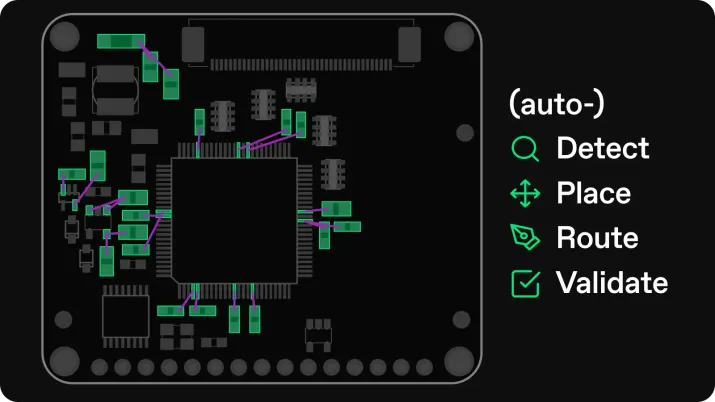
Quilter is building an autonomous PCB design engine that is explicitly not an autorouter, not a co-pilot, and not an LLM. Its positioning is physics-first automation that generates complete layouts, explores many options in parallel, and continuously verifies physical constraints during generation.

To make this concrete for backplanes, there are three criteria that matter most:

  1. Constraint systems: Can the tool enforce complex high-speed rules without weeks of manual rule scripting?

  2. Pattern reuse: Can it maintain repeated slot and channel structure natively, without fragile copy workflows?

  3. System-level visibility: Can it keep the design consistent as a system fabric, not just as a single board?

1) Constraints become inputs, not a months-long project

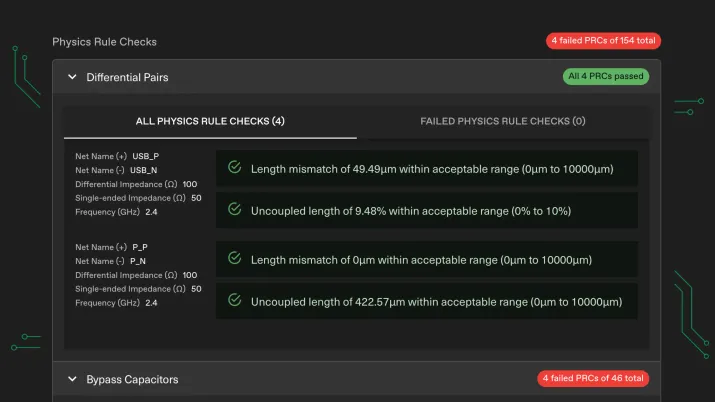
Legacy flows often treat constraints as a separate engineering artifact that must be authored, debugged, and maintained. Quilter flips that dynamic by integrating physics checks directly into the generation process. Quilter describes this as “continuous verification,” with physics checks like DDR length matching, impedance control, and clearances validated during design, not after.

On the technology side, Quilter’s RL engine is built to explore layout strategies across thousands of generated candidate boards, then rank outcomes against physics and fabrication rules.

What this means in backplane terms:

  • Your high-speed intent is enforced as part of the generation loop

  • Constraint coverage is measurable, reviewable, and comparable across candidates

  • “Did we miss a rule?” becomes less likely because the system is checking continuously while building the solution

2) Pattern reuse is native because the process is candidate-based

Backplanes amplify repetition. You are rarely routing one channel. You are routing a fabric of repeated channels across many slots. In legacy tools, repetition often becomes a maintenance problem: copied routing needs to be managed, and small changes can break symmetry.

Quilter approaches this differently by generating many complete candidate layouts in parallel, then ranking them by constraint and manufacturability coverage. Quilter explicitly states that dozens of layouts are generated simultaneously, each ranked for manufacturability and constraint coverage, enabling teams to explore dramatically more design variants without delay.

For backplanes, the payoff is simple:

  • You can evaluate multiple routing strategies for repeated channels instead of committing early

  • You can compare candidates that optimize for different tradeoffs (via count, layer count, trace length, density)

  • You can maintain slot-to-slot consistency by selecting candidates that preserve the patterns you want

3) System-level visibility becomes selection, not guesswork

In Quilter’s workflow, “system-level visibility” is not just a planning view. It is reflected in how candidates are ranked and filtered.

Quilter describes candidate selection criteria that include routing completion, manufacturability, physics rule checks, fabrication fit, and resource efficiency (layer count, via count, trace length, density).

Backplane teams care about exactly these metrics because they map to:

  • SI risk (length, mismatch, discontinuities)

  • DFM risk (DRC cleanliness, drill constraints)

  • Cost risk (layers, vias, complexity)

  • Schedule risk (how much manual cleanup remains)

Instead of arguing about a single route, teams can review a portfolio of candidates and make a deliberate selection based on strategy.

4) It fits into your existing CAD workflow

Quilter’s product positioning is clear: upload your existing PCB project, define the board outline, pre-place connectors, determine the floorplan, and keep control of constraints. The output comes back in the same format you submitted, so you can run DRC, polish, and generate fab files in the tools you already use.

For teams evaluating AI PCB design tools, this matters because it reduces adoption friction:

  • You do not need to migrate away from Cadence, Siemens, Altium, or KiCad workflows

  • Quilter accelerates layout generation, then hands off to your existing signoff processes

Related pages for deeper context

What results can you expect with AI-driven backplane design?

Quilter’s backplane solution page states the headline outcome plainly: backplane and interconnect boards can move from 30+ days to under 24 hours.

That is a bold claim, so let’s break down what “results” should mean in a backplane context.

1) Cycle time reduction that actually compounds

Backplane schedules are often dominated by:

  • constraint setup and review

  • repeated channel routing and cleanup

  • SI-driven rework loops

  • late-stage manufacturability fixes

When layout generation becomes fast and abundant, you get leverage:

  • You can explore more topologies early (before committing to a painful routing approach)

  • You can compare stack-up or manufacturer rule changes without losing weeks

  • You can generate candidates quickly when requirements change, instead of patching a fragile design

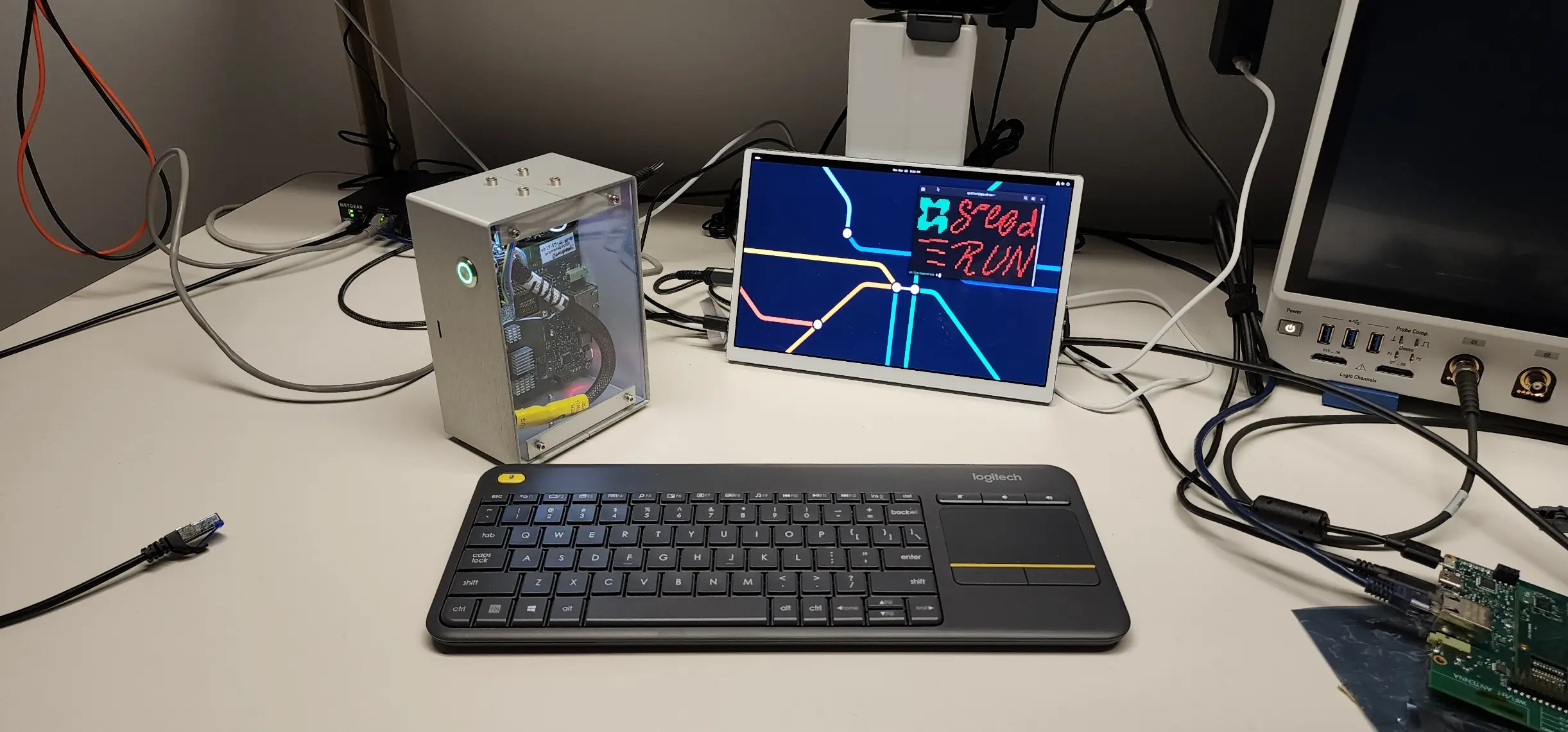
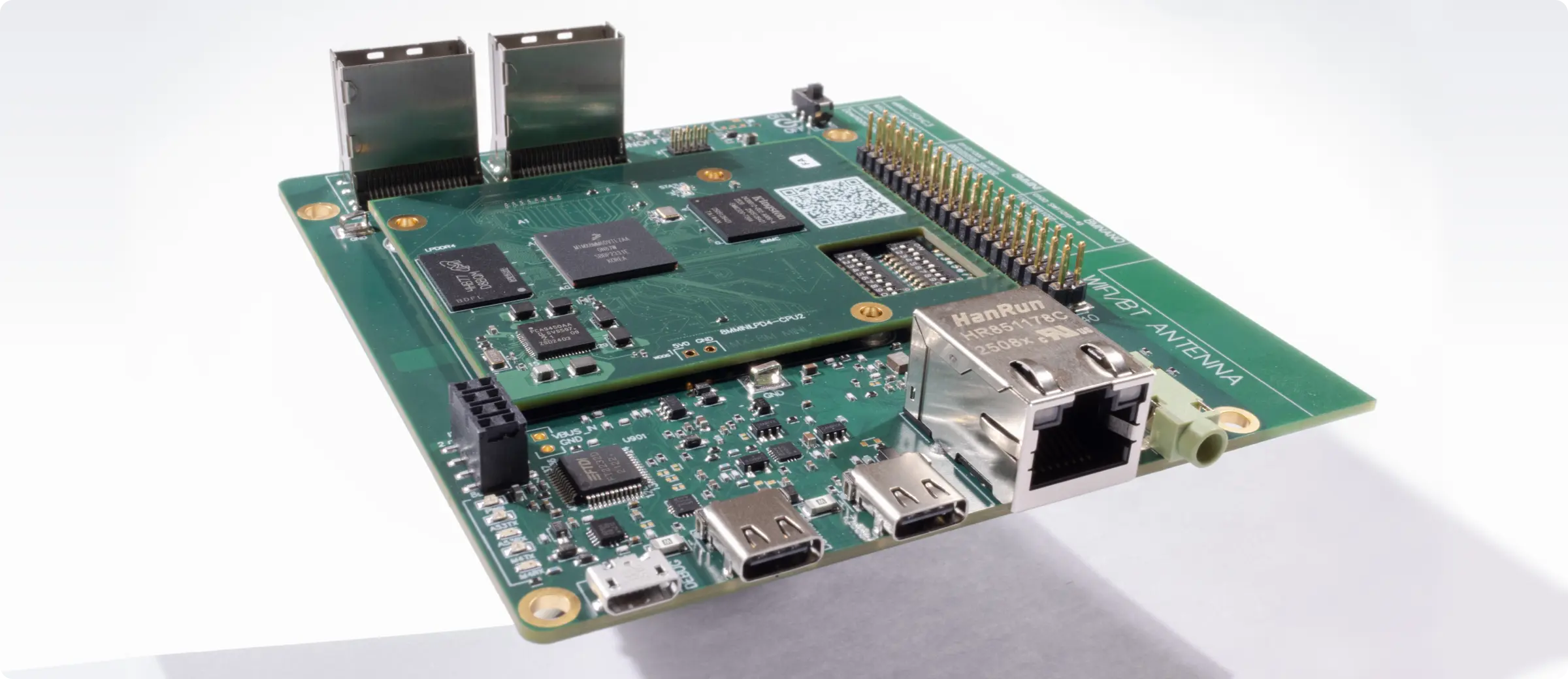
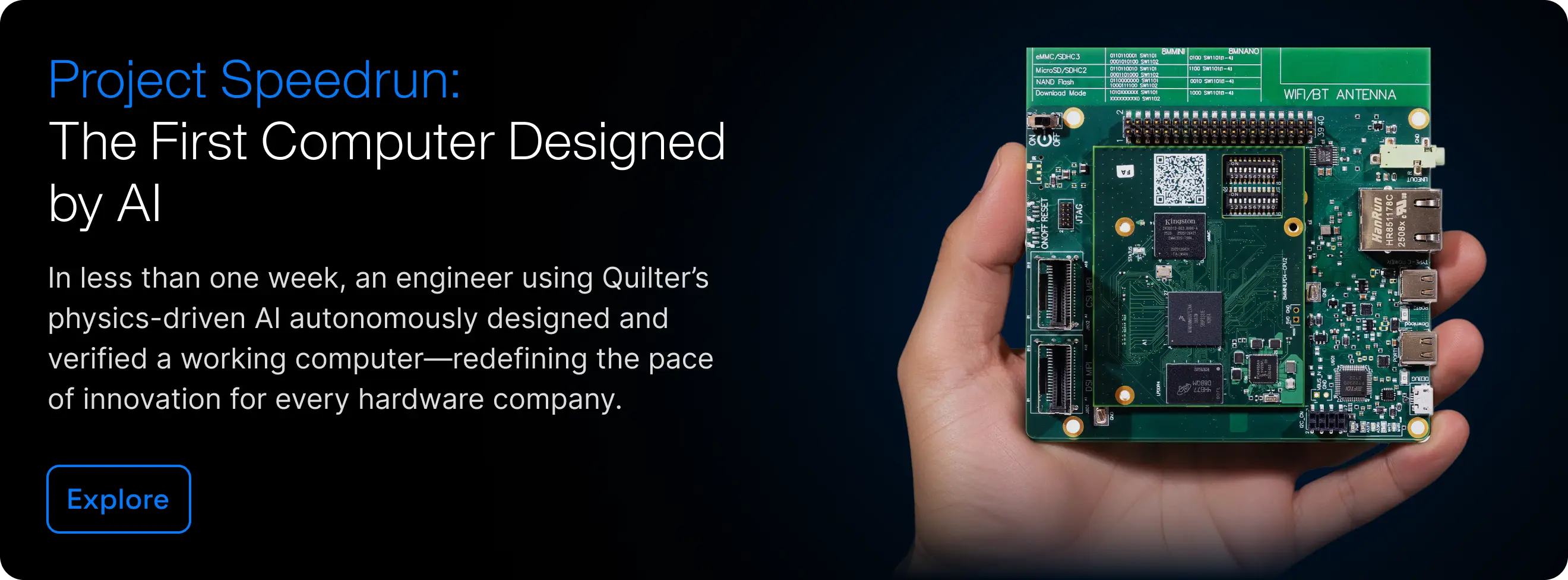
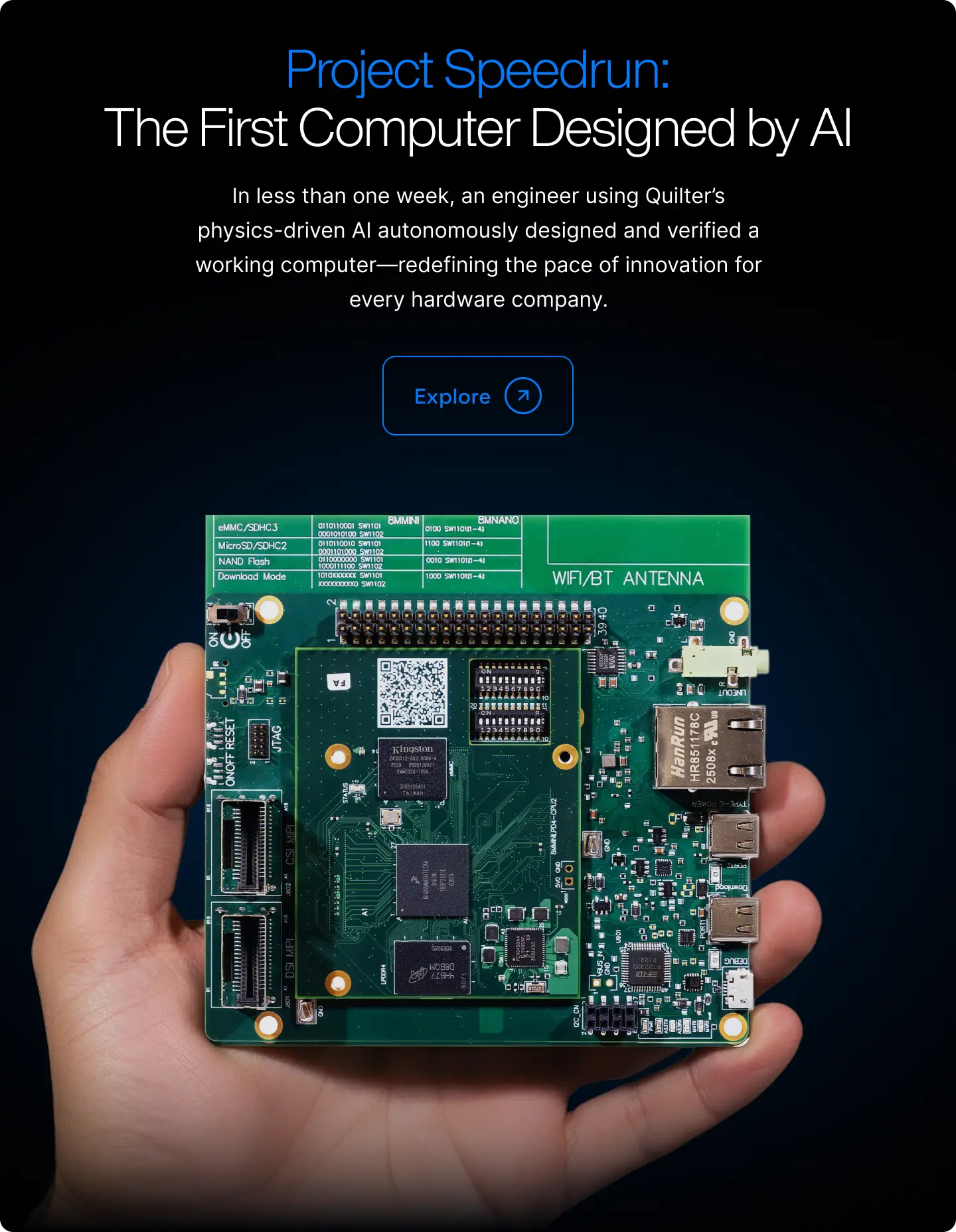
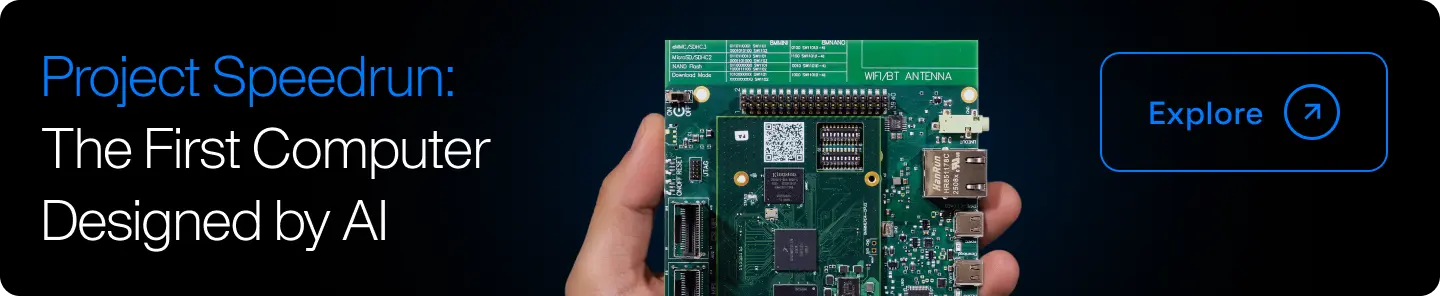
A useful proof point for the “automation fraction” is Quilter’s Project Speedrun. Quilter reports that professional PCB designers quoted 428 hours of manual layout for that design, while engineers spent about 38.5 hours end-to-end with Quilter and the rest was automated.
Backplanes differ from a two-board computer, but the point carries: when the engine does the repetitive work, humans spend time on judgment and signoff, not on routing grind.

2) Quality improvements you can evaluate, not just hope for

Backplane teams do not want “fast.” They want “fast and defensible.”

Quilter’s candidate ranking criteria are a practical way to evaluate quality early:

  • routing completion and pin escape success

  • DRC compliance and manufacturability scoring

  • physics rule checks that flag issues like differential mismatch and trace width accuracy

  • fabrication fit against real stackups and constraints

This supports a better review culture:

  • Pick candidates that meet constraints cleanly, then spend human effort on the truly domain-specific decisions (connector selection, stack-up negotiation, SI signoff)

  • Use metrics like via count and layer count to balance cost and performance across candidates

3) More iterations before freeze, fewer surprises after

In traditional flows, a backplane is often treated like a once-per-program artifact because it is expensive to change. AI-driven backplane PCB automation changes that posture. Instead of delaying change because it is painful, teams can:

  • run more iterations earlier

  • validate feasibility before committing to mechanical lock-in

  • keep the design responsive to evolving system requirements

Comparison table: Quilter vs legacy automated layout tools for backplanes

Capability

Legacy EDA automation (Cadence, Siemens, Zuken, Altium)

Quilter AI

Constraint-driven routing

Powerful, but setup-heavy and expert-dependent

Constraints and physics checks integrated into generation and ranking

Pattern reuse across repeated slots

Possible, often manual to maintain

Candidate-driven approach supports repeated channel evaluation at scale

System-level PCB design

Supported via modules and workflows

Candidate selection metrics reflect system-level tradeoffs (layers, vias, density)

Speed to first viable layout

Often days to weeks for complex backplanes

Stated goal: from 30+ days to under 24 hours

Workflow integration

Native ecosystem strength

Works with existing CAD workflows via file handoff

Ready to see what's possible for your next backplane?

If you are evaluating automated layout tools for backplanes and you want to compress layout cycles without lowering the bar on constraints, Quilter AI is built for exactly this use case: high-speed, high-complexity interconnect boards where iteration speed is a competitive advantage.

Upload a backplane project for a free AI-powered layout preview, or book a demo with Quilter’s engineering team to see candidate generation, constraint coverage, and native CAD handoff in your workflow. Start with Quilter’s Backplane and Interconnect Boards solution page.


Try Quilter for Yourself

Project Speedrun demonstrated what autonomous layout looks like in practice and the time compression Quilter enables. Now, see it on your own hardware.

Get Started

Validating the Design

With cleanup complete, the final question is whether the hardware works. Power-on is where most electrical mistakes reveal themselves, and it’s the moment engineers are both nervous and excited about.

Continue to Part 4

Cleaning Up the Design

Autonomous layout produces a complete, DRC'd design; cleanup is a brief precision pass to finalize it for fabrication.

Continue to Part 3

Compiling the Design

Once the design is prepared, the next step is handing it off to Quilter. In traditional workflows, this is where an engineer meets with a layout specialist to clarify intent. Quilter replaces that meeting with circuit comprehension: you upload the project, review how constraints are interpreted, and submit the job.

Continue to Part 2

AI-Powered Backplane Design: How Quilter Automates High-Speed Layouts in Hours

February 16, 2026
by
Quilter AI
and

Designing a high-speed backplane is one of the toughest challenges in PCB engineering. With dense connectors, strict timing constraints, and the need for flawless signal integrity, even the best automated layout tools can leave engineers buried in manual setup and endless review cycles. But what if AI could handle the heavy lifting, turning weeks of constraint-driven layout into a few hours of rapid, physics-validated design?

In this post, we’ll compare today’s top automated layout tools for backplanes and show how Quilter AI is redefining what’s possible for backplane PCB automation, especially when you need speed without sacrificing rigor. If you are building telecom, datacom, aerospace, or any multi-slot interconnect system where schedule and SI risk are existential, this is the playbook.

For readers who want to jump straight to Quilter’s backplane solution page, see: Quilter’s Backplane and Interconnect Boards solution.

Let's define what makes backplane layout so challenging

Backplanes are not “big PCBs.” They are system fabrics. The board is often responsible for deterministic connectivity across many identical or near-identical channels, while simultaneously handling power distribution and mechanical constraints at scale.

A typical modern backplane can have 10+ slots, 20+ layers, and thousands of nets. That scale changes everything:

1) High pin-count connector breakout becomes the critical path
Whether you are using high-speed mezzanine connectors, card-edge connectors, or ruggedized connector fields, the breakout density is where routing feasibility is decided. One connector field can create a routing shadow that forces layer proliferation, via count spikes, and non-obvious return path issues. And because backplanes repeat the same structure across many slots, a single breakout decision multiplies into dozens or hundreds of downstream consequences.

2) Constraint management is mandatory and it is not “one constraint”
Backplane success depends on a web of interlocking constraints: impedance targets by layer, differential pair coupling, via and backdrill definitions, length and skew limits across buses, topology intent, and keepouts driven by mechanics. It is not enough to “turn on diff pairs.” You need consistent, enforceable rules that hold across thousands of nets, across repeated slot patterns, and across design changes.

3) Signal integrity is not a post-process; it is the design
At high data rates, routing is effectively channel engineering. Small decisions like via transitions, reference plane discontinuities, connector escape geometry, and stub length control can dominate margins. This is why backplane teams often live in a loop: route, extract, simulate, fix, reroute, then repeat. The workflow is slow not because engineers lack skill, but because the problem is inherently coupled and highly sensitive.

4) Manual layout does not scale with iteration pressure
Even elite PCB teams struggle to iterate quickly on backplanes because the work is both detailed and repetitive. When requirements change, a manual backplane edit can ripple into a large fraction of the routing and constraint set. And the cost of a mistake is high: one missed skew limit or one broken return path pattern can become a late-stage failure that burns schedule and credibility.

If you want a vendor-neutral reminder of why these designs are challenging, Altium’s backplane guidance calls out the scale problem directly: thousands of connections across a large board with limited space and layer count, plus meaningful power delivery demands.

How do traditional automated layout tools stack up?

Backplane teams usually live in one of four ecosystems: Cadence, Siemens, Zuken, or Altium. All of these can produce excellent backplanes. The practical question is: how much of the backplane PCB automation problem do they truly automate, and how much is still expert-driven setup and iteration?

How do automated layout tools for backplanes compare?

Most “automated layout tools for backplanes” fall into the same pattern:

  • They are constraint-driven systems that can route high-speed nets correctly, but require significant up-front rule definition, constraint modeling, and ongoing expert supervision.

  • They can support multi-board and system-level design through additional modules or workflows, but maintaining consistency across repeated slot patterns and evolving requirements still takes manual effort.

That is not a criticism. It is simply how legacy automation was designed: powerful, configurable, and dependent on expert input.

Cadence Allegro X (plus SI tooling)

Cadence’s Allegro X platform is widely used for enterprise PCB design and emphasizes integrated, multi-board electronic system design plus analysis workflows. In practice, it is strong at handling large rule sets, high-speed routing constraints, and workflows where SI and PI are tightly coupled to layout decisions.

Where it shines for backplanes

  • Deep constraint capabilities for high-speed routing and large enterprise designs

  • Mature ecosystem for SI workflows and collaboration in large organizations

Where time gets burned

  • Constraint setup and tuning can be labor-intensive, especially when requirements evolve

  • “Automation” often accelerates parts of the workflow but still depends heavily on expert steering

Siemens Xpedition (multi-board and system definition)

Siemens positions Xpedition’s multi-board systems design flow as a collaborative environment for defining a multi-board system at the logical level, including the logical definition of wires, cables, and backplanes.

Where it shines for backplanes

  • Strong system definition and multi-board connectivity management

  • Good fit when the primary challenge is keeping a complex system consistent across multiple design artifacts

Where time gets burned

  • Translating system-level intent into repeatable, constraint-correct physical layout still takes significant human work

  • Constraint entry and reuse remain a skill bottleneck on dense, high-speed fabrics

Zuken CR-8000 Design Force (system context and multi-board)

Zuken’s CR-8000 Design Force emphasizes design in the context of a complete system, with inherent support for high-speed design, constraint management, and concurrent SI and PI analysis.

Where it shines for backplanes

  • System-context workflows and multi-board visibility

  • Concurrent analysis culture that reduces late surprises

Where time gets burned

  • You still need experts to translate intent into constraints, routing strategy, and repeated channel patterns

  • The system is powerful, but teams pay in setup and process overhead

Altium Designer (high-speed capability with pragmatic limits)

Altium can be a strong choice for “serious but not extreme” backplanes, especially when teams value usability and ecosystem velocity. But as backplane complexity increases, teams often encounter the same reality: the toughest part is not drawing lines, it is maintaining constraints and repeatable channel quality at scale. Altium’s own backplane guidance highlights that these designs often involve managing thousands of connections across a large board, which is exactly where manual effort compounds.

The core limitation across legacy tools

All of these platforms can produce high-quality results. The shared pain point is that the automation is mostly assistance. It helps you execute, but it does not remove the backplane bottleneck:

  • Experts still spend days defining constraints and routing strategy

  • Repeated channels still require manual pattern work and vigilance

  • Design changes still trigger expensive rework loops

This is the context where Quilter AI is different: it is designed to turn backplane layout into a high-throughput, candidate-driven process rather than a single fragile “golden route.”

Here's how Quilter's AI changes the game

Quilter is building an autonomous PCB design engine that is explicitly not an autorouter, not a co-pilot, and not an LLM. Its positioning is physics-first automation that generates complete layouts, explores many options in parallel, and continuously verifies physical constraints during generation.

To make this concrete for backplanes, there are three criteria that matter most:

  1. Constraint systems: Can the tool enforce complex high-speed rules without weeks of manual rule scripting?

  2. Pattern reuse: Can it maintain repeated slot and channel structure natively, without fragile copy workflows?

  3. System-level visibility: Can it keep the design consistent as a system fabric, not just as a single board?

1) Constraints become inputs, not a months-long project

Legacy flows often treat constraints as a separate engineering artifact that must be authored, debugged, and maintained. Quilter flips that dynamic by integrating physics checks directly into the generation process. Quilter describes this as “continuous verification,” with physics checks like DDR length matching, impedance control, and clearances validated during design, not after.

On the technology side, Quilter’s RL engine is built to explore layout strategies across thousands of generated candidate boards, then rank outcomes against physics and fabrication rules.

What this means in backplane terms:

  • Your high-speed intent is enforced as part of the generation loop

  • Constraint coverage is measurable, reviewable, and comparable across candidates

  • “Did we miss a rule?” becomes less likely because the system is checking continuously while building the solution

2) Pattern reuse is native because the process is candidate-based

Backplanes amplify repetition. You are rarely routing one channel. You are routing a fabric of repeated channels across many slots. In legacy tools, repetition often becomes a maintenance problem: copied routing needs to be managed, and small changes can break symmetry.

Quilter approaches this differently by generating many complete candidate layouts in parallel, then ranking them by constraint and manufacturability coverage. Quilter explicitly states that dozens of layouts are generated simultaneously, each ranked for manufacturability and constraint coverage, enabling teams to explore dramatically more design variants without delay.

For backplanes, the payoff is simple:

  • You can evaluate multiple routing strategies for repeated channels instead of committing early

  • You can compare candidates that optimize for different tradeoffs (via count, layer count, trace length, density)

  • You can maintain slot-to-slot consistency by selecting candidates that preserve the patterns you want

3) System-level visibility becomes selection, not guesswork

In Quilter’s workflow, “system-level visibility” is not just a planning view. It is reflected in how candidates are ranked and filtered.

Quilter describes candidate selection criteria that include routing completion, manufacturability, physics rule checks, fabrication fit, and resource efficiency (layer count, via count, trace length, density).

Backplane teams care about exactly these metrics because they map to:

  • SI risk (length, mismatch, discontinuities)

  • DFM risk (DRC cleanliness, drill constraints)

  • Cost risk (layers, vias, complexity)

  • Schedule risk (how much manual cleanup remains)

Instead of arguing about a single route, teams can review a portfolio of candidates and make a deliberate selection based on strategy.

4) It fits into your existing CAD workflow

Quilter’s product positioning is clear: upload your existing PCB project, define the board outline, pre-place connectors, determine the floorplan, and keep control of constraints. The output comes back in the same format you submitted, so you can run DRC, polish, and generate fab files in the tools you already use.

For teams evaluating AI PCB design tools, this matters because it reduces adoption friction:

  • You do not need to migrate away from Cadence, Siemens, Altium, or KiCad workflows

  • Quilter accelerates layout generation, then hands off to your existing signoff processes

Related pages for deeper context

What results can you expect with AI-driven backplane design?

Quilter’s backplane solution page states the headline outcome plainly: backplane and interconnect boards can move from 30+ days to under 24 hours.

That is a bold claim, so let’s break down what “results” should mean in a backplane context.

1) Cycle time reduction that actually compounds

Backplane schedules are often dominated by:

  • constraint setup and review

  • repeated channel routing and cleanup

  • SI-driven rework loops

  • late-stage manufacturability fixes

When layout generation becomes fast and abundant, you get leverage:

  • You can explore more topologies early (before committing to a painful routing approach)

  • You can compare stack-up or manufacturer rule changes without losing weeks

  • You can generate candidates quickly when requirements change, instead of patching a fragile design

A useful proof point for the “automation fraction” is Quilter’s Project Speedrun. Quilter reports that professional PCB designers quoted 428 hours of manual layout for that design, while engineers spent about 38.5 hours end-to-end with Quilter and the rest was automated.
Backplanes differ from a two-board computer, but the point carries: when the engine does the repetitive work, humans spend time on judgment and signoff, not on routing grind.

2) Quality improvements you can evaluate, not just hope for

Backplane teams do not want “fast.” They want “fast and defensible.”

Quilter’s candidate ranking criteria are a practical way to evaluate quality early:

  • routing completion and pin escape success

  • DRC compliance and manufacturability scoring

  • physics rule checks that flag issues like differential mismatch and trace width accuracy

  • fabrication fit against real stackups and constraints

This supports a better review culture:

  • Pick candidates that meet constraints cleanly, then spend human effort on the truly domain-specific decisions (connector selection, stack-up negotiation, SI signoff)

  • Use metrics like via count and layer count to balance cost and performance across candidates

3) More iterations before freeze, fewer surprises after

In traditional flows, a backplane is often treated like a once-per-program artifact because it is expensive to change. AI-driven backplane PCB automation changes that posture. Instead of delaying change because it is painful, teams can:

  • run more iterations earlier

  • validate feasibility before committing to mechanical lock-in

  • keep the design responsive to evolving system requirements

Comparison table: Quilter vs legacy automated layout tools for backplanes

Capability

Legacy EDA automation (Cadence, Siemens, Zuken, Altium)

Quilter AI

Constraint-driven routing

Powerful, but setup-heavy and expert-dependent

Constraints and physics checks integrated into generation and ranking

Pattern reuse across repeated slots

Possible, often manual to maintain

Candidate-driven approach supports repeated channel evaluation at scale

System-level PCB design

Supported via modules and workflows

Candidate selection metrics reflect system-level tradeoffs (layers, vias, density)

Speed to first viable layout

Often days to weeks for complex backplanes

Stated goal: from 30+ days to under 24 hours

Workflow integration

Native ecosystem strength

Works with existing CAD workflows via file handoff

Ready to see what's possible for your next backplane?

If you are evaluating automated layout tools for backplanes and you want to compress layout cycles without lowering the bar on constraints, Quilter AI is built for exactly this use case: high-speed, high-complexity interconnect boards where iteration speed is a competitive advantage.

Upload a backplane project for a free AI-powered layout preview, or book a demo with Quilter’s engineering team to see candidate generation, constraint coverage, and native CAD handoff in your workflow. Start with Quilter’s Backplane and Interconnect Boards solution page.