



Gen AI

Published

Written by

Workbench

A Guide to the Top-Rated Automated Circuit Design Software of 2026

Published

February 7, 2026

Automated circuit design software has come a long way since the days of basic autorouting. In 2026, a new generation of AI-driven tools is changing what’s possible, delivering complete, physics-validated PCB layouts in hours instead of weeks. Whether you’re leading a hardware team or building your first prototype, choosing the right platform can mean the difference between hitting your deadline and missing your market window. Here’s what you need to know about the top-rated options, and why AI-native solutions like Quilter are setting a new standard for speed, quality, and iteration. 

Let's define what "automated circuit design software" really means in 2026

Automated circuit design software in 2026 typically means software that reduces hands-on effort across schematic, placement, routing, and verification, not software that invents your product’s circuit for you. Most “top-rated” tools still rely on engineers to define architecture, critical constraints, and intent, then use automation to accelerate execution and reduce errors.

Traditional automation: helpful, but not hands-off

When most teams say “automation,” they mean features like:

  • Autorouting and interactive routing to speed up trace completion
  • Rule-driven constraint management for impedance, clearances, differential pairs, length matching, via styles, and regions
  • Real-time DRC and manufacturability checks to catch violations early rather than during cleanup

This is the core of modern mainstream EDA. For example, OrCAD X positions its PCB layout around intelligent routing (interactive and auto-routing) and integrated checks that provide immediate feedback on fabrication and assembly constraints. 

AI-native automation: end-to-end layout generation with verification built in

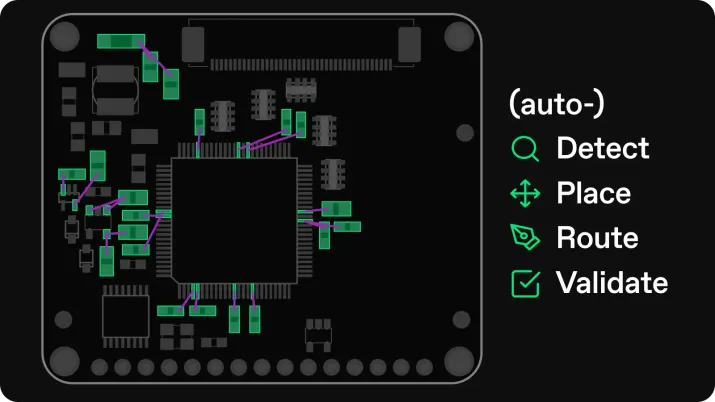
AI-native automation is different in a simple way: instead of assisting you while you route, it generates complete layout candidates (placement + routing) and evaluates them against constraints during generation, not after.

This is where Quilter sits. Quilter describes itself as a physics-first AI system for complete PCB layout that generates multiple candidates in hours and enforces constraints like differential pairs and DDR timing during generation. 

Why “push-button” is still rare, and why it’s showing up now

Even in 2026, truly push-button design is uncommon because PCB layout is not one problem. It is many problems stacked on top of each other: electrical constraints, SI and PI considerations, mechanical realities, fabrication limits, assembly rules, and human preferences about risk.

What changed recently is that some platforms moved from “routing help” to “layout execution engines,” combining AI search with physics-aware checks and producing many complete candidates so teams can choose based on evidence, not guesses. Quilter explicitly frames this as shifting layout from a manual bottleneck to an autonomous generation and review loop. 

What should you look for in a modern automated design tool?

A modern automated design tool should reliably shorten layout time while keeping constraints transparent and reviewable. The best tools do not just route faster. They reduce rework by making constraint intent explicit, by catching violations early, and by producing outputs your team can trust.

1) Speed matters, but only if quality is measurable

Automation is only useful if it compresses cycle time without creating hidden risk. In practice, you want to evaluate:

  • How quickly the tool gets you to a routable board state (placement quality, escape strategies, topology)
  • How much “last mile” cleanup remains (tuning, via strategy, plane integrity, DFM fixes)
  • Whether the tool helps you iterate, not just finish one layout

AI-native tools often market “complete layouts in hours.” Quilter’s product positioning repeatedly emphasizes completing entire layouts autonomously and producing many options per design cycle. 

2) Integration with your existing workflow and file formats

For most teams, switching tools is the real cost. Even if a platform is powerful, it fails adoption if it breaks your libraries, version control, release process, or manufacturing handoff.

Quilter explicitly positions itself as “same workflow, faster results,” stating it automates routine PCB design using existing tools and workflows and returns native CAD outputs and fabrication deliverables. 

3) Support for complex constraints and real-world signoff

In 2026, “automation” is table stakes. The differentiator is how well the platform handles real constraints:

  • High-speed: differential pairs, length matching, timing-driven rules
  • DFM: fabrication and assembly constraints that change by vendor and stackup
  • Design intent: regions, net classes, and exceptions that reflect engineering tradeoffs

OrCAD X, for example, highlights constraint-driven design and real-time DRC feedback that flags deviations as you route. 

4) Transparency and reviewability of results

The best automation still assumes a human review step. So ask:

  • Can you see why the tool did what it did?
  • Can you audit constraints and violations quickly?
  • Can you compare alternatives side by side?

Quilter leans heavily into candidate comparison, selection based on evidence, and review workflows.

5) Collaboration, security, and deployment reality

If you are in aerospace, defense, or regulated industries, tool choice is also about deployment, security posture, and IP control. If you are a startup, it is about fast onboarding, predictable cost, and the ability to move without tool friction.

This is why “best tool” is usually “best fit.” The right evaluation criteria depend on your constraints, your risk tolerance, and how often you need to respin boards.

How do the top traditional platforms stack up?

Traditional EDA platforms are still the default for most teams because they combine schematic capture, layout, constraints, and manufacturing outputs in mature ecosystems. Their automation is strong, but it usually accelerates human execution rather than replacing it.

Below is a practical comparison of commonly shortlisted tools in 2026, focused on automation features that matter for PCB execution.

Comparison table: traditional tools and where automation actually helps

Tool

Best for

Automation strengths

Where manual work still dominates

Typical cost tier

Cadence OrCAD X

Pro teams needing strong constraints + manufacturability feedback

Intelligent routing (interactive + auto), real-time DRC feedback, integrated manufacturability checks

Placement strategy, complex tuning, architecture-driven tradeoffs

Mid to enterprise 

Altium Designer

Cross-functional product teams that value integrated workflow

Rule-driven routing workflows, differential pair and length tuning tooling, broad ecosystem

High-speed closure, dense BGAs, power integrity, manual polish

Mid to enterprise 

Siemens Xpedition

Larger orgs with complex constraints and enterprise flows

Advanced constraint-driven layout environment within enterprise stack

Upfront setup, library governance, process integration

Enterprise 

Zuken CR-8000

Enterprise scale designs and multi-board system complexity

System-level design and enterprise-grade integration focus

Specialized setup, workflow complexity, expert-driven signoff

Enterprise 

Autodesk Fusion 360 Electronics (EAGLE)

Teams that want ECAD-MCAD workflows and fast iteration

Integrated electronics workflow inside Fusion environment

Advanced constraints, very dense or high-speed designs

Low to mid 

DipTrace

Smaller teams that want a simpler suite with autorouting

Integrated autorouter, approachable workflow

Complex constraints and high-speed nuance

Low to mid 

KiCad

Cost-sensitive teams, education, and many pro prototypes

Strong interactive router and rules support in modern versions

Enterprise-scale collaboration, some advanced automation polish

Free 

What these tools do very well

  1. Constraint-driven guardrails. OrCAD X emphasizes constraint-driven design and real-time rule checking during routing. This reduces late-stage surprises and helps keep complex boards consistent across designers. 
  2. Ecosystem depth. Platforms like Altium and Cadence come with mature libraries, manufacturing outputs, and integration paths that teams rely on.
  3. Human-in-the-loop control. Interactive routing remains valuable because it lets designers apply intuition where automation cannot know intent, such as noise-sensitive placement choices or analog isolation decisions.

Where traditional automation still hits a wall

Even the strongest legacy toolchains usually require significant hands-on work in these areas:

  • Placement quality in dense, constraint-heavy layouts
  • High-speed closure where tradeoffs are contextual
  • Power distribution and return path management where “routed” is not the same as “good”
  • Iteration speed when requirements change and you have to rework manually

This is why many teams say routing is not the only bottleneck. The bottleneck is the full loop: place, route, verify, fix, re-verify, and repeat.

Here's where AI-native platforms change the game

AI-native PCB automation changes the game by producing complete, constraint-aware layout candidates in parallel, then letting engineers select and refine the best option. Instead of treating automation as a feature inside a CAD tool, AI-native platforms treat layout as a solvable generation and evaluation problem.

What makes a platform “AI-native” instead of “automated”

A platform is AI-native when:

  • It generates full layout candidates end to end (not just route segments)
  • It evaluates candidates against constraints continuously during generation
  • It produces multiple options so you can choose based on outcomes, not hope
  • It integrates into existing CAD workflows rather than forcing a tool migration

Quilter’s product pages highlight all of the above: multiple candidates in parallel, physics enforcing constraints during generation, and output that fits into existing workflows with native files. 

Quilter’s approach: reinforcement learning trained on physics

Quilter positions its engine as reinforcement learning that actively explores the layout search space, with physics checks built into generation. It explicitly distinguishes itself from autorouters and from LLM-style copilots, focusing on constraint enforcement like DDR length matching and impedance control during generation. 

This matters because it changes the question from “Can the router finish?” to “How many viable boards can we explore this week?”

Where other “AI” tools fit

Not all AI in electronics design targets PCB layout execution. Some platforms focus on:

  • Schematic synthesis and design reuse
  • Code-first design where circuits are described programmatically
  • Library intelligence, component selection, or assistive routing suggestions

These approaches can be valuable, but they are often not a substitute for end-to-end layout generation. A useful way to evaluate is: does the tool produce a manufacturable, constraint-checked PCB candidate without hours of manual routing?

Feature comparison chart: traditional vs AI-native automation

Capability

Traditional EDA suites

Add-on automation and scripts

AI-native execution engines (example: Quilter)

Placement automation

Partial, often template-driven

Can help with repetition

Generates full placement as part of candidate creation 

Routing automation

Strong interactive + autorouting options

Can accelerate cleanup

Generates complete routed candidates in parallel 

Constraint enforcement

Usually validated during and after routing

Depends on setup

Enforced during generation, not just checked after 

Multi-candidate exploration

Manual effort, sequential

Limited

Core workflow: compare many candidates, select based on evidence 

Workflow integration

Native, mature

Native, but brittle

Designed to fit existing workflows, returns native outputs 

What results can you expect from end-to-end AI automation?

End-to-end AI PCB automation can reduce layout execution from weeks to hours for many boards, while increasing the number of viable design iterations per cycle. The biggest impact is not just speed. It is learning velocity: more candidates, more prototypes, fewer bottlenecks.

1) Time savings: shifting layout from a schedule gate to a parallel step

Quilter positions itself around completing entire layouts autonomously and producing candidates quickly. 

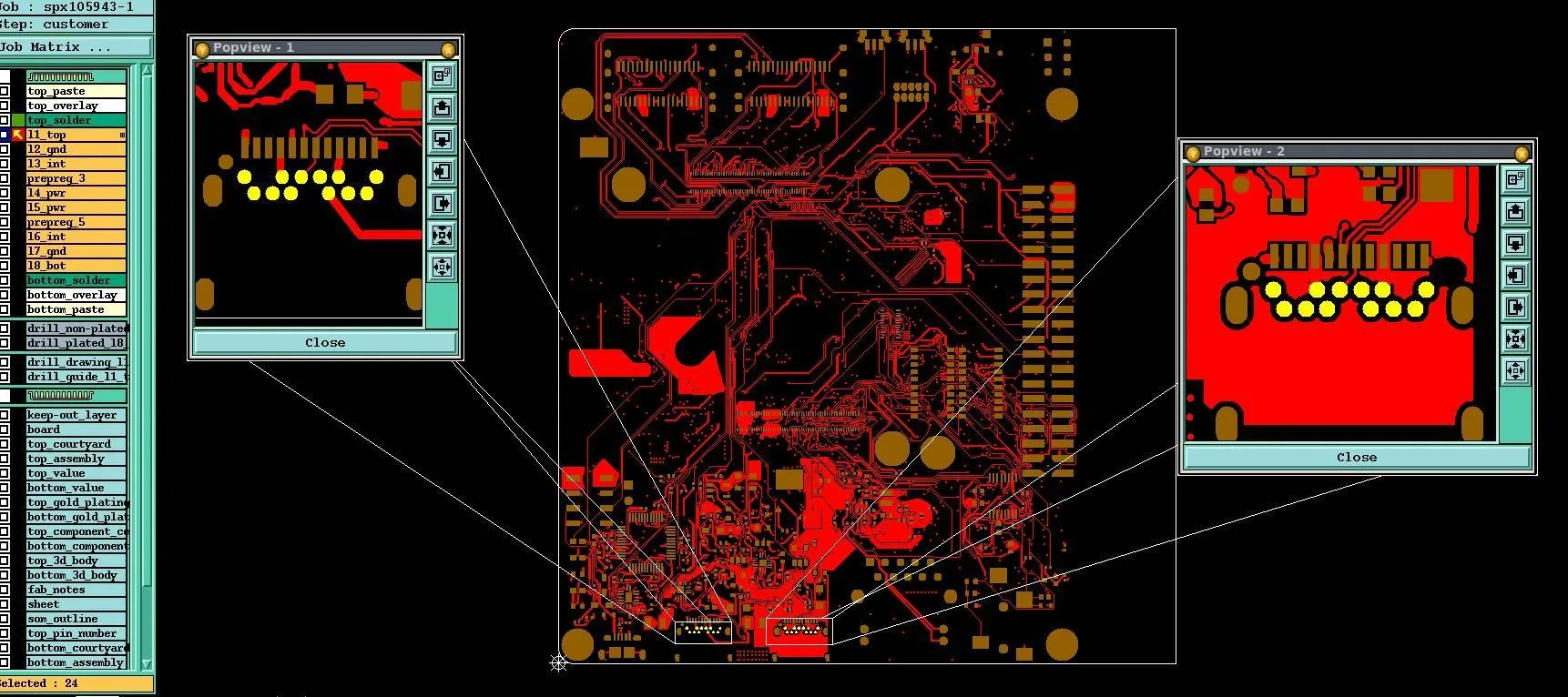
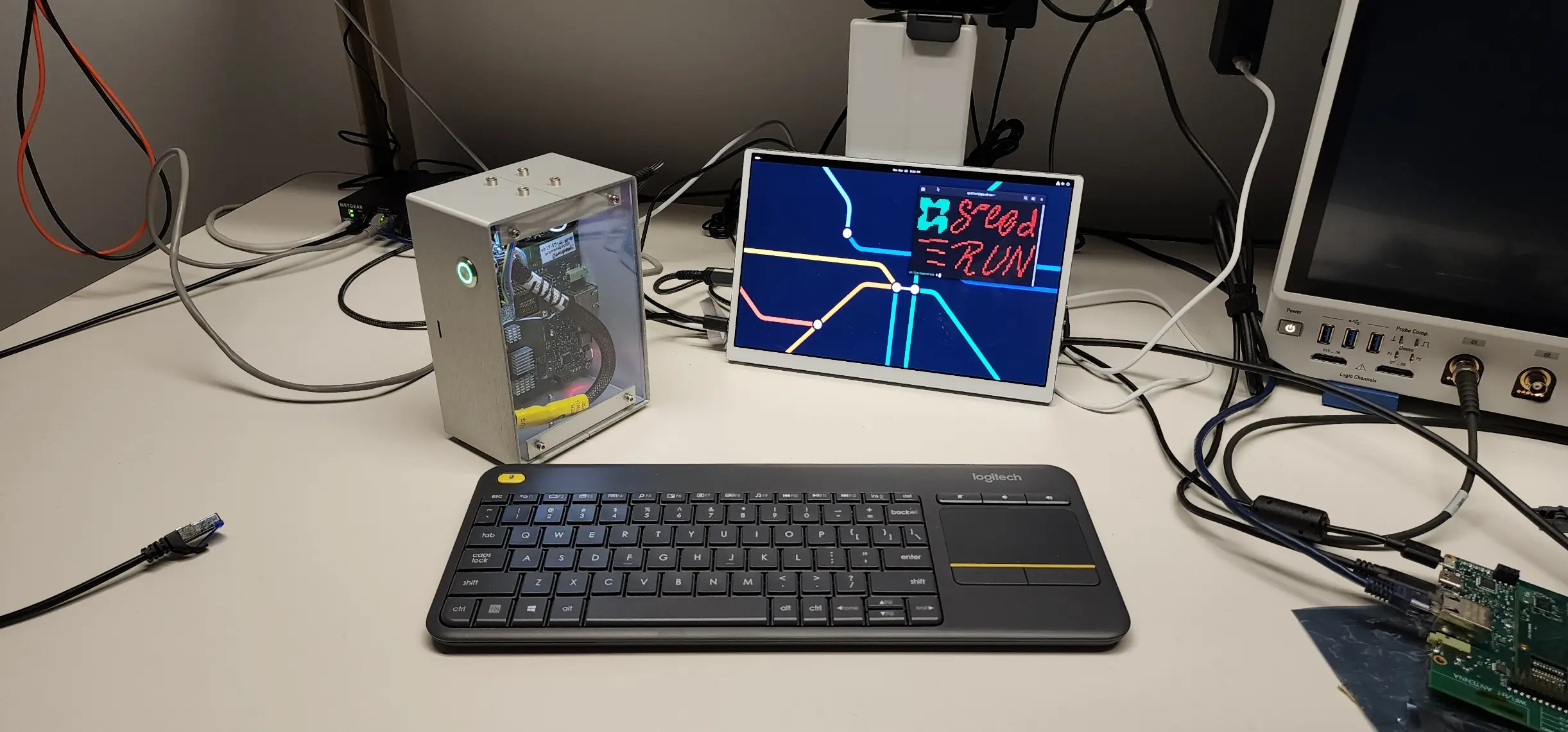
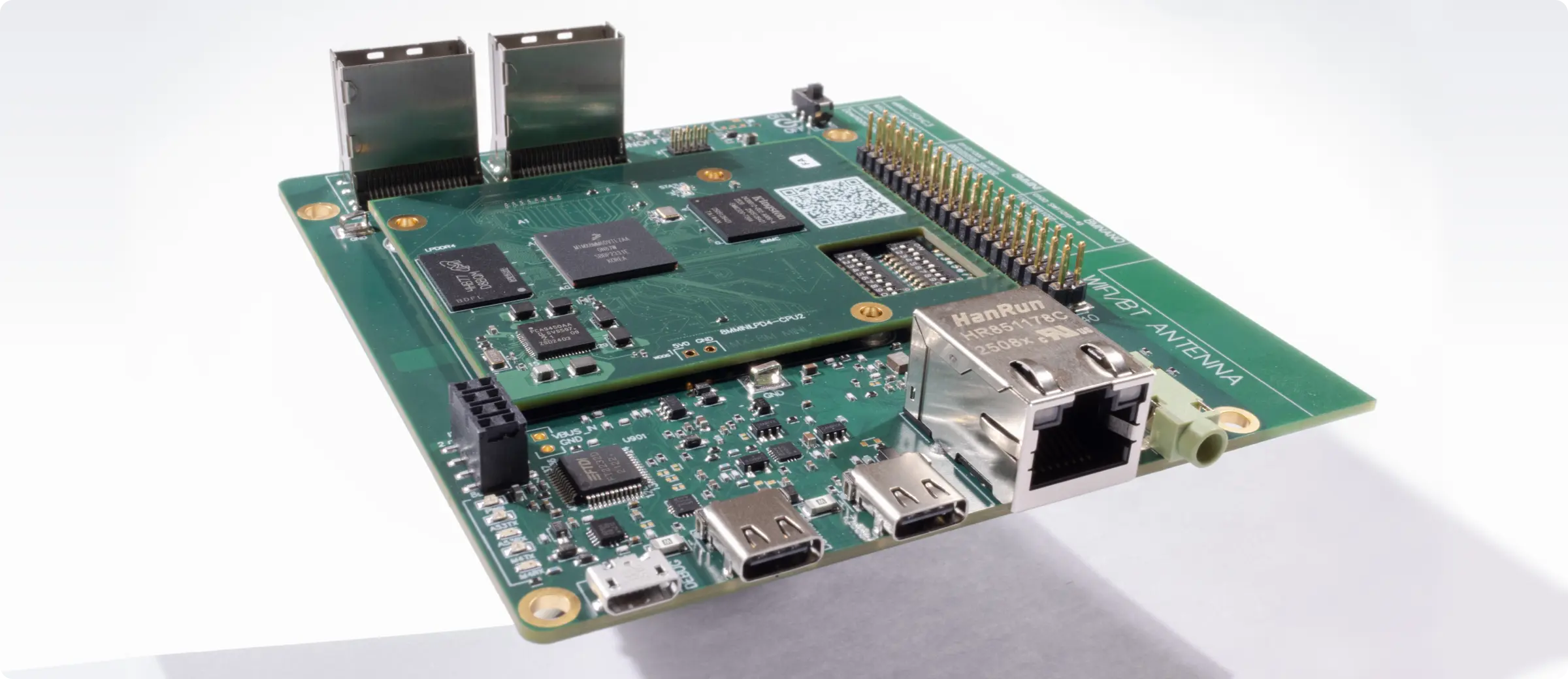
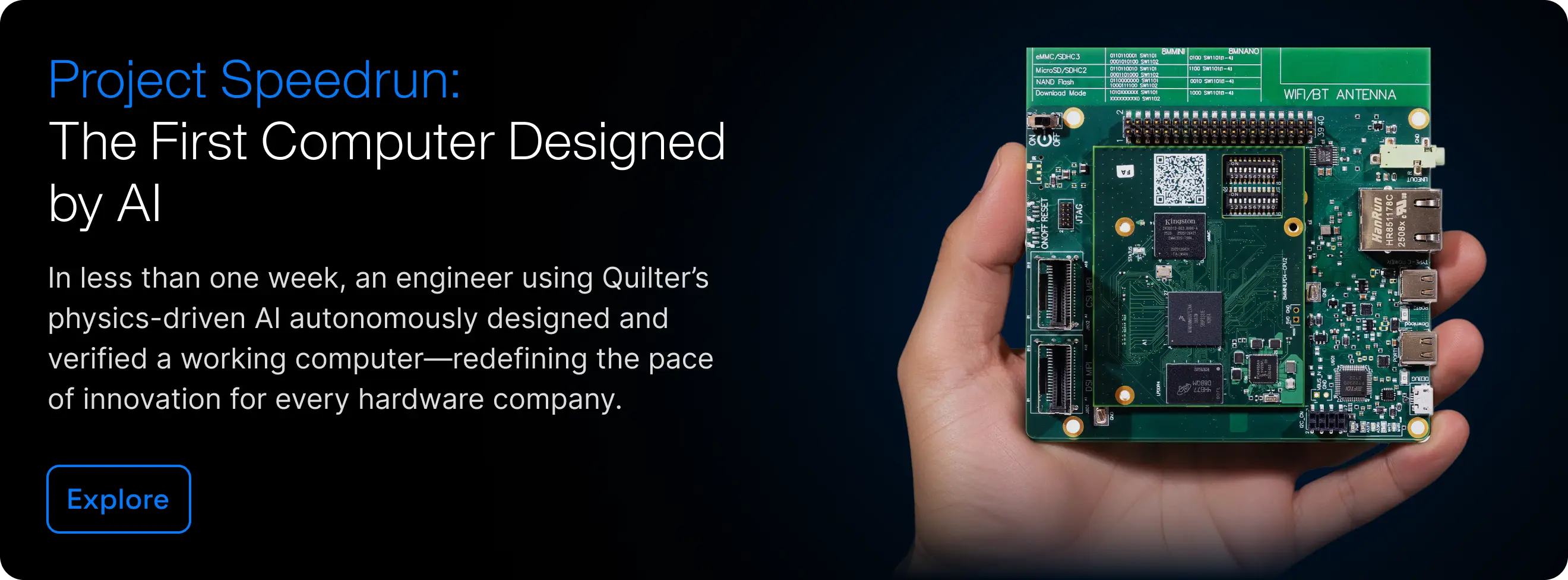
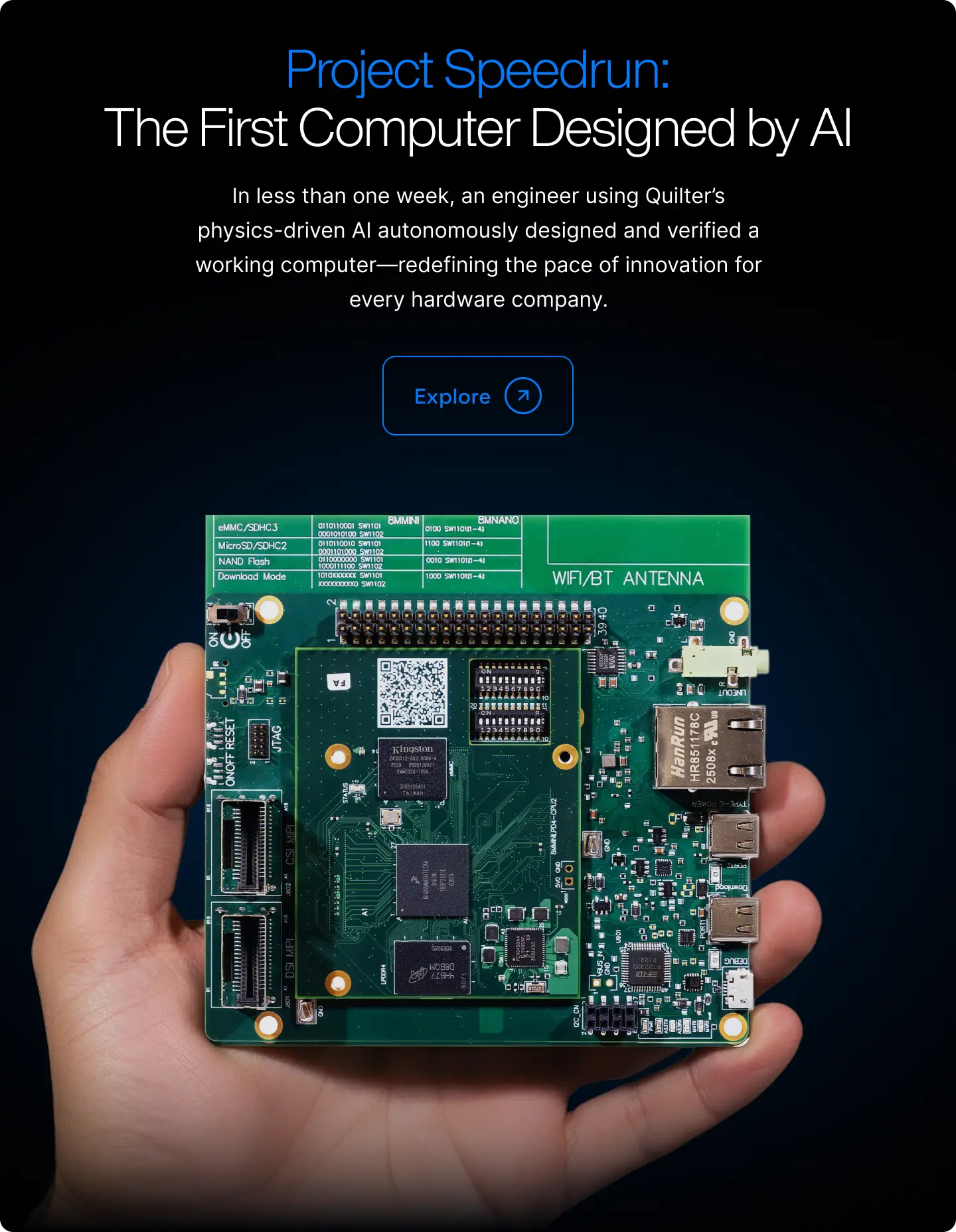
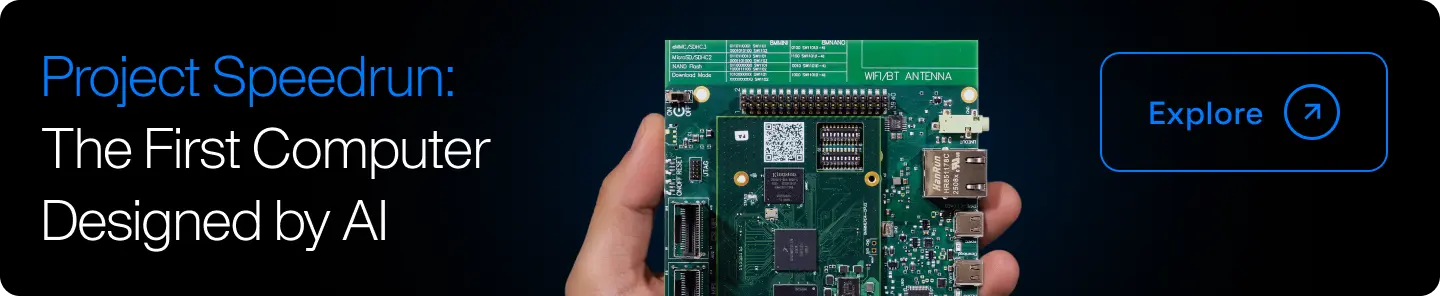
A widely circulated example is Quilter’s “Project Speedrun,” reported by Tom’s Hardware: an AI-designed Linux SBC across dual PCBs with 843 components that booted successfully on first power-up, completed in about one week with 38.5 hours of expert human support versus an estimated 430 hours manually. 

That delta is what teams mean by “automation that changes timelines,” not just “automation that saves a few clicks.”

2) Quality and reliability: physics checks during generation

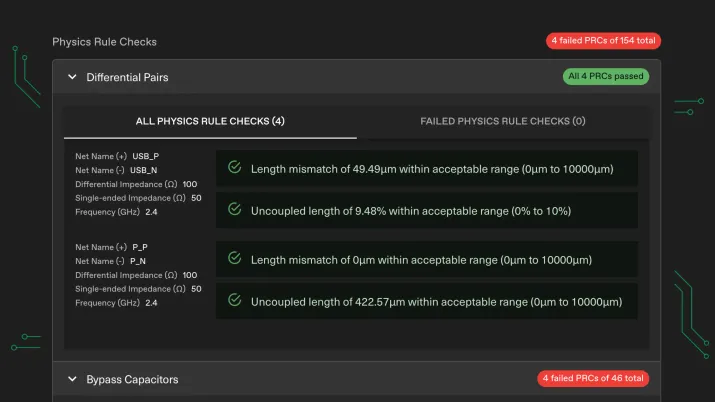
Speed is useless if it produces boards that fail basic constraints. The key promise of AI-native platforms is that physics-driven checks are integrated into generation. Quilter explicitly states it validates constraints like DDR length matching and impedance control during design, not after. 

In practical terms, this can reduce the amount of late-stage cleanup and the number of “why did the autorouter do that?” moments.

3) Increased iteration and innovation bandwidth

The most overlooked benefit is that AI automation changes what your team can attempt. When you can generate many candidates and compare them, you can test:

  • Different floorplans
  • Different stackups and fab rules
  • Different connector placements or form factors

Quilter’s workflow page explicitly describes generating dozens of layouts, evaluating multiple stackups and fab rules, then downloading fab-ready files. 

Mini case study: high pin-count, high-speed layout compression

Quilter published a detailed “1200-pin BGA” walkthrough describing how it approached dense, constraint-heavy routing and layout generation. 

Hypothetical but realistic outcome model (use for planning):
If a team typically spends 3-6 weeks in layout execution for a constrained board and can offload routine routing plus early candidate generation, the practical result is often a shorter critical path and more parallel experimentation. Use your own historical layout hours to benchmark ROI: layout hours saved per month multiplied by prototype turns gained per quarter.

Let's talk about choosing the right tool for your workflow

The right tool depends on your constraints, your team, and how much of layout execution you want to automate. Use this section as a decision guide you can share internally when you shortlist options.

Quick decision guide

Choose traditional EDA automation if:

  • You have deep internal PCB expertise and want maximum manual control
  • You are doing highly specialized analog or RF work where human intent dominates
  • Your workflow is tightly coupled to enterprise libraries and signoff processes

Choose AI-native automation if:

  • PCB layout is a recurring bottleneck
  • You need more iteration per cycle (more prototypes, more variants, more learning)
  • You want to keep your current CAD tools but offload routine execution

Decision tree

  • Are you mostly bottlenecked by layout execution time?
    • Yes → shortlist AI-native layout execution (Quilter) plus your existing CAD toolchain
    • No → evaluate traditional tools based on constraints, SI/PI integration, and collaboration
  • Do you need multiple candidate options quickly (stackups, vendors, form factors)?
    • Yes → prioritize platforms built for parallel candidate generation 
    • No → interactive routing + constraint management may be sufficient
  • Are you required to keep native outputs and existing signoff?
    • Yes → prioritize tools that return native CAD outputs and fit current workflows 
    • No → you can consider heavier workflow changes if ROI is strong

Practical next steps for evaluation

  1. Pick a representative board from your backlog: not your hardest, not your easiest.
  2. Define constraints clearly: net classes, diff pairs, length matching targets, keepouts, DFM rules.
  3. Run a time-boxed bakeoff: measure time to first viable candidate, number of violations, and time to signoff-ready output.
  4. Compare not just “finished layout,” but how many alternatives you could realistically explore in the same calendar time.

Getting started with Quilter

If your goal is true end-to-end PCB automation with physics-driven candidate generation, Quilter’s core entry points are:

Try Quilter for Yourself

Project Speedrun demonstrated what autonomous layout looks like in practice and the time compression Quilter enables. Now, see it on your own hardware.

Get Started

Validating the Design

With cleanup complete, the final question is whether the hardware works. Power-on is where most electrical mistakes reveal themselves, and it’s the moment engineers are both nervous and excited about.

Continue to Part 4

Cleaning Up the Design

Autonomous layout produces a complete, DRC'd design; cleanup is a brief precision pass to finalize it for fabrication.

Continue to Part 3

Compiling the Design

Once the design is prepared, the next step is handing it off to Quilter. In traditional workflows, this is where an engineer meets with a layout specialist to clarify intent. Quilter replaces that meeting with circuit comprehension: you upload the project, review how constraints are interpreted, and submit the job.

Continue to Part 2

A Guide to the Top-Rated Automated Circuit Design Software of 2026

February 7, 2026
by
Ben Jordan
and

Automated circuit design software has come a long way since the days of basic autorouting. In 2026, a new generation of AI-driven tools is changing what’s possible, delivering complete, physics-validated PCB layouts in hours instead of weeks. Whether you’re leading a hardware team or building your first prototype, choosing the right platform can mean the difference between hitting your deadline and missing your market window. Here’s what you need to know about the top-rated options, and why AI-native solutions like Quilter are setting a new standard for speed, quality, and iteration. 

Let's define what "automated circuit design software" really means in 2026

Automated circuit design software in 2026 typically means software that reduces hands-on effort across schematic, placement, routing, and verification, not software that invents your product’s circuit for you. Most “top-rated” tools still rely on engineers to define architecture, critical constraints, and intent, then use automation to accelerate execution and reduce errors.

Traditional automation: helpful, but not hands-off

When most teams say “automation,” they mean features like:

  • Autorouting and interactive routing to speed up trace completion
  • Rule-driven constraint management for impedance, clearances, differential pairs, length matching, via styles, and regions
  • Real-time DRC and manufacturability checks to catch violations early rather than during cleanup

This is the core of modern mainstream EDA. For example, OrCAD X positions its PCB layout around intelligent routing (interactive and auto-routing) and integrated checks that provide immediate feedback on fabrication and assembly constraints. 

AI-native automation: end-to-end layout generation with verification built in

AI-native automation is different in a simple way: instead of assisting you while you route, it generates complete layout candidates (placement + routing) and evaluates them against constraints during generation, not after.

This is where Quilter sits. Quilter describes itself as a physics-first AI system for complete PCB layout that generates multiple candidates in hours and enforces constraints like differential pairs and DDR timing during generation. 

Why “push-button” is still rare, and why it’s showing up now

Even in 2026, truly push-button design is uncommon because PCB layout is not one problem. It is many problems stacked on top of each other: electrical constraints, SI and PI considerations, mechanical realities, fabrication limits, assembly rules, and human preferences about risk.

What changed recently is that some platforms moved from “routing help” to “layout execution engines,” combining AI search with physics-aware checks and producing many complete candidates so teams can choose based on evidence, not guesses. Quilter explicitly frames this as shifting layout from a manual bottleneck to an autonomous generation and review loop. 

What should you look for in a modern automated design tool?

A modern automated design tool should reliably shorten layout time while keeping constraints transparent and reviewable. The best tools do not just route faster. They reduce rework by making constraint intent explicit, by catching violations early, and by producing outputs your team can trust.

1) Speed matters, but only if quality is measurable

Automation is only useful if it compresses cycle time without creating hidden risk. In practice, you want to evaluate:

  • How quickly the tool gets you to a routable board state (placement quality, escape strategies, topology)
  • How much “last mile” cleanup remains (tuning, via strategy, plane integrity, DFM fixes)
  • Whether the tool helps you iterate, not just finish one layout

AI-native tools often market “complete layouts in hours.” Quilter’s product positioning repeatedly emphasizes completing entire layouts autonomously and producing many options per design cycle. 

2) Integration with your existing workflow and file formats

For most teams, switching tools is the real cost. Even if a platform is powerful, it fails adoption if it breaks your libraries, version control, release process, or manufacturing handoff.

Quilter explicitly positions itself as “same workflow, faster results,” stating it automates routine PCB design using existing tools and workflows and returns native CAD outputs and fabrication deliverables. 

3) Support for complex constraints and real-world signoff

In 2026, “automation” is table stakes. The differentiator is how well the platform handles real constraints:

  • High-speed: differential pairs, length matching, timing-driven rules
  • DFM: fabrication and assembly constraints that change by vendor and stackup
  • Design intent: regions, net classes, and exceptions that reflect engineering tradeoffs

OrCAD X, for example, highlights constraint-driven design and real-time DRC feedback that flags deviations as you route. 

4) Transparency and reviewability of results

The best automation still assumes a human review step. So ask:

  • Can you see why the tool did what it did?
  • Can you audit constraints and violations quickly?
  • Can you compare alternatives side by side?

Quilter leans heavily into candidate comparison, selection based on evidence, and review workflows.

5) Collaboration, security, and deployment reality

If you are in aerospace, defense, or regulated industries, tool choice is also about deployment, security posture, and IP control. If you are a startup, it is about fast onboarding, predictable cost, and the ability to move without tool friction.

This is why “best tool” is usually “best fit.” The right evaluation criteria depend on your constraints, your risk tolerance, and how often you need to respin boards.

How do the top traditional platforms stack up?

Traditional EDA platforms are still the default for most teams because they combine schematic capture, layout, constraints, and manufacturing outputs in mature ecosystems. Their automation is strong, but it usually accelerates human execution rather than replacing it.

Below is a practical comparison of commonly shortlisted tools in 2026, focused on automation features that matter for PCB execution.

Comparison table: traditional tools and where automation actually helps

Tool

Best for

Automation strengths

Where manual work still dominates

Typical cost tier

Cadence OrCAD X

Pro teams needing strong constraints + manufacturability feedback

Intelligent routing (interactive + auto), real-time DRC feedback, integrated manufacturability checks

Placement strategy, complex tuning, architecture-driven tradeoffs

Mid to enterprise 

Altium Designer

Cross-functional product teams that value integrated workflow

Rule-driven routing workflows, differential pair and length tuning tooling, broad ecosystem

High-speed closure, dense BGAs, power integrity, manual polish

Mid to enterprise 

Siemens Xpedition

Larger orgs with complex constraints and enterprise flows

Advanced constraint-driven layout environment within enterprise stack

Upfront setup, library governance, process integration

Enterprise 

Zuken CR-8000

Enterprise scale designs and multi-board system complexity

System-level design and enterprise-grade integration focus

Specialized setup, workflow complexity, expert-driven signoff

Enterprise 

Autodesk Fusion 360 Electronics (EAGLE)

Teams that want ECAD-MCAD workflows and fast iteration

Integrated electronics workflow inside Fusion environment

Advanced constraints, very dense or high-speed designs

Low to mid 

DipTrace

Smaller teams that want a simpler suite with autorouting

Integrated autorouter, approachable workflow

Complex constraints and high-speed nuance

Low to mid 

KiCad

Cost-sensitive teams, education, and many pro prototypes

Strong interactive router and rules support in modern versions

Enterprise-scale collaboration, some advanced automation polish

Free 

What these tools do very well

  1. Constraint-driven guardrails. OrCAD X emphasizes constraint-driven design and real-time rule checking during routing. This reduces late-stage surprises and helps keep complex boards consistent across designers. 
  2. Ecosystem depth. Platforms like Altium and Cadence come with mature libraries, manufacturing outputs, and integration paths that teams rely on.
  3. Human-in-the-loop control. Interactive routing remains valuable because it lets designers apply intuition where automation cannot know intent, such as noise-sensitive placement choices or analog isolation decisions.

Where traditional automation still hits a wall

Even the strongest legacy toolchains usually require significant hands-on work in these areas:

  • Placement quality in dense, constraint-heavy layouts
  • High-speed closure where tradeoffs are contextual
  • Power distribution and return path management where “routed” is not the same as “good”
  • Iteration speed when requirements change and you have to rework manually

This is why many teams say routing is not the only bottleneck. The bottleneck is the full loop: place, route, verify, fix, re-verify, and repeat.

Here's where AI-native platforms change the game

AI-native PCB automation changes the game by producing complete, constraint-aware layout candidates in parallel, then letting engineers select and refine the best option. Instead of treating automation as a feature inside a CAD tool, AI-native platforms treat layout as a solvable generation and evaluation problem.

What makes a platform “AI-native” instead of “automated”

A platform is AI-native when:

  • It generates full layout candidates end to end (not just route segments)
  • It evaluates candidates against constraints continuously during generation
  • It produces multiple options so you can choose based on outcomes, not hope
  • It integrates into existing CAD workflows rather than forcing a tool migration

Quilter’s product pages highlight all of the above: multiple candidates in parallel, physics enforcing constraints during generation, and output that fits into existing workflows with native files. 

Quilter’s approach: reinforcement learning trained on physics

Quilter positions its engine as reinforcement learning that actively explores the layout search space, with physics checks built into generation. It explicitly distinguishes itself from autorouters and from LLM-style copilots, focusing on constraint enforcement like DDR length matching and impedance control during generation. 

This matters because it changes the question from “Can the router finish?” to “How many viable boards can we explore this week?”

Where other “AI” tools fit

Not all AI in electronics design targets PCB layout execution. Some platforms focus on:

  • Schematic synthesis and design reuse
  • Code-first design where circuits are described programmatically
  • Library intelligence, component selection, or assistive routing suggestions

These approaches can be valuable, but they are often not a substitute for end-to-end layout generation. A useful way to evaluate is: does the tool produce a manufacturable, constraint-checked PCB candidate without hours of manual routing?

Feature comparison chart: traditional vs AI-native automation

Capability

Traditional EDA suites

Add-on automation and scripts

AI-native execution engines (example: Quilter)

Placement automation

Partial, often template-driven

Can help with repetition

Generates full placement as part of candidate creation 

Routing automation

Strong interactive + autorouting options

Can accelerate cleanup

Generates complete routed candidates in parallel 

Constraint enforcement

Usually validated during and after routing

Depends on setup

Enforced during generation, not just checked after 

Multi-candidate exploration

Manual effort, sequential

Limited

Core workflow: compare many candidates, select based on evidence 

Workflow integration

Native, mature

Native, but brittle

Designed to fit existing workflows, returns native outputs 

What results can you expect from end-to-end AI automation?

End-to-end AI PCB automation can reduce layout execution from weeks to hours for many boards, while increasing the number of viable design iterations per cycle. The biggest impact is not just speed. It is learning velocity: more candidates, more prototypes, fewer bottlenecks.

1) Time savings: shifting layout from a schedule gate to a parallel step

Quilter positions itself around completing entire layouts autonomously and producing candidates quickly. 

A widely circulated example is Quilter’s “Project Speedrun,” reported by Tom’s Hardware: an AI-designed Linux SBC across dual PCBs with 843 components that booted successfully on first power-up, completed in about one week with 38.5 hours of expert human support versus an estimated 430 hours manually. 

That delta is what teams mean by “automation that changes timelines,” not just “automation that saves a few clicks.”

2) Quality and reliability: physics checks during generation

Speed is useless if it produces boards that fail basic constraints. The key promise of AI-native platforms is that physics-driven checks are integrated into generation. Quilter explicitly states it validates constraints like DDR length matching and impedance control during design, not after. 

In practical terms, this can reduce the amount of late-stage cleanup and the number of “why did the autorouter do that?” moments.

3) Increased iteration and innovation bandwidth

The most overlooked benefit is that AI automation changes what your team can attempt. When you can generate many candidates and compare them, you can test:

  • Different floorplans
  • Different stackups and fab rules
  • Different connector placements or form factors

Quilter’s workflow page explicitly describes generating dozens of layouts, evaluating multiple stackups and fab rules, then downloading fab-ready files. 

Mini case study: high pin-count, high-speed layout compression

Quilter published a detailed “1200-pin BGA” walkthrough describing how it approached dense, constraint-heavy routing and layout generation. 

Hypothetical but realistic outcome model (use for planning):
If a team typically spends 3-6 weeks in layout execution for a constrained board and can offload routine routing plus early candidate generation, the practical result is often a shorter critical path and more parallel experimentation. Use your own historical layout hours to benchmark ROI: layout hours saved per month multiplied by prototype turns gained per quarter.

Let's talk about choosing the right tool for your workflow

The right tool depends on your constraints, your team, and how much of layout execution you want to automate. Use this section as a decision guide you can share internally when you shortlist options.

Quick decision guide

Choose traditional EDA automation if:

  • You have deep internal PCB expertise and want maximum manual control
  • You are doing highly specialized analog or RF work where human intent dominates
  • Your workflow is tightly coupled to enterprise libraries and signoff processes

Choose AI-native automation if:

  • PCB layout is a recurring bottleneck
  • You need more iteration per cycle (more prototypes, more variants, more learning)
  • You want to keep your current CAD tools but offload routine execution

Decision tree

  • Are you mostly bottlenecked by layout execution time?
    • Yes → shortlist AI-native layout execution (Quilter) plus your existing CAD toolchain
    • No → evaluate traditional tools based on constraints, SI/PI integration, and collaboration
  • Do you need multiple candidate options quickly (stackups, vendors, form factors)?
    • Yes → prioritize platforms built for parallel candidate generation 
    • No → interactive routing + constraint management may be sufficient
  • Are you required to keep native outputs and existing signoff?
    • Yes → prioritize tools that return native CAD outputs and fit current workflows 
    • No → you can consider heavier workflow changes if ROI is strong

Practical next steps for evaluation

  1. Pick a representative board from your backlog: not your hardest, not your easiest.
  2. Define constraints clearly: net classes, diff pairs, length matching targets, keepouts, DFM rules.
  3. Run a time-boxed bakeoff: measure time to first viable candidate, number of violations, and time to signoff-ready output.
  4. Compare not just “finished layout,” but how many alternatives you could realistically explore in the same calendar time.

Getting started with Quilter

If your goal is true end-to-end PCB automation with physics-driven candidate generation, Quilter’s core entry points are: