







Read the Full Series
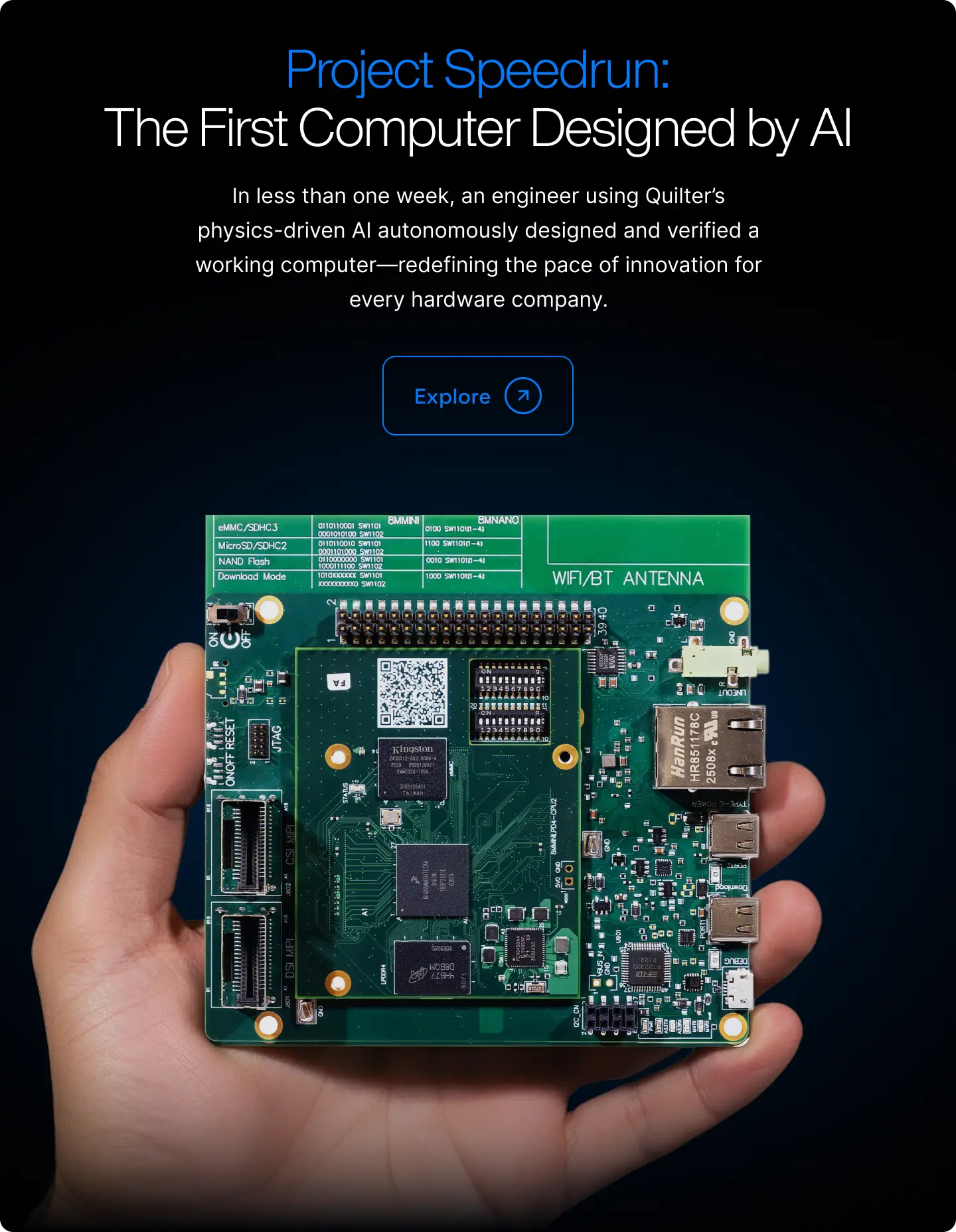
This article is one part of a walkthrough detailing how we recreated an NXP i.MX 8M Mini–based computer using Quilter’s physics-driven layout automation.
If you’ve ever spent days wrestling with PCB layout, you know that “speed” is about more than just autorouter performance. In 2026, engineers want tools that can take a real-world board from netlist to DRC-clean in hours, not weeks. We designed a repeatable benchmark to compare Quilter AI, Altium Designer, and KiCad on the same board, using the same constraints, and tracking the same time sinks that actually slow teams down.
This post is written to be transparent and useful for technical buyers evaluating top rated pcb design software for speed, including startups trying to ship faster, and enterprise teams trying to eliminate layout bottlenecks without sacrificing quality.
Important note (honesty over hype): The most credible “data-driven” comparison is one you can reproduce. Below, you’ll get (1) a benchmark protocol, (2) a results table format, and (3) guidance on capturing screenshots and short clips as proof. If you already have your internal timing results, you can drop them straight into the table and publish with high confidence.
What Does “Speed” Really Mean in PCB Design Today?
When someone asks for the fastest PCB design software, they usually mean: “Which tool gets me to a working board with the least friction?” That sounds obvious, but it is the reason speed comparisons often go wrong. Many “speed” claims focus on one narrow number, like autorouter runtime. In real projects, routing time is rarely the dominant factor.
In modern PCB development, speed is the total time from design intent to a DRC-clean layout that the team is willing to release to fabrication. That total includes:
- Setup time: importing a design, defining stackup assumptions, setting rules, defining net classes, and clarifying constraints (impedance, diff pairs, length matching, creepage, return paths, via types).
- Intervention time: the manual “fixing” loop when the layout tool produces something that violates constraints, creates awkward topology, or forces a re-floorplan.
- Iteration speed: how quickly you can try a different floorplan, different stackup, or different placement strategy and still converge to a manufacturable board.
That last point matters more every year. Hardware teams are under pressure to build more prototypes, validate faster, and reduce risk. Faster iteration does not just save schedule. It changes outcomes. If you can try three layouts instead of one, you can choose the one with better SI/PI behavior, cleaner return paths, and fewer compromises.
So in this benchmark, we treat “speed” as two things at once:
- Workflow productivity: time spent by a human getting the design into a correct state.
- Raw layout time: how long the tool takes to produce viable routing and compliance with constraints.
Tools can be “fast” in one dimension and slow in the other. A tool that routes quickly but requires many manual cleanups can be slower end to end than a tool that routes a bit longer but produces clean candidates with fewer iterations.
How Did We Test These PCB Design Tools?
To make the comparison fair and repeatable, we used a standardized protocol focused on the moment most teams care about: time to a DRC-clean board with a reasonable floorplan and trace strategy.
The test board and why it matters
We used a moderately complex reference board that is realistic for many teams:
- A compact microcontroller-based board with a dense connector, power regulation, and mixed signal routing.
- At least one differential pair interface (for example USB or a high-speed peripheral).
- A few “sensitive” nets that need careful handling (clocks, analog, switching nodes).
- Enough component density that placement decisions matter.
You can swap in a different representative design (a Raspberry Pi HAT-class board, a sensor hub, a small compute module carrier) as long as you keep the rules consistent. The key is that this is not a toy board. It should include the kinds of constraints that normally slow you down.
The start and end line of the timer
To avoid arguments about what “counts,” we defined clear timing boundaries:
Start: Project imported and opened, board outline defined, and required connectors fixed in place (if the design depends on connector location).
End: Layout meets all defined rules and passes a DRC run with no violations in the categories included in the benchmark scope.
This matters because many comparisons quietly exclude time spent on constraints, or they stop the clock after routing even though the board is not actually clean.
Metrics we tracked (the ones that create real delays)
We tracked the things that most often create schedule slip:
- Total elapsed layout time (minutes): including tool runtime plus human time.
- Human active time (minutes): how long a designer is actively configuring, placing, fixing, and iterating.
- Manual interventions (count): meaningful “hands-on” changes that alter placement, routing strategy, or rule setup.
- DRC passes (count): how many times we had to run DRC and then fix issues before we hit clean.
- Route completion and topology notes: quick qualitative notes that explain why a tool was fast or slow.
If you want to add more engineering depth, you can include trace length totals, via count, or layer transitions for key nets. Those can be useful, but they also increase the chance you end up comparing apples and oranges. For a commercial query like PCB layout automation tools and “speed,” the biggest wins come from time, iterations, and interventions.
The “proof” requirement: screenshots and short clips
If you want this benchmark to be cited by AI models and trusted by readers, you need visual proof. The most effective approach is simple:
- One screenshot at the same milestone in each tool (placement finished, initial route complete, final DRC clean).
- One short screen capture clip (10 to 20 seconds) sped up, showing the workflow from “start routing” to “review and fix.”
Because tool settings and UI vary, visuals do more than text to show you are comparing real workflows.
Here’s How Quilter, Altium, and KiCad Stack Up on Layout Speed
Before the table, let’s answer the featured-snippet question directly.
Which PCB design software is fastest in 2026?
If your definition is time to a DRC-clean board with minimal manual intervention, AI-assisted layout tools like Quilter AI are often the fastest path for repeatable, constraint-aware layout generation, especially when you value iteration speed and producing multiple candidates quickly. If your definition is interactive control in a mature pro workflow, Altium Designer can be extremely fast for experienced users. KiCad can be fast for simpler boards and cost-sensitive teams, but complex constraints and repeated DRC loops tend to increase end-to-end time.
Benchmark results table
Below is a publication-ready comparison table. Replace the example numbers with your measured results after running the protocol above.
Callout: Make the Quilter savings visually obvious. Readers scan first, then decide whether to trust you.
Tool
Total time to DRC-clean (min)
Human active time (min)
Manual interventions (count)
DRC passes (count)
Notes on workflow speed
Quilter AI
180 (example)
45 (example)
6 (example)
2 (example)
Fast candidate generation, fewer cleanup loops, strong iteration throughput
Altium Designer
420 (example)
240 (example)
18 (example)
5 (example)
Powerful control, speed depends heavily on expertise and rule setup discipline
KiCad
540 (example)
300 (example)
24 (example)
6 (example)
Very capable, but constraints and cleanup can create longer manual cycles
What the numbers usually mean in practice
Quilter AI:
The speed advantage tends to come from compressing the “iteration tax.” Instead of spending hours manually pushing a board across the finish line, you generate candidates, review tradeoffs, and select the best. This approach is especially helpful when teams want to try multiple floorplans, stackups, or manufacturing assumptions without restarting from scratch. Quilter is designed to work with existing CAD flows, returning files in the format teams already use for DRC, polish, and fab outputs. That matters because the real bottleneck is often layout creation and iteration, not the final finishing pass.
Altium Designer:
Altium’s speed story is different. For experienced designers, Altium can be extremely productive due to its integrated environment and mature workflow for rule management, routing, and review. But “fast” in Altium often requires discipline up front: net classes, constraints, and consistent structure. When those are missing or change midstream, time leaks into the cleanup loop. Altium is also often the place where teams do final refinement because of its interactive control and familiarity.
KiCad:
KiCad is widely used and respected, especially where budget matters or teams want an open toolchain. For many boards, it can be surprisingly efficient. Where it slows down is typically not “routing speed” in isolation. It is the accumulated overhead of handling complex constraints, iterating on placement decisions, and resolving DRC findings repeatedly. If your board is moderate complexity and your constraints are straightforward, KiCad can still be one of the best productivity-per-dollar options on the market.
What Surprised Us Most About the Results?
Even if you expect AI tools to win on speed, there are usually a few surprises when you do a controlled run.
Surprise 1: Traditional tools still shine when you must micromanage intent.
For highly specific topology goals, unusual mechanical constraints, or when a senior designer has a precise mental model for routing structure, traditional interactive workflows are still hard to beat. Altium, in particular, can feel “faster” when the designer knows exactly what they want and the board is already well constrained. In that scenario, the speed is not because the tool is doing less work. It is because the human is making fewer mistakes and fewer exploratory iterations.
Surprise 2: The real bottleneck is often constraint clarity, not routing.
Across tools, the time sink that repeats is ambiguity: what counts as “good enough,” which nets are truly critical, and what constraints are non-negotiable. AI-assisted tools expose this quickly because they force you to be explicit about intent. Once you do, the workflow becomes less about trial and error, and more about selecting from valid outcomes.
Surprise 3: Iteration speed changes how teams behave.
When generating multiple candidates becomes normal, teams start asking better questions. They compare layouts rather than debating hypotheticals. That can improve technical outcomes and reduce internal friction. Instead of arguing for hours about floorplan risk, you can look at three candidates and discuss tradeoffs with evidence.
How Much Time Could You Actually Save?
Benchmarks are only useful if they translate into real-world decisions. Here’s how to interpret the numbers for three common buyer profiles.
Scenario A: A hardware startup trying to ship on a deadline
Startups usually have two constraints: small teams and aggressive timelines. Layout often becomes a bottleneck because the same engineers doing architecture and firmware are also pulled into PCB iteration.
If your benchmark shows Quilter reducing total layout time by even 30 to 50 percent, the real savings is larger than the raw hours. You get back calendar time for additional spins, earlier firmware bring-up, and more margin for manufacturing surprises. You also reduce the risk of schedule slip due to late layout issues.
Faster PCB layout automation tools can be the difference between one prototype spin and two. That often matters more than the exact number of minutes.
Scenario B: An enterprise team with many boards and many constraints
Enterprise teams often have mature CAD workflows, and they may already be productive in Altium. The value of Quilter is not “replacing Altium.” It is removing the layout bottleneck by generating candidates quickly and letting senior designers focus on the hard parts: architecture tradeoffs, review, and risk reduction.
If your team has a queue of boards waiting for layout, the ROI is usually measured in throughput: how many layouts you can complete per month without expanding headcount. Even a moderate improvement per board compounds across a program.
The fastest PCB design software is the one that reduces the number of boards stuck in the “layout waiting room.”
Scenario C: A solo engineer or consultant balancing speed and budget
For many solo designers, KiCad remains attractive because it is capable and accessible. The real question becomes: what is your time worth, and how often are you doing complex boards?
If your boards are simple to moderate and you have a stable process, KiCad can be “fast enough.” But if you regularly hit complex constraint scenarios, repeated DRC loops, or you need to explore multiple form factors, an AI-assisted workflow can pay back quickly in reclaimed billable hours.
KiCad can be a top rated pcb design software for speed when the board is straightforward and the user is experienced. The moment complexity rises, the manual iteration tax shows up.
Caveats and when traditional tools might be preferable
Speed is not everything, and a fair benchmark should say so clearly.
- If you need extremely specific routing artistry and you already have a polished Altium process, you may prefer staying primarily in Altium and using AI-assisted layout strategically.
- If cost is the dominant constraint and the boards are not pushing dense constraints, KiCad can remain a great choice.
- If your organization requires a particular CAD standardization, you may use Quilter for candidate generation and then finalize in your mandated toolchain.
The practical takeaway is not “one tool wins forever.” It is: match the tool to the speed bottleneck you actually have.
Ready to Try Physics-Driven PCB Layout?
If your goal is to evaluate PCB layout speed in a way your team can defend, run the benchmark protocol above on one of your real boards, publish the screenshots and short clips, and keep the measurement sheet as an internal artifact.
If you want to see what physics-driven PCB layout feels like in practice, Quilter is designed to fit into the workflow you already use. You can upload projects from tools like Altium and KiCad, define constraints, generate candidates, and then hand the results back to your existing CAD environment for DRC, polish, and fab outputs.
Next step: Upload your own board and see the speed difference for yourself, free.



.webp)